
How AIPAC evades FEC bundling disclosure in Michigan's primary
- Authority
- Federal Election Commission
- Rule type
- advisory opinion
- Jurisdiction scope
- US federal
- Source text
- Read primary rule text ↗
SSFs may use approved platform to solicit contributions without triggering bundler disclosure
As of July 28, 2026, the Michigan Democratic Senate primary is still underway. The relevant record is therefore provisional: FEC Advisory Opinion 2022-03, campaign filings through March 31, and reported analyses of those filings. On that record, the legal issue is not that AIPAC has been shown to violate federal campaign-finance law. It is that a lawful payment structure appears to let AIPAC perform the practical work of steering contributions while keeping AIPAC’s name out of the candidate’s bundling disclosures.
The filing clue is a mundane expense line: roughly $135,000 in Democracy Engine processing fees reported by Rep. Haley Stevens’ Senate campaign through March 31, 2026. Detroit News reported that, using Democracy Engine’s stated 3.75% to 6% fee range, those fees imply approximately $2.2 million to $3.6 million in fundraising routed through the platform.[1] That line matters because processing fees are one of the few public traces left when contributions arrive as ordinary individual donations rather than as reportable bundled checks attributed to a named intermediary.
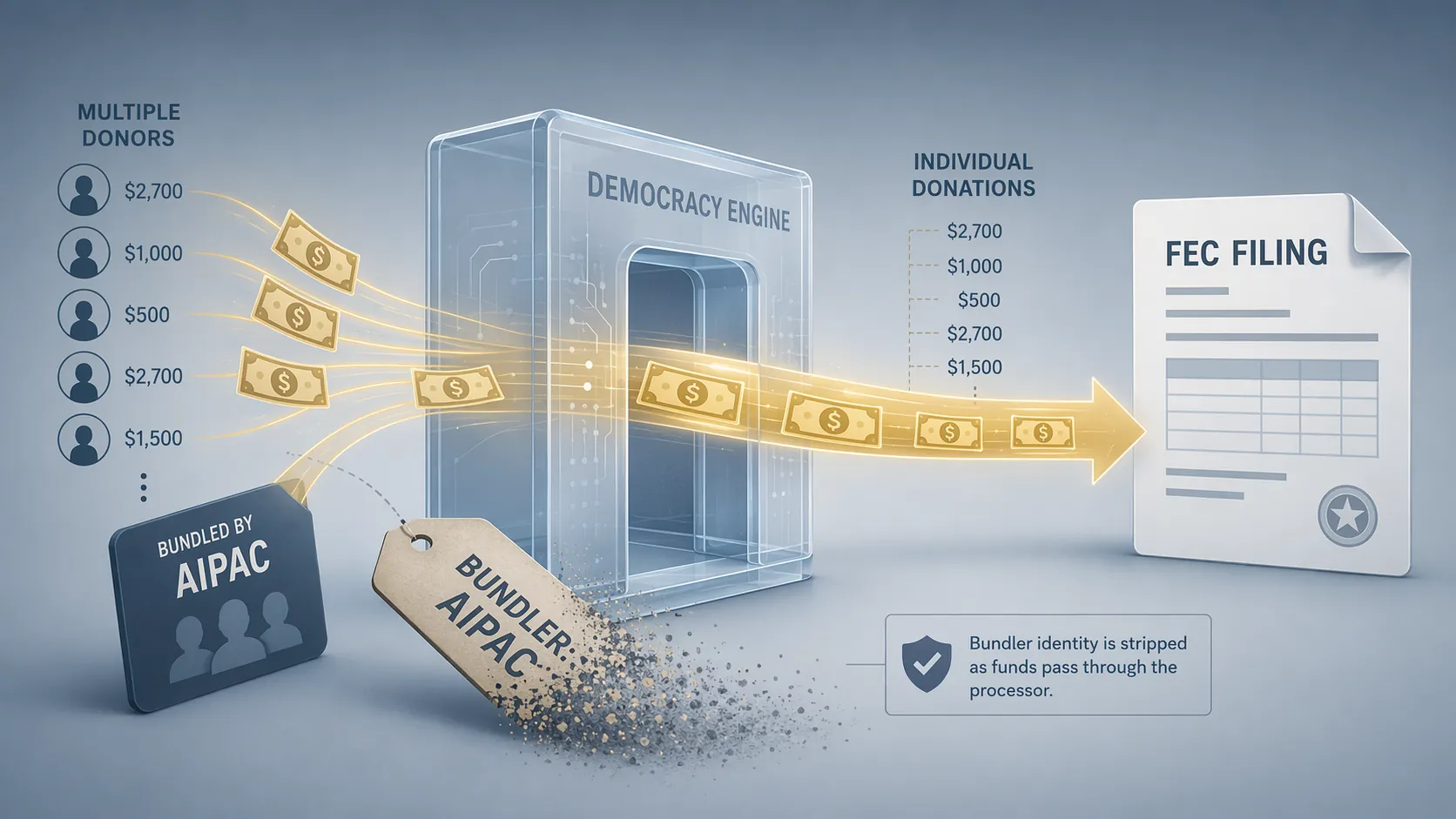
The advisory opinion did not call this bundling
FEC Advisory Opinion 2022-03 is the hinge. Democracy Engine asked whether a separate segregated fund could use its web platform to solicit contributions from the general public for federal candidates and political committees without the SSF being treated as a conduit or bundler. The Commission approved that SSF question by the required four votes.[2]
That approval matters because bundling disclosure is not triggered merely because a political actor urges donors to give. The reporting consequence depends on how the money is received, transmitted, and credited. In the approved Democracy Engine arrangement, the individual donor gives through the platform; the processor transmits the contribution; the recipient campaign reports the donor as an individual contributor. The SSF’s solicitation role does not become a bundler attribution line on the candidate’s FEC report.
The Commission’s result was also narrower than the platform wanted. It approved the SSF use case, but it did not resolve whether non-SSF corporate clients could use the same mechanism. The agency could not reach a decision on that separate corporate-client question.[2] For compliance purposes, that split outcome is more important than a clean press-release version of the ruling. It marks the permitted path and the unresolved edge at the same time.
The result is a disclosure gap with a technical shape. If AIPAC’s separate segregated fund solicits public contributions to Stevens through Democracy Engine, and Democracy Engine transmits the money in a way the FEC has approved for SSFs, the Stevens campaign’s public filings can show the donor and the amount without also showing AIPAC as the bundler. The donor record is not false on that basis. It is incomplete for anyone trying to see who organized the fundraising.
What disappears in the payment architecture
The mechanism is easier to see if the transaction is separated into three acts: solicitation, payment processing, and FEC reporting.
| Stage | What the public can usually see | What the structure obscures |
|---|---|---|
| Solicitation | A political group may ask its donors or supporters to give to a preferred candidate. | The public filing may not show that the group organized or steered the giving. |
| Processing | A third-party platform handles the contribution and takes a processing fee. | The processor’s fee is visible only as an expense line; it does not identify each source campaign behind the donations. |
| Candidate reporting | The candidate reports the individual donor’s name, address, employer information where required, amount, and date. | The candidate’s filing can lack a bundler field connecting those donors to the soliciting SSF. |
Traditional bundling disclosure is useful because it adds a second layer of information to individual-contribution records. The donor’s identity answers one question: who gave the money? The bundler field answers another: who assembled or delivered the money in a politically meaningful way? The Democracy Engine pathway leaves the first answer intact while making the second answer difficult to reconstruct from the recipient committee’s filings.
That distinction is not cosmetic. A campaign can receive thousands of lawful individual contributions, each within the applicable rules, and still owe the public a different kind of information if a covered intermediary bundled them. When a processor’s structure prevents the intermediary from being treated as the bundler, the campaign’s report becomes formally populated but politically flattened. A reader can see contributors in rows. She cannot see the fundraising channel that made those rows arrive together.
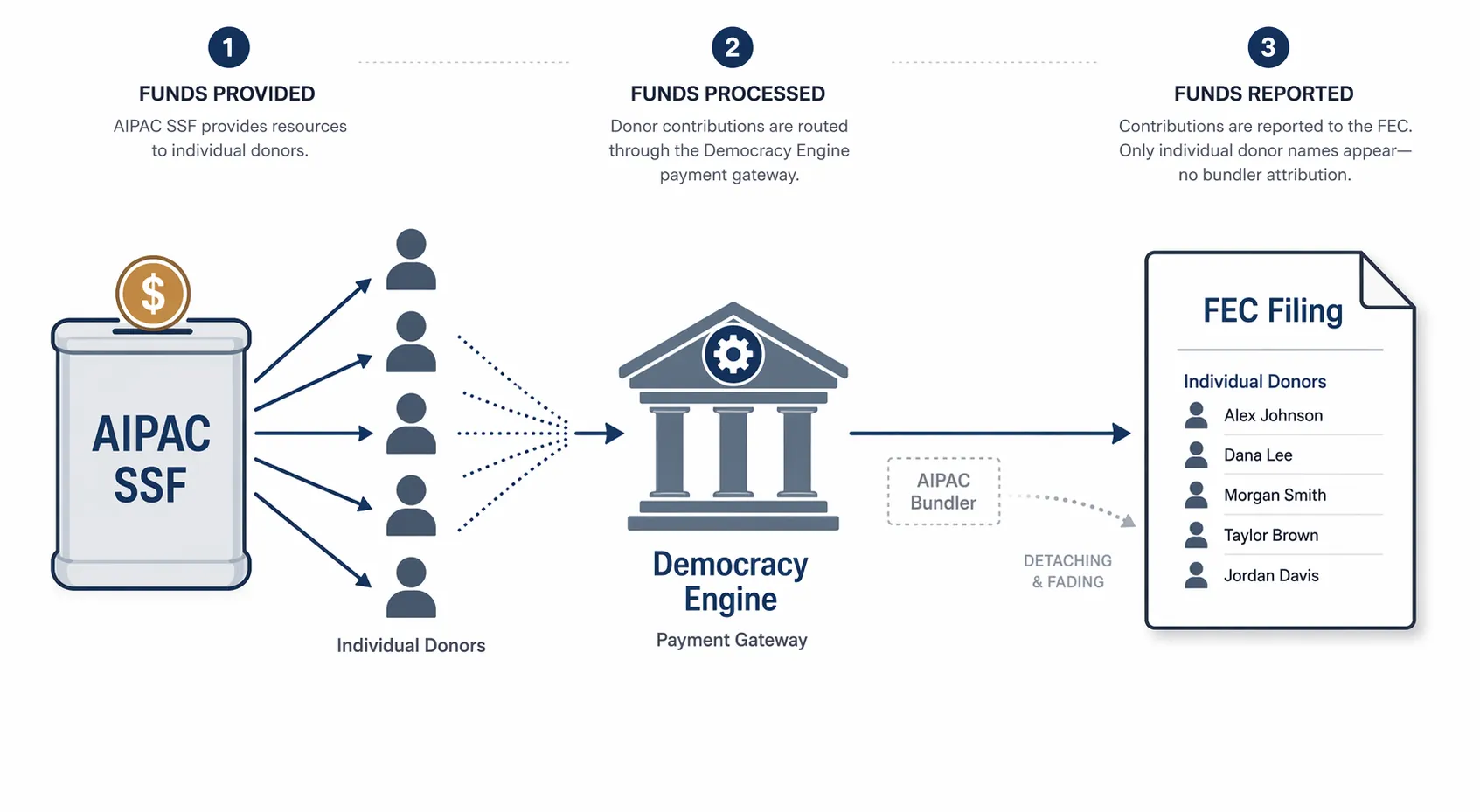
This is why the Democracy Engine fee line becomes evidence of structure rather than proof of any particular donor’s origin. The fee suggests volume through the platform. It does not, by itself, reveal how much of that volume came from AIPAC-sourced solicitations, how many donors arrived from another link, or which transactions were attributable to which sponsor. That limitation is not a footnote; it is the disclosure failure.
The Michigan numbers show a sizable route, not a complete ledger
The $135,000 in reported Democracy Engine processing fees is the starting point. At the 3.75% to 6% fee range reported by Detroit News, the implied fundraising volume is approximately $2.2 million to $3.6 million.[1] That is a reconstruction from fees, not a platform export. The exact share of those fees attributable specifically to AIPAC-sourced donations is not public.
The donor-overlap analysis supplies a second clue. Detroit News found that 1,172 of Stevens’ 3,728 donors who gave more than $200 also had donated to AIPAC since the start of 2025 — 31% of that donor group.[1] That figure does not prove that every overlapping donor gave to Stevens because of an AIPAC solicitation. It does make the Democracy Engine pathway more than an abstract compliance hypothetical.
The same report said Stevens’ primary opponents had lower overlap rates with AIPAC donors.[1] The legally useful point is not that overlap alone establishes bundling. It does not. The point is that a campaign showing substantial Democracy Engine fees and unusually high donor overlap with AIPAC has public filings that still do not identify AIPAC as the fundraising intermediary for those contributions.
AIPAC’s earlier reporting history makes the shift visible. The group bundled about $700,000 in the 2022 cycle and reported $334,000 in bundled contributions in the first quarter of 2025 before appearing to move substantial activity through the Democracy Engine vehicle.[1] The public record therefore does not show a disappearance of fundraising activity. It shows a change in the reporting category where that activity can be seen.
Outside spending is visible; the routed contributions are the harder problem
AIPAC’s role in the Michigan race is not otherwise hidden. AP reported that AIPAC and affiliated groups had spent close to $30 million backing Stevens, the organization’s largest investment ever in a single race.[3] Bridge Michigan reported that total outside spending in the Senate race had topped $41 million, with AIPAC-affiliated groups comprising the largest share.[4]
Those sums are large, but they are not the main disclosure problem here. Independent expenditures and outside-spending vehicles leave visible tracks. They may raise other campaign-finance concerns, and they may dominate the political story of the primary, but they are not the same as routed hard-dollar contributions appearing on a candidate’s own filings without a bundler attribution.
The distinction matters because the legal issue is not simply that a well-funded outside group supports a candidate. The narrower issue is that the hard-money donor records can be formally disclosed while the steering role behind those donations is not.
Watchdogs are describing a loophole, not an adjudicated violation
Issue One characterized the arrangement as “a loophole in current disclosure rules around bundling,” according to Detroit News.[1] Public Citizen’s Craig Holman told the paper that AIPAC was using “a multitude of vehicles to cover up the source of their funding.”[1] Those critiques are pointed, but they do not convert the public record into a finding of illegality.
The careful charge is more durable: AO 2022-03 gives SSFs an approved route for public solicitations through Democracy Engine, and the resulting campaign filings do not have to show the SSF as a bundler merely because the SSF steered donors there. If enforcement staff, a court, Congress, or a future Commission majority wants a different disclosure result, it would have to confront the architecture the advisory opinion accepted.
AIPAC did not respond to requests for comment from AP, Detroit News, or Al Jazeera, according to those reports.[1][3][5] Its internal fundraising data for Stevens is not public. That leaves outside observers with fee math, donor overlap, prior-cycle bundling reports, and the legal permission structure created by the FEC advisory opinion.
What a compliance reader can and cannot conclude
The defensible conclusions are limited but consequential.
- AO 2022-03 approved the SSF use of Democracy Engine’s web platform by a four-vote Commission majority, while leaving the non-SSF corporate-client question unresolved.[2]
- Stevens’ filings show roughly $135,000 in Democracy Engine processing fees through March 31, 2026, implying about $2.2 million to $3.6 million routed through the platform under the reported fee range.[1]
- The exact portion of that routed money attributable to AIPAC-sourced solicitations is not public.
- A substantial share of Stevens’ larger donors also appear in AIPAC donor records: 1,172 of 3,728 donors over $200, or 31%, according to Detroit News.[1]
- The primary is not complete as of July 28, 2026, so final spending totals, amended filings, or later enforcement activity could change the record.
For lawyers, the live question is not whether every Democracy Engine contribution should be treated as AIPAC money. The public data cannot support that. The question is whether a regulated actor may obtain the practical benefits of bundling — identifying a favored candidate, mobilizing aligned donors, and producing hard-dollar fundraising volume — while the candidate’s FEC report treats the resulting money as unbundled individual contributions. On the current record, the answer for SSFs using the approved platform structure appears to be yes.
That is the narrow disclosure failure. The donor names remain visible. The outside spending remains visible. The organizing hand behind a substantial stream of candidate contributions can drop out of the visible record because the processor, rather than the SSF, sits in the transmission position that would otherwise carry legal significance.
Unless the FEC, Congress, or a later enforcement posture closes that gap, bundling disclosure is optional for this strategy in the 2026 cycle in the only sense that matters to the filing reader: the same fundraising relationship can be politically real, financially measurable, and absent from the bundler field.
References
- Pro-Israel PAC uses 'loophole' to quietly fund Stevens in Dem primary, Detroit News, May 27, 2026
- AO 2022-03: SSF's use of LLC's web platform to solicit contributions, Federal Election Commission
- AIPAC has spent a record amount on Michigan's Senate primary, AP, July 19, 2026
- Outside spending floods Michigan's US Senate race, Bridge Michigan, July 2026
- How AIPAC channels millions through shell PACs, Al Jazeera, May 20, 2026
Operationalizing workflow
No workflow has been explicitly linked to this obligation yet. See Workflows generally.
Illustrative cases
No illustrative case is currently tracked for this obligation. See Risk Digest for documented incidents generally.
← Back to RegulationReport a correction or tip
Spotted an outdated figure, a misstated fact, or a ruling this regulation entry should reflect? Public comments are disabled for this content given the professional cost of a misreported case outcome, penalty amount, or rule text — use the structured correction channel instead.
Report a correction or tip for this record →