
How Japan's Lawful Rare Earth Mining Tests UNCLOS
- Authority
- United Nations
- Rule type
- regulation
- Jurisdiction scope
- International
- Source text
- Read primary rule text ↗
The compliance answer is narrower than the politics around it. Japan’s rare-earth mud program near Minamitorishima is not, on the facts now available, mining “the Area” under the International Seabed Authority. Minamitorishima lies within Japan’s exclusive economic zone, roughly 1,950 kilometers southeast of Tokyo, and UNCLOS Article 56 gives the coastal state sovereign rights for exploring and exploiting natural resources in the EEZ’s waters, seabed, and subsoil.[1][2] That is the legal starting point. It is also not the end of the analysis.
As of Q3 2026, the harder question for companies is not whether Japan has a plausible EEZ basis for the Minamitorishima project. It does. The harder question is whether participation in the project, financing around it, technical services for it, or offtake from it now places a company inside a two-front risk environment: one front grounded in Japan’s domestic EEZ authority, the other in the United States-Japan critical-minerals alignment created by the March 19, 2026 Memorandum of Cooperation while the ISA Mining Code remains unresolved.

The first classification question: EEZ mud, not the Area
For international seabed mining law, location does most of the early work. UNCLOS separates coastal-state maritime entitlements from the seabed beyond national jurisdiction. The latter is “the Area,” where mineral resources are subject to the common-heritage regime and administered through the ISA. A seabed deposit inside a coastal state’s EEZ is legally different. It is still subject to UNCLOS duties, including environmental obligations, but ISA approval is not the permit gateway in the same way it would be for exploitation in the Area.
That distinction matters because the rare-earth muds at issue are associated with Minamitorishima, not with a contractor’s claim in the Clarion-Clipperton Zone or another site beyond national jurisdiction. Article 56 is not a commercial blank check, but it does give Japan sovereign rights for resource exploration and exploitation within its EEZ.[1] A board paper that labels the project simply as “deep seabed mining” without identifying the jurisdictional zone would be too crude for a transaction decision.
Japan also appears to have built the domestic legal step that turns EEZ entitlement into extractive authorization. A JIIA/Japan Review analysis by Makoto Seta reports that Japan amended its Mining Act in 2022 to incorporate rare-earth minerals into the domestic mineral list, thereby authorizing extraction within Japan’s EEZ without ISA approval.[2] Because that point rests on a secondary description rather than directly extracted statutory text, counsel should verify the Japanese statutory text and implementing rules before treating it as settled. Still, the reported amendment is too central to ignore: it is the domestic bridge between Article 56 and a real mining program.
February 2026 made the legal issue operational
Until 2026, much of the Minamitorishima discussion could still be filed under strategic planning, resource mapping, and industrial policy. The February 2026 operation changed the weight of the file. JAMSTEC, using the deep-sea drilling vessel Chikyu, successfully lifted rare-earth-rich mud from depths of about 5,700 to 6,000 meters; AP described it as the world’s first continuous lift from that depth.[3]
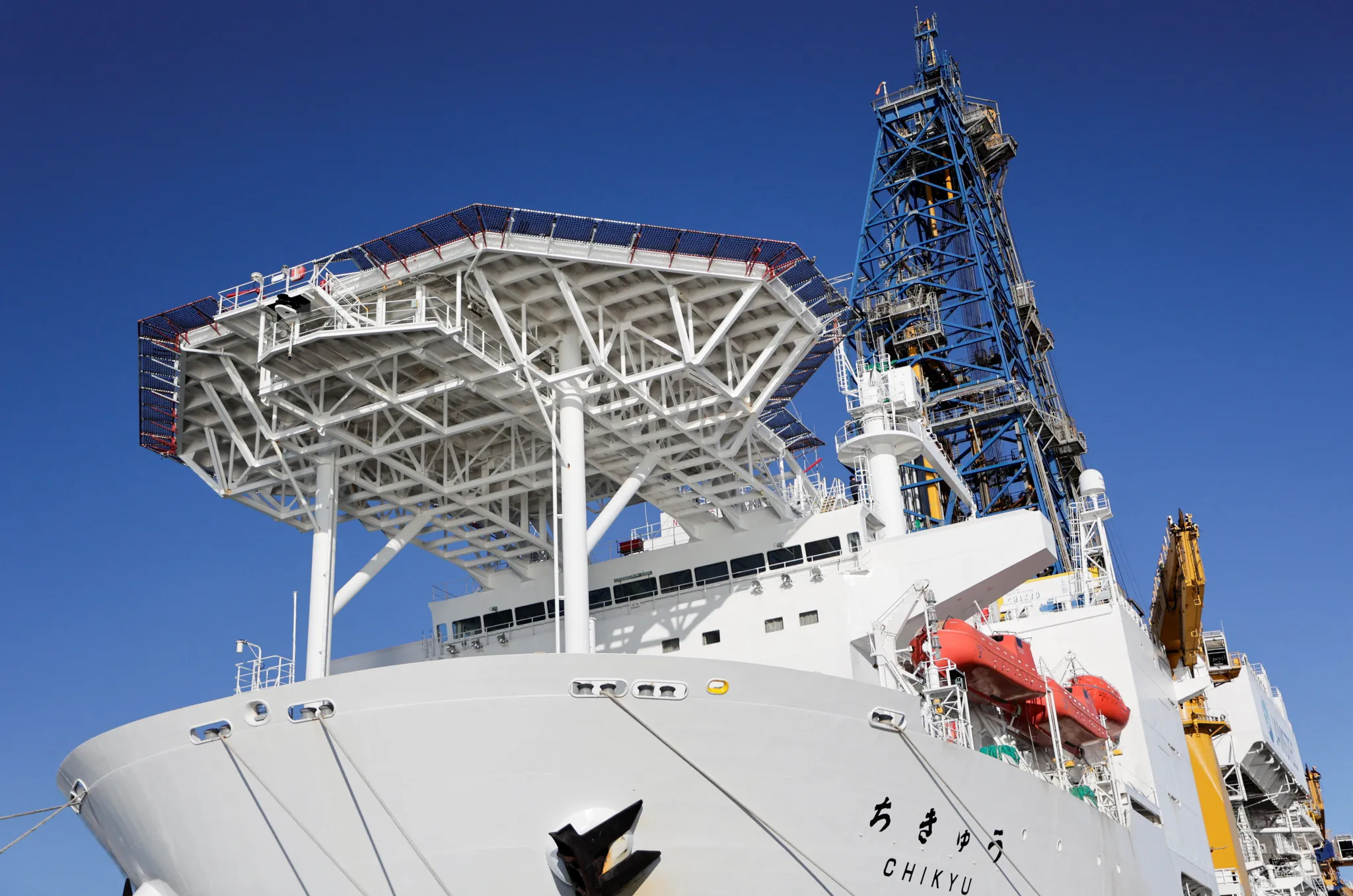
That does not prove commercial viability. It proves that the legal classification is no longer academic. Once mud can be lifted, procurement teams start asking what equipment will be supplied, who will process the material, who will finance scale-up, who will insure the work, and whether the resulting oxides can enter allied supply chains without being treated as politically contaminated.
The cost profile argues against treating the project as a solved independence story. Japan’s SIP cross-ministerial program, involving the Cabinet Office, METI, and JAMSTEC, has reportedly cost about ¥40 billion since 2018, while a full domestic supply chain including refining has been estimated at an additional ¥340 billion.[4] Separate analysis cited in the same policy discussion warns that rare earths from deep-sea mud could be far more expensive than Chinese supply, depending on technology and price conditions.[4] For diligence, that uncertainty matters: uneconomic production can still generate sanctions, export-control, reputational, or treaty-interpretation questions before it generates stable cash flow.
Why the United States-Japan MOC is the document to read closely
The March 19, 2026 United States-Japan Memorandum of Cooperation is formally modest. That is precisely why it deserves attention. The MOC is deliberately non-binding. It does not, on its face, create enforceable legal obligations that directly conflict with UNCLOS. It was also presented to the ISA, which undercuts any easy claim that the two governments were concealing a rival regime.[5]
But non-binding instruments can still organize conduct. The MOC creates a Japan-U.S. Working Group and includes information sharing from the Minamitorishima rare-earth muds project.[5] Those verbs are operationally important. “Share” can feed technical due diligence. “Coordinate” can shape funding priorities. “Cooperate” can become the basis for offtake discussions, export-control planning, and public procurement preferences even when no court could enforce the memorandum as a treaty.
Nothing in that structure makes Japan’s EEZ extraction unlawful by itself. The concern is different: a lawful domestic project may become useful as a bilateral workaround while the multilateral system is stalled. Just Security has framed this possibility as “defection by proxy,” meaning a route by which states remain formally inside the UNCLOS/ISA framework while arranging critical-mineral cooperation through domestic or allied channels that reduce dependence on the common-heritage regime.[6] That is an argument by commentators, not settled law. It is still a risk category worth adding to a transaction memorandum because it describes the pressure point more accurately than a simple breach/no-breach chart.
The careful point is that the MOC’s legal weakness may be its policy strength. Because it is not binding, it can sit beside UNCLOS rather than openly collide with it. Because it does not purport to license mining in the Area, it avoids the most obvious treaty objection. Because it incorporates information from Minamitorishima, however, it ties a Japanese EEZ project to U.S. critical-mineral strategy at the exact moment when the ISA has not produced final exploitation rules.
The ISA deadlock matters even if Minamitorishima is outside ISA jurisdiction
A narrow jurisdictional answer would say: if the mud is in Japan’s EEZ, the ISA Mining Code is not the governing exploitation code. That answer is correct as far as it goes. It is inadequate for supply-chain risk because the legitimacy of domestic deep-sea extraction is now being assessed against a multilateral process that has been unable to finalize rules for the Area.
The ISA’s 31st Council session in March 2026 ended without adoption of a Mining Code.[7] Reporting and civil-society analysis from that session described more than 30 major regulatory issues as still unresolved, while the secretary-general called the situation “absolutely existential.”[7][8] Those are not mere institutional frustrations. They affect how governments and companies characterize legitimacy: whether a domestic EEZ program is seen as normal coastal-state resource development, or as a precedent that helps sophisticated states route demand away from a stuck common-heritage system.
Japan’s own positioning reflects that tension. During the March 2026 Council session, Japan reportedly reaffirmed its commitment to the ISA process.[6] That matters. It suggests Japan is not presenting Minamitorishima as an open repudiation of multilateral seabed governance. But a state can reaffirm a process and still reduce its practical dependence on that process through domestic authority, allied technical cooperation, and supply-chain planning.
For companies, the unresolved Mining Code creates a comparison problem. A mining contractor in the Area remains exposed to uncertainty over environmental standards, financial terms, inspection mechanisms, benefit sharing, and the timing of exploitation approvals. A company working around Minamitorishima faces a different set of questions: Japanese domestic law, EEZ environmental regulation, export controls, allied industrial-policy conditions, and reputational claims that the project contributes to a parallel pathway. The second set may be more manageable, but it is not the same as clean.
China risk explains the urgency, not the legal conclusion
Japan and the United States are not acting in a vacuum. Japan remains heavily dependent on Chinese rare-earth imports, and recent Chinese measures have made that dependence more legally and commercially salient. China imposed export controls on seven heavy rare earths in April 2025 — samarium, gadolinium, terbium, dysprosium, lutetium, scandium, and yttrium — and tightened dual-use restrictions in January 2026 in ways reported to affect Japanese companies.[9][4]
The maritime setting also sharpened the issue. A Chinese naval fleet entered Japan’s EEZ near Minamitorishima in June 2025 while JAMSTEC survey vessels were operating there, according to Reuters reporting later cited in regional-security analysis.[10] That fact does not alter Article 56, and it does not transform the Japanese project into a military program. It does explain why a rare-earth mud project that once looked like long-horizon industrial policy now appears in critical-mineral security discussions.
The mistake would be to let the China-risk narrative answer the treaty question. Export controls and naval pressure make diversification rational. They do not determine where EEZ sovereignty ends, whether an allied cooperation instrument erodes the common-heritage regime, or what representations a supplier can safely make to customers.
What should appear in a Minamitorishima diligence file
The practical risk register should not begin with a conclusion that the project is unlawful. It should begin with classification and then move outward. A company’s exposure will vary depending on whether it supplies drilling equipment, receives technical data, finances processing capacity, buys separated oxides, provides environmental services, or participates in the Japan-U.S. Working Group’s orbit through a government-backed program.
| Diligence issue | Why it matters |
|---|---|
| Jurisdictional classification | Confirm that the relevant activity is tied to Minamitorishima within Japan’s EEZ, not to a site in the Area or to data obtained from an ISA contract area. |
| Japanese domestic authority | Verify the 2022 Mining Act amendment, implementing regulations, licensing status, environmental review requirements, and the government entity responsible for approvals. |
| Role under the March 2026 MOC | Identify whether the company will share information, receive project data, join working-level discussions, or support activities described in the U.S.-Japan cooperation framework. |
| UNCLOS and ISA positioning | Avoid representations that imply the ISA regime is irrelevant to all deep-sea minerals; distinguish Japan’s EEZ project from exploitation in the Area. |
| Export-control and dual-use exposure | Map Chinese controls, Japanese rules, U.S. restrictions, and customer-side certification requirements before assuming rare-earth diversification lowers regulatory burden. |
| Reputational framing | Prepare for claims that the project is lawful domestically but contributes to multilateral avoidance while the ISA Mining Code remains unresolved. |
| Commercial assumptions | Separate legal authorization from economic viability; deep-sea mud recovery, refining, and full supply-chain buildout remain cost-sensitive. |
Two drafting points follow from that table. First, contracts should not describe Minamitorishima output as “ISA-free” or “outside international seabed mining law” without qualification. The cleaner formulation is that the project is understood to be within Japan’s EEZ and therefore governed primarily through Japan’s coastal-state authority under UNCLOS Article 56 and domestic law, subject to confirmation of site, permit, and environmental facts.
Second, board materials should treat the MOC as a conduct-shaping instrument even if it is not legally binding. The relevant question is not whether the memorandum can be enforced in court. It is whether reliance on its working group, information-sharing channels, or policy language makes the company part of an allied workaround that counterparties, NGOs, investors, or other states may characterize as undermining the ISA process.
The boundary is being written in practice
The Minamitorishima program sits in an uncomfortable but legally recognizable place. On its own terms, it is a Japanese EEZ project supported by Article 56 and, subject to verification of the statutory record, by Japan’s amended domestic mining law. The February 2026 Chikyu lift makes that domestic authority operational. The March 2026 MOC then gives the project a second function: it becomes a source of information and coordination for U.S.-Japan critical-mineral strategy.
That second function is where the risk sits. It is not a clean UNCLOS breach theory. It is a treaty-interpretation, policy-alignment, and reputation problem created by the interaction of lawful EEZ extraction, a non-binding bilateral instrument, China-driven supply-chain urgency, and a multilateral institution still unable to finalize exploitation rules for the Area.
For now, the narrow conclusion is the useful one: Japan’s Minamitorishima rare-earth mud program should not be treated as mining the Area, and Article 56 gives Japan a serious legal basis for EEZ resource development. Participation around the project may still carry exposure because the governing boundary between domestic seabed autonomy and common-heritage avoidance is being defined in real time. Later updates should track the July 2026 Legal and Technical Commission compliance report and the July 2026 NORI contract-extension decision when source material is available.
References
- United Nations Convention on the Law of the Sea — United Nations.
- Japan Review paper by Makoto Seta — The Japan Institute of International Affairs / Japan Review.
- Japan retrieves rare earth-rich mud from seabed to lower reliance on China — AP News.
- Japan's deep-sea quest for mineral supply security — East Asia Forum / CSIS.
- US and Japan Move to Strengthen Deep-Sea Mining Ties through Memorandum of Cooperation — Gibson Dunn.
- Deep Sea Mining and the Logic of Contracting Around the Commons — Just Security.
- ISA Council meeting ends without mining code — Oceanographic Magazine.
- Analysis of unresolved ISA Mining Code issues — The Pew Charitable Trusts.
- Japan Looks Seaward for Rare-Earth Independence — Nippon.com.
- Japan to test mine rare-earth mud from deep seabed — Reuters.
Operationalizing workflow
No workflow has been explicitly linked to this obligation yet. See Workflows generally.
Illustrative cases
No illustrative case is currently tracked for this obligation. See Risk Digest for documented incidents generally.
← Back to RegulationReport a correction or tip
Spotted an outdated figure, a misstated fact, or a ruling this regulation entry should reflect? Public comments are disabled for this content given the professional cost of a misreported case outcome, penalty amount, or rule text — use the structured correction channel instead.
Report a correction or tip for this record →