
What humanoid robot cleaning really costs, and who pays
- Authority
- European Union
- Rule type
- regulation
- Jurisdiction scope
- EU
- Effective date
- Aug 2, 2026
- Source text
- Read primary rule text ↗
High-risk AI systems under the EU AI Act must address documentation, risk management, transparency, and post-market monitoring.
The first number a buyer sees is not outrageous. Gatsby advertised a flat $150 apartment clean and was reported as completing a first U.S. consumer humanoid clean on May 14, 2026; Tau Robotics later drew attention in San Francisco with an invite-only humanoid cleaning service priced at $30 per hour and disclosed as remotely operated by a human from a central location with AI assistance. [1][2]
Those are real procurement numbers, not science-fiction numbers. They sit close enough to ordinary local cleaning prices to force the next question: whether the quoted humanoid robot cleaning service cost includes the party that pays when a machine dents a refrigerator, knocks over a resident, damages flooring, records something it should not, or receives a bad update before the next job.
| Visible price point | What is being priced | What is not yet priced |
|---|---|---|
| Gatsby: $150 flat clean, regardless of apartment size [1] | A consumer apartment clean using a humanoid robot | Allocation of bodily-injury, property-damage, software, supervision, and insurance risk |
| Tau Robotics: $30/hour, invite-only [2] | A teleoperated humanoid cleaning service with AI assistance | Operator training, remote-control failure, network latency, and vicarious-liability exposure |
| Typical San Francisco human cleaner: roughly $150–$300 [2] | A familiar service benchmark for residential cleaning | Robot-specific product, software, and manufacturer exposure |
| Commercial cleaning robots: about $10,000–$50,000 to buy or roughly $300–$1,500/month as RaaS [4] | Mostly commercial floor-cleaning equipment, not humanoid in-home service | Residential premises risk, human-robot contact, and consumer-facing claims |
This analysis is not legal advice. Source-dependent facts are treated as last checked on August 2, 2026. No humanoid-cleaning-specific injury ruling, sanction, or reported liability decision was identified in the research set. The legal analysis therefore has to proceed by analogy: product liability, negligence, vicarious liability, contract allocation, and insurance coverage.
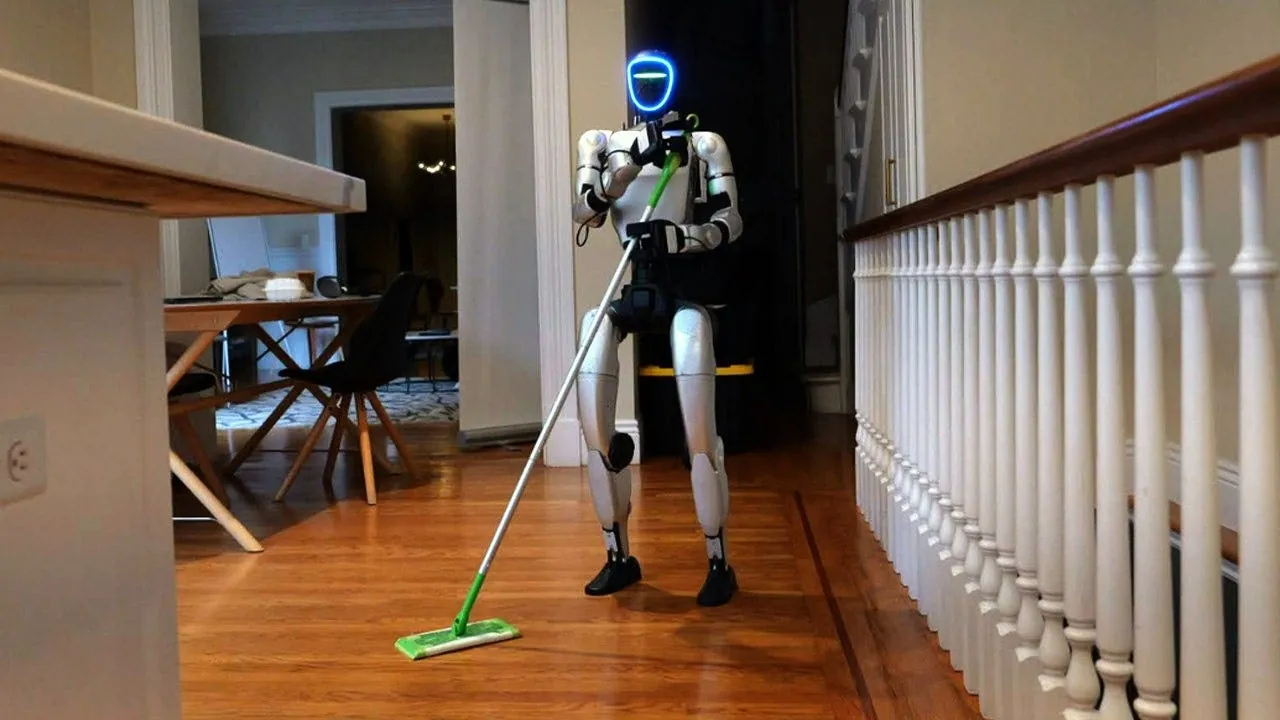
The price advantage is plausible, but it is not the full cost
The narrow cost case is not hard to understand. If a consumer can buy a $150 robot clean where a human cleaner might cost a similar or higher amount, the robot offer is at least commercially legible. Tau’s $30-per-hour figure is also low enough to matter, especially in a city where labor-intensive household services are expensive. [1][2]
Commercial floor-cleaning robots show why buyers take these comparisons seriously. RobotLAB describes cleaning labor as 70%–90% of cleaning cost, estimates about $27 per day per robot against about $144 per human labor shift, and gives a typical payback period of 9–18 months. Those figures concern commercial cleaning equipment and should not be treated as proof that a humanoid in an apartment has the same economics, but they do explain why procurement teams are willing to run the math. [4]
Market-size forecasts add only limited help. A projection that the cleaning-robot market grows from $14.8 billion to $96.8 billion through 2035 suggests vendor momentum, not liability performance. It does not say how often robot cleaners break property, injure people, trigger coverage disputes, or shift losses among manufacturers, operators, and customers. [5]
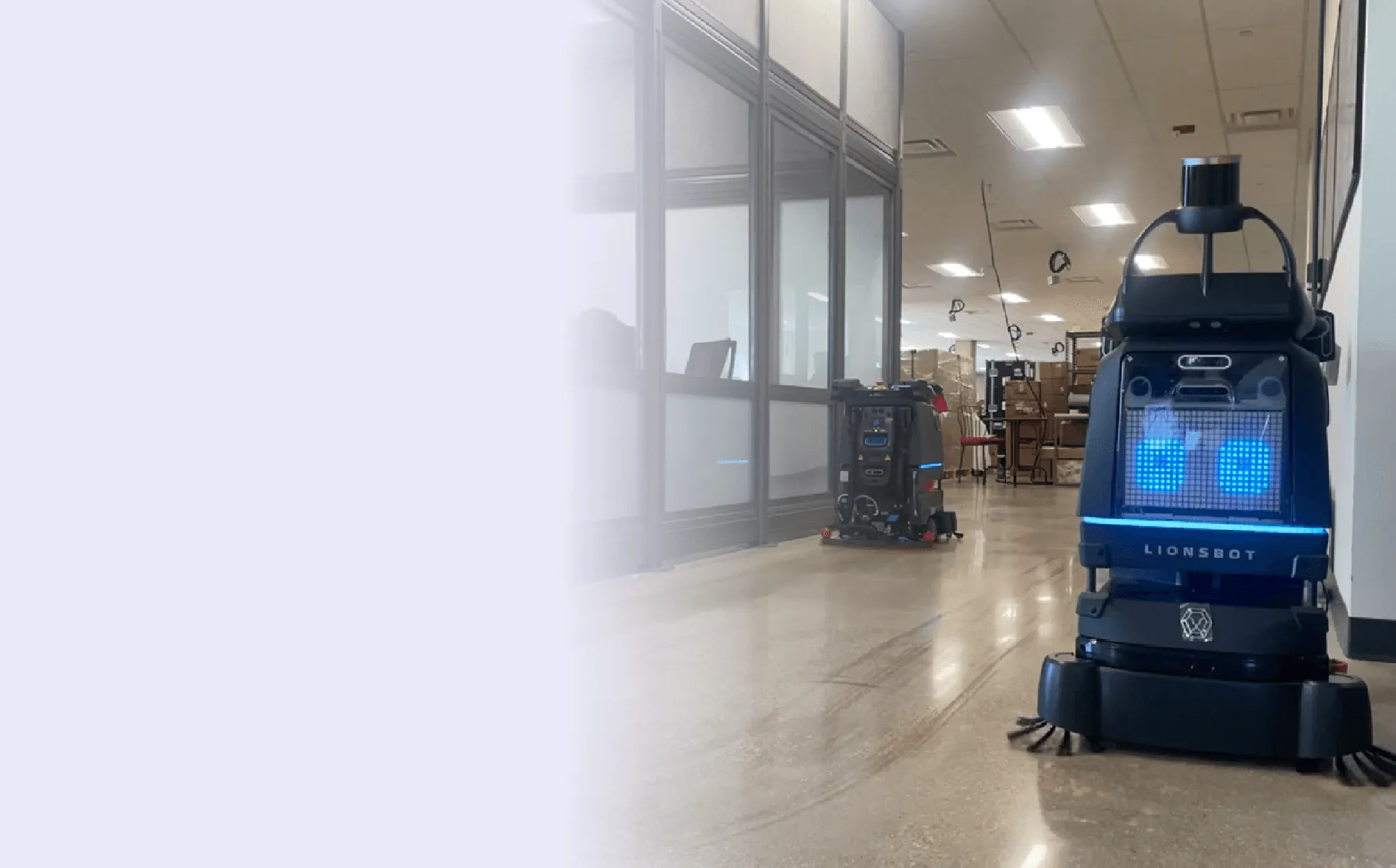
There is also a control issue in the consumer materials. Gatsby’s own public-facing materials describe a no-humans-involved model, while Fox News reported that harder tasks could involve remote human teleoperation. That discrepancy is not a branding footnote. If a human sometimes controls or intervenes in the machine’s work, then training, supervision, handoff protocols, and response time become part of the liability analysis. [3][1]
The parties most likely to appear in the claim
Munich Re’s robot-liability framework is useful because it starts with parties rather than slogans. It identifies the manufacturer, owner, keeper, user, and network or software provider as potential claim targets, and it highlights the proof problem created when AI behavior is difficult to reconstruct after the event. That is the right starting point for humanoid cleaning: not “the robot did it,” but which human or corporate defendant controlled the risk that materialized. [6]
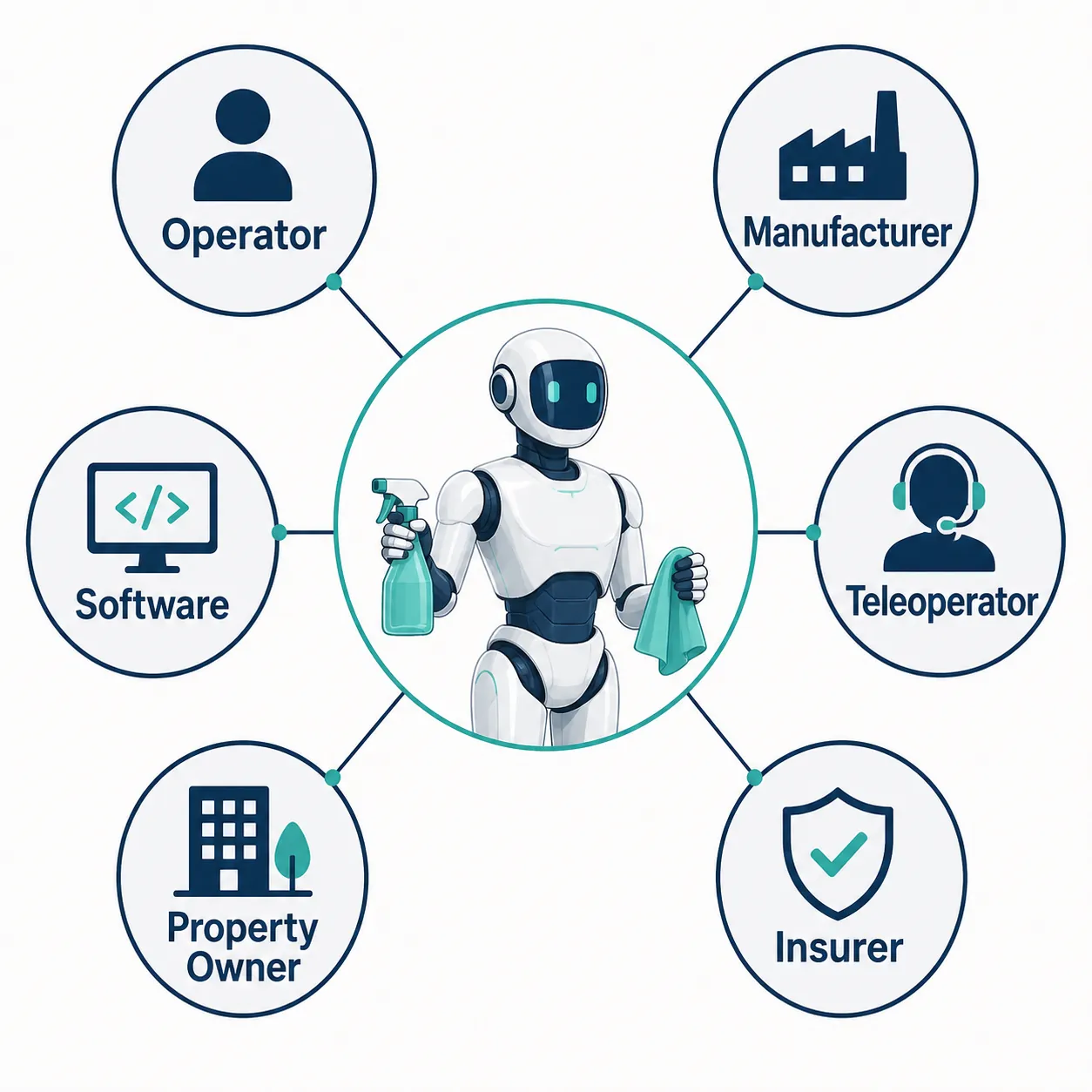
Cleaning-service operator
The service operator is the easiest first defendant to understand because it is the entity the buyer hired. If a customer books a cleaning and the robot scratches stone, spills cleaning fluid, damages electronics, or strikes a resident, the demand letter will usually start with the company that sold the clean.
The operator’s exposure is not limited to what it physically touched. Plaintiffs can argue negligent deployment, negligent maintenance, inadequate pre-job screening, poor training, failure to warn, unsafe cleaning protocols, or use of a robot in a residence where the machine was not reasonably suited to the environment. If the robot is operated or supervised by the service provider’s personnel, ordinary agency and vicarious-liability theories become available without needing a court to invent a new robot doctrine.
For a cleaning company adding robots to a human workforce, this is the uncomfortable part of the cheap-price story. A $150 clean or a $30 hourly rate may cover labor substitution, but it may not cover a claim in which the plaintiff argues that the company chose an unproven machine, failed to inspect it, failed to pause it during an unsafe maneuver, or sent it into a cluttered apartment with no workable incident-response path.
Manufacturer
The manufacturer becomes central when the injury looks like a defect rather than a bad cleaning decision. A gripper applies too much force. A balance system fails near stairs. A sensor misses a pet, child, or resident. A battery or actuator creates a fire or impact hazard. In those scenarios, the plaintiff will not stop at the local cleaning vendor if the deeper engineering pocket is visible.
The legal fight then turns on whether the humanoid system is treated as a product, a service, or some hybrid of the two. Defense commentary on AI injury claims emphasizes that traditional strict product liability is built around products, while software and AI services create classification fights that can change the available theories. The 2026 Boston College Law Review article “Rethinking Robot Liability” likewise treats robot liability as a problem that does not fit neatly into legacy categories. [7][8]
That classification matters more than the marketing copy. If a robot is sold or leased as equipment and a physical defect causes injury, strict-liability theories may be easier to plead. If the buyer purchased only a managed cleaning service, the manufacturer and service provider may argue that the claim sounds in negligence, contract, or service performance rather than product defect. A plaintiff, unsurprisingly, will try to frame the harmful robot behavior as the foreseeable output of a defective integrated product.
The manufacturer’s best procurement-world defense will not be a press quote about autonomy. It will be documentation: design limits, warnings, maintenance intervals, approved-use environments, human-override requirements, release notes, testing records, and logs showing what the machine perceived and why it acted. Without those records, the AI “black box” problem identified by Munich Re becomes a litigation problem rather than a technical inconvenience. [6]
Software, network, and AI providers
Humanoid cleaning is not just a chassis with arms. Navigation, object recognition, force control, remote-assistance workflows, authentication, cloud connectivity, and update pipelines can all sit outside the entity that owns the robot or sells the clean. Munich Re’s inclusion of network and software providers in the possible liability map is therefore not incidental. [6]
A software provider is most exposed where the alleged failure is traceable to code, model behavior, connectivity, or update management: a perception system fails to distinguish a fragile object from a movable one; a route-planning update changes how close the robot passes to furniture; a cloud outage interrupts remote supervision; a security flaw allows unauthorized control; or logs are too incomplete to reconstruct the event. Some of those theories will sound like product defect, some like negligent service, and some like contract breach.
This is the same structural problem that appears in other autonomous-system risk maps. A drone crash, an AI-driven enterprise system, or an automated vehicle incident rarely belongs to one entity cleanly. The useful procurement question is who had practical control over the failing layer. For readers comparing adjacent frameworks, the party-by-party structure in the Amazon MK30 delivery-drone crash liability map is a closer analogy than a consumer-gadget warranty dispute.
Teleoperator
Tau’s disclosed model makes the teleoperator impossible to ignore. ABC News reported that CEO Alex Koch said a person operates the robot from a central location with AI assistance. That is a different risk object from a fully autonomous machine moving through a home without live human control. [2]
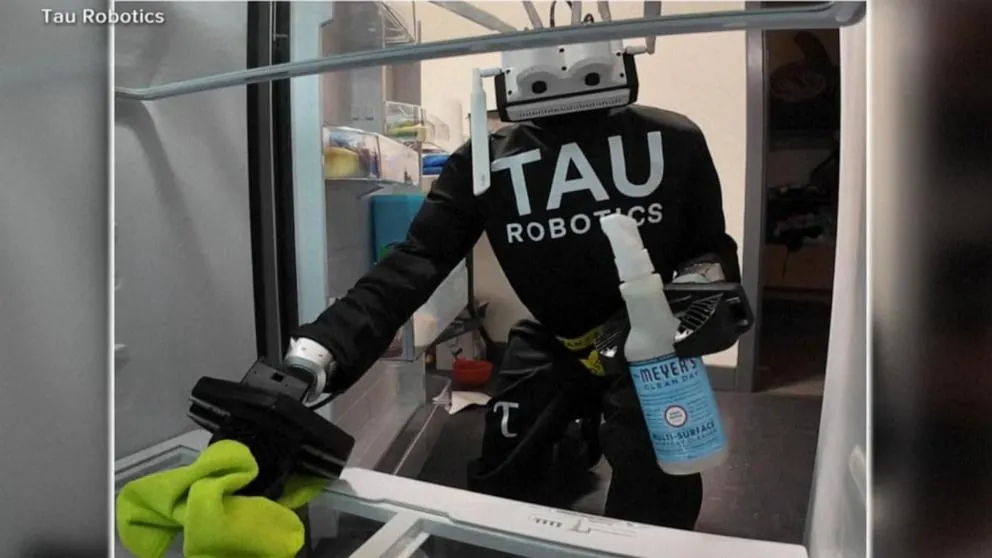
Teleoperation can reduce some risk because a person can intervene when the machine encounters a confusing environment. It also creates familiar negligence questions. Was the operator trained for residential hazards? Was one operator supervising one robot or several? What latency was acceptable? Could the operator see the relevant angle? Were there fatigue limits? Was the operator an employee, contractor, or vendor employee? Who had authority to stop the job?
Those questions affect both direct and vicarious liability. If the remote operator made a bad maneuver, the plaintiff may sue the service company that employed or contracted with that person. If the remote interface obscured a hazard, the software or manufacturer may be pulled in. If the service contract promised autonomous cleaning but actual performance depended on remote human intervention, the representation itself can become evidence in a consumer, contract, or insurance dispute.
Property owner, resident, or user
The property owner or resident is not automatically a passive victim. A defendant may argue that the customer created or failed to disclose a hazard: loose rugs, obstructed pathways, unsecured valuables, pets, children, stairs, wet surfaces, or fragile items left in the robot’s operating area. In a commercial setting, the property owner may also control premises warnings, access restrictions, after-hours operations, and emergency procedures.
That does not mean the property owner becomes the main payer. It means comparative fault and contractual responsibility are likely to appear. A residential customer who books a humanoid cleaner will usually not have negotiated robot-specific risk terms. A commercial customer might have procurement leverage, site-safety obligations, insurance requirements, and indemnity language. The same robot can therefore produce very different allocation outcomes depending on whether it is cleaning a studio apartment, a hotel corridor, or a corporate lobby.
Insurer
The insurer is not the wrongdoer, but it may be the party whose drafting determines whether the cheap clean remains cheap after a claim. Hartford’s public cleaning-business insurance page gives a useful conventional baseline: its customers pay an average of about $1,553 per year for a business owner’s policy, and the page describes ordinary cleaning liability coverage around third-party bodily injury, property damage, and related business risks. [9]
That baseline is useful precisely because it is traditional. It does not answer, by itself, whether robot-caused bodily injury, property damage caused by an autonomous or teleoperated machine, software failure, cyber compromise, product defect, or professional service failure is covered without endorsement, exclusion, sublimit, or separate technology errors-and-omissions coverage. A cleaning company cannot assume that a policy priced for mops, ladders, chemicals, keys, and human employees automatically prices humanoid manipulation inside occupied homes.
The same uncertainty affects manufacturers and RaaS providers. A product-liability tower may respond differently from general liability, cyber, technology E&O, professional liability, or a bespoke robotics program. The policy answer will turn on definitions: product, completed operations, professional services, expected or intended injury, care-custody-control, impaired property, electronic data, autonomous operations, and contractual liability. If those terms are not reviewed before deployment, they will be reviewed after the demand letter arrives.
Robot incidents already give plaintiffs a vocabulary
The absence of a humanoid-cleaning ruling does not leave courts with no analogies. Industrial and workplace robot incidents have already produced the language plaintiffs need: guarding, lockout, foreseeable human proximity, system integration, training, emergency stop, maintenance, warnings, and design defect.
One caveat matters. A useful public compilation at humanoidliability.com lists incidents including a 1979 Ford robot fatality, a 2021 Tesla Giga Texas robot-related injury allegation, a November 2023 South Korea vegetable-plant fatality, a November 2025 Figure AI whistleblower suit, and roughly 77 OSHA-recorded robot accidents from 2015 to 2022. The site is a personal-injury marketing site, not a neutral institutional reporter, so any incident count or case description should be verified against OSHA Severe Injury Reports, court filings, or other primary records before being used as claim frequency evidence. [10]
Used carefully, those incidents do not prove that humanoid apartment cleaners are unsafe. They prove something narrower and more important for liability planning: when a robot injures a person, existing legal systems already know how to ask who designed it, who maintained it, who controlled it, who trained the human around it, who could stop it, and who insured the risk.
Contract terms decide who carries the first loss
The courtroom theories matter, but procurement teams will first see the issue in contract language. A cleaning-service operator buying robots from a manufacturer or RaaS provider will want indemnity for design defects, software failures, security defects, documentation errors, and recalls. The manufacturer will try to narrow that indemnity to proven product defects and exclude misuse, unauthorized modifications, improper maintenance, and unsafe deployment environments.
Limitation-of-liability clauses then become the economic center of the deal. A robot may be cheap per clean because the vendor has capped liability at fees paid, excluded consequential damages, or refused to indemnify for third-party bodily injury except in narrow circumstances. That cap may be commercially ordinary in software contracting and intolerable in a premises-injury scenario. The mismatch is predictable because humanoid cleaning sits between a physical service, a product, and a cloud-connected AI system.
Additional-insured status is another place where the advertised rate can quietly change. A property owner may want to be added to the service operator’s policy. The service operator may want additional-insured protection from the manufacturer or RaaS provider. The manufacturer may refuse to cover claims arising from the operator’s cleaning methods. The insurer may accept the form but later dispute whether the claim arose out of covered operations.
For enterprise buyers, this is why the better comparison is not robot hourly rate versus human hourly rate. It is robot hourly rate plus contract-retained risk plus insurance premium plus uninsured loss exposure. A familiar version of the same allocation problem appears in the Rivian robotaxi regulation-and-liability tracker, where the operating model matters as much as the machine.
The EU layer is real, but it does not solve the U.S. allocation question
For companies deploying humanoid cleaning systems across borders, EU AI and product-safety obligations may affect documentation, risk management, transparency, and post-market monitoring. In 2026, that means working against a changed timeline: the EU AI Act has been in force since August 1, 2024, high-risk AI obligations begin applying on August 2, 2026, and the AI Liability Directive was withdrawn in October 2025.
It is not, however, the center of a U.S.-oriented claim-allocation analysis. If a robot cleaner injures a tenant in California or damages a hotel lobby in Texas, the first fight will still be over state tort theories, contract duties, policy language, and who had control over the risk. EU compliance materials may become evidence of reasonable design or process, but they do not replace the liability map.
The real cost formula
Gatsby’s $150 clean and Tau’s $30-per-hour teleoperated service deserve attention because they make humanoid cleaning economically plausible at the unit level. The mistake is treating that visible price as the full price. The first serious loss will not ask whether the robot was cheaper than a human cleaner. It will ask who selected it, who built it, who updated it, who controlled it, who supervised it, who warned the customer, who insured it, and who agreed to indemnify whom.
Until cleaning-specific precedent develops, the likely defendants are predictable even if the final allocation is not: the service operator that sold the clean, the manufacturer that supplied the machine, the software or network provider that shaped its behavior, the teleoperation entity or employer if a human was in the loop, the property owner or user if site conditions matter, and the insurers standing behind or outside each of them.
So the procurement question is not whether humanoid robot cleaning can be quoted cheaply. It can. The question is whether the quote still looks cheap after the contract says who pays for the broken countertop, the injured resident, the failed update, the distracted remote operator, and the coverage denial. Price per clean is the visible line item; price per clean plus allocated risk is the number that matters.
References
- Humanoid robot cleans first U.S. apartment — Fox News, May 2026.
- San Francisco company offers cleaning service with humanoid robots — ABC News, July 31, 2026.
- Gatsby — Gatsby.
- Cleaning Robots — RobotLAB.
- Cleaning Robot Market — Future Market Insights.
- Who is liable when robots cause damage? — Munich Re.
- AI Product Liability and Person Injury Claims — Phelan Petty.
- Rethinking Robot Liability — Boston College Law Review, Vol. 67 Issue 2, 2026.
- Cleaning Business Insurance — The Hartford.
- Humanoid Robots — humanoidliability.com.
Operationalizing workflow
No workflow has been explicitly linked to this obligation yet. See Workflows generally.
Illustrative cases
No illustrative case is currently tracked for this obligation. See Risk Digest for documented incidents generally.
← Back to RegulationReport a correction or tip
Spotted an outdated figure, a misstated fact, or a ruling this regulation entry should reflect? Public comments are disabled for this content given the professional cost of a misreported case outcome, penalty amount, or rule text — use the structured correction channel instead.
Report a correction or tip for this record →