
ICE AI Surveillance Targeting Haitian TPS Communities
- Authority
- U.S. Department of Homeland Security
- Rule type
- regulation
- Jurisdiction scope
- US federal
- Source text
- Read primary rule text ↗
Last verified: July 27, 2026. This is a regulation-and-ethics risk registry for immigration, criminal-defense, and employer counsel tracking ICE operations targeting Haitian TPS holders, related legal challenges, and adjacent surveillance exposure. It is not legal advice. It tracks AI-powered and AI-adjacent surveillance tools reported in the ICE operational environment affecting Haitian TPS holders and other noncitizens. It does not establish that every enforcement action involving a Haitian TPS holder can be traced to a named AI system.
The reason to keep a separate surveillance-risk file is not that every tool is proven to have decided a case. The reason is that DHS’s own AI inventory now lists more than 235 AI use cases, added 25 new ICE applications in 2026, and acknowledges that risk-management fields are “more than 80% empty across all records.” At the same time, reporting on surveillance contracting placed ICE-related surveillance contracts at $513 million in 2026, up from $310 million in 2025 and less than $50 million in 2013.[1][2]
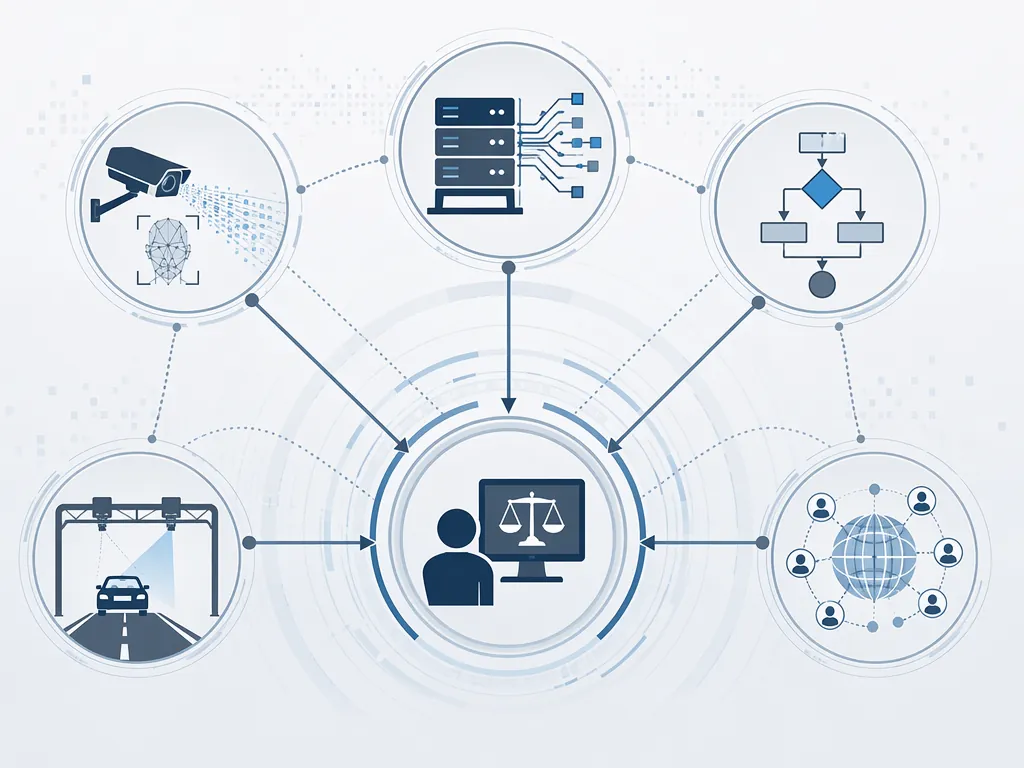
Compact surveillance-risk registry
| Tool or system | DHS use-case identifier | Function in the enforcement record | Deployment or contract signal | Affected legal interests | Challenge or litigation status | Primary sources |
|---|---|---|---|---|---|---|
| Mobile Fortify | DHS-2577 | Street-level facial-recognition app used to compare a live or uploaded image against a large identity-image pool. DHS describes results as advisory; reporting says ICE officials have treated matches as definitive. | Reported deployment in May 2025; ACLU analysis describes access to more than 200 million images and retention of photos of U.S. citizens and lawful permanent residents in the Automated Targeting System. | Fourth Amendment seizure and identification issues; due-process notice and contestability; First Amendment concerns where observers or protesters are scanned; racial-bias reliability concerns where field conditions are uncontrolled. | Tincher v. Noem and Hilton v. Noem are identified in the research record as active facial-recognition challenges. DHS classifies the use case as not high-impact; civil-liberties groups contest the practical risk of that classification. | [1][3][4] |
| ELITE / Palantir | DHS-2578 | Generative-AI and data-integration workflow reported to extract addresses and other information from records, consolidate government data, and support raid-planning or targeting logic. | Listed in DHS’s AI inventory; reporting links the tool to Palantir-supported ICE workflows and describes pulls involving HHS or Medicaid-related data in enforcement targeting. | Fourth Amendment warrant and probable-cause concerns; due-process issues if source data cannot be reconstructed; equal-protection risk if neighborhood targeting burdens protected communities. | No tool-specific merits ruling is identified in the supplied record. The active risk layer is constitutional challenge to data-driven targeting, warrantless data pulls, and the disputed DHS not-high-impact classification. | [1][4][5] |
| Clearview AI | Not supplied in the research record | Facial-recognition search against scraped public-web and social-media images. | DHS contract value reported at more than $3.8 million. | Fourth Amendment and due-process concerns where a match supplies investigative direction; First Amendment concerns where public association or expressive activity becomes searchable identity evidence. | ACLU v. Clearview AI litigation is identified as ongoing in the research record; Clearview-related use should be tracked separately from Mobile Fortify because the source image pool and vendor posture differ. | [2][3] |
| Hurricane Score | DHS-2408 | Machine-learning risk model assigning a 1-to-5 absconding-risk score for noncitizens in Alternatives to Detention. | Listed in DHS’s AI inventory. | Due-process concerns over supervision levels, check-in burdens, and contestability of a score; counsel should distinguish use in supervision from use in arrest targeting unless the case record shows both. | No named active case is identified in the supplied record. The immediate litigation risk is individualized challenge to conditions or consequences influenced by a score without meaningful explanation. | [1] |
| Automated license-plate readers | Not supplied in the research record | Vehicle and location tracking that can surface addresses, movement patterns, or presence near workplaces, homes, schools, courts, or community sites. | Included in reporting on ICE’s surveillance arsenal and contracting growth. | Fourth Amendment location-tracking concerns; due-process issues if an address or stop cannot be traced to the database query that produced it. | No tool-specific active case is identified in the supplied record. The challenge posture depends on the stop, query history, retention period, and whether the government discloses the database source. | [2][11][13] |
| OSINT and social-media scraping | Not supplied in the research record | Collection and analysis of public or semi-public online activity, associations, images, protest attendance, employer information, and community networks. | Reported as part of the immigration-surveillance environment and broader DHS use of AI in immigration decisions. | First Amendment association and speech concerns; due-process problems when a lead is treated as intelligence rather than discoverable evidence. | No single tool-specific case is identified in the supplied record. Counsel should track vendor, query terms, analyst notes, and whether the result was used only as a lead or as asserted factual support. | [2][11][12] |
| AI-written or AI-assisted field narratives | No ICE inventory identifier supplied | Use of a general AI system to draft, summarize, or polish enforcement reports. | A federal judge in the Northern District of Illinois noted in November 2025 that an ICE agent used ChatGPT to write a use-of-force narrative that conflicted with body-camera footage. | Due-process and evidentiary integrity; impeachment; sanctions; Brady/Giglio-style disclosure questions in overlapping criminal or immigration proceedings. | This is not proof that ChatGPT is an authorized ICE surveillance system. It is a warning that AI-generated language may enter the record after the stop or raid and then obscure what happened. | [6] |
Why Mobile Fortify deserves its own file
Mobile Fortify is the cleanest example of the gap between a government inventory label and a field consequence. In the DHS inventory, it appears as DHS-2577 and is classified as not high-impact. In civil-liberties reporting, it is a street-level facial-recognition tool deployed in May 2025 that can draw from more than 200 million images. ACLU analysis also warns that DHS retains photos of U.S. citizens and lawful permanent residents in the Automated Targeting System after Mobile Fortify encounters.[1][3]
The legal problem is not limited to whether the algorithm produces a match. It is whether the person stopped, counsel, and the court can later determine what image was captured, what database was searched, what confidence or ranking was returned, who reviewed it, whether the output was described as advisory, and whether officers treated it as definitive. NPR reported the practical tension plainly: DHS described Mobile Fortify results as advisory, while ICE officials characterized matches in more conclusive terms.[4]
That distinction matters in an emergency motion. If an officer says a person was “identified” at a worksite or in a traffic stop, the lawyer needs to know whether the identification came from a human witness, a database biographic hit, a Mobile Fortify facial comparison, or some mixture of all three. A facial-recognition lead that becomes the practical basis for detention without disclosure is not merely a privacy issue; it changes what counsel can contest.
Reliability concerns are not abstract here. The research record includes NIST facial-recognition findings, discussed in ACLU analysis, that performance degrades in uncontrolled conditions and is less accurate for Black individuals. NPR also reported a woman misidentified twice during an ICE raid in Woodburn, Oregon. Those facts do not prove every Mobile Fortify match is wrong. They do mean counsel should not accept “the app identified him” as a complete evidentiary sentence.[3][4]
For a Mobile Fortify file, the minimum record should include the encounter date, officer or unit, captured image, searched gallery, confidence or ranking output if available, retention system, body-camera footage, report language describing the match, and any later government claim that the tool was only advisory. If a client is a Haitian TPS holder, that file should sit beside the TPS-status record, because status litigation does not answer how enforcement attention was generated.
ELITE and Palantir move the risk from identification to targeting
ELITE, listed as DHS-2578, requires a different kind of review. Mobile Fortify raises the question, “How was this person identified?” ELITE raises the earlier question, “How did ICE decide where to go?” The supplied record describes ELITE as a generative-AI-assisted system that extracts addresses from rap sheets and integrates data for enforcement targeting. Reporting also describes pulls involving HHS or Medicaid-related data and the use of such information to identify neighborhoods for raids.[1][4][5]
The warrant problem is immediate. A raid plan can be built from many fragments that are individually mundane: an old address, a benefit record, a vehicle record, a prior arrest entry, a family member’s address, or a commercially sourced location lead. Once those fragments are fused into a target list, the resulting record can look more certain than its inputs. If the government later produces only the final address or the final operation plan, counsel loses the ability to test stale data, mistaken identity, database contamination, or targeting criteria.
The DHS inventory classification again does not end the inquiry. DHS’s not-high-impact label is a government classification under its own inventory framework. It is not a judicial finding that the tool cannot affect liberty, housing stability, employment, family separation, or access to medical care. When a system helps select homes, workplaces, or neighborhoods for enforcement, the risk field is not administrative housekeeping; it is the map an attorney needs to reconstruct the operation.
For ELITE or Palantir-linked workflows, counsel should ask for the data sources used to generate the target, the date each source was last refreshed, whether health or benefits data was queried, what human review occurred, whether the system produced a ranked list or narrative summary, and whether the warrant affidavit or operation plan disclosed the automated or vendor-assisted step. If the answer is that the system merely “organized” information, that answer still needs a record.
The shorter records: Clearview, Hurricane Score, ALPRs, and social scraping
Clearview AI
Clearview belongs in a separate file from Mobile Fortify even though both involve facial recognition. The risk is not interchangeable. Clearview’s image corpus is associated with scraped public-web and social-media material, while Mobile Fortify is described through DHS’s own inventory and immigration-system retention practices. Reporting identifies more than $3.8 million in DHS contracting with Clearview, and the research record identifies ACLU v. Clearview AI litigation as ongoing.[2][3]
The practical question is whether a Clearview search supplied a lead that later appeared in the case as something else: a surveillance location, an identity assertion, a social-media association, or a photograph in an officer’s report. A lead can disappear into the file unless counsel asks for the first query, not only the final arrest narrative.
Hurricane Score
Hurricane Score, DHS-2408, is not a raid-planning tool in the supplied record. It is a machine-learning risk model that assigns a 1-to-5 absconding-risk score for noncitizens in Alternatives to Detention. The legal interest is therefore different: supervision levels, check-in burdens, electronic monitoring decisions, and the ability to contest the score before it hardens into a condition of release.[1]
A lawyer should avoid overstating the record by calling every supervision condition “AI-driven.” The narrower, supportable question is whether Hurricane Score influenced the condition and whether the client received any meaningful notice of the factors used. If the score shaped a check-in schedule, location restriction, or monitoring requirement, the score is part of the case file even if no judge independently reviewed it.
Automated license-plate readers
Automated license-plate readers do not need a dramatic AI label to create a constitutional problem. They can connect a person to a home, workplace, school pickup route, clinic, court appearance, or community meeting. Reporting on ICE’s surveillance arsenal places ALPRs within the broader enforcement-technology buildout, and Fourth Amendment commentators have flagged the location-tracking implications of immigration surveillance technology.[2][13]
The file questions are ordinary but often skipped: which ALPR database was queried, whether the query was historical or real time, who authorized it, what retention period applied, and whether the result appeared in an affidavit, an operational plan, or only an internal lead sheet.
OSINT and social-media scraping
OSINT and social-media scraping are the easiest tools to describe loosely and the hardest to litigate cleanly. Freedom House and the American Immigration Council have both described the expansion of AI-enabled immigration surveillance and decision systems, including systems that can turn online traces into government leads.[11][12]
The legal issue depends on use. A public post manually viewed by an officer is not the same as a vendor scrape, a facial-recognition search across social images, a network-analysis map, or a risk narrative generated from online associations. If expressive activity, protest observation, church participation, mutual-aid work, or employer organizing appears to have triggered attention, the file should preserve the First Amendment theory with the same discipline used for a Fourth Amendment stop.
TPS litigation changes the exposure; it does not prove the toolchain
The TPS layer matters because Haitian communities are facing renewed enforcement exposure while status litigation remains active. SCOTUSblog reported in June 2026 that the Supreme Court allowed the administration to end removal protections for Syrian and Haitian nationals. CRS later described likely spillover effects for TPS litigation involving other countries, while employer guidance warned that Haiti and Syria TPS changes require close attention to work authorization and reverification issues.[8][9][10]
Miot v. Trump remains relevant as an equal-protection challenge to Haiti TPS termination. But it should not be used as a shortcut to claim that any particular Haitian TPS enforcement action was caused by Mobile Fortify, ELITE, Clearview, or another tool. The record supports a narrower and more useful point: as TPS protection becomes unstable, the surveillance environment around the affected communities becomes more legally consequential.
For employer counsel, that means the TPS file and the surveillance file should not be siloed. If an employee misses a check-in, receives a supervision change, is arrested near a worksite, or is identified during a raid, the question is not only whether work authorization remains valid. It is also whether a facial-recognition match, address-extraction workflow, ALPR hit, social-media lead, or risk score shaped the encounter.
Judicial warning signs already exist
The strongest warning in the current record is not a final appellate ruling on ICE AI surveillance. It is the accumulation of judicial friction around enforcement practices and record reliability. In November 2025, PBS NewsHour reported that a federal judge noted an ICE agent’s use of ChatGPT to draft a use-of-force narrative that conflicted with body-camera footage.[6]
In January 2026, a Minnesota federal judge found 96 court-order violations across 74 cases, according to Tech Policy Press. That finding does not prove that each violation was caused by an AI tool. It does show why incomplete risk documentation cannot be dismissed as a paperwork flaw. When courts are already documenting noncompliance, the missing fields in a government AI inventory become litigation-relevant gaps.[7]
The due-process problem is especially sharp where the government relies on systems it characterizes as advisory. Advisory systems can still determine which address is visited, which person is questioned first, which photograph is retained, which supervision level is imposed, or which narrative appears in the file. If the system’s role is invisible, the remedy comes late or not at all.
Challenge tracker for the surveillance file
| Challenge or proceeding | Tool or practice implicated | Legal theory to track | Use in a client risk file |
|---|---|---|---|
| Tincher v. Noem | ICE facial recognition | First Amendment and related constitutional concerns where facial recognition is used against protected activity or community observation. | Track whether client, observer, family member, attorney, or community supporter was scanned or photographed in a context involving speech, protest, legal observation, or association.[3][13] |
| Hilton v. Noem | Facial recognition against observers | Challenge to the use of facial recognition on people observing or documenting enforcement. | Useful where a raid file includes photos, observer identification, crowd scanning, or later questioning tied to presence at an enforcement scene.[3][13] |
| ACLU v. Clearview AI | Clearview facial-recognition searches | Privacy, biometric, and scraping-related challenge posture. | Keep Clearview queries distinct from Mobile Fortify queries because the vendor database, source images, and disclosure issues differ.[3] |
| Miot v. Trump | Haiti TPS termination | Equal-protection challenge to Haiti TPS termination. | Use to track status exposure. Do not treat it as proof that a particular ICE action was AI-generated unless the enforcement record supplies that link.[8][9] |
| Judge Ellis footnote, N.D. Ill. | AI-written use-of-force narrative | Accuracy, impeachment, and evidentiary-integrity concerns. | Compare officer narratives with body-camera footage and ask whether AI was used to draft, revise, translate, or summarize the report.[6] |
| Minnesota federal court-order violations | ICE compliance environment | Due process, court compliance, and remedial supervision. | Use as context for seeking complete records and preserving objections, not as proof that any particular tool caused the violation.[7] |
What belongs in the maintained file
A competent surveillance-risk file should be maintained like a status file: dated, sourced, and revisable. It should not depend on a client’s ability to name the system that touched them. Most clients will not know whether an address came from ELITE, an ALPR query, a benefits-data pull, a social-media scrape, a human informant, or an old database hit. That uncertainty is the reason to preserve the questions early.
- Tool name and DHS use-case identifier, if available.
- Vendor, contract, or procurement signal keeping the tool active.
- Operational role: lead generation, identity match, address extraction, risk scoring, report drafting, or supervision-setting.
- Government classification, including any not-high-impact label and the source for that classification.
- Output type: score, ranked match, narrative summary, address list, alert, photograph, or analyst note.
- Human-review step, including who accepted, rejected, or acted on the output.
- Retention system, especially where images or encounter records enter ATS or another reusable database.
- Disclosure status in the warrant, charging document, supervision order, immigration filing, or officer report.
- Known challenges, injunctions, judicial findings, and last verification date.
That file will often reveal less than counsel wants. It may show only that a tool was available in the operational environment, not that it caused the stop. It may show that DHS listed a system but left the risk fields blank. It may show that the government calls an output advisory while the field record reads as if the output settled identity. Those distinctions are not academic. They decide what can be challenged, what can be discovered, and what must be preserved before the record is overwritten by a cleaner narrative.
The current record does not justify predicting that courts will strike down ICE’s AI surveillance infrastructure wholesale. It also does not justify treating every Haitian TPS enforcement action as AI-driven. It does justify maintaining a living registry next to the TPS-status file. DHS’s own inventory is incomplete, contracting is expanding, and courts are already documenting violations. Representation now requires tracking the tools, contracts, classifications, legal challenges, and verification dates before the technology disappears into the ordinary case narrative.
References
- AI Use Case Inventory, Department of Homeland Security, Jul. 15, 2026.
- ICE tech surveillance arsenal, The Guardian, Jun. 24, 2026.
- ICE Face Recognition, ACLU, Nov. 2025.
- ICE, DHS immigrants surveillance confrontation deportation Mobile Fortify, NPR, Mar. 4, 2026.
- DHS AI inventory Mobile Fortify Palantir, FedScoop.
- Judges’ note on immigration agents using AI raises accuracy and privacy concerns, PBS NewsHour, Nov. 26, 2025.
- DHS AI Surveillance Arsenal Grows As Agency Defies Courts, Tech Policy Press, Feb. 2026.
- Supreme Court allows Trump administration to end removal protections for Syrian and Haitian nationals, SCOTUSblog, Jun. 2026.
- CRS Legal Sidebar LSB11446, EveryCRSReport.com.
- TPS for Haiti and Syria After Mullin: What Employers Need to Know Now, Morgan Lewis, Jun. 30, 2026.
- Trump’s Immigration Crackdown Is Built on AI Surveillance and Disregard for Due Process, Freedom House.
- Invisible Gatekeepers: DHS’s Growing Use of AI in Immigration Decisions, American Immigration Council.
- ICE’s Surveillance Tech Raises 4th Amendment Concerns, Law360.
Operationalizing workflow
No workflow has been explicitly linked to this obligation yet. See Workflows generally.
Illustrative cases
No illustrative case is currently tracked for this obligation. See Risk Digest for documented incidents generally.
← Back to RegulationReport a correction or tip
Spotted an outdated figure, a misstated fact, or a ruling this regulation entry should reflect? Public comments are disabled for this content given the professional cost of a misreported case outcome, penalty amount, or rule text — use the structured correction channel instead.
Report a correction or tip for this record →