
ICE Contract Clauses Can't Preempt State Law, Court Rules
- Authority
- U.S. District Court for the Western District of Washington
- Rule type
- regulation
- Jurisdiction scope
- US federal
- Source text
- Read primary rule text ↗
Preemption requires Congressional intent, not a contract clause.
The operative sentence is blunt enough to look stronger than it is. ICE’s July 10, 2026 draft request for proposals for 5,500 detention beds across four states says state and local laws “shall not apply” to the facilities, and the same language appeared in GEO’s March 2026 Tacoma detention contract. [1]
That is the whole fight in miniature. ICE wants detention contracts written as if a procurement clause can disable ordinary state enforcement. Judge Benjamin Settle, in the Western District of Washington, rejected that move in July 2026: “Preemption requires Congressional intent, not a contract.” [1] The Ninth Circuit then stayed his order, which means the ruling is not an immediate green light for Washington inspectors and is not binding authority for courts elsewhere. [1]
For counsel assessing ICE detention contracts after the 2025 appellate cases, the clause should be treated neither as meaningless boilerplate nor as a constitutional wand. It is a litigation position placed inside a contract. That may matter. It does not answer the Supremacy Clause question.
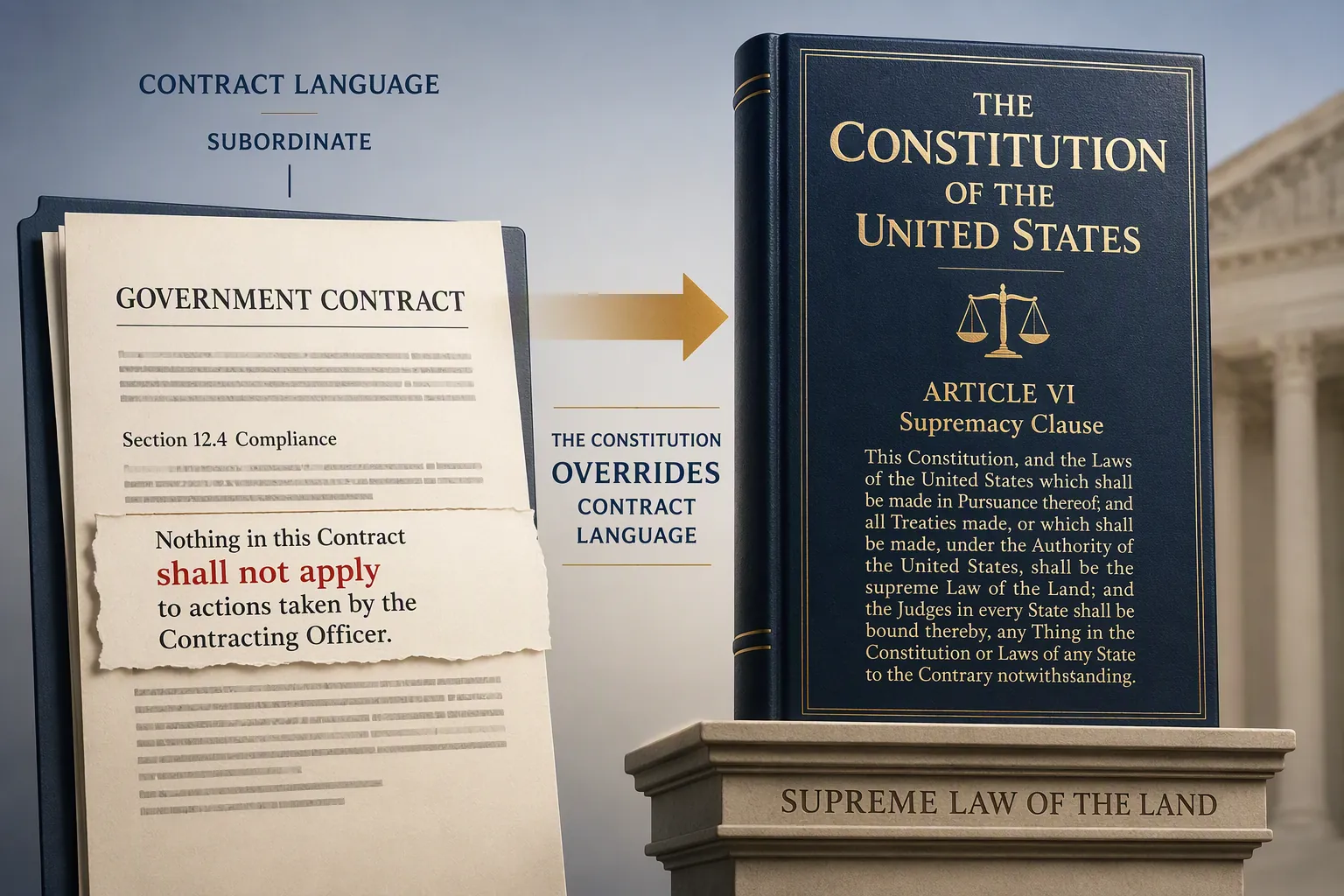
A procurement term cannot do Article VI’s work
The mistake in the “shall not apply” language is not subtle. Contracts can allocate obligations between the parties to the contract. They can tell a detention operator what ICE expects, what it will pay for, what it will indemnify, and what position the agency intends to take if a regulator arrives at the gate. They cannot, by their own force, erase a state’s police powers.
Preemption is a constitutional consequence of federal law. The relevant hierarchy starts with the Supremacy Clause and Congressional intent, then moves to statutory structure and conflict analysis. Contract language comes later, if at all. It may be evidence that ICE believes a particular state rule obstructs its detention program. It may explain why a private operator refused entry to an inspector. It may frame a request for injunctive relief. But the clause is not itself the source of federal supremacy.
That distinction is why Judge Settle’s reasoning matters even though the stay limits its practical effect. He did not hold that every Washington rule automatically applies to every ICE contractor in every circumstance. He rejected the narrower shortcut: the idea that ICE and GEO could write state law out of the facility by contract.
The timing of the Tacoma contract also mattered. The court found that GEO entered the March 2026 contract while litigation was already underway and treated the clause as a litigation tactic, not as a term ICE had required as an operational necessity. [1] That finding should not be inflated into a universal rule that similar clauses are always bad-faith drafting. It does, however, weaken the claim that the language merely memorialized a settled federal command.
The stay is where legal clarity becomes administrative delay
A stayed order is not a merits victory for ICE. It is also not much comfort to the official holding the inspection file. The Ninth Circuit’s stay keeps the practical dispute alive while appellate review proceeds, leaving the clause available as a reason for operators to resist state enforcement and as a reason for state lawyers to expect emergency briefing rather than routine compliance. [1]
Washington’s record shows why that procedural posture is not academic. State officials have faced 10 refused inspections since 2024, while the Tacoma facility has been associated with 3,500 detainee complaints and two deaths. [1] Those numbers do not prove the merits of any particular inspection demand, complaint, or causal theory. They do show the cost of turning ordinary regulatory contact into a federal preemption fight.
The morning after a “shall not apply” clause appears, a state agency does not get to pretend the clause is invisible. The safer file-building response is more disciplined: identify the statutory authority for the inspection or enforcement action, show that the rule is generally applicable, document the refusal, separate access issues from substantive violations, and preserve the state’s position that the contract is only evidence of ICE’s litigation theory.
For the operator, the calculus is different but no less uncomfortable. Refusing entry may preserve the federal defense ICE wants to litigate. It may also create a separate record of noncompliance if the preemption argument fails. Agency counsel, meanwhile, should be candid about what the clause can and cannot promise: it may buy time, but it cannot guarantee immunity from state health, safety, wage, access, or local regulatory demands.
The better test is what the state law regulates, not who signed the ICE contract
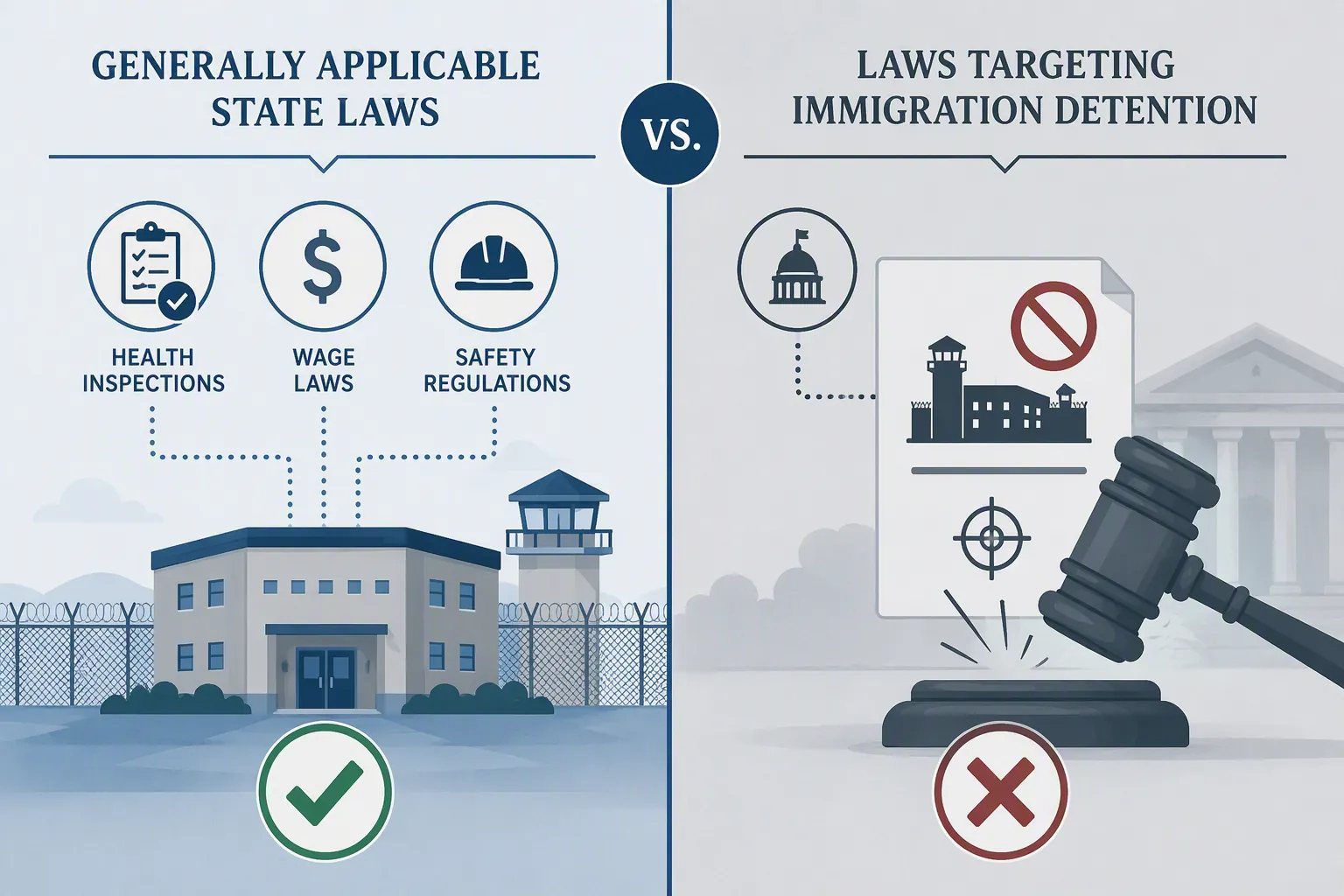
The harder cases do not ask whether the building houses ICE detainees. Of course it does. The useful question is whether the state is enforcing a generally applicable police-power rule, or whether it has targeted immigration detention in a way that effectively forces ICE to abandon or redesign its chosen detention arrangements.
Nwauzor v. GEO Group is the important counterweight to the contract-preemption argument. In January 2025, the Ninth Circuit held that state minimum wage law could apply to detention labor and was not preempted, emphasizing wage and employment regulation as an area of historic state police power. [2] That is a different legal object from a state statute designed to shut down private immigration detention as such.
GEO Group v. Newsom marks the other side of the line. Sitting en banc in 2022, the Ninth Circuit held California’s AB 32 preempted as applied to ICE’s private detention contractors because the law would have forced ICE to “cease ongoing immigration detention operations in California and adopt an entirely new approach.” [3] CoreCivic v. Murphy belongs in the same warning column for counsel evaluating state laws that single out private immigration detention rather than applying ordinary regulation to a facility that happens to hold ICE detainees.
| Question for counsel | Why it matters |
|---|---|
| Does the rule apply across comparable facilities or employers? | Generally applicable health, wage, safety, and employment rules are more likely to receive the presumption against preemption. |
| Does the rule single out immigration detention or private ICE contractors? | Targeted restrictions create a stronger federal argument that the state is obstructing ICE’s chosen detention method. |
| Can ICE comply while continuing operations in the same general form? | If compliance requires inspections, wages, records, or safety changes, the preemption argument is weaker than if compliance forces closure or replacement of the detention model. |
| Is the asserted federal authority statutory, regulatory, or merely contractual? | Congressional intent and federal statutory purpose carry the constitutional weight; contract language is evidence, not supremacy. |
That distinction is not tidy in application. Access rules can look like ordinary oversight until the requested access interferes with federal custody protocols. Zoning and environmental review can look neutral until the record shows local officials are using them to prevent an ICE facility from operating at all. A detention tax can look like revenue legislation until its design and burden make it function like a targeted penalty. The name of the law will not decide the case.
Federal ownership is a different argument
ICE’s contract clause should also be kept separate from DHS’s facility-purchase strategy. In July 2026, CalMatters reported DHS’s $1.5 billion purchase of the California City and Otay Mesa detention facilities from CoreCivic. [4] Federal ownership changes the analysis because it can bring federal enclave doctrine into view, depending on the history of jurisdiction over the land and the specific state law being enforced.
That is a more serious preemption route than a private contract term. A federally owned site may present questions about exclusive federal jurisdiction, retained state authority, and whether later-enacted state laws apply inside the enclave. Those questions are fact-bound and property-specific. They should not be treated as settled for California City or Otay Mesa merely because DHS bought the facilities.
The federal-enclave issue also explains why the government may prefer ownership to argumentative boilerplate. A deed and jurisdictional history can create legal questions a contract clause cannot. But ownership still does not answer every inspection, wage, access, tort, taxation, or local enforcement question. It just moves the dispute to a stronger and more technical battlefield.
Where the pressure points will keep appearing
The clause will be most tempting where the state demand is mundane and repeatable: a health inspection, an occupational-safety request, a wage claim, an access statute, a local permit condition, a tax assessment, or a zoning and environmental review dispute. Those are the files where preemption arguments become operational tools. They postpone entry, shift the forum, and increase the cost of enforcement.
California’s access litigation, including disputes tied to Gilroy and Otay Mesa, belongs in that category. So do local land-use and environmental fights over proposed or expanded detention capacity. None should be described as resolved by Judge Settle’s order. None is automatically controlled by GEO Group v. Newsom either. The outcome will turn on the rule’s design, the burden it imposes on federal detention operations, and the remedy the state or locality seeks.
That is the practical point the “shall not apply” clause tries to obscure. A state law can be valid in the abstract and still preempted as applied to a particular federal operation. A federal contractor can have a serious preemption defense and still lose if the rule is an ordinary exercise of state police power. The contract language does not eliminate that analysis; it merely announces where the operator and ICE intend to start arguing.
The clause is a signal, not a shield
A “shall not apply” provision in an ICE detention contract is not self-executing preemption. It does not bind state regulators, county counsel, detainees, employees, or courts simply because ICE and a private operator agreed to say so. The Supremacy Clause still requires a federal-law basis, and the strongest preemption arguments will be the ones grounded in Congressional intent, statutory structure, actual conflict, or facility ownership—not procurement drafting.
The clause is still useful to ICE and operators because it creates delay and frames the dispute before enforcement begins. With the Ninth Circuit stay in place, states should expect litigation before access, litigation before penalties, and litigation before any clean answer about the reach of particular inspection or access laws. Generally applicable health, wage, safety, and employment rules remain on stronger ground than statutes aimed at shutting down private immigration detention, but stronger ground is not the same thing as quick enforcement.
The next cases will not produce one national sentence replacing ICE’s national sentence. They will be jurisdiction-specific fights over particular facilities, particular laws, and particular burdens on federal detention choices. That is slower than a contract clause. It is also how preemption law actually works.
References
- ICE's New Detention Center Contracts Declare State Laws "Shall Not Apply", WIRED, July 2026.
- Nwauzor v. GEO Group, Inc., U.S. Court of Appeals for the Ninth Circuit, January 16, 2025.
- GEO Group, Inc. v. Newsom, U.S. Court of Appeals for the Ninth Circuit, September 26, 2022.
- What the sale of 2 ICE detention centers reveals about Trump's new immigration strategy, CalMatters, July 2026.
Operationalizing workflow
No workflow has been explicitly linked to this obligation yet. See Workflows generally.
Illustrative cases
No illustrative case is currently tracked for this obligation. See Risk Digest for documented incidents generally.
← Back to RegulationReport a correction or tip
Spotted an outdated figure, a misstated fact, or a ruling this regulation entry should reflect? Public comments are disabled for this content given the professional cost of a misreported case outcome, penalty amount, or rule text — use the structured correction channel instead.
Report a correction or tip for this record →