
What Kenya law requires for IEBC commissioner selection
- Authority
- Parliament of Kenya
- Rule type
- statute
- Jurisdiction scope
- Kenya (national)
- Effective date
- Jul 19, 2024
- Source text
- Read primary rule text ↗
IEBC commissioner vacancies must follow the First Schedule selection process: 7-day vacancy notice, nine-member panel appointed within 14 days, public interviews, 2 chairperson and 9 member nominees, 7-day presidential/National Assembly deadlines, and 90-day panel term unless extended by both Houses.
Last verified: 2026-08-03 UTC. This Regulation & Ethics record is a statutory process tracker, not legal advice. It treats the Independent Electoral and Boundaries Commission Act, Cap. 7C, as the controlling source, using the version consolidated by Kenya Law on 19 July 2024. The completed 2025 reconstitution cycle is used here as a date-by-date check against that statutory clock, with court and constitutional materials treated cautiously where the primary order or text has not been verified. [1]
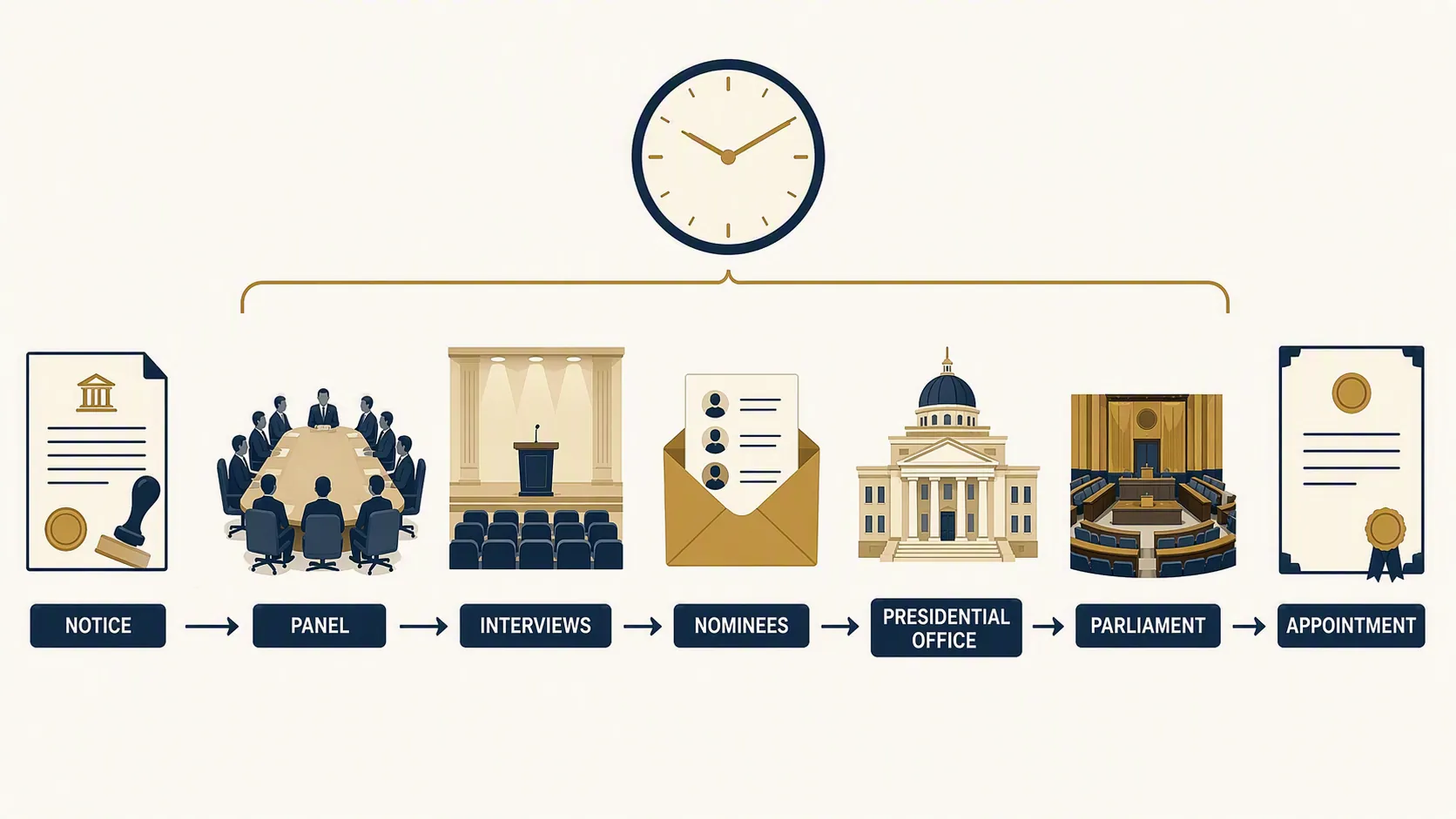
The controlling clock starts in the Act, not in political shorthand
For the current legal process for selecting IEBC commissioners in Kenya, the useful starting point is not a general statement that the Commission is being “reconstituted.” The useful starting point is the handoff rule: when a vacancy arises in the office of chairperson or member, section 7A requires the President to publish a Gazette notice within seven days declaring the vacancy. The First Schedule then moves the process out of ordinary administrative discretion and into a fixed sequence of institutional acts. [1]
Under the current Act, the selection panel has nine members. Two are nominated by the Parliamentary Service Commission, three by the Political Parties Liaison Committee, one by the Law Society of Kenya, one by the Institute of Certified Public Accountants of Kenya, and two by the Inter-Religious Council of Kenya. The President appoints the panel within 14 days of the vacancy. [1]
That composition matters because older explainers can be legally stale. A seven-member panel description may have been accurate under the earlier version of the Act; it is not the current First Schedule composition after the 2024 amendment. [1]
What the First Schedule requires, step by step
The First Schedule is compact, but it does a lot of work. It creates the panel, assigns nomination slots, fixes the application and interview sequence, controls the number of names that leave the panel, and sets the panel’s lifespan. The sequence below is the statutory spine against which any selection cycle should be checked.
| Stage | Actor named by law | Legal requirement or deadline | What to verify |
|---|---|---|---|
| Vacancy notice | President | Gazette notice declaring a vacancy within 7 days of the vacancy arising under section 7A. | Date the vacancy arose; date and number of the Gazette notice. |
| Selection panel appointment | President, after institutional nominations | Nine-member panel appointed within 14 days of the vacancy under the First Schedule. | Correct current composition: 2 PSC, 3 PPLC, 1 LSK, 1 ICPAK, 2 Inter-Religious Council. |
| Application invitation | Selection panel | Within 7 days of appointment, the panel invites applications from qualified persons. | Date of panel appointment; date of invitation; publication route used. |
| Publication and shortlisting | Selection panel | The panel publishes the names of applicants and proceeds toward interviews under the First Schedule. | Applicant list, deduplication or correction record, and shortlist criteria. |
| Public interviews | Selection panel | The panel conducts interviews in public. | Interview dates, interview lists, public access and record of attendance. |
| Nominee output | Selection panel | The panel submits two qualified persons for chairperson and nine qualified persons for member positions. | Whether the output is exactly 2 + 9 and whether the chair/member tracks are kept separate. |
| Forwarding to National Assembly | President | Within 7 days of receiving names, the President forwards nominees to the National Assembly. | Date the President received the panel report; date names were forwarded. |
| Parliamentary approval | National Assembly | The Act links the nominees to the parliamentary approval process. | Committee report, House approval record, and any rejection or substitution issue. |
| Final appointment | President | Within 7 days of National Assembly approval, the President appoints the chairperson and members. | Approval date; Gazette appointment notices; oath or swearing-in date as a separate endpoint. |
| Panel lifespan | Selection panel; both Houses if extension is needed | The panel stands dissolved after 90 days from appointment unless the period is extended by both Houses of Parliament. | Appointment date; 90th day; wording and duration of any extension by the Senate and National Assembly. |
The Act also sets qualification gates before the panel can sensibly rank candidates. The chairperson must be qualified to hold office as a judge of the Supreme Court. Members must meet the statutory education and experience requirements, including the Act’s degree and 10-year experience language. The appointment also sits within Kenya’s integrity framework: the Act refers to Chapter Six, which is why the selection process cannot be reduced to interview scores alone. [1]
The 2025 cycle against the statutory sequence
The 2025 reconstitution is useful because it is complete: the chairperson and six commissioners were ultimately sworn in on 11 July 2025. It is also useful because it exposes a common verification problem. A reader who only remembers “90 days” will miss the First Schedule’s extension mechanism and the reported court interruptions before final gazettement.
| Legal checkpoint | Statutory actor and clock | 2025 public date or event | Source note |
|---|---|---|---|
| Vacancy notice | President; Gazette notice within 7 days of vacancy under section 7A. | Not reconstructed from the public sources used for this tracker. | Use the Gazette notice itself before asserting compliance. [1] |
| Panel appointment and oath | President appoints nine-member panel within 14 days of vacancy; panel lifespan then matters under paragraph 6. | The selection panel was sworn in on 27 January 2025. | Public date from Parliament reporting; formal appointment instrument should be checked for the exact paragraph 6 start point. [2] |
| Panel internal organization | Not the main statutory clock, but operationally relevant. | Nelson Makanda was reported elected chairperson and Charity Kisotu Kiome vice-chairperson on 31 January 2025, with an 85-day commitment reported. | Secondary news report; useful for chronology, not a statutory deadline. [3] |
| Application intake | Panel invites applications within 7 days of appointment and publishes applicant names under the First Schedule. | Applications reportedly closed on 15 February 2025; 1,848 applications were received and 1,356 remained after deduplication. | Do not substitute the 925-applicant figure from the earlier 2023 process. [4] |
| Public interviews | Panel conducts public interviews. | Chairperson interviews were reported as concluding on 26 March 2025; commissioner interviews ran from 27 March to 25 April 2025. | The Star’s report is used for the date range; minor date variations in other public reporting should be checked before litigation use. [5] |
| 90-day panel lifespan | Panel dissolves after 90 days from appointment unless extended by both Houses. | Using 27 January 2025 as the public operational marker, the 90-day period ran into late April; Parliament extended the panel’s term for 14 days from 28 April to 12 May 2025. | The extension mechanism is statutory; the actual 2025 extension is reported in the completed-cycle chronology. [1][5] |
| Panel report and presidential nomination | Panel submits 2 chairperson names and 9 member names; President forwards selected nominees to the National Assembly within 7 days. | The panel reportedly submitted its report to the President on 6 May 2025; the President nominated candidates on 8 May 2025; Speaker’s Notification No. 007 of 2025 was dated 9 May 2025. | This is the key handoff from panel to President to National Assembly. [6] |
| Final appointment | President appoints within 7 days after National Assembly approval. | Gazette Notices No. 7724 and No. 7725 were reported on 10 June 2025, appointing the chairperson and commissioners. | The sources used here do not reproduce the National Assembly approval date; check the House record before calculating the 7-day final appointment window. [7] |
| Swearing-in | Not the First Schedule appointment act itself, but the practical endpoint of the completed reconstitution. | The Chief Justice presided over the swearing-in of the IEBC chairperson and six commissioners on 11 July 2025. | Judiciary report confirms the completed endpoint. [8] |

The table leaves two points deliberately unresolved. First, the available public materials do not establish the original section 7A vacancy notice trail. That notice is the statutory first move and should be verified directly in the Gazette for any formal opinion. Second, the table uses 27 January 2025 as the public operational marker for the panel because that is the reported oath date; the exact legal start for the 90-day paragraph 6 calculation should be tied to the appointment instrument if the issue is contested.
Why the process ran past 90 days
The 2025 cycle should not be described simply as a panel that “missed” a 90-day timetable. Paragraph 6 of the First Schedule contains the 90-day rule, but it also allows extension if both Houses of Parliament extend the period. The reported 2025 extension ran for 14 days, from 28 April to 12 May. That is materially different from an open-ended administrative delay. [1][5]
There is also a separate caution on court interruptions. The public chronology includes reported court orders before the June 10 gazettement of appointments, but the primary orders were not available for parsing in the source set used here. Those reports can help explain chronology; they should not be converted into settled holdings without the orders, case numbers and operative terms. [7]
The current nine-member panel is not the old seven-member panel
The current Act should be used for any new vacancy cycle. The pre-amendment Act had a different selection-panel structure. The 2024 version now reflected in the consolidated Cap. 7C supplies the nine-member model and the current institutional slots. Comparing the two versions is not a historical nicety; it prevents the most basic kind of source contamination in a briefing note. [1][9]
| Issue | Earlier version | Current version to use for new checks |
|---|---|---|
| Panel size | Seven-member structure under the earlier version. | Nine-member panel under the Act consolidated on 19 July 2024. |
| Institutional slots | Different allocation under the old First Schedule. | 2 Parliamentary Service Commission, 3 Political Parties Liaison Committee, 1 Law Society of Kenya, 1 ICPAK, 2 Inter-Religious Council. |
| Practical risk | Older explainers may still circulate with obsolete composition language. | For 2025 and later, cite the current consolidated Act and identify the panel slots from the current First Schedule. |
The amendment context is straightforward enough for process purposes. Act No. 9 of 2024 was assented to on 9 July 2024 and came into force on 19 July 2024; the consolidated Kenya Law version used in this tracker is dated 19 July 2024. [1][10]
Qualifications and integrity gates are part of the process
A commissioner-selection tracker should not stop at dates. Dates tell the reader whether the right office acted on time; qualification and integrity gates tell the reader whether the pool itself was legally eligible. The Act’s chairperson requirement points to Supreme Court-judge qualification. For members, the Act requires a degree and at least 10 years’ relevant experience, including fields such as accounting and information and communications technology. The Act also requires compliance with Chapter Six. [1]
That integrity framing is not decorative in an election body. ICJ Kenya has argued publicly that it is in Kenyans’ interest for the IEBC to be properly constituted, connecting proper constitution of the Commission with electoral integrity and public confidence. That is an advocacy source, not the statute, but it helps explain why the technical gates are treated seriously. [11]
Known verification cautions for the 2025 record
The 2025 cycle is checkable, but it is not a licence to flatten the record. Four cautions are worth keeping with the file.
- Do not use the 925-applicant figure for the 2025 cycle. The 2025 public report used here gives 1,848 applications received and 1,356 after deduplication. The 925 figure belongs to an earlier seven-member process. [4]
- Do not treat the reported court interruptions as fully analysed holdings unless the primary orders are in hand. The safe statement on the available record is chronological: reported court orders intervened before the June 10 appointment gazettement. [7]
- Check the LSK slot carefully if naming the final panel. Public sources show a mismatch: an initial slot was associated with Carolene Kituku, while Morris Kimuli was later reported sworn in as a member of the panel. That is a source-trail issue to resolve from the Gazette and Judiciary record before relying on a final list. [12]
- Verify constitutional appointment text directly from the Constitution before quoting it. This tracker relies on the IEBC Act for the statutory sequence and does not cite an inaccessible constitutional page for Article 250 language.
There is also amendment-litigation context around the 2024 law. Public reporting described a High Court ruling striking the IEBC law, but the available record does not provide the exact date, case number or primary judgment. For this tracker, that material is context only. It should not displace the consolidated Act unless the operative court orders and appellate position are independently verified. [13]
What to check in the next vacancy cycle
The next IEBC vacancy cycle should be read from the first public act, not from the first press conference. The section 7A Gazette notice should appear within seven days of the vacancy. The selection panel should be the current nine-member panel, not the old seven-member model. The panel’s invitation to applicants should be checked against the seven-day paragraph 3 clock. The interview record should show public interviews. The panel’s output should remain 2 chairperson names and 9 member names. The President’s forwarding and final appointment windows should each be calculated from the correct triggering date. [1]
If the process approaches 90 days, the question is not simply whether the panel is late. The question is whether both Houses extended the panel under paragraph 6, for how long, and on what dates. The 2025 cycle shows why that distinction matters: the selection process was longer than a casual 90-day description, but it had a statutory extension route and reported court interruptions that have to be separated from ordinary delay. [1][5][7]
The useful final conclusion is narrow but firm: Kenya’s IEBC commissioner selection is a legally clocked, multi-actor process. The 2025 cycle can be measured stage by stage, but the safest file keeps the Gazette notices, panel composition, extension record, parliamentary approval record and any court orders in their primary form.
References
- Independent Electoral and Boundaries Commission Act, Cap. 7C — Kenya Law, 19 July 2024.
- IEBC Selection Panel takes oath of office — Parliament of Kenya, 27 January 2025.
- Nelson Makanda elected chairman of IEBC selection panel — Nation, 31 January 2025.
- What next for IEBC selection panel after long list of applicants — The Star, 6 March 2025.
- IEBC selection panel concludes interviews — The Star, 25 April 2025.
- Notification No. 007 of 2025 — Parliament of Kenya, 9 May 2025.
- Ruto appoints IEBC chair, commissioners — The Star, 10 June 2025.
- Chief Justice Presides Over Swearing-In of IEBC Chairperson and Six Commissioners — Judiciary of Kenya, 11 July 2025.
- Independent Electoral and Boundaries Commission Act, Cap. 7C — Kenya Law, 6 February 2023.
- Kenya to reconstitute electoral commission as Ruto signs IEBC bill into law — The Africa Report, 2024.
- Law and Order: It’s in Kenyans’ Best Interest to Ensure IEBC is Properly Constituted — ICJ Kenya.
- Member of IEBC Selection Panel Sworn In — Judiciary of Kenya.
- Court strikes IEBC law: Parliament does not, you panic — Nation.
Operationalizing workflow
No workflow has been explicitly linked to this obligation yet. See Workflows generally.
Illustrative cases
No illustrative case is currently tracked for this obligation. See Risk Digest for documented incidents generally.
← Back to RegulationReport a correction or tip
Spotted an outdated figure, a misstated fact, or a ruling this regulation entry should reflect? Public comments are disabled for this content given the professional cost of a misreported case outcome, penalty amount, or rule text — use the structured correction channel instead.
Report a correction or tip for this record →