
Illinois DREAM Act ruling creates Supreme Court circuit split
- Authority
- U.S. District Court for the Southern District of Illinois
- Rule type
- court order
- Jurisdiction scope
- US federal
- Effective date
- Jul 24, 2026
- Source text
- Read primary rule text ↗
Extend residence-based tuition benefits to all U.S. citizens or deny them to undocumented students
The July 24 order creates an immediate compliance problem
Judge David W. Dugan’s July 24, 2026 summary judgment ruling in United States v. Illinois struck down three Illinois tuition-equity measures—HB 60, the RISE Act, and the Illinois DREAM Act—as preempted by 8 U.S.C. § 1623 under the Supremacy Clause, with a 14-day stay that runs into the first week of August 2026.[1]
The practical consequence is not abstract. As reported, Illinois has two compliance paths while the stay is in place: extend the same postsecondary education benefit to every U.S. citizen nationwide, regardless of Illinois residence, or deny the benefit to undocumented students.[1] That choice arrives weeks before fall 2026 billing and financial-aid deadlines, which is why the stay—not the press-cycle reaction—is the first calendar item counsel should mark.
There is one publication-level caveat worth stating at the front. Available detailed legal reporting attributes the July 24 order to Judge Dugan, while some secondary reporting has named another Southern District of Illinois judge. The full opinion text was not available in the materials reviewed here, so the order, judge attribution, and exact injunction language should be verified against the docket before any filing, client alert, or legislative memo relies on the quotation or remedial framing.[1][2]
The laws at issue are the relevant starting point. The Justice Department’s complaint challenged Illinois’ 2003 HB 60 in-state tuition law, the 2019 RISE Act governing state financial aid, and the 2011 Illinois DREAM Act, which created the DREAM Fund scholarship structure and related commission.[3] Illinois’ own public statutory summary describes those measures in the same general tuition, aid, and scholarship categories.[4]
The operative trigger is “on the basis of residence”
Section 1623(a) is short, and that is part of its force. It provides that an alien who is not lawfully present in the United States is not eligible “on the basis of residence within a State” for a postsecondary education benefit unless a U.S. citizen or national is eligible for the same benefit “without regard to whether the citizen or national is such a resident.”[5]
The reported sentence from Judge Dugan’s order captures the court’s reading: “Put simply, U.S. citizens or nationals must be treated no worse than illegal aliens.”[1] The sentence is rhetorically sharp, but its legal work is narrower than the rhetoric. The court read § 1623 to prohibit a state from offering a postsecondary education benefit to unlawfully present aliens when the benefit turns on state residence and is not equally available to all U.S. citizens, including citizens who live outside the state.
That reading reaches beyond a sticker-price tuition discount. HB 60 supplied the in-state tuition rule; the RISE Act opened state financial-aid access, including Illinois’ Monetary Award Program grants; and the Illinois DREAM Act addressed scholarship infrastructure through the DREAM Fund and commission.[3][4] Once those benefits were treated as residence-based postsecondary education benefits, the court’s § 1623 analysis did not need a separate constitutional theory for each program. If the state benefit is available to an unlawfully present student because of Illinois residence and is not available on identical terms to a U.S. citizen from another state, the federal statute supplies the preemption rule.
That is the risk for program design. A narrow administrative tweak may not solve the problem if the eligibility architecture still uses Illinois residence as the gate.
Illinois’ anti-commandeering defense did not change the route
Illinois’ structural-federalism argument was important because it tried to move the case out of ordinary statutory preemption and into anti-commandeering territory. The state’s point, in substance, was that Congress cannot force Illinois to deploy state programs and state resources according to federal immigration priorities. Judge Dugan rejected that frame, treating § 1623 as a prohibition on state action rather than a command requiring Illinois to administer a federal program.[1]
That distinction matters for any state still evaluating tuition-equity statutes. An anti-commandeering argument is strongest when the federal government orders a state legislature, officer, or agency to regulate on Congress’ behalf. The Illinois ruling characterizes § 1623 differently: the federal statute does not require Illinois to create a benefit, process applications, collect information, or pay money. It says that if Illinois chooses to confer a covered postsecondary education benefit on an unlawfully present alien on the basis of residence, the state must make the benefit available to U.S. citizens without regard to state residence.
For counsel, the distinction changes the defensive memo. It is not enough to say that education is traditionally state-administered, or that tuition classifications sit within a state’s own higher-education budget. Under Dugan’s reading, the operative question is whether Congress has validly set a condition that disables a particular state preference from operating when it favors unlawfully present aliens over out-of-state U.S. citizens. The court answered yes.
Minnesota supplies the cleanest conflict
The Illinois order matters nationally because it now sits against the March 27, 2026 Minnesota Dream Act dismissal. In Minnesota, Judge Katherine Menendez allowed the state’s program to survive because the eligibility framework was tied to high-school attendance rather than residence; on that view, § 1623 was not triggered in the same way because the benefit was not granted “on the basis of residence.”[6]
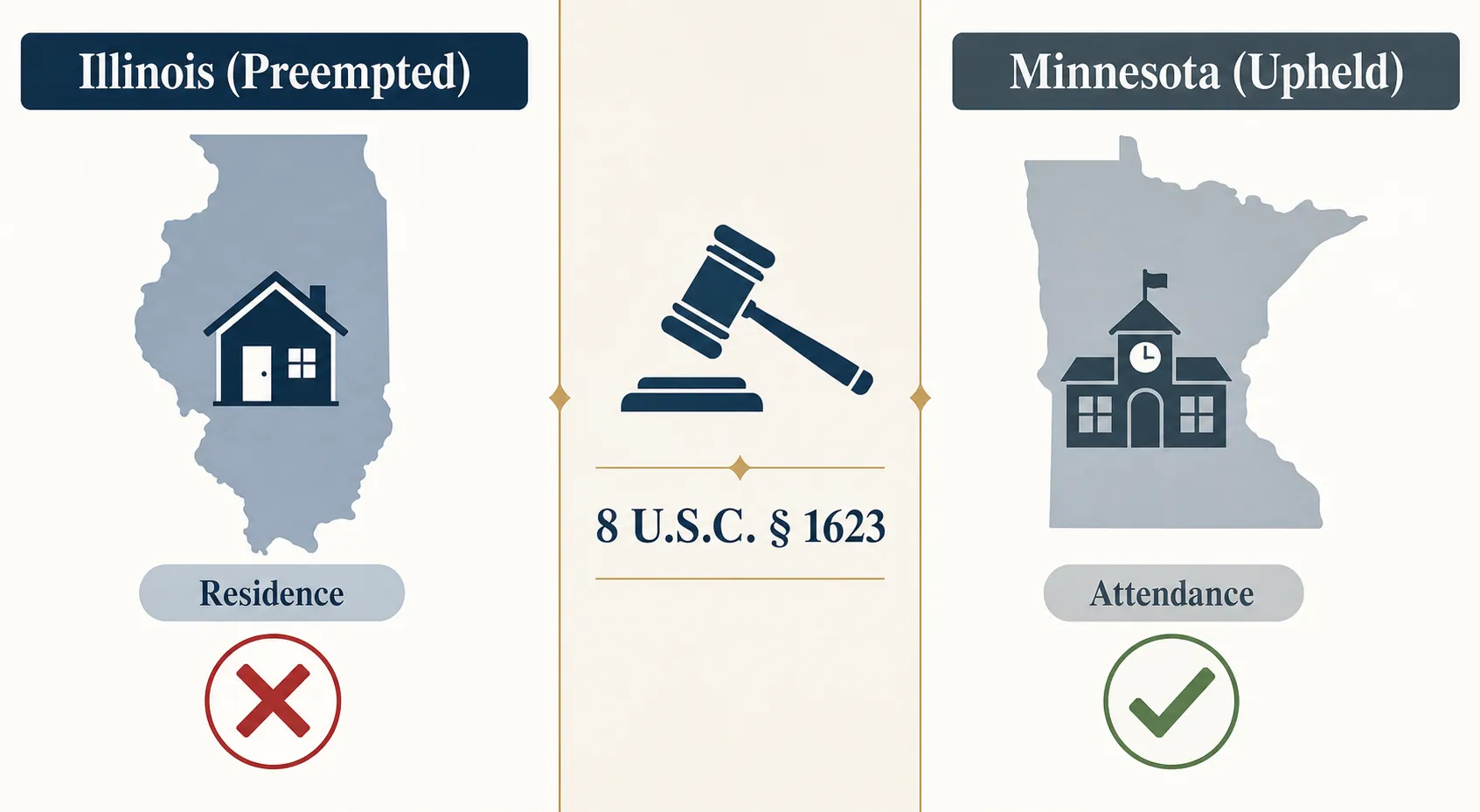
That is the legal distinction to watch. Illinois turns on residence-based eligibility and the requirement that all U.S. citizens receive the same benefit regardless of residence. Minnesota turns on an attendance-based eligibility theory: if the state defines the benefit by attendance at a Minnesota high school rather than by residence in Minnesota, the benefit is not necessarily one conferred “on the basis of residence.”[6]
| Issue | Illinois ruling | Minnesota ruling |
|---|---|---|
| Statutory hook | 8 U.S.C. § 1623 preempts residence-based postsecondary education benefits unless equally available to all U.S. citizens regardless of residence.[1][5] | Eligibility framed around high-school attendance did not trigger § 1623 in the same way.[6] |
| State program posture | HB 60, the RISE Act, and the Illinois DREAM Act were invalidated on summary judgment.[1][3] | The DOJ challenge was dismissed at the district-court stage.[6][7] |
| Appellate significance | Likely emergency posture in the Seventh Circuit because of the 14-day stay and fall billing calendar.[1] | Appeal status should be verified; available higher-education reporting described an appeal as likely after dismissal.[7] |
It is more precise to call this a cross-circuit district-court conflict than a mature court-of-appeals split. That precision matters. The Supreme Court does not need loose claims that it “will” take the case. The stronger point is that the Illinois and Minnesota rationales cannot comfortably coexist if appellate courts endorse both. One court’s reasoning makes residence the decisive statutory trigger; the other allows a state to avoid the trigger by structuring eligibility around high-school attendance.
If the Seventh Circuit moves quickly on Illinois and an Eighth Circuit appeal from Minnesota is confirmed and proceeds, the certiorari question becomes much easier to frame: what counts as a postsecondary education benefit granted “on the basis of residence” under § 1623?
The DOJ campaign is context, not the holding
The Illinois decision sits inside a broader Justice Department enforcement campaign against state tuition and financial-aid rules for unlawfully present students. Available reporting places the campaign at at least 11 lawsuits or related actions, with settlements reported in Texas, Kentucky, Oklahoma, and Nebraska; a DOJ merits win in Illinois; a DOJ loss in Minnesota; and pending or recent actions involving states including Virginia, California, New Jersey, Kansas, Massachusetts, Rhode Island, Maryland, and Colorado, with Colorado sued on July 23, 2026.[1][7]
That map is useful only if it is sorted by statutory architecture. A settlement may show enforcement pressure, but it does not resolve the meaning of § 1623. A dismissal may preserve a state program, but only on the eligibility theory actually before that court. The Illinois ruling is the clearest contested DOJ merits win identified in the available materials because it gives the federal government a summary judgment ruling on the preemption theory itself.[1]
| Risk category | Why it matters now |
|---|---|
| Residence-based tuition or aid rules | These are closest to the Illinois holding and should be reviewed first for § 1623 exposure. |
| Attendance-based rules | These have the Minnesota decision to cite, but the protection depends on whether attendance is genuinely the eligibility basis rather than a proxy for residence. |
| Settled jurisdictions | They show federal enforcement priorities but do not create controlling appellate law. |
| States facing new or pending actions | Their pleadings may reveal whether DOJ is targeting residence language, aid administration, scholarship structures, or all of them together. |
The appellate calendar is now the legal-risk calendar
The 14-day stay is the immediate pressure point. Counting from the July 24 ruling, the stay expires around August 7, 2026, absent further relief.[1] That date is uncomfortably close to fall semester billing, aid packaging, student account adjustments, and institutional communications. Universities and state agencies do not have the luxury of waiting for a clean Supreme Court posture before deciding what appears on a bill.
An emergency Seventh Circuit posture should be expected, but the specific relief sought will matter. A stay pending appeal would preserve the status quo while the appellate court considers the merits. A narrower administrative stay could buy only enough time for briefing. A denial would force Illinois to choose between the two reported compliance routes unless another court intervenes.
Minnesota is the other docket to verify. Inside Higher Ed reported after the March 27 dismissal that the Justice Department was likely to appeal, but the materials reviewed here did not confirm an Eighth Circuit docket entry.[7] That is not a minor housekeeping point. A confirmed Eighth Circuit appeal would put the attendance-versus-residence distinction on a second appellate track; without it, Minnesota remains persuasive conflict material rather than an active appellate counterpart.
- Check the Southern District of Illinois docket for the final order, injunction language, judge attribution, and any stay extension.
- Monitor the Seventh Circuit for emergency stay filings, briefing schedules, and any order that narrows or expands the district court’s remedy.
- Verify whether the Minnesota matter has been docketed in the Eighth Circuit before treating it as an active appellate conflict.
- Review state tuition, grant, and scholarship provisions for residence language, including provisions that use residency indirectly through eligibility forms or institutional guidance.
- Watch whether states revise programs toward attendance-based criteria before appellate courts settle the meaning of § 1623.
The Illinois DREAM Act ruling is therefore not just another filing in the DOJ campaign. It is the cleanest merits ruling so far for the federal government’s § 1623 theory, and it presents the contrast with Minnesota in the terms appellate courts can actually use: residence-based eligibility on one side, attendance-based eligibility on the other. Until the Seventh Circuit acts, and until Minnesota’s appellate status is confirmed, the safest posture is procedural watchfulness rather than prediction.
References
- IL can't give cheaper college tuition to illegal immigrants, judge rules, LegalNewsline / Madison-St. Clair Record
- United States v. Illinois, Civil Rights Litigation Clearinghouse
- Justice Department Files Complaint Challenging Illinois Laws Providing State Tuition and Scholarships to Illegal Aliens, DOJ Office of Public Affairs
- Legislation & Policies, Open Illinois / University of Illinois
- 8 U.S.C. 1623 - Limitation on eligibility for preferential treatment of aliens not lawfully present on basis of residence for higher education benefits, US House of Representatives
- Minnesota tuition benefit for undocumented residents upheld, Sahan Journal
- DOJ Loses Lawsuit Over Minnesota State Tuition Policies, Inside Higher Ed, March 30, 2026
Operationalizing workflow
No workflow has been explicitly linked to this obligation yet. See Workflows generally.
Illustrative cases
No illustrative case is currently tracked for this obligation. See Risk Digest for documented incidents generally.
← Back to RegulationReport a correction or tip
Spotted an outdated figure, a misstated fact, or a ruling this regulation entry should reflect? Public comments are disabled for this content given the professional cost of a misreported case outcome, penalty amount, or rule text — use the structured correction channel instead.
Report a correction or tip for this record →