
Illinois nuclear moratorium lift creates a multi-layered regulatory regime
- Authority
- Illinois General Assembly and Governor
- Rule type
- statute
- Jurisdiction scope
- US state
- Effective date
- Jun 1, 2026
- Source text
- Read primary rule text ↗
Comply with state administrative rules, ICC integrated resource plan, IPA procurement, executive order notice, NRC licensing, and environmental review
Illinois did not deregulate nuclear construction in 2026. It changed the legal work. The old state moratorium gave counsel a single threshold question: had the federal government established a permanent disposal solution for high-level nuclear waste? The new regime removes that state construction prohibition, but it leaves developers, utilities, large-load customers, counties, and agencies with a more crowded map: state administrative rules, Illinois Commerce Commission planning authority, Illinois Power Agency procurement implementation, a gubernatorial notice process, local land-use approvals, federal Nuclear Regulatory Commission licensing, environmental review, and the unresolved federal waste issue that made the 1987 moratorium politically durable in the first place.
That is the practical legal impact of Illinois lifting its nuclear moratorium in 2026. The Clean and Reliable Grid Affordability Act, Public Act 104-0458, creates legal possibility for new large nuclear development in Illinois. It does not create a clear path to construction.

The hinge: waste disposal, not general hostility to nuclear power
The prior Illinois moratorium is often described as a ban on new nuclear plants, but the more useful legal description is narrower. Since 1987, Illinois had conditioned new nuclear construction on the federal government identifying and approving a demonstrable technology or means for the disposal of high-level nuclear waste. That condition remained unsatisfied at the federal level when CRGA was signed, which is why the repeal matters without eliminating the waste issue as a legal and political vulnerability.[1]
CRGA, signed in January 2026 and effective June 1, 2026, repeals the prohibition on construction of new nuclear power reactors with nameplate capacity greater than 300 megawatts. It does so inside an omnibus energy statute running more than 1,000 pages, alongside provisions on battery storage, resource planning, virtual power plants, geothermal, labor, and procurement implementation.[1]
The political arc is relevant mainly because it explains why the statutory language should not be read as a casual technical cleanup. Gov. J.B. Pritzker vetoed an earlier nuclear-expansion bill in 2023, later signed a partial small modular reactor measure, and then signed the broader CRGA lift in January 2026. Illinois also enters this change from an unusual baseline: it already has 11 operating nuclear reactors and receives roughly 53% to 54% of its electricity from nuclear generation, more than any other state.[2]
The state prohibition is gone; the state process is not
For a developer or load-serving entity, the repeal of the greater-than-300 MW prohibition is only the first entry on the calendar. The state now has several procedural channels that can affect whether a project is timely, financeable, or even ripe for filing.
| State-level item | Practical significance |
|---|---|
| IEMA rulemaking completed in January 2026 | Creates the state administrative substrate that nuclear developers and counsel must verify against project design and filings. |
| CRGA effective June 1, 2026 | Marks the date on which the full statutory repeal and related energy provisions become operative. |
| Executive Order 2026-01 notice process | Requires a 60-day notice-of-intent process involving the IPA and ICC and developer disclosures before certain new nuclear development moves forward. |
| Inter-agency working group report | Requires a report to the governor within 120 days, creating an early state record on implementation and policy coordination. |
| First ICC integrated resource plan due November 15, 2026 | Gives the ICC a new planning forum that can influence procurement, reliability, affordability, and program amendments. |
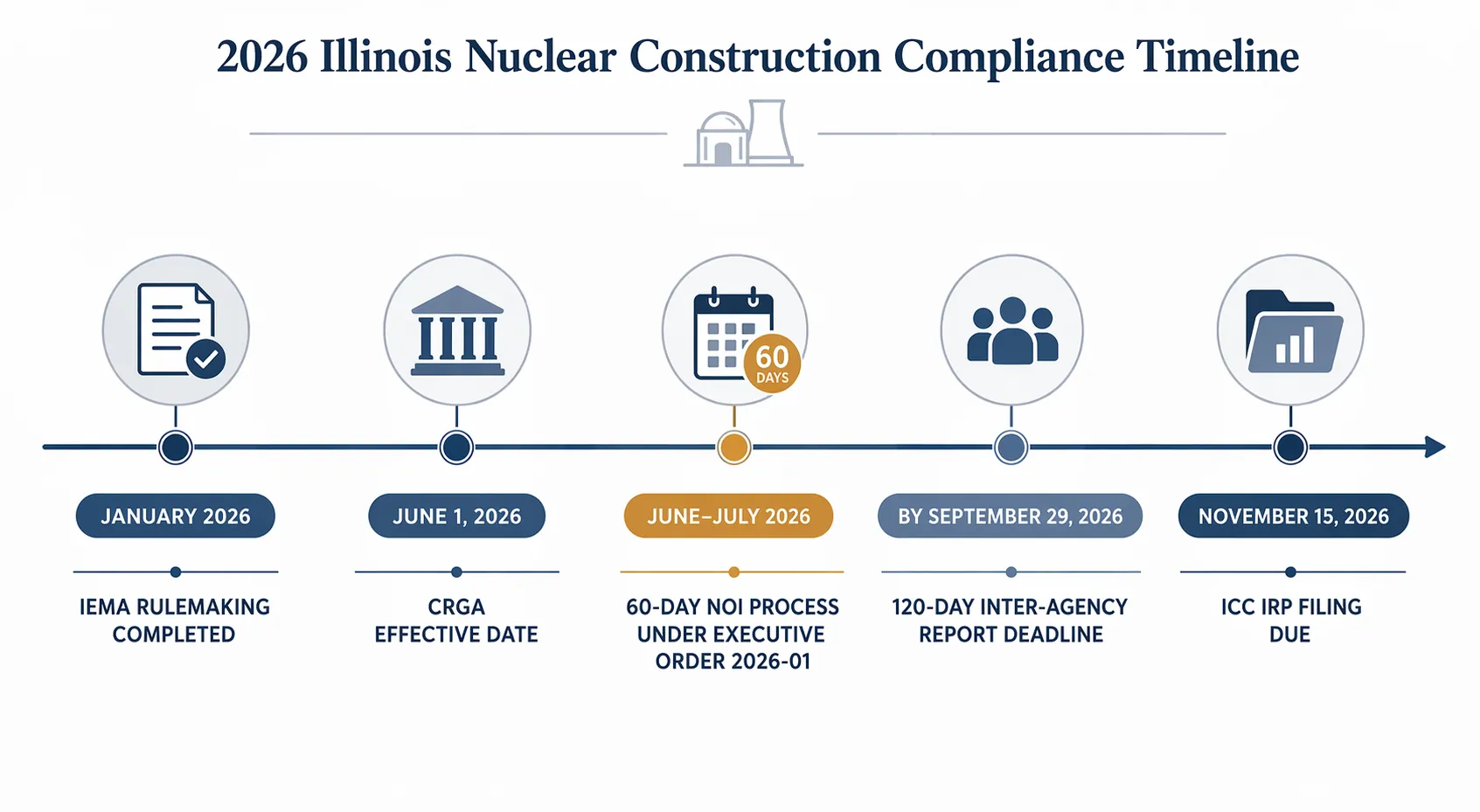
Executive Order 2026-01 is where the moratorium-lift story becomes less like a headline and more like a docket-management problem. The order sets a 2 GW nuclear development target, directs the IPA and ICC to create a 60-day notice-of-intent process, and requires developer disclosures across 14 categories. It also creates an inter-agency working group and requires a report to the governor within 120 days.[3]
Those disclosures are not a decorative exercise. A notice process creates a record. A record gives agencies a basis for conditions, comments, objections, and later arguments about whether a developer supplied enough information at the right time. Counsel tracking a potential Illinois nuclear project should treat the notice file as an early administrative record, not as a press-facing expression of interest.
CRGA also expands the ICC’s role through integrated resource planning. The first ICC IRP is due November 15, 2026, and the IPA’s implementation materials identify that deadline as part of the agency timeline for the new statute. The same implementation page also reflects the broader CRGA procurement context, including storage procurement deadlines of 1,038 MW by August 26, 2026 and 3 GW total.[4]
The nuclear provisions should therefore be read with the planning and procurement provisions nearby. A project may be legally allowed in the abstract, yet still shaped by ICC planning assumptions, IPA procurement design, reliability findings, rate impacts, labor conditions, and agency views about how nuclear fits with storage and renewable-resource obligations. That is not the same as a construction ban, but it is also not a neutral empty field.
Federal licensing remains the main gate for actual construction
Nothing in CRGA authorizes a nuclear reactor to be built without NRC approval. Illinois can remove a state-law prohibition; it cannot displace the federal licensing regime for civilian nuclear facilities. Depending on technology and application posture, counsel still has to analyze the NRC route under Part 50 for traditional licensing, Part 53 for advanced and small modular reactors, or Part 57 for microreactors.
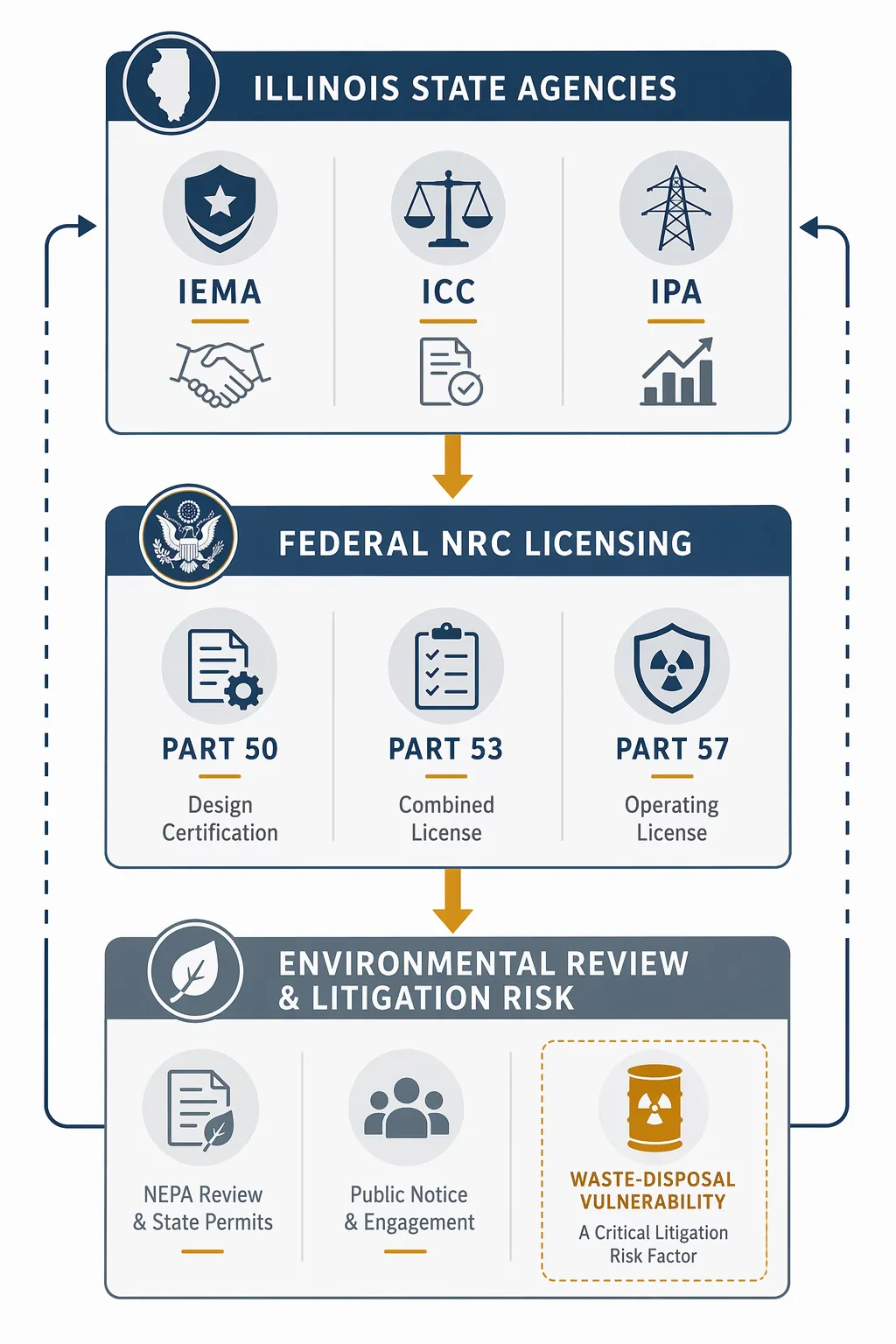
Part 53 deserves particular attention because it became effective April 29, 2026, just weeks before CRGA’s June 1 effective date. Reuters reported that the NRC rolled out reforms intended to accelerate small-reactor licensing, while also noting concerns tied to staff reductions at the agency under the Trump administration. That distinction matters: a new licensing pathway and an agency reform program are not the same thing as a reduced legal standard or a guaranteed faster approval for any particular applicant.[5]
For Illinois matters, the most important practical question is sequencing. A developer may have to coordinate state notice requirements, local zoning or siting steps, environmental studies, grid-interconnection work, procurement eligibility, and NRC application strategy before any single body has a full record. A premature filing may invite deficiency letters or local resistance. A delayed filing may lose queue position, procurement timing, or political momentum.
Waste disposal remains the latent litigation handle
The unresolved federal waste-disposal problem did not disappear when Illinois repealed the old statutory condition. It changed form. Before CRGA, the waste issue operated as a direct state-law precondition to new construction. After CRGA, it is more likely to appear in administrative comments, environmental objections, local siting disputes, procurement challenges, or arguments about whether state agencies adequately considered long-term waste, decommissioning, security, and cost allocation.
That does not mean a successful lawsuit is pending or inevitable. The available sources reviewed for this article did not identify an environmental-group lawsuit specifically challenging CRGA or Executive Order 2026-01. The risk is narrower: public opposition and the historic waste premise give challengers a subject matter around which to build comments and preserve issues.
Some opposition also runs through the shape of CRGA itself. The Illinois Policy Institute argued that Illinois lifted the nuclear ban while tightening state control over energy supply through expanded planning and regulatory authority.[6] Environmental advocates quoted in IPM Newsroom coverage sought a role in the moratorium-lift implementation process and raised concerns about nuclear waste, cost, and process.[7]
Those positions are not interchangeable. A market-oriented critique of expanded state planning is not the same as an environmental critique of waste and safety. But both can matter in the same proceeding if they converge on agency authority, adequacy of findings, disclosure sufficiency, ratepayer exposure, or whether a decision-maker has moved faster than the record supports.
Two early proceedings are worth watching, but neither proves the path is clear
The first useful state-level markers are likely to come from concrete filings rather than statewide speeches. Constellation’s rezoning requests near Byron are important for that reason. A zoning matter is not an NRC licensing decision, but it can show how local bodies frame land-use compatibility, economic-development claims, public opposition, emergency planning, and record-building around potential nuclear expansion in a state whose moratorium has just been lifted.
The federal marker is the University of Illinois Urbana-Champaign and Nano Nuclear Energy Kronos MMR application. Nuclear Newswire reported that the application, submitted in April 2026, is the first Part 53 construction permit application. Its procedural importance is substantial because it tests the new advanced-reactor licensing pathway soon after Part 53 became effective. It is not evidence that the NRC will approve the project, approve it quickly, or treat later Illinois applicants the same way.[8]
For counsel, the point is not to turn either matter into a forecast. The useful work is more modest: collect pleadings, deficiency notices, agency questions, public comments, staff reports, zoning conditions, and scheduling orders. Early documents often reveal which arguments become routine and which ones surprise decision-makers.
What should be tracked in Q3 2026
By Q3 2026, the relevant work is calendar discipline. A nuclear project team considering Illinois should not treat “moratorium lifted” as a green light. It should maintain a matter-specific tracker that separates state-law eligibility, executive-order notice obligations, local approvals, NRC licensing status, environmental review, procurement or planning relevance, and litigation risk.
- Verify the CRGA effective provisions against the enrolled act and any agency implementation updates before relying on a filing assumption.
- Track the Executive Order 2026-01 notice-of-intent process, including what the IPA and ICC require from developers during the 60-day window.
- Monitor the inter-agency working group report for positions that agencies may later treat as implementation baselines.
- Prepare for the November 15, 2026 ICC IRP filing as a planning record that may influence later procurement, reliability, and affordability findings.
- Follow NRC Part 53 practice closely, especially the treatment of first-wave advanced-reactor applications and any staffing or review-timeline constraints.
- Preserve the distinction between public opposition, filed litigation, and legally cognizable claims; the first two are not the same thing.
The Illinois moratorium lift creates a new legal opening in a state that already knows nuclear power. It also moves the pressure from one statutory condition into several procedural systems. The first serious answers will come from agency implementation, local records, NRC review practice, and the way opponents and developers use the waste-disposal issue now that it is no longer the state’s threshold bar.
References
- Illinois Governor Signs Wide-Ranging Illinois Energy Legislation Addressing Battery Storage, Nuclear Power, Renewables, and More, Quarles
- Illinois lifts moratorium on new large nuclear reactors, AP News
- Executive Order 2026-01, State of Illinois
- Clean and Reliable Grid Affordability Act, Illinois Power Agency
- NRC rolls out reforms to accelerate small reactor licensing, Reuters, May 26, 2026
- Illinois lifts nuclear ban but tightens grip on energy supply, Illinois Policy Institute
- Clock ticks on lifting Illinois nuclear moratorium as environmental groups want a say, IPM Newsroom
- Illinois lifts moratorium on new large nuclear reactors, ANS Nuclear Newswire, January 9, 2026
Operationalizing workflow
No workflow has been explicitly linked to this obligation yet. See Workflows generally.
Illustrative cases
No illustrative case is currently tracked for this obligation. See Risk Digest for documented incidents generally.
← Back to RegulationReport a correction or tip
Spotted an outdated figure, a misstated fact, or a ruling this regulation entry should reflect? Public comments are disabled for this content given the professional cost of a misreported case outcome, penalty amount, or rule text — use the structured correction channel instead.
Report a correction or tip for this record →