
Is Indiana's Campaign Finance Law a Haven for AI Dark Money?
- Authority
- Indiana General Assembly
- Rule type
- statute
- Jurisdiction scope
- US state
- Effective date
- Jan 1, 2023
- Source text
- Read primary rule text ↗
No contribution limits, no super PAC donor transparency, donor privacy law limits nonprofit donor data disclosure.
For a lawyer trying to monitor AI-industry political money in Indiana during the 2026 election cycle, the first problem is not ideology or prediction. It is visibility. National AI and Big Tech political spending is now documented at a scale that makes it a live compliance concern. Indiana-specific AI political spending, however, has not been isolated in the available public materials. That distinction matters: the better-supported conclusion is that Indiana’s campaign finance framework leaves counsel with unusually few tools to trace such spending if it occurs.
This is sourced analysis for regulatory and ethics monitoring, not legal advice. The question behind “dark money campaign finance law Indiana 2026” is operational: what can a compliance professional actually see, document, and escalate under Indiana’s current rules?

Indiana’s problem is not merely low transparency; it is missing monitoring points
The Coalition for Integrity’s State Campaign Finance Index is dated, but still central to the Indiana analysis because it remains the only comprehensive cross-state transparency ranking identified in the available materials. In that 2022 index, Indiana ranked 50th, with a score of 38.33 out of 100.[1] A stale ranking would usually deserve only passing weight. Here it deserves more because the later legislative record does not show the state curing the relevant defects before the 2026 cycle.
The ranking matters less as a reputational label than as a checklist of missing controls. The index identified Indiana as having no individual contribution limits, no PAC contribution limits, and no super PAC donor transparency.[1] Those are not abstract weaknesses. They remove the ordinary points where counsel would expect to set alerts, compare donor names, track ceiling pressure, or explain why a contribution pattern was legally significant.
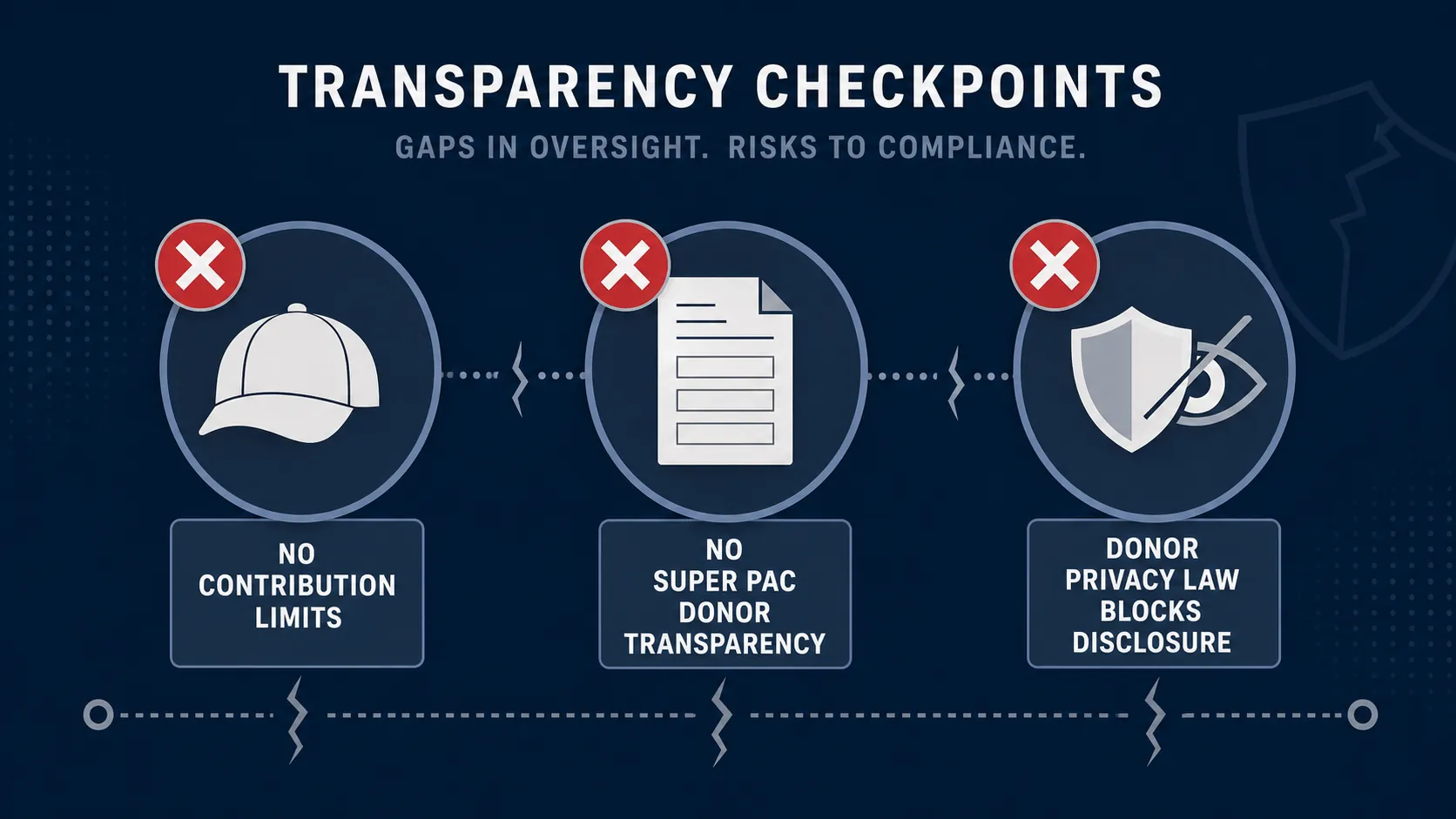
A contribution limit is not only a cap. It is also a compliance signal. When a state imposes a ceiling, the filer, the recipient, the regulator, and outside reviewers all have a number around which scrutiny can organize. Without that ceiling, one common review question disappears: whether a donor, entity, or affiliated group is approaching or exceeding a legal limit. That does not make every large contribution suspicious. It means the law supplies fewer tripwires.
The super PAC donor-transparency gap is more direct. If an AI executive, investor network, trade association, nonprofit, or intermediary supports an independent-expenditure vehicle, the central compliance question is not simply whether the spending is independent. It is whether the funding source can be traced with enough confidence to document exposure. The Coalition for Integrity index says Indiana lacks super PAC donor transparency.[1] That is the point at which a routine monitoring exercise can become a dead end.
| Monitoring question | What counsel would normally look for | Indiana gap identified in the available materials |
|---|---|---|
| Is a donor near or over a legal ceiling? | Contribution limits and aggregate tracking | No individual or PAC contribution limits identified by the Coalition for Integrity index |
| Who funded the independent-expenditure vehicle? | Donor disclosure for super PACs or equivalent committees | No super PAC donor transparency identified by the Coalition for Integrity index |
| Can nonprofit donor information be required or disclosed by state or local government? | Government access to, or disclosure of, nonprofit donor data where legally authorized | Indiana’s 2023 donor privacy law bars state and local governments from requiring or disclosing nonprofit donor data |
Why AI money makes the gap harder to treat as theoretical
The national AI political-money environment changed the practical risk calculation for 2026. CNBC reported in July 2026 that Leading the Future had raised $125 million and had spent more than $44 million by the end of the second quarter of 2026 across 40 House and Senate races. CNBC also reported Public First Action at more than $80 million.[2] Those figures do not prove an Indiana AI dark-money campaign. They do show that AI-aligned political spending is no longer too speculative to include in state-level political-risk diligence.
Public Citizen’s 2026 corporate-sector analysis points in the same direction, but with a different scope. It reported $517 million in corporate election spending for 2026 and identified AI/Big Tech at $60 million, crypto at $189 million, and online betting at $46 million; together, those categories accounted for 57% of the total corporate contributions in that analysis.[3] That is not the same dataset as CNBC’s reporting on Leading the Future and Public First Action, and the numbers should not be added together as though they measure one pot of money. They are separate indicators that high-stakes technology sectors are spending heavily in the 2026 cycle.
The Brennan Center’s May 2026 money-in-politics roundup supplies the broader dark-money context, again at a national level rather than as Indiana-specific proof.[4] For compliance purposes, the value of that context is limited but real. It helps explain why a state with weak donor visibility should not be evaluated as if all relevant political money will appear in a clean, name-matched public filing.
The careful formulation is exposure plus poor monitorability. AI political spending is documented nationally. Indiana’s campaign finance transparency tools are unusually weak. The available materials do not isolate Indiana-specific AI spending, and they do not show that a named AI super PAC secretly targeted Indiana. A competent memo should say exactly that.
The 2023 donor privacy law narrows another route to visibility
Indiana’s donor privacy law adds a separate visibility problem. As of Q3 2026, Indiana’s 2023 donor privacy law should be treated as part of the state’s operative legal environment. Indiana Capital Chronicle reported in April 2023 on legislation barring state and local governments from requiring or disclosing nonprofit donor data.[5] That matters because nonprofit entities are a common concern in dark-money analysis: they may participate in advocacy ecosystems without presenting the same donor trail that a compliance team would want for source-of-funds review.
This point should not be overstated. A donor privacy law is not itself evidence of unlawful spending, and nonprofit donor privacy arguments are not automatically illegitimate. The compliance problem is narrower: when state or local government is barred from requiring or disclosing nonprofit donor data, counsel loses another possible source for reconstructing who financed a political message, pressure campaign, or independent expenditure.
In a stronger disclosure system, a risk officer might still have alternative records to compare: committee filings, donor reports, contribution caps, independent-expenditure disclosures, state enforcement files, or nonprofit-related disclosures where law permits them. Indiana’s framework leaves fewer places to look. The result is not just less information for the public; it is less defensible diligence for the person who has to sign the file.
No 2026 reform fix appears in the record
The reason the 2022 index remains useful in Q3 2026 is not that old rankings should be treated as permanent. It is that the available legislative update does not show a material repair. Common Cause Indiana’s 2026 Legislative Review reported that reform bills did not advance and that HB1256 died in the Senate.[6] On this record, there is no basis to tell a client that Indiana has since added the missing transparency mechanisms identified in the Coalition for Integrity index.
That is the practical hinge. If a state ranked poorly in 2022 but later enacted donor transparency, contribution limits, or comparable reporting reforms, the old index would be mostly historical. The 2026 legislative review points the other way: the relevant weaknesses remain part of the compliance landscape for the current cycle.[6]
What can actually be monitored
Counsel can still monitor public filings that Indiana law requires, federal filings where federal committees are involved, public independent-expenditure reports where available, vendor records available to the client, public advertising libraries, press reports, and voluntary disclosures. Those sources may be useful. They should not be described as equivalent to a donor-transparency regime that Indiana does not have.
A workable 2026 monitoring file for Indiana should separate three categories:
- Confirmed records: filings, expenditures, donor information, contracts, or public statements that can be tied to a specific entity or transaction.
- National exposure indicators: documented AI, Big Tech, corporate, or dark-money spending outside Indiana-specific proof, including the CNBC, Public Citizen, and Brennan Center materials.
- Unresolved visibility gaps: funding sources that cannot be traced because Indiana does not supply the relevant disclosure mechanism or because nonprofit donor information is shielded.
That separation prevents a common mistake: importing national PAC data into an Indiana memo and implying a state-level finding the records do not support. It also prevents the opposite mistake: treating the absence of Indiana-specific AI spending data as proof that there is no meaningful risk. In a low-visibility jurisdiction, absence of evidence often means only that the available records are thin.
Is Indiana a haven for AI dark money?
“Haven” is a strong word if it implies proven, active concealment by a specific AI donor or PAC in Indiana. The available materials do not establish that. They establish something more limited and more useful for compliance: Indiana is a regulatory blind spot for AI-industry political spending in the 2026 cycle because its campaign finance framework lacks the transparency mechanisms counsel would need to trace that spending with confidence.
The state’s last-place transparency score, absence of individual and PAC contribution limits, lack of super PAC donor transparency, donor privacy law, and failure to advance 2026 reforms all point in the same operational direction.[1][5][6] National AI and corporate-sector spending data makes that weakness relevant now, but it does not fill the Indiana-specific evidentiary gap.[2][3][4]
The appropriate 2026 posture is therefore disciplined rather than dramatic: document Indiana’s state-law limitations, do not overclaim from national AI PAC numbers, and treat standard disclosure-based diligence as unreliable where the legal framework does not create an auditable trail.
References
- State Campaign Finance Index 2022, Coalition for Integrity, 2022.
- What AI companies want for the millions they’re spending on elections, CNBC, July 2026.
- Corporate Supremacist Super PACs Drive $500 Million Midterm Spending Surge, Public Citizen.
- Money in Politics Roundup, Brennan Center for Justice, May 2026.
- Indiana donor privacy law reporting, Indiana Capital Chronicle, April 2023.
- 2026 Legislative Review, Common Cause Indiana, 2026.
Operationalizing workflow
No workflow has been explicitly linked to this obligation yet. See Workflows generally.
Illustrative cases
No illustrative case is currently tracked for this obligation. See Risk Digest for documented incidents generally.
← Back to RegulationReport a correction or tip
Spotted an outdated figure, a misstated fact, or a ruling this regulation entry should reflect? Public comments are disabled for this content given the professional cost of a misreported case outcome, penalty amount, or rule text — use the structured correction channel instead.
Report a correction or tip for this record →