
Can International Law Block the US-Israel Military Merger?
- Authority
- International Court of Justice
- Rule type
- standing order
- Jurisdiction scope
- US federal
- Effective date
- May 24, 2024
- Source text
- Read primary rule text ↗
Exercise due diligence to prevent genocide
The legal implications of AOC opposing the US-Israel military merger do not turn on whether Section 219 is a treaty in disguise or whether Congress may condition appropriations. International law adds a separate risk framework, but not a clean litigation answer. The Genocide Convention, the International Court of Justice’s provisional measures in South Africa v. Israel, and the Arms Export Control Act all give counsel reasons to treat the provision as more than ordinary defense cooperation. None of them, as of Q3 2026, supplies controlling US precedent that would automatically block the language if Congress enacts it.
That distinction matters. A lawyer asked to review Section 219 before final NDAA language is settled would not responsibly write, “international law makes this illegal” and stop there. The better memo would identify three different layers of exposure: a treaty-based duty to prevent genocide, a domestic statutory limit on the use of US defense articles, and a narrower biotechnology concern arising from cooperation with a state outside the Biological Weapons Convention.

The treaty question starts with prevention, not punishment
The strongest international-law objection to Section 219 is not that the United States would instantly become a party to Israel’s conduct in Gaza by authorizing deeper cooperation. It is that Article I of the Genocide Convention obliges state parties to prevent genocide, and a structural integration program can make prevention harder to cabin if the partner state is already operating under a serious risk finding.
Amnesty International USA made that point directly in its June 22, 2026 call for Congress to remove Section 219 from the NDAA. It argued that “the risk is clear” that US military and security support to the Israeli government would be used to commit genocide, crimes against humanity, and war crimes, and tied that warning to the proposed integration and co-production language rather than to a single arms package alone.[1]
The ICJ materials sharpen the due-diligence problem. In the January 2024 provisional measures phase of South Africa v. Israel, the Court found a plausible risk of genocide; in May 2024, it ordered Israel to take immediate and effective measures to enable urgently needed basic services and humanitarian assistance.[1] Those orders do not put the United States in the same procedural posture as Israel. The case is not a direct judgment against the United States, and the ICJ’s provisional measures bind Israel in that dispute.
Still, the orders are difficult to ignore in a risk memo. Article I’s prevention obligation is concerned with foreseeable risk. If Congress authorizes more integrated planning, co-production, data sharing, or weapons development after a competent international tribunal has identified a plausible genocide risk, the question becomes whether US officials took reasonable steps to avoid facilitating prohibited conduct. That is a due-diligence question, not a magic word that converts every cooperation channel into complicity.
This is where advocacy force and justiciable force separate. The ICJ orders are powerful evidence for opponents who argue that Congress should not deepen military integration. They are much less certain as a basis for a US court to enjoin Section 219. No US federal court has held that the Genocide Convention creates a self-executing bar against this kind of cooperation, and the Supreme Court has not treated Article I as creating a private cause of action that would let plaintiffs block Congress’s defense legislation on that theory.
That does not make the argument merely symbolic. Institutional legal risk often appears before a court supplies a remedy. A program can be lawful enough to pass an immediate justiciability screen and still be hazardous enough to require narrowing language, reporting conditions, end-use restrictions, or a carveout for operations connected to Gaza. Section 219 sits in that uncomfortable space.
AECA gives the objection a domestic statutory hook
The Arms Export Control Act matters because it translates an international-law concern into a US-law compliance question. Sections 3 and 4 are used by opponents to argue that US defense articles and services may be supplied only for limited purposes, including internal security and legitimate self-defense. If a partner’s use of US-origin weapons is alleged to fall outside those purposes, the objection is no longer only about the Genocide Convention. It becomes an argument about statutory authorization.
The argument runs this way: ICJ proceedings, humanitarian conditions in Gaza, and documented human-rights concerns make it unsafe for Congress to assume that deeper US-Israel integration would support only legitimate self-defense. If Section 219 enables co-production or shared military development that predictably feeds operations alleged to violate international law, opponents say the AECA’s limiting language should constrain the program before implementation, not merely after misuse is proven.
That is the most practical route for lawyers who need more than a moral objection. AECA analysis can be written into oversight letters, end-use monitoring demands, Joint Resolutions of Disapproval, committee reports, and appropriations conditions. It also speaks the language executive-branch lawyers already use: authorization, purpose, recipient assurances, end-use, suspension, and waiver.
But the enforceability problem remains. US courts have not used the AECA to block a structural military integration provision of this kind. Arms-transfer disputes are often treated as heavily committed to the political branches, and executive interpretation usually carries substantial practical weight. A court may be reluctant to decide whether Israel’s conduct satisfies “legitimate self-defense” in the middle of contested foreign-policy and military judgments.
The Sanders Joint Resolutions of Disapproval in the 119th Congress illustrate the procedural channel, not a final legal victory. The same is true of H.R. 3565, the Block the Bombs Act, which Amnesty International USA described as having 75 bipartisan co-sponsors as of June 2026 and as proposing a partial arms embargo.[1] Those measures show how international-law and AECA arguments enter congressional machinery. They do not prove that a court would treat Section 219 as unlawful.
The co-sponsor count should be checked against Congress.gov before publication. Legislative tallies move, and the legal significance of the bill does not depend on freezing a June 2026 number as if it were jurisdictional fact.
The unsettled NDAA posture keeps the analysis conditional
As of July 24, 2026, the final NDAA language is not settled. The House passed H.R. 8800 on July 22, 2026, by a 216-212 vote, while a Senate motion to proceed on S. 4784 failed on July 14, 2026, by a 50-46 vote. Those facts matter less because of the vote margins than because they keep Section 219 in drafting territory. Counsel still has to speak conditionally: if the final provision retains the integration language, then the international-law and AECA issues should be addressed before implementation.
That timing also explains why opposition from members such as Alexandria Ocasio-Cortez should not be reduced to political branding. For lawyers, the useful question is not whether a member’s position is ideologically predictable. It is whether the objection points to a statutory or treaty-based risk that could alter drafting, reporting, certification, or funding conditions.
A broader constitutional account belongs elsewhere. The treaty-clause and appropriations concerns are real, but they answer a different question: who has authority to bind the United States and spend money. The international-law objection asks whether, even assuming Congress may legislate, the United States is increasing its exposure under treaty duties and arms-control statutes. For that broader domestic-law context, see Three Tests of Congress’s Authority Over Israel Aid.
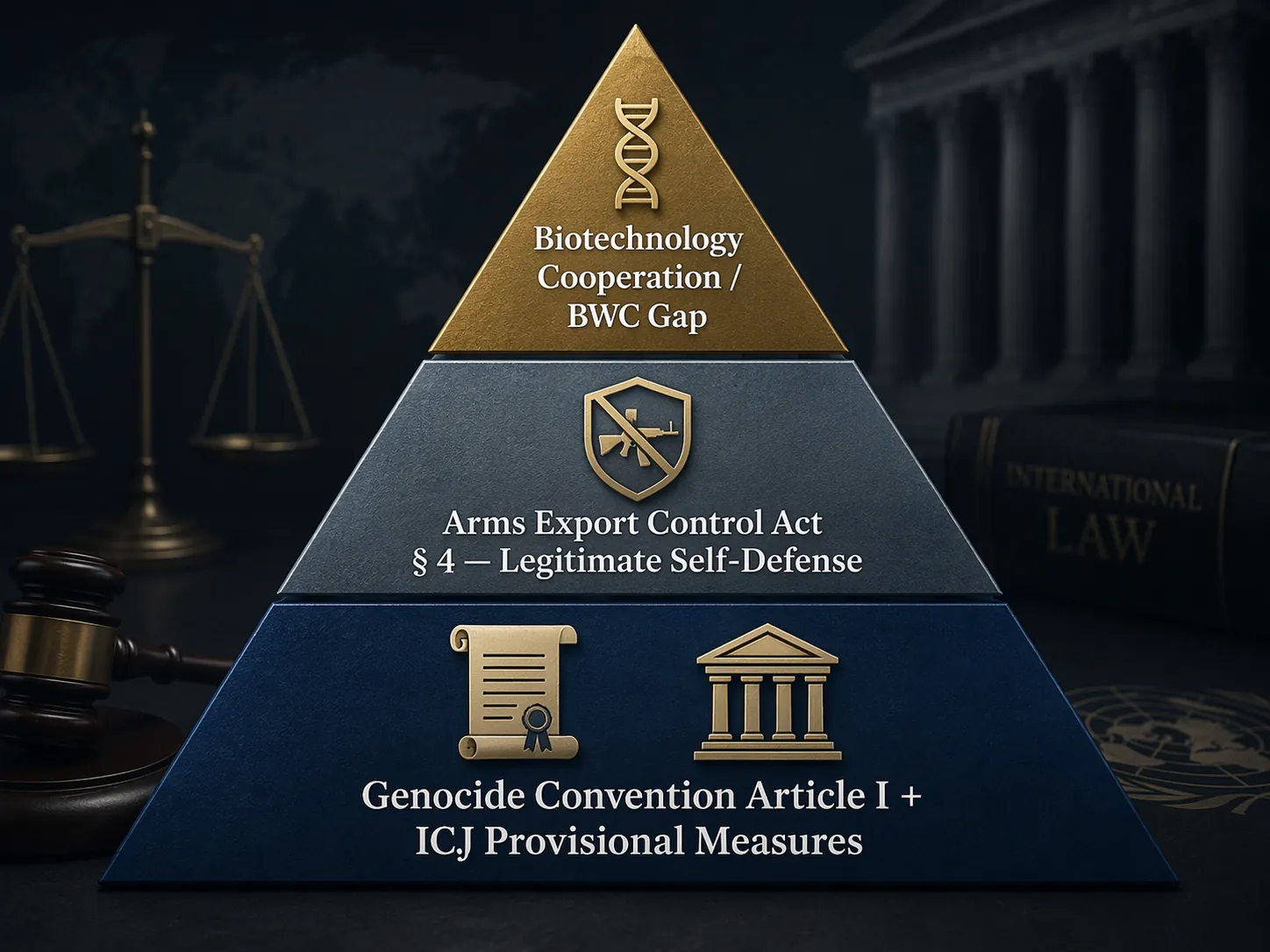
Biotechnology is a narrower but sharper multiplier
The biotechnology provision should not carry the whole argument against Section 219, but it changes the texture of the risk. A New Policy’s section-by-section analysis states that Section 219 extends collaboration to biotechnology with Israel, and notes that Israel has neither signed nor ratified the Biological Weapons Convention.[2]
That fact does not mean the program is a biological-weapons program. It does mean the provision is harder to characterize as routine military cooperation if the final text authorizes biotechnology collaboration without tight limits, transparency, or safeguards. Cooperation with a BWC non-party raises different questions from procurement, training, or conventional weapons co-production. The concern is not only what the program is intended to do, but what legal architecture exists if research, data, or dual-use capabilities move through it.
The claim remains legally untested. There is no identified precedent using BWC non-party status to block a Department of Defense cooperative program. Nor does the available material establish that Section 219 would authorize prohibited biological activity. The prudent conclusion is narrower: biotechnology collaboration with a non-party to the BWC increases the need for statutory boundaries and compliance review, especially when layered on top of Genocide Convention and AECA concerns.
What counsel can responsibly put in the risk register
A careful risk register would not treat Section 219 as automatically void under international law. It would identify several points that require attention before final enactment or implementation.
- Genocide Convention risk: Article I creates a prevention duty, and the ICJ’s provisional measures make continued or deeper military cooperation harder to defend without documented due diligence.
- ICJ posture risk: the orders bind Israel in South Africa v. Israel, not the United States as a direct respondent, so the US legal issue is facilitation, complicity, and prevention rather than direct noncompliance with the orders.
- AECA risk: the legitimate self-defense limitation gives opponents a domestic statutory hook, but courts have not used it to block a structural integration provision.
- Biotechnology risk: collaboration with a BWC non-party is a novel multiplier that supports tighter drafting, not a settled prohibition.
- Legislative-process risk: because final NDAA language remains unsettled, risk assessment should track the enacted text rather than assume every draft phrase survives conference or amendment.
The most useful drafting response would be concrete. Congress could remove the provision, narrow it to non-operational research, require certifications under the AECA, exclude support connected to operations subject to credible genocide-risk allegations, impose reporting obligations, or delay implementation pending end-use and international-law review. Those choices belong to lawmakers, but they are the kinds of choices a legal-risk analysis can make visible.
For related analysis of Section 219’s data-fusion and IHL dimensions, see US-Israel Military AI Merger Creates New International Law Risks. The Genocide Convention and AECA issues do not replace that analysis; they add a separate reason to resist treating the provision as ordinary defense modernization.
The answer, then, is yes but limited. International law can support opposition to the US-Israel military integration provision and should be weighed seriously by congressional and executive counsel. It is not, on the present record, a settled court-enforceable blockade. Section 219 is better described as a legal-risk problem whose seriousness comes from the accumulation of treaty, statutory, and arms-control hooks, not from any one authority already doing all the work.
References
- Congress Must Oppose U.S.-Israel Military Integration and Co-Production, Amnesty International USA, June 22, 2026.
- Section 224 NDAA, A New Policy.
Operationalizing workflow
No workflow has been explicitly linked to this obligation yet. See Workflows generally.
Illustrative cases
No illustrative case is currently tracked for this obligation. See Risk Digest for documented incidents generally.
← Back to RegulationReport a correction or tip
Spotted an outdated figure, a misstated fact, or a ruling this regulation entry should reflect? Public comments are disabled for this content given the professional cost of a misreported case outcome, penalty amount, or rule text — use the structured correction channel instead.
Report a correction or tip for this record →