
Are magic mushrooms illegal in Japan? Penalties explained
- Authority
- Ministry of Health, Labour and Welfare (Japan)
- Rule type
- statute
- Jurisdiction scope
- Japan
- Effective date
- Jul 23, 2026
- Source text
- Read primary rule text ↗
Possession of psilocybin/psilocin-containing mushrooms, truffles, or products is illegal; novel hallucinogen analogs may be controlled as designated substances.
Regulation & Ethics record. Last verified: August 2, 2026, UTC. This is a foreign-jurisdiction legal-risk summary for research and compliance use, not legal advice for any individual case.
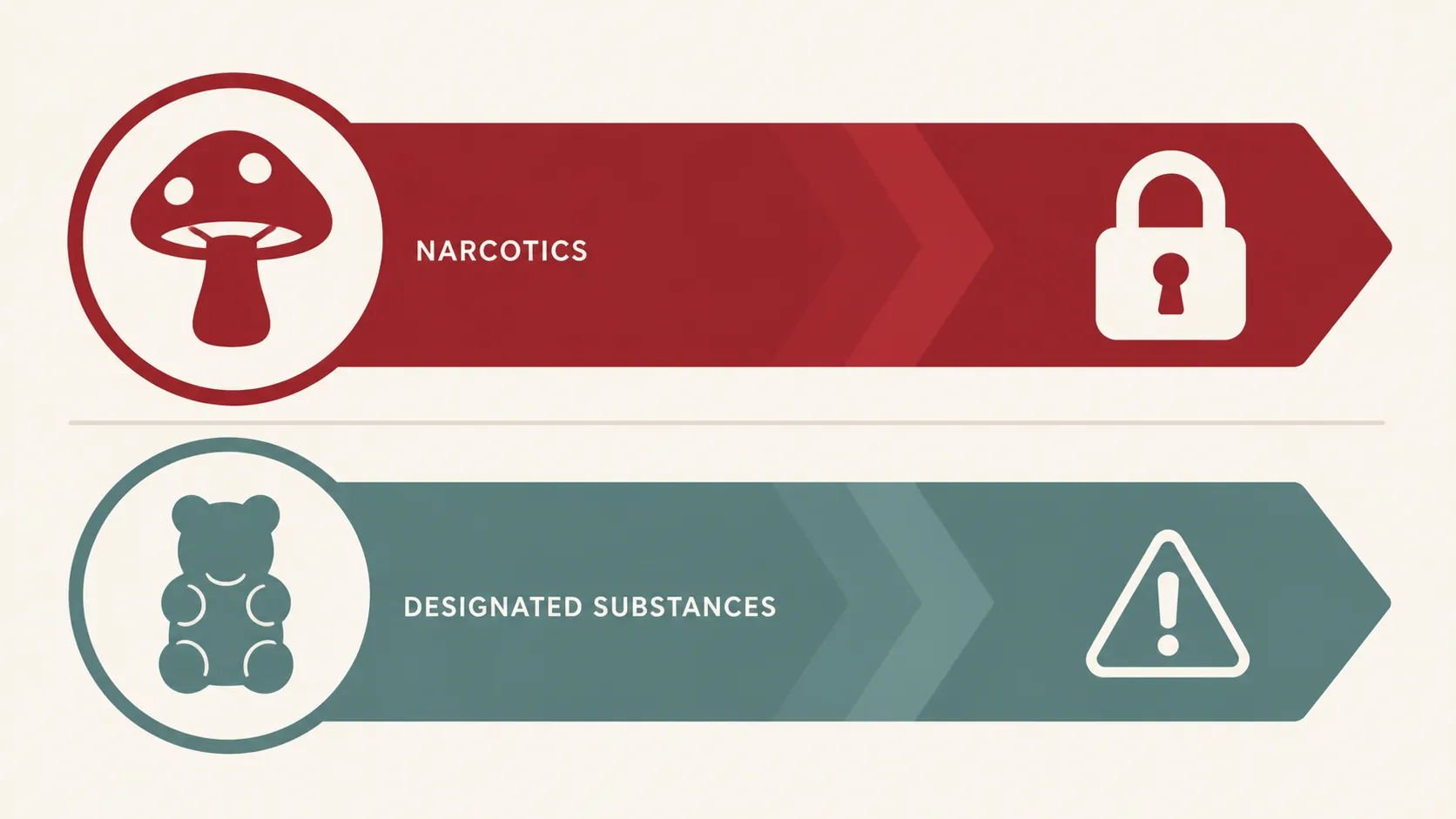
Yes. Magic-mushroom possession is illegal in Japan when the product contains psilocybin or psilocin. The more useful answer is narrower: Japanese exposure is set by the compound, not by the retail name. A dried mushroom, a “truffle,” a capsule, or another product containing psilocybin or psilocin is treated on the narcotics track. A hallucinogenic gummy or other product built around a newer analog may sit on the separate designated-substances track unless and until the compound is routed into the narcotics schedule.
The freshest legal anchor is the July 23, 2026 ruling from the Naha branch of the Fukuoka High Court. In upholding a U.S. sailor’s sentence over magic truffles mailed to Japan, the court rejected the defense argument that the truffles themselves were not illegal and stated that “both psilocybin and psilocin are substances defined as narcotics.” The significance is not just that the isolated chemicals are listed. The ruling confirms the product-level point that ordinary explainers often blur: mushrooms or truffle-like products containing those compounds fall within the narcotics treatment too.[1]
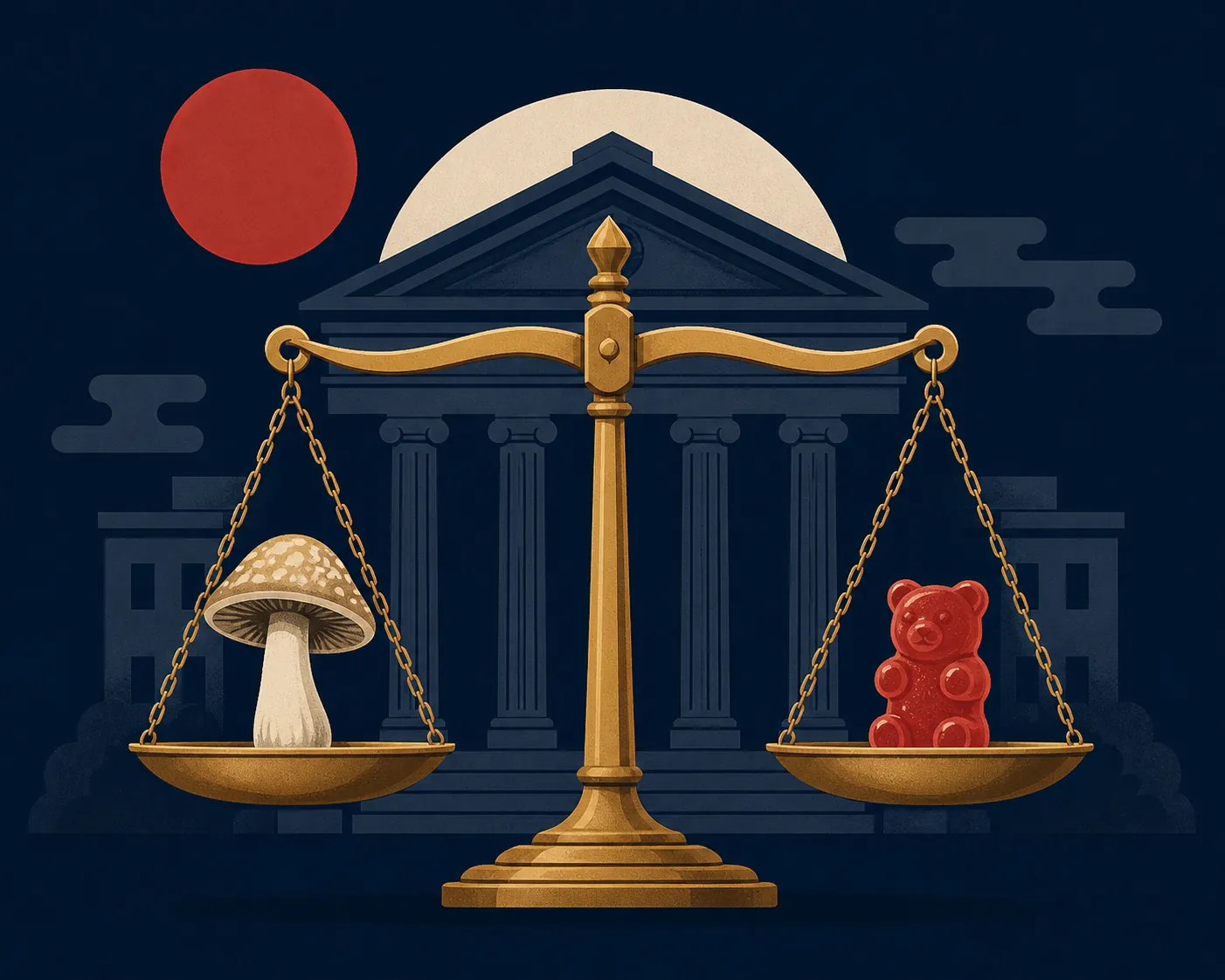
The operative category is chemical content
“Magic mushroom” is not the statutory category that decides the penalty. The Ministry of Health, Labour and Welfare’s Narcotics Control Department lists Psilocin and Psilocybin under the Narcotics and Psychotropics Control Law in its controlled-substances list dated December 12, 2024.[2] The English translation of the Narcotics and Psychotropics Control Act supplies the statutory framework for narcotics control, but the schedule listing does the more practical classification work for this question.[3]
That distinction matters because consumer labels are legally noisy. “Truffles” may be marketed as something different from mushrooms. Gummies may contain a scheduled compound, a newly appearing analog, or a compound that has not been confirmed in the public record. For Japan, the first classification question is not whether the item looks like a mushroom or a candy. It is whether the item contains psilocybin, psilocin, or another controlled compound.
What the 2026 sailor case adds
The 2026 case is useful because it turns the classification issue into a litigated point. The defendant was not simply accused of possessing a lab vial labeled psilocybin. The reported facts involved magic truffles mailed to Japan and an attempted-smuggling posture. The appellate court upheld a two-year sentence suspended for four years, while also making the classification statement tying psilocybin and psilocin to narcotics treatment.[1]
That does not make the case a complete sentencing dataset. It is one case, with a suspended sentence, in a mailing/import context. Its value for a jurisdiction note is more specific: it confirms that a defense framed around the product not being the pure chemical did not carry the day at the appellate level.
The 2002 scheduling point, stated carefully
Japan’s current treatment traces back to the 2002 move to outlaw hallucinogenic mushrooms. Voice of America reported on June 6, 2002, that Japan had outlawed the use of hallucinogenic mushrooms and described the then-maximum prison term for possession as seven years.[4] Some secondary descriptions of the 2002 change use loose language that can sound like the later “designated substances” regime. That wording should not be allowed to do more work than it can support.
For the present legal answer, the cleaner chain is: the current MHLW controlled-substances list places Psilocin and Psilocybin under the Narcotics and Psychotropics Control Law; the English statute translation provides the Act framework; and the 2026 appellate ruling confirms that mushrooms or truffle products containing those substances are treated as narcotics.[1][2][3]
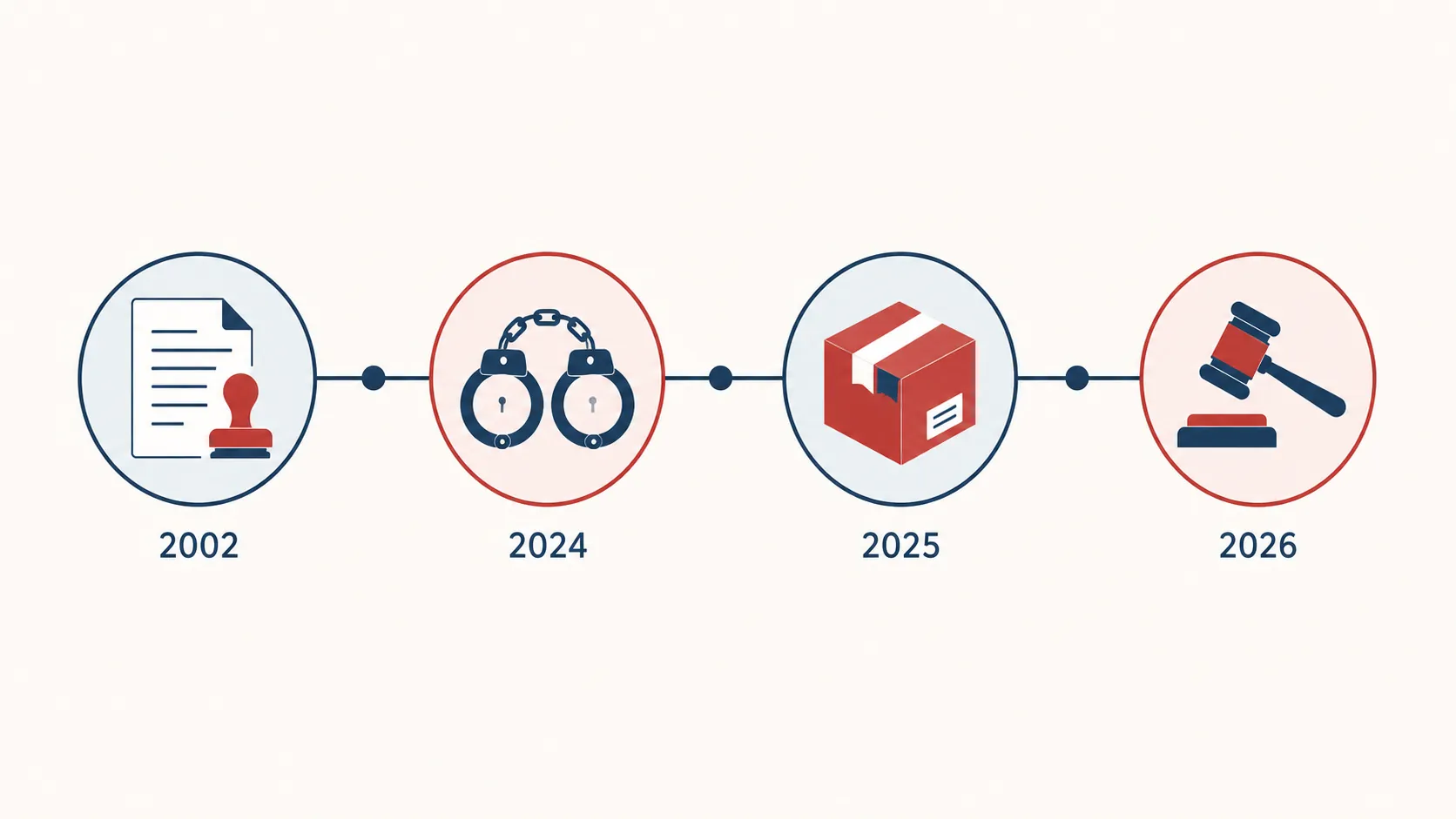
Penalty map: narcotics track versus designated-substances track
The penalty table below separates the two tracks. The narcotics-track penalties are drawn from the official MHLW penalty chart where available and from Abe Legal’s lawyer-reviewed 2026 penalty guide for the offense-by-offense fine figures. Those fine figures are useful, but they should be treated as attributed penalty-summary figures unless checked directly against the controlling Japanese text in a case file.[5][6]
| Track | Product or offense posture | Penalty exposure described in the cited sources | What the classification turns on |
|---|---|---|---|
| Narcotics | Possession or use of a product containing psilocybin or psilocin | Up to 7 years’ imprisonment.[4][5][6] | The item contains psilocybin or psilocin, which are listed as narcotics.[1][2] |
| Narcotics | Possession for profit of a product containing psilocybin or psilocin | Imprisonment of 1 to 10 years, with a fine of up to ¥3 million described in the lawyer-reviewed penalty guide.[5][6] | Profit purpose increases the exposure within the narcotics framework. |
| Narcotics | Import or export of a product containing psilocybin or psilocin | Imprisonment of 1 to 10 years.[5][6] | Mailing, carrying, or otherwise bringing the product across the border can move the case beyond simple possession. |
| Narcotics | Import or export for profit of a product containing psilocybin or psilocin | Imprisonment of 1 to 10 years, with a fine of up to ¥5 million described in the lawyer-reviewed penalty guide.[5][6] | The profit element adds the fine exposure reported in the penalty summary. |
| Designated substances | A hallucinogenic gummy or other product containing a designated analog that is not being treated as psilocybin, psilocin, or another narcotic | Commonly summarized as up to 3 years’ imprisonment and/or a fine of up to ¥3 million.[7][8] | The product is controlled through the designated-substances regime unless the compound is later moved or otherwise classified into the narcotics track. |
The table is deliberately offense-specific. “Possession” is not the same posture as import. “For profit” is not the same posture as personal possession. A mailed parcel can therefore carry a different legal profile from a small quantity found domestically, even if both involve the same active compound.
Where gummies and novel analogs fit
The designated-substances track is the source of much of the confusion. It is a real enforcement track, but it is not the correct bucket for a product that actually contains psilocybin or psilocin. The JMA Journal’s 2025 discussion of synthetic new psychoactive substances reports that 2,439 substances had been designated as of January 19, 2024, illustrating the breadth and continuing movement of that regime.[7]
For a risk note, the consequence is practical. If a gummy is confirmed to contain psilocybin or psilocin, the narcotics analysis is triggered. If the public record only says “hallucinogen gummy” or identifies a newer analog, the safer classification statement is narrower: it may fall under the designated-substances regime unless the specific compound has been scheduled or otherwise treated as a narcotic. The IDPC/Keio 2020 materials describe the designated-substances penalty level as up to three years and/or a fine of up to 3 million yen, a materially lighter track than the narcotics penalties mapped above.[8]
A 2024 Chiba arrest shows why labels are not enough
A January 2024 Japan Today report described a Chiba arrest over alleged possession of magic mushrooms and also referred to hallucinogen gummies in the same general enforcement context.[9] The report is useful as an enforcement marker, not as a penalty source. It shows the fact pattern that creates classification mistakes: mushrooms and gummies may appear together in press coverage, but they do not necessarily travel through the same statutory path.
For compliance research, the public-facing product name should be treated as a lead, not a conclusion. The next step is compound identification. Without it, a note that says “magic mushrooms and gummies are illegal in Japan” is too blunt to support penalty exposure analysis.
Verification notes for a defensible jurisdiction entry
- Current status: psilocybin and psilocin are listed by MHLW under the Narcotics and Psychotropics Control Law, and the 2026 appellate ruling confirms that mushrooms or truffle products containing those substances are covered as narcotics.[1][2]
- 2002 history: VOA reported the June 6, 2002 outlawing of hallucinogenic mushrooms and the seven-year possession maximum. Because secondary sources can describe the mechanism imprecisely, current classification should be anchored to the MHLW list and the 2026 ruling rather than to loose shorthand about the 2002 change.[1][2][4]
- Penalty figures: the seven-year possession maximum is consistently reflected in the 2002 reporting and current penalty summaries. The ¥3 million and ¥5 million fine figures for profit-related narcotics offenses should be cited as lawyer-reviewed penalty-summary figures unless the Japanese statutory text is checked directly for the matter at hand.[4][5][6]
- Designated substances: the lighter up-to-three-years and/or ¥3 million track applies to designated substances, not to psilocybin or psilocin products already treated as narcotics. The exact classification of a gummy or analog product depends on the identified compound.[7][8]
The resulting risk answer is specific: possession of psilocybin- or psilocin-containing magic mushrooms, truffles, or derivative products is illegal in Japan and carries narcotics-track exposure, including a reported maximum of seven years for simple possession or use. Novel hallucinogenic gummies require a compound-level check; if they are controlled only as designated substances, the penalty track is lighter, but that does not make them lawful.
References
- Court upholds sentence of US sailor who had magic truffles mailed to Japan, Stars and Stripes, July 23, 2026
- Controlled Substances List, MHLW Narcotics Control Department, December 12, 2024
- Narcotics and Psychotropics Control Act, Japanese Law Translation
- Japan Outlaws Use of Hallucinogenic Mushrooms, Voice of America, June 6, 2002
- About the Penalties for Drug Offenses in Japan, Ministry of Health, Labour and Welfare
- Japan Drug Penalties 2026, Abe Legal / Houritsu no Mikata, updated April 2026
- Challenges in Regulating Synthetic New Psychoactive Substances, JMA Journal, 2025
- Drug Use, Regulations and Policy in Japan, IDPC / Keio, 2020
- Man arrested over possession of magic mushrooms, Japan Today, January 6, 2024
Operationalizing workflow
No workflow has been explicitly linked to this obligation yet. See Workflows generally.
Illustrative cases
No illustrative case is currently tracked for this obligation. See Risk Digest for documented incidents generally.
← Back to RegulationReport a correction or tip
Spotted an outdated figure, a misstated fact, or a ruling this regulation entry should reflect? Public comments are disabled for this content given the professional cost of a misreported case outcome, penalty amount, or rule text — use the structured correction channel instead.
Report a correction or tip for this record →