
Did the Jones Act waiver cut California energy costs?
- Authority
- Department of Homeland Security
- Rule type
- regulation
- Jurisdiction scope
- US federal
- Effective date
- Mar 17, 2026
- Source text
- Read primary rule text ↗
Covered non-Jones Act fuel voyages require pre-voyage Vessel Availability Requests and CBP/MARAD post-voyage reporting.
Short answer: the 2026 Jones Act waiver did move fuel, and the movement was large enough to matter operationally. It did not, on the citable record available as of August 26, 2026, support a clean claim that California drivers received material pump-price relief. The safer formulation is narrower: the waiver relieved supply constraints; the price effect belongs in fractions of a cent to, at most, a few cents per gallon depending on the source, geography, and measurement basis.
The status point matters because this is not a stale emergency order. The Department of Homeland Security issued the waiver on March 17, 2026, in response to the Iran conflict and related fuel-supply concerns, and Holland & Knight reported the issuance on March 20, 2026.[1] DHS later extended the waiver again, with covered cargo loading allowed through November 15, 2026, at 11:59 p.m. ET, and added a new pre-voyage Vessel Availability Request process tied to a 237-HTS-code extension list.[2]
One potentially relevant May 27 press data analysis should not carry the argument unless its exact figures and wording are verified. That is not a small caveat in this topic. A cents-per-gallon figure without a verified source, time window, and geography is precisely how “fuel moved” becomes “drivers saved money” without enough intervening work.

The waiver moved real barrels
The strongest evidence for the waiver is not a pump-price chart. It is a cargo-volume record. Cato’s Jones Act Waiver Tracker, built from MARAD Section 501(c) voyage reports, says roughly 1.59 million barrels of energy products moved from Gulf Coast ports to West Coast ports in the waiver’s first 50 days, about four times the waterborne volume on that route for all of 2025.[3] Cato also reports that, in the first 70 days, more gasoline and jet fuel moved on that Gulf-to-West Coast route than in 2020 through 2025 combined.[3]
That is a real operational result. It is also the place where the claim should stop unless it changes units, defines the market, and explains price formation. Barrels on a tanker are not cents on a California pump. They can affect supply availability, inventory pressure, and refinery logistics without producing a visible reduction in the statewide retail average.
Cato’s tracker is also useful because it shows why the waiver has drawn so much attention. Cato characterizes the measure as the longest Jones Act waiver since at least 1950, and its voyage-report approach gives observers a running view of cargoes rather than a one-time political assertion.[3] For a lawyer or analyst, that makes it a serious supply-side source. It does not make it a retail-price source.
McCown’s arithmetic keeps the price claim small
John D. McCown’s Center for Maritime Strategy analysis is the necessary counterweight because it starts converting the waiver cargoes into gasoline-market scale. As of April 28, 2026, McCown counted nine full tanker loads under the waiver, including four inbound California gasoline loads totaling 1,072,000 barrels.[4] Across all movements, he calculated 104.5 million gallons, equal to 0.6586% of U.S. gasoline consumption for the relevant comparison, and then estimated a nationwide effect of 0.0157 cents per gallon using a 2.38 cents-per-gallon differential assumption.[4]
That last number is easy to misread. It is not 1.57 cents per gallon. It is 0.0157 cents per gallon under McCown’s nationwide calculation. In dollars, that is $0.000157 per gallon. A figure that small can coexist with Cato’s observation that the waiver produced unusually large waterborne movements. The two claims are not mutually exclusive; they are answering different questions.
| Claim in circulation | Best citable source in this record | What it supports | What it does not support |
|---|---|---|---|
| The waiver moved unusually large Gulf-to-West Coast fuel volumes. | Cato tracker using MARAD Section 501(c) voyage reports.[3] | Supply relief and a measurable operational response. | A quantified California pump-price reduction. |
| The waiver’s gasoline-market price effect was tiny on a nationwide basis. | McCown’s Center for Maritime Strategy arithmetic as of April 28, 2026.[4] | A nationwide modeled effect of 0.0157 cents per gallon under stated assumptions. | A visible statewide California price cut. |
| California’s pump premium is mostly structural. | McCown’s Capitol Weekly discussion of CARB fuel, taxes and fees, and refining capacity.[5] | Why vessel availability can touch only part of the price stack. | A precise waiver savings figure. |
| Jones Act petroleum-market costs can be modeled. | Kellogg & Sweeney’s East Coast petroleum-market paper.[6] | A cautionary comparison showing how scope-specific modeling works. | Evidence of 2026 California waiver savings. |
This is the audit problem in one row: Cato’s evidence is strongest on movement; McCown’s evidence is strongest on scale. If a briefing uses Cato to say the waiver carried meaningful supply volumes, that is well supported. If it uses the same evidence to say the waiver materially cut California energy costs, it has skipped the price calculation.
Why the California pump price is hard for a shipping waiver to move
California gasoline is not simply Gulf Coast gasoline plus freight. The state uses a CARB-specific blend, carries roughly 90 cents per gallon in combined taxes and fees, and has lost in-state refining capacity.[5] Those are not temporary tanker-availability variables. They sit inside the price structure before a Jones Act waiver can do much work.
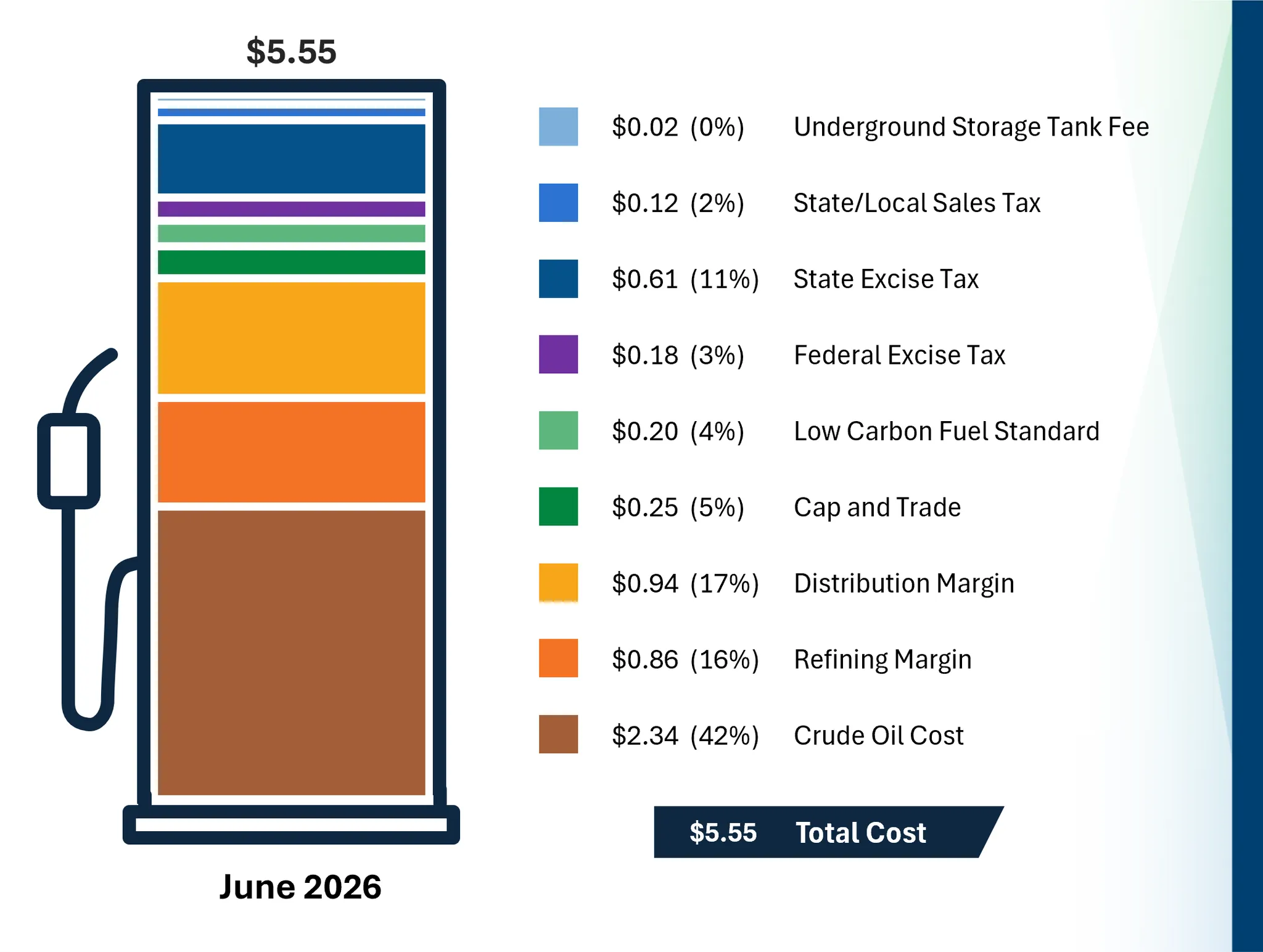
The waiver can reduce one constraint: whether a non-Jones Act vessel may carry covered fuel between U.S. points. It cannot waive California’s fuel specification. It cannot repeal a per-gallon tax or fee. It cannot reopen closed refining capacity. That is why a vessel-policy action can be operationally useful while still leaving the retail price premium largely intact.
This distinction is also why the word “energy costs” needs care. Refiners, traders, shippers, and consumers face different costs at different points in the chain. A cargo that arrives when inventories are tight can be valuable to refiners and wholesalers even if the effect at a retail pump rounds to nothing. A consumer-facing statement should not borrow the urgency of the supply chain unless it can show the pass-through.
The East Coast modeling paper is useful, but not as California proof
Kellogg and Sweeney’s NBER and MIT CEEPR paper is often relevant in Jones Act petroleum discussions because it models the statute’s effects in U.S. petroleum markets. For 2018–2019 East Coast markets, the paper estimated Jones Act-related effects of $0.63 per barrel for gasoline, $0.80 per barrel for jet fuel, and $0.82 per barrel for diesel, along with a $769 million annual consumer-benefit estimate in the modeled scenario.[6]
Those figures do not become California 2026 savings. They are per-barrel estimates for a different geography, a different period, and a modeled East Coast market. Converted loosely, a per-barrel petroleum estimate can look like a few cents per gallon, but that conversion still would not answer whether the 2026 California waiver changed retail prices. The paper is valuable here mainly as a discipline check: serious Jones Act price claims are scoped, modeled, and labeled. They are not inferred from cargo counts alone.
The compliance machinery shows the waiver is active, not that prices fell
The waiver also has an administrative life that is easy to understate. The August extension added a pre-voyage Vessel Availability Request, and Holland & Knight’s alert describes the extension’s 237 covered HTS codes and cargo-loading deadline.[2] Separately, the reporting structure includes CBP Form 1302 reporting, Section 501(c) post-voyage reporting within 10 days, and MARAD publication timing tied to those reports.[2]
There is also a tax wrinkle. Holland & Knight flagged IRS guidance under which foreign shipowners relying on the waiver may not receive the Section 883 exclusion and may need to file Form 1120-F.[2] That is not a consumer gasoline-price point, but it is a reason compliance teams should treat the waiver as a live legal instrument rather than a press-release event.
This layer belongs in the analysis because it explains why the waiver remains worth tracking through the November cargo-loading deadline. The filings can improve the voyage record over time. They do not, by themselves, measure pass-through to retail prices.
Safe wording for briefings
For a client memo, board slide, or legal-news paragraph, the clean version is this: the 2026 Jones Act waiver enabled measurable Gulf-to-West Coast fuel movements at volumes far above recent waterborne trade, but the citable price-impact evidence does not support a claim of material California pump-price relief.
If more precision is needed, separate the statements. Cato supports the volume claim: roughly 1.59 million barrels in the first 50 days and unusually large gasoline and jet-fuel movements in the first 70 days.[3] McCown supports a much smaller price-effect frame: nine full tanker loads as of April 28, 104.5 million gallons across all movements, and a nationwide calculated effect of 0.0157 cents per gallon under his assumptions.[4] California structural-price sources explain why the pump price remains difficult to move through vessel availability alone: CARB-specific fuel, roughly 90 cents per gallon in taxes and fees, and reduced in-state refining capacity.[5]
A sentence saying the waiver “cut California energy costs” is too broad unless it defines which cost, whose cost, what time period, and which measurement basis. A sentence saying the waiver “provided supply relief while credible pump-price estimates remain limited to fractions of a cent or a few cents per gallon depending on scope” is much harder to impeach.
References
- Jones Act Waiver Issued in Response to Iran Conflict — Holland & Knight, March 20, 2026.
- DHS Extends Jones Act Waiver Again — Holland & Knight, August 13, 2026.
- Jones Act Waiver Tracker — Cato Institute.
- The Jones Act Waivers Aren’t Achieving Stated Purpose But Hinder Long-Term Maritime Goals — Center for Maritime Strategy, May 7, 2026.
- Jones Act waivers won’t sink California gas prices — Capitol Weekly.
- Impacts of the Jones Act on U.S. Petroleum Markets — MIT CEEPR.
Operationalizing workflow
No workflow has been explicitly linked to this obligation yet. See Workflows generally.
Illustrative cases
No illustrative case is currently tracked for this obligation. See Risk Digest for documented incidents generally.
← Back to RegulationReport a correction or tip
Spotted an outdated figure, a misstated fact, or a ruling this regulation entry should reflect? Public comments are disabled for this content given the professional cost of a misreported case outcome, penalty amount, or rule text — use the structured correction channel instead.
Report a correction or tip for this record →