
Why Juan Orlando Hernández Now Faces Charges in Honduras
- Authority
- Honduran Supreme Court
- Rule type
- statute
- Jurisdiction scope
- Honduras
- Source text
- Read primary rule text ↗
Non-advice status note. Last verified: August 4, 2026, 00:00 UTC, against the docket and source set listed below. Reviewer convention: treat this as a current-status record, not as a merits brief; before relying on it in a filing, client alert, regulatory memo, or newsroom legal review, recheck the cited docket entries and any Honduran court update after August 3.
Current answer: Juan Orlando Hernández’s U.S. convictions no longer stand because the presidential pardon mooted the pending appeal and led to vacatur and dismissal, not because an appellate court acquitted him or reversed on the merits. The Honduras question is separate: the Pandora II fraud and money-laundering proceeding had its own warrant, suspension order, return date, and hearing schedule, with an August 3, 2026 hearing reported as expected but no outcome verified in the materials available for this update.[1][2][3][4]
| Current-status question | Answer as of August 4, 2026 |
|---|---|
| Does Hernández still have standing U.S. federal convictions? | No. In the SDNY case, the pardon warrant was docketed on December 3, 2025; the Second Circuit vacated and remanded in April 2026; Judge P. Kevin Castel dismissed the indictment as moot on April 14; and the mandate issued on June 2.[1] |
| Was the U.S. result a merits reversal or exoneration? | No. The operative sequence is pardon, mootness, vacatur, remand, dismissal. That is different from a finding that the evidence failed or that the trial judgment was legally wrong on the merits.[1] |
| What are the Juan Orlando Hernández charges in Honduras? | Public reporting identifies the live Honduran matter as the Pandora II fraud and money-laundering case, tied to alleged public-contract kickbacks and diverted public funds, not as a continuation of the U.S. narcotics prosecution.[2][3] |
| Is the Honduran case still separate after the U.S. pardon? | Yes. The Honduran proceeding had a December 8, 2025 international arrest warrant, a June 2026 Honduran Supreme Court suspension of that warrant, Hernández’s July 26 return to Honduras, and a hearing reported as scheduled for August 3, 2026. The hearing outcome is not verified here.[2][3][4] |
| What date should be used for the pardon? | Do not compress the date. The pardon was reported as announced on November 28, 2025; Hernández was reported released from USP Hazelton on December 1; and the warrant was docketed in the SDNY case on December 3.[5][1] |
Why “pardoned” and “charged” can both be accurate
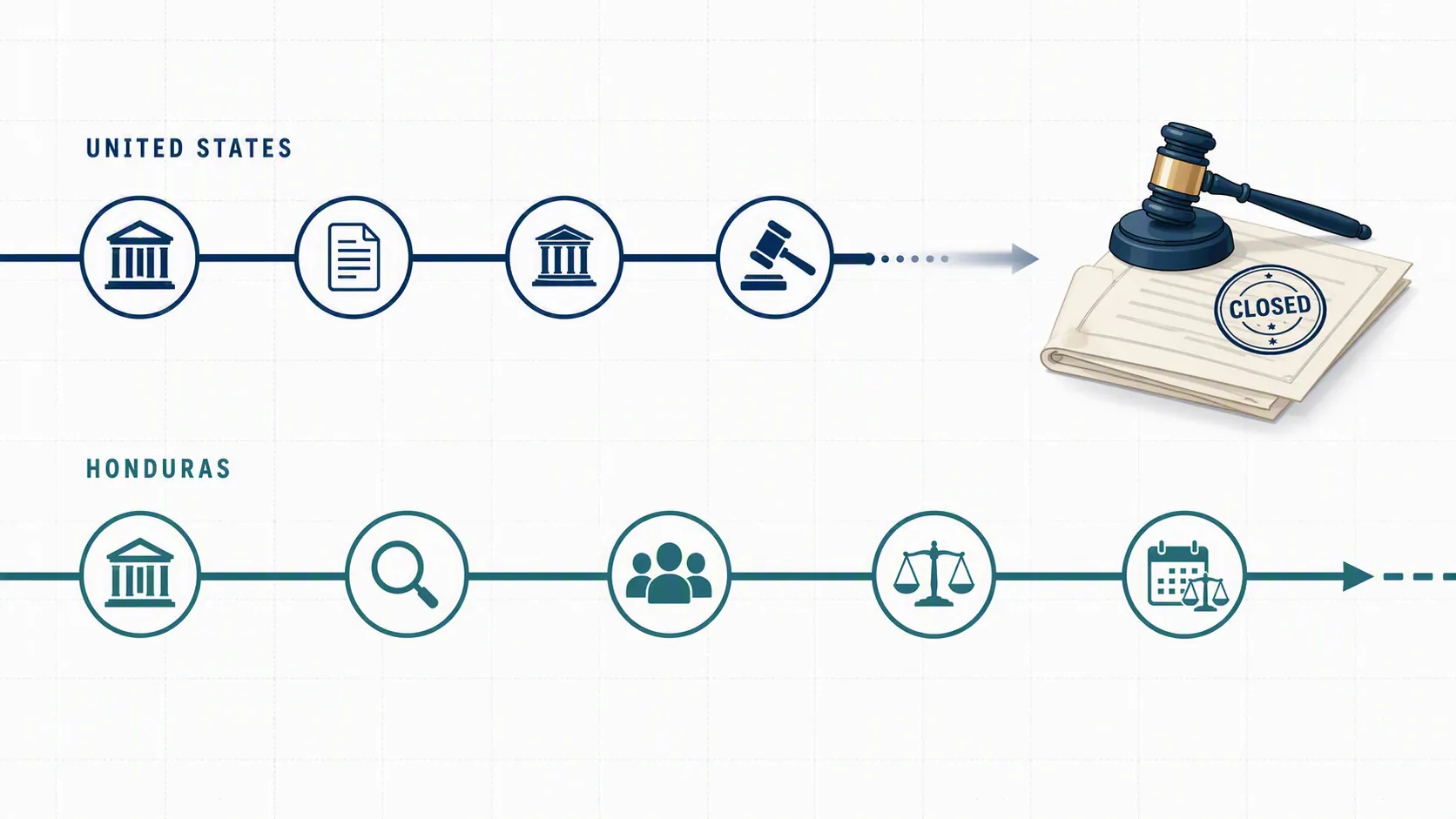
The apparent contradiction disappears once the jurisdiction is attached to each verb. The United States case was the federal narcotics prosecution in the Southern District of New York. The Honduras case is the Pandora II corruption proceeding. A U.S. presidential pardon can affect the federal judgment and pending appeal in the United States; it does not dismiss a Honduran warrant, erase Honduran charges, or decide what a Honduran court should do with a domestic corruption file.
That distinction matters because a single headline can make the record look cleaner than it is. “Conviction overturned” may be serviceable shorthand in a news alert, but it is too loose for a legal-status record if it suggests a merits ruling. The docket language is narrower: the judgment was vacated and the indictment dismissed as moot after the pardon.[1]
The two-track timeline
| Date or period | U.S. federal track | Honduran Pandora II track |
|---|---|---|
| 2010–2013 | InSight Crime describes the Pandora II network as involving about $12 million diverted from poverty programs during this period. Al Jazeera later reported the figure at about $11 million, so the reporting should not be smoothed into a single amount.[3][6] | |
| March 8, 2024 | The SDNY docket records the jury verdict against Hernández on three counts.[1] | |
| May 9, 2024 | Judge Castel denied Hernández’s Rule 33 motion for a new trial.[1] | |
| June 26, 2024 | The SDNY docket records a 540-month sentence, equal to 45 years, along with an $8 million fine and forfeiture.[1] | |
| November 28–December 3, 2025 | The pardon date should be stated in stages: announcement reported November 28; release from USP Hazelton reported December 1; pardon warrant docketed December 3.[5][1] | Honduran action followed almost immediately after the U.S. release, but it belonged to a different proceeding. |
| December 8, 2025 | Honduras issued an international arrest warrant in the Pandora II matter. CNN reported Attorney General Johel Antonio Zelaya’s allegation of about $2.4 million in kickbacks from public contracts into Hernández’s 2013 campaign.[2] | |
| April 2026 | The Second Circuit vacated the judgment and remanded; Judge Castel dismissed the indictment as moot on April 14.[1] | |
| June 2026 | The Second Circuit mandate issued on June 2.[1] | InSight Crime reported that the Honduran Supreme Court suspended the warrant in June 2026.[3] |
| July 26, 2026 | Hernández returned to Honduras after the U.S. pardon and the suspension of the Honduran warrant.[3][6] | |
| August 3, 2026 | The New York Times reported that a court hearing was expected on this date. This article does not verify an outcome for that hearing.[4] |
What actually ended in the United States
The U.S. case had already reached judgment before the pardon. The SDNY docket records the March 8, 2024 jury verdict, the May 9 denial of a new-trial motion, and the June 26 sentence of 540 months, an $8 million fine, and forfeiture. Those entries matter because the later vacatur did not occur in an unfinished case; it operated on an existing federal judgment while appellate review was pending.[1]
The ending then came in docketed steps. First, the pardon warrant was filed in the district court on December 3, 2025. Then the Second Circuit vacated and remanded in April 2026, citing the mootness consequence of a pardon accepted while an appeal is pending. Judge Castel followed with an April 14 order dismissing the indictment as moot and vacating the judgment. The mandate issued June 2.[1]
That is the controlling procedural sequence. It is not the same as a court saying the jury heard insufficient evidence, the indictment failed as a matter of law, or the trial court committed reversible error. Reuters accurately reported the court action, but its headline used the verb “overturns,” a word that needs narrowing when moved from a headline into a legal-status memo.[7]
For practical purposes, the U.S. judgment against Hernández is no longer standing. For legal-record purposes, the reason is just as important as the result: pardon-driven mootness, followed by vacatur and dismissal. The docket does not convert the U.S. case into an acquittal.
What remained in Honduras
The Honduran track is the reason charges in Honduras still present a live-status question after the U.S. pardon. Public reporting identifies the proceeding as Pandora II, a domestic corruption case involving fraud and money-laundering allegations. CNN reported the attorney general’s allegation that about $2.4 million in kickbacks from public contracts flowed into Hernández’s 2013 campaign. InSight Crime describes the broader Pandora II network as involving about $12 million diverted from poverty programs between 2010 and 2013.[2][3]
There is a reporting discrepancy on the total diversion figure. InSight Crime gives about $12 million; Al Jazeera reported about $11 million when covering Hernández’s July 2026 return. The safer record entry is not to choose one silently, but to state the variance and cite the source being used for the particular figure.[3][6]
The December 8, 2025 warrant did not revive the U.S. narcotics case. It belonged to Honduras. CNN reported that Honduran authorities issued an international arrest warrant shortly after Hernández’s U.S. release, with Attorney General Johel Antonio Zelaya announcing the action in connection with Pandora II.[2]
The warrant’s later suspension also should not be overread. InSight Crime reported that Honduras’s Supreme Court suspended the warrant in June 2026 and that Hernández returned to Honduras on July 26, 2026. Suspension of an arrest warrant is a procedural development in the Honduran track; it is not the same thing as dismissal of the charges unless a Honduran court record says so.[3]
The co-defendant context belongs in the same modest lane. InSight Crime notes that charges against former president Porfirio Lobo and former finance minister Wilfredo Cerrato were dismissed. That fact helps identify the Pandora II file and its procedural history, but it does not itself decide Hernández’s current posture.[3]
The August 3 hearing should be treated as scheduled unless a later court record confirms more
The most recent dated Honduran event in this source set is not an outcome. The New York Times reported that Hernández was expected in court on August 3, 2026. Because this article is verified on August 4 but has no independently checked post-hearing court record, the status should remain: hearing scheduled or expected; outcome pending verification.[4]
That may feel unsatisfying, but it is the only clean way to handle a record that is moving across jurisdictions. If a Honduran court later dismisses the Pandora II case, imposes conditions, revives an arrest measure, or sets a new hearing, that would be a new Honduran docket event. It would not rewrite the U.S. mootness vacatur, and the U.S. vacatur does not pre-decide it.
The rule-of-law debate is real, but it is not the docket
Once the two tracks are separated, the policy debate can be read without doing procedural damage to either case. WOLA argued that the Hernández pardon damaged U.S. anti-corruption credibility and compared the episode to the U.S. handling of former Mexican defense minister Salvador Cienfuegos. That is a foreign-policy and rule-of-law critique, not evidence of the Honduran Pandora II charges.[8]
Congressional responses sit in the same category. CRS treated the pardon as an issue for Congress in U.S.-Honduras relations and oversight. The congressional record also includes H.Res. 929 and S.Res. 530, with S.Res. 530’s text placing the matter in a formal Senate-resolution frame. Senator Jeanne Shaheen’s public criticism belongs in that oversight and foreign-policy response bucket, not in the proof column for a Honduran criminal charge.[9][10]
The narrow status answer therefore holds. Hernández was pardoned in the United States, and the U.S. judgment was vacated and dismissed as moot. Hernández also faced a separate Honduran Pandora II proceeding, with its own charges, warrant history, return date, and hearing schedule. “Pardoned” and “charged” are not competing descriptions of the same proceeding; they are accurate only when attached to the correct jurisdiction, docket, date, and procedural posture.
References
- United States v. Diaz Morales, CourtListener, https://www.courtlistener.com/docket/63255050/united-states-v-diaz-morales/?page=2
- Honduras issues arrest warrant for ex-president Hernández recently pardoned by Trump, CNN, December 9, 2025, https://www.cnn.com/2025/12/09/americas/honduras-issues-arrest-warrant-for-ex-president-hernandez-recently-pardoned-by-trump
- Juan Orlando Hernández, InSight Crime, https://insightcrime.org/honduras-organized-crime-news/juan-orlando-hernandez/
- Juan Orlando Hernández Trump Honduras, The New York Times, August 3, 2026, https://www.nytimes.com/2026/08/03/world/americas/juan-orlando-hernandez-trump-honduras.html
- Former Honduras President Hernandez freed from prison after Trump pardon, PBS NewsHour, December 1, 2025, https://www.pbs.org/newshour/world/former-honduras-president-hernandez-freed-from-prison-after-trump-pardon
- Former President Hernández returns to Honduras after Trump pardon, Al Jazeera, July 26, 2026, https://www.aljazeera.com/news/2026/7/26/former-president-hernandez-returns-to-honduras-after-trump-pardon
- US court overturns conviction of former Honduran president Hernandez, Reuters, April 9, 2026, https://www.reuters.com/world/us-court-overturns-conviction-former-honduran-president-hernandez-2026-04-09/
- The Juan Orlando Hernández Pardon: Implications for U.S. Foreign Policy, WOLA, https://www.wola.org/analysis/juan-orlando-hernandez-pardon-implications-for-u-s-foreign-policy/
- CRS Insight IN12621, Congressional Research Service, https://www.congress.gov/crs-product/IN12621
- S.Res. 530 text, Congress.gov, https://www.congress.gov/bill/119th-congress/senate-resolution/530/text
Operationalizing workflow
No workflow has been explicitly linked to this obligation yet. See Workflows generally.
Illustrative cases
No illustrative case is currently tracked for this obligation. See Risk Digest for documented incidents generally.
← Back to RegulationReport a correction or tip
Spotted an outdated figure, a misstated fact, or a ruling this regulation entry should reflect? Public comments are disabled for this content given the professional cost of a misreported case outcome, penalty amount, or rule text — use the structured correction channel instead.
Report a correction or tip for this record →