
How Louisiana's Act 822 Reshapes Prompt Payment for Contractors
- Authority
- Louisiana Legislature
- Rule type
- statute
- Jurisdiction scope
- US state
- Effective date
- Aug 1, 2026
- Source text
- Read primary rule text ↗
35-day owner payment deadline; 7-day downstream payment; uncapped 1.5% monthly penalty; waivers void; residential exemption removed
As of July 25, 2026, Louisiana contractors have one week before Act 822 changes the private-project payment calendar. The practical question is not whether the statute sounds significant. It does. The practical question is whether the person receiving, approving, disputing, or redistributing project money can identify the day the clock starts.
The enrolled statutory text of Act 822 was not directly verified for this brief, so the deadline and penalty details below are attributed to the cited law-firm analyses. Those analyses describe the same core shift: effective August 1, 2026, Louisiana private-project owners face a 35-day payment obligation after receiving a written payment request, contractors and other upstream recipients must move payment downstream within 7 days after receipt, and the penalty changes to an uncapped 1.5% per month structure.[1][2][3]
| Rule | Prior baseline described in the analyses | Act 822 rule | Who feels it first | Effective date |
|---|---|---|---|---|
| Private owner payment deadline | Private owners were not under the same kind of prompt-payment clock as downstream construction participants. | Owner must pay within 35 days after receiving a written payment request, subject to stated exceptions.[1][2][3] | Owners, GCs, and anyone waiting for owner funding | August 1, 2026 |
| Penalty for late payment | 0.5% per day, capped at 15%. | 1.5% per month, uncapped.[1][2][3] | Any party deciding whether delay is cheaper than payment | August 1, 2026 |
| Downstream payment window | 14 days after receipt of upstream payment. | 7 days after receipt of upstream payment.[2][3] | GCs, subcontractors, suppliers, and accounting departments | August 1, 2026 |
| Waiver | Payment provisions could still become a contract-drafting fight. | Waivers of the statute are an absolute nullity, with a narrow single-family residence rule allowing extension to 61 days.[1][2] | Contract drafters and anyone relying on legacy forms | August 1, 2026 |
| Residential and condominium projects | Prior exemption shielded residential and condominium projects. | Residential exemption is removed.[1] | Residential builders, condo project participants, owners, and counsel | August 1, 2026 |
| Withholding and short-pay administration | Disputes and partial payments were often treated as project-by-project leverage points. | Loan-proceeds exception, good-faith dispute safe harbor, undisputed-amount obligation, and proportional distribution of owner short-pay all matter under the new framework.[1][2][3] | Anyone approving a partial payment or documenting a dispute | August 1, 2026 |
The new private-project payment sequence
Act 822 is easiest to understand as a sequence of handoffs. A written payment request arrives. The owner’s 35-day period begins. If payment is made to the GC, the GC then has 7 days to pay subcontractors and suppliers. If the owner pays less than the amount requested, the GC cannot simply protect its own position first; the short-pay must be distributed proportionally to affected subcontractors, according to the Jones Walker analysis.[3]
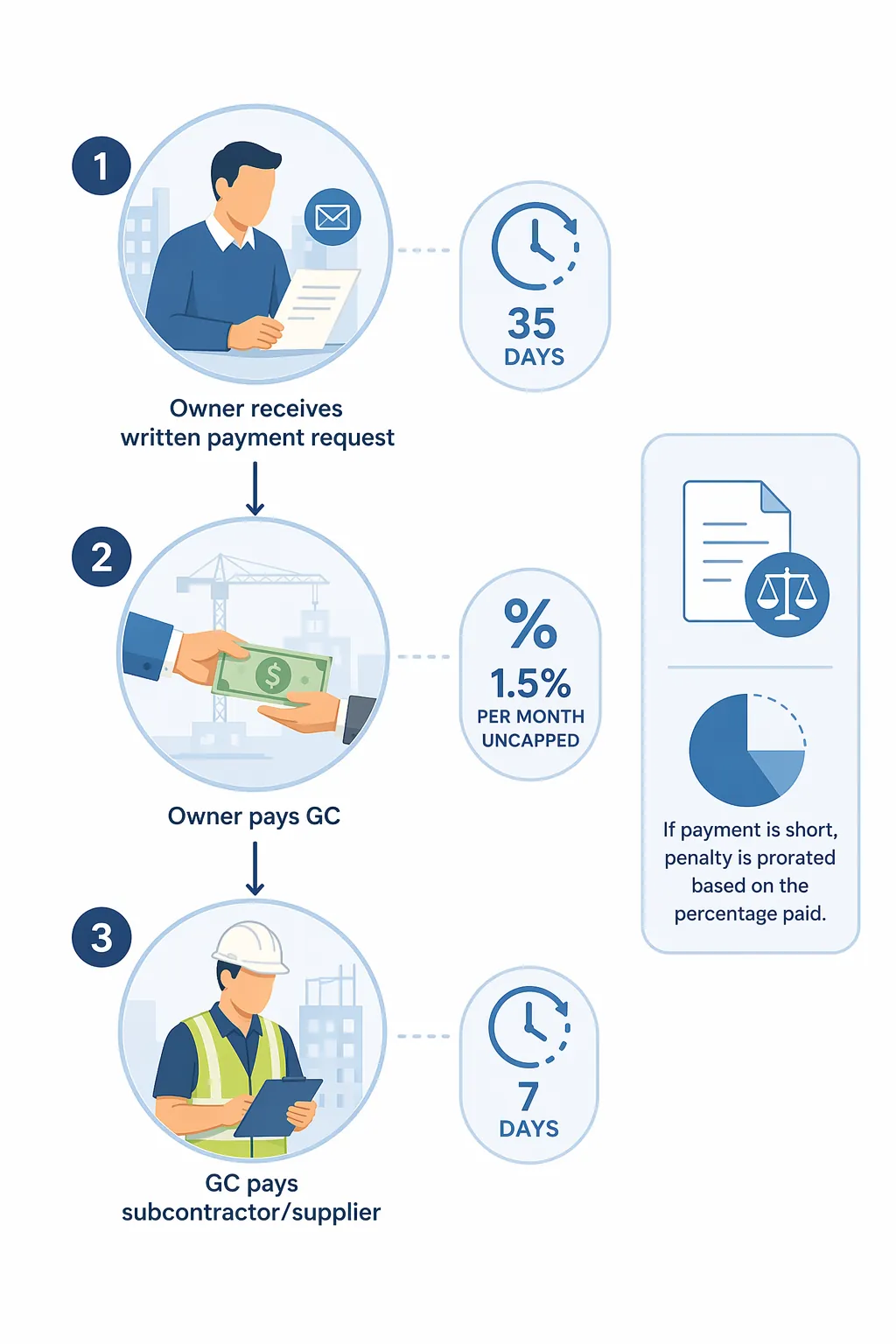
- Owner receives a written payment request. That receipt date matters because the 35-day private-owner payment clock runs from it.[1][2][3]
- Owner reviews funding and disputes. The analyses describe a loan-proceeds exception and a good-faith dispute safe harbor, but disputed payment administration does not erase the obligation to pay undisputed amounts.[1][2][3]
- Owner pays, short-pays, or withholds. The choice must be tied to a recognized basis, not just ordinary cash-flow preference.
- GC receives upstream payment. That receipt starts the 7-day downstream clock.[2][3]
- GC distributes money downstream. If the owner short-paid, the distribution must be proportional rather than self-preferential.[3]
That workflow is where exposure attaches. The owner’s delay is no longer only a contract-administration problem. The GC’s delay is no longer cushioned by a two-week downstream window. A partial payment is no longer safely handled by paying the loudest claimant, the closest relationship, or the party with the strongest lien leverage first.
The owner’s 35-day clock is the first calendar control point
For private Louisiana construction projects, the owner deadline is the change that should alter the front end of the payment process. Under the cited Act 822 analyses, private owners must pay within 35 days after receiving a written payment request.[1][2][3] That does not mean every invoice, draw package, or pay application will be uncontested. It does mean the first compliance question becomes clean and factual: when was the written request received?
Contractors should expect owners to care more about intake mechanics. A payment request that arrives by email, portal upload, courier, or project-management platform needs a reliable receipt record. If the project team cannot later prove when the request was received, the penalty dispute will start with avoidable evidentiary noise.
The loan-proceeds exception deserves separate attention. Baker Donelson’s analysis states that owners may withhold payment if project financing has not yet funded.[1] That exception matters because many Louisiana payment disputes begin with some version of “we will pay when the lender funds.” Act 822 does not make financing delays irrelevant, but it also makes them something to administer under a statute rather than casually pass down the chain.
The good-faith dispute safe harbor works the same way. The Kean Miller and Jones Walker analyses describe protection for disputed amounts withheld in good faith, while emphasizing that undisputed portions still must be paid.[2][3] That distinction is not paperwork trivia. A real defect dispute, scope disagreement, retainage issue, or pay-application deficiency may justify withholding a defined amount. It does not justify freezing an entire payment request when only part of it is actually disputed.
Why the new penalty can be more dangerous than it first looks
At first glance, 1.5% per month may sound less severe than the prior 0.5% per day structure. That is the wrong comparison if it stops at the daily rate. The cited analyses describe the old penalty as 0.5% per day capped at 15%, while Act 822 replaces it with a 1.5% per month penalty with no cap.[1][2][3]
The missing cap changes the litigation posture. A capped penalty creates a point where delay stops increasing the statutory penalty. An uncapped monthly penalty keeps adding pressure while the dispute remains unresolved. That does not guarantee a claimant wins, and it does not make every withholding improper. But it makes a weak withholding position more expensive to carry.
Fee shifting adds another reason to be precise. Baker Donelson and Kean Miller both describe prevailing-party attorney-fee provisions, meaning fee exposure can cut in favor of a claimant or a defendant depending on who prevails.[1][2] That should discourage both sloppy nonpayment and overreaching prompt-payment demands. The better file is the one that shows the date received, the amount approved, the amount disputed, the reason for the dispute, and the date any undisputed amount was released.
Seven days downstream leaves little room for accounting lag
The downstream rule is the part subcontractors and suppliers will feel most directly. Kean Miller and Jones Walker describe Act 822 as shortening the time for payment downstream from 14 days to 7 days after receipt of payment from the owner or other upstream party.[2][3] A week is not much time if the accounting department waits for batch processing, lien-waiver review, joint-check signatures, or project-manager approval after the funds are already in hand.
That is the point. Once the upstream money is received, the party holding it is carrying money that belongs, at least in part, to those who performed downstream work. Act 822 compresses the period during which that float can sit in the middle of the chain.
The proration rule is especially important when the owner short-pays. Jones Walker’s analysis states that when an owner does not pay the GC in full, the GC must distribute the payment proportionally to subcontractors and cannot pay itself first.[3] That is a practical litigation fact. A GC that receives a partial payment and then chooses winners and losers may create a separate statutory problem even if the owner’s short-pay created the first cash-flow shortage.
A workable downstream process should identify three things before the money arrives: which subcontractor and supplier amounts are undisputed, which amounts are disputed in good faith, and how any owner short-pay will be prorated. Waiting until funds hit the account to answer those questions invites a late payment problem that the old 14-day window may have concealed.
Disputes still matter, but undisputed money has to move
Nothing in the cited Act 822 commentary supports the idea that every withholding is bad faith. Construction payment disputes can be real: incomplete work, defective work, missing backup, disputed change orders, retainage treatment, offsets, and lender conditions all appear in ordinary project administration. The statute’s practical force is in separating a documented dispute from a general refusal to release money.
Kean Miller and Jones Walker both describe a good-faith dispute safe harbor and an obligation to pay undisputed amounts.[2][3] That means the dispute file should not merely say “payment disputed.” It should identify the amount disputed, the basis for the dispute, who made the decision, what backup was reviewed, and what amount remains undisputed. The party waiting downstream should be able to see why the nonpayment is tied to a real issue rather than a general cash-management decision.
For owners and GCs, this is where project documentation and payment documentation need to meet. A field report may support a defective-work withholding. A change-order log may support a scope dispute. A lender communication may matter to a loan-proceeds exception. But those records need to be connected to the payment decision before the statutory deadline becomes the main event.
Waiver language should be reviewed before it becomes useless language
Act 822’s non-waiver rule is not a drafting preference. Baker Donelson and Kean Miller describe statutory waivers as an absolute nullity.[1][2] Under those analyses, a contract clause purporting to waive the prompt-payment protections does not merely become disfavored or narrowly construed. It fails.
The narrow exception is worth noting because it will be easy to overread. The same analyses describe a single-family residence exception that may extend the payment period to 61 days.[1][2] That is not a general residential carveout, and it should not be treated as permission to keep old waiver language in every owner-contractor form.
Legacy forms should be checked for provisions that assume prompt-payment rights can be waived, delayed indefinitely, conditioned beyond the statute, or blurred into broader release language. Even if a clause is unenforceable, leaving it in the contract can create negotiation confusion, payment-administration mistakes, and unnecessary argument after a deadline passes.
Residential and condominium projects lose the old shield
The elimination of the residential exemption is a major scope change. Baker Donelson’s analysis states that Act 822 removes the prior exemption for residential and condominium projects.[1] For post-August 1, 2026 claims, residential and condominium participants should not assume they sit outside the prompt-payment regime simply because older law or older forms treated them differently.
Baker Donelson also references SRP Environmental Co. v. Claremont Property Co., a Western District of Louisiana decision dated June 2, 2026, as an example applying the old residential exemption.[1] The full docket and procedural posture were not independently verified in the available research materials, so the case should be treated here only as a secondary-source reference. Its significance for present compliance is the contrast: Act 822 removes the exemption that made that older defense available for residential and condominium work.
Residential builders should therefore review pay applications, owner-facing payment terms, subcontractor payment provisions, and closeout documents before the effective date. Condominium projects should do the same. The narrow single-family 61-day rule should be handled deliberately, not assumed.
Do not mix Act 822 with public works, surety, or pay-if-paid changes
Act 822 is the private-project prompt-payment track. Baker Donelson’s analysis states that public contracts under La. R.S. 38:2191 and oil-and-gas projects are excluded from Act 822.[1] That distinction matters because 2026 also brought other Louisiana construction-payment changes that can sound similar in a headline but operate differently.
Act 255 is the public-works track. Kean Miller describes Act 255 as prohibiting public entities from withholding contested liquidated damages from progress or final payments and as including two-way fee shifting.[4] That is important for public contractors, but it is not the same 35-day private-owner clock created by Act 822.
Acts 758 and 761 are separate 2026 enactments affecting surety bonds and pay-if-paid clauses, according to NACM’s coverage.[5] They belong in the same broader conversation about construction payment risk, but they should not be folded into an Act 822 compliance checklist as if they created the same deadlines.
What to check before August 1
The immediate work is procedural. Contractors and counsel do not need a philosophical position on prompt-payment reform to see where the files can fail. They need a payment system that can prove receipt, identify disputes, release undisputed amounts, and move money downstream within the shortened window.
- Payment-request intake: confirm how written payment requests are received, date-stamped, routed, and preserved.
- Owner review process: decide who confirms funding status, who approves payment, and who documents any loan-proceeds issue.
- Dispute documentation: require a specific amount, reason, reviewer, and supporting record for any good-faith withholding.
- Undisputed-amount release: build a process that pays the clean portion even when another portion is contested.
- Downstream disbursement: treat receipt of upstream funds as the start of a 7-day operational deadline, not the beginning of internal review.
- Short-pay proration: prepare a proportional distribution method before an owner short-pay creates pressure.
- Residential-project forms: remove assumptions based on the prior residential and condominium exemption.
- Waiver language: identify clauses that purport to waive or contract around prompt-payment protections.
Act 822 is not only a harsher penalty provision. It reallocates timing risk. Owners now carry a statutory private-project payment clock. GCs and other upstream recipients have less time to move money downstream. Subcontractors and suppliers gain a clearer basis to ask why undisputed money has not moved. And because waivers are described as an absolute nullity, parties should not assume they can draft around the calendar after August 1.
This article is an editorial regulation brief for Louisiana construction-payment compliance. It is not project-specific legal advice, and parties should have counsel review the governing contract, project type, payment history, and dispute record before making or rejecting an Act 822 demand.
References
- Louisiana Legislature Increases Prompt Payment Stakes for All Project Participants — Baker Donelson
- What Louisiana's HB 638 Means for Anyone Who Builds, Hires a Builder, or Gets Hired on a Construction Project — Kean Miller
- Louisiana Owners Are Now on a 35-Day Clock — and the Penalty Meter Has No Ceiling — Jones Walker
- New Rules of the Game: How Act 255 Changes Louisiana Public Works — Kean Miller
- New Louisiana laws impact construction payments — NACM
Operationalizing workflow
No workflow has been explicitly linked to this obligation yet. See Workflows generally.
Illustrative cases
No illustrative case is currently tracked for this obligation. See Risk Digest for documented incidents generally.
← Back to RegulationReport a correction or tip
Spotted an outdated figure, a misstated fact, or a ruling this regulation entry should reflect? Public comments are disabled for this content given the professional cost of a misreported case outcome, penalty amount, or rule text — use the structured correction channel instead.
Report a correction or tip for this record →