
AI Classifiers in Medicaid Lawsuits Face a Legal Hinge
- Authority
- Centers for Medicare & Medicaid Services (CMS)
- Rule type
- regulation
- Jurisdiction scope
- US federal
- Source text
- Read primary rule text ↗
States must apply a narrow two-part medical-frailty standard for exemptions from Medicaid work requirements.
The legal problem for AI classifiers in Medicaid work requirements starts before anyone asks whether the model is accurate. It starts with the rule the model is being asked to apply. In Massachusetts v. Oz, filed June 29, 2026, a coalition of 26 states challenges CMS’s final Medicaid work-requirements rule, with the medical-frailty exemption sitting near the center of the APA dispute.[1] The states’ argument, as summarized by KFF, is that CMS adopted a narrow two-part medical-frailty standard after departing from earlier guidance, and that departure is legally vulnerable under ordinary administrative-law review.[2]
That matters for AI because the systems now being discussed for work-requirement administration are not floating above the law as generic efficiency tools. They are being built to sort people into legal categories: exempt, not exempt, compliant, noncompliant, eligible, ineligible. If the medical-frailty standard is invalid, a classifier trained or configured to operationalize that standard inherits the defect. It may be beautifully documented, auditable, and statistically impressive, and still produce denials based on a rule the agency had no lawful basis to enforce.

The Medical-Frailty Hinge
Medical frailty is not a tidy data field. In a Medicaid file, it may appear as diagnoses spread across claims, a disability determination from another program, behavioral-health records, functional limitations, prescription history, managed-care assessments, or a provider form that arrived after the eligibility system generated its notice. A narrow exemption standard changes which of those signals count and who bears the burden when the file is incomplete.
The Massachusetts v. Oz challenge, as publicly described, does not need to be an AI lawsuit to create AI exposure. The reported dispute is about CMS’s authority and process: whether the agency could adopt the final rule’s two-part medical-frailty test after earlier guidance took a different approach.[1][2] But once states and vendors build claims-based exemption tools around that test, the APA issue becomes embedded in eligibility operations. The classifier is no longer just predicting administrative workload. It is helping decide whether a person must satisfy work-reporting obligations or can avoid that obligation because the law treats them as medically frail.
For beneficiary-side lawyers, the immediate litigation question is not whether “AI” appears in the caption. It is whether an adverse action can be traced to an automated application of a contested federal standard. For state agency counsel, the risk is just as concrete. A vendor dashboard can make implementation look orderly while also creating a record that the state deliberately encoded the very interpretation plaintiffs say CMS had no authority to impose.
What a Claims-Based Frailty Classifier Would Actually Do
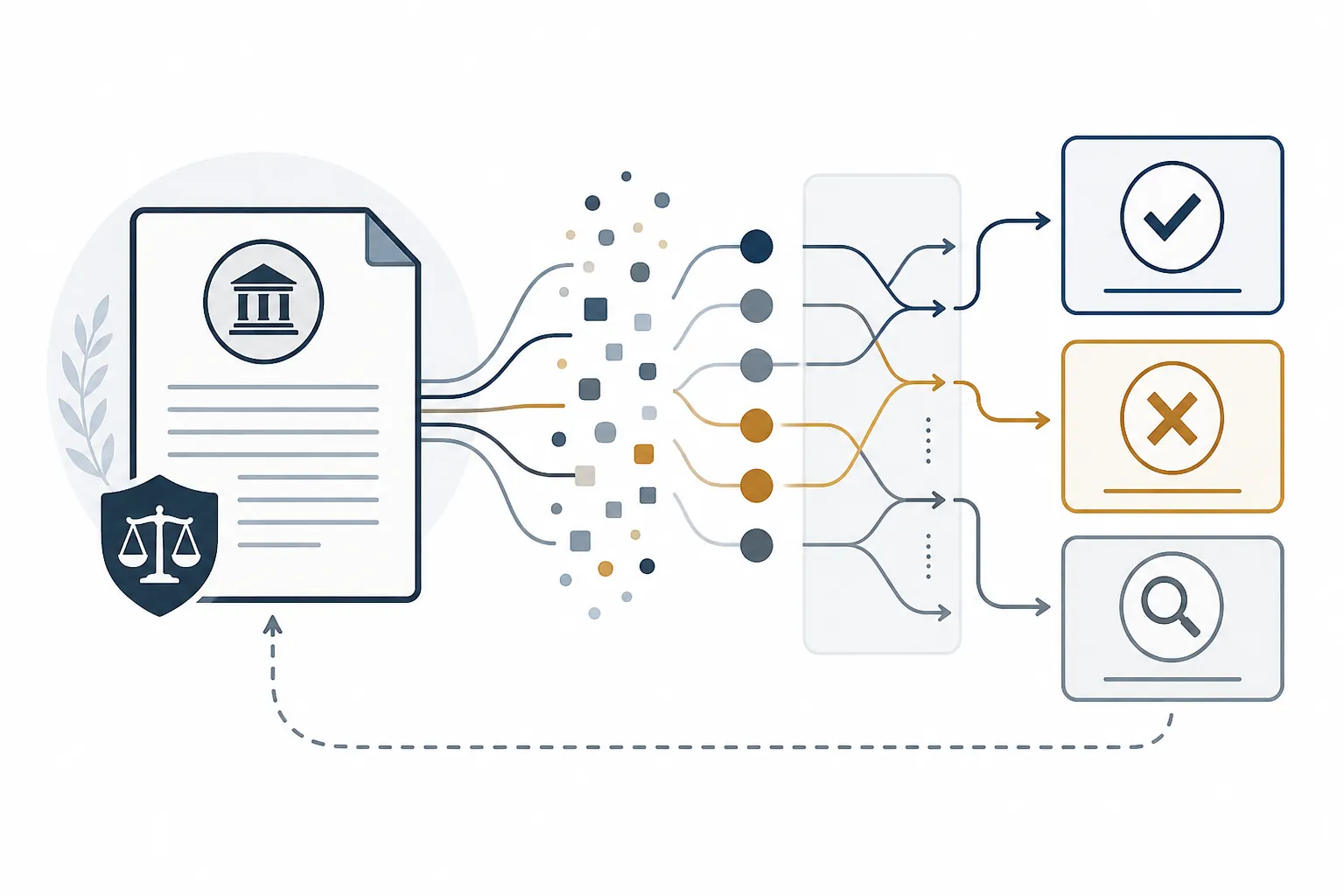
A medical-frailty classifier in this setting would not merely flag “risk.” It would perform a sequence of administrative acts that lawyers usually see only after coverage has already been lost. First, it would ingest available data: claims, encounter records, eligibility history, managed-care feeds, disability indicators, provider submissions, and possibly prior exemption records. Second, it would search for conditions or utilization patterns that correspond to the exemption standard. Third, it would sort beneficiaries into operational groups: automatically exempt, probably exempt but needing documentation, not exempt, or requiring manual review. Fourth, it would feed that classification into a work-requirement workflow that can affect notices, reporting obligations, suspension, or termination.
Each step has a legal consequence. A missing diagnosis code is not just a bad feature. It can become the reason the person never receives an exemption notice. A claims lag is not just a data-quality problem. It can shift the burden to a beneficiary who has no realistic way to know that the system failed to see recent treatment. A triage category is not just workflow management. It can determine whether a human ever looks at the file before coverage is interrupted.
| Classifier task | Administrative effect | Legal pressure point |
|---|---|---|
| Identify frailty signals in claims and eligibility data | Determines who is routed toward exemption review | Whether the system uses the lawful exemption standard and considers relevant evidence |
| Rank or sort beneficiaries by likely exemption status | Determines who receives automated approval, manual review, or no exemption action | Whether similarly situated disabled beneficiaries are treated consistently |
| Generate or suppress work-reporting obligations | Changes what the beneficiary must do to keep coverage | Whether the notice explains the factual and legal basis for the obligation |
| Transmit nonexempt status into termination workflows | Creates the pathway to suspension or loss of coverage | Whether the beneficiary can contest the data and obtain timely human review |
The two-part standard is therefore not an abstract interpretive dispute once it enters a classifier. It becomes a set of machine-readable gates. One gate may ask whether a beneficiary has a qualifying condition. Another may ask whether the condition meets the rule’s severity, documentation, or timing requirements. If either gate is too narrow because the underlying CMS rule is unlawful, the system can deny the exemption even when a broader, legally proper standard would have protected the person.
That is where classification language can become misleading. “Exemption classification” sounds like a neutral administrative layer. In practice, it allocates risk. The beneficiary bears the medical risk of losing coverage and the procedural risk of trying to correct a record they may never see. The agency bears the litigation risk of relying on a system whose logic may be aligned with a federal interpretation that is still being challenged. The vendor may bear contract, indemnity, or reputational risk, but the public-law injury lands first on the person whose coverage stops.
The Implementation Pressure Is Already Visible
The operational push is not hypothetical. CHAI convened a 2025 tiger team to examine uses of AI for Medicaid work requirements, including exemption classification.[3] Missouri, one of the states reported to be planning AI use, approved roughly $50 million for system upgrades tied to Medicaid eligibility and work-requirement administration.[4] CBPP has also mapped a broad vendor landscape, identifying more than nine categories of products being marketed or positioned for Medicaid work-requirement implementation.[5]
Those facts do not prove that any particular state has already made unlawful AI-driven denials under the new rule. They do show why the legal question is urgent. Work-requirement programs produce large volumes of small eligibility events: reminders, data matches, exemption checks, reporting failures, notices, and closure codes. Once a state builds the disputed frailty test into that machinery, the state may have to unwind not just a policy memo but an eligibility architecture.
Scale sharpens the point but should not distract from it. CMS has projected that 2.3 million to 3.3 million enrollees could lose coverage under the work-requirement regime.[6] At that size, even a low misclassification rate can translate into many wrongful denials. But the legal defect does not require a dramatic error rate. A single medically frail beneficiary denied an exemption because the system applied an invalidly narrow standard has the same core problem: the wrong legal rule reached the file.
TennCare Connect Shows the Litigation Shape
The closest precedents are not science-fiction AI cases. They are benefits-administration cases where automated systems made it too hard for people to understand, contest, or correct eligibility decisions. In A.M.C. v. Smith, a federal judge in the Middle District of Tennessee ruled in 2024 that Tennessee’s Deloitte-built TennCare Connect system unlawfully denied Medicaid benefits through an algorithmic eligibility system reported to cost $400 million.[7] The system at issue was not a Medicaid work-requirement AI classifier, and treating it as a direct ruling on the new CMS rule would overstate the case. Its importance is procedural: the court’s concern was what happened when an automated benefits system produced adverse decisions that beneficiaries could not meaningfully navigate.
That is the pattern lawyers should expect to see again. A beneficiary receives a notice saying she is subject to work requirements or has failed to comply. The record later shows the system did not recognize a qualifying condition, did not ingest recent claims, or treated a disability-related limitation as legally irrelevant under the narrow standard. The appeal file contains codes, batch actions, and vendor-generated status fields, but not a clear explanation of why the exemption was denied. At that point, the case is no longer about whether automation is permissible in the abstract. It is about whether the state gave a person enough information and process to prevent an erroneous deprivation.
Michigan’s Bridges experience adds a cautionary parallel. NPR reported in July 2026 on disabled Medicaid beneficiaries denied through Deloitte-run systems in Michigan.[8] The available public record does not establish that those denials involved the same work-requirement exemption standard at issue in Massachusetts v. Oz. The value of the example is narrower and still important: large eligibility systems can fail disabled beneficiaries in ways that are difficult to detect until after medical access has already been disrupted.
If CMS Loses, the Classifier’s Rule Logic Is Exposed
If the states prevail on the medical-frailty claim, the cleanest challenge to AI exemption tools would not require proving that the model is biased, opaque, or statistically unreliable. Plaintiffs could argue that the system was designed to enforce an unlawful federal standard. Discovery would then focus on configuration: what exemption criteria were encoded, what guidance documents the vendor used, what state officials approved, how the system handled ambiguous records, and whether adverse actions flowed from the invalid criterion.
The state’s defense would not be helped much by saying the tool merely followed CMS’s final rule. If that rule is vacated or held unlawful, faithful automation becomes part of the problem. The more closely the classifier mirrors the invalid standard, the stronger the trace between the legal defect and the coverage loss. In that posture, model accuracy may become secondary. The machine accurately applying the wrong rule is still producing legally vulnerable determinations.
This is also where procurement records become litigation records. Statements of work, training materials, validation reports, business rules, exception queues, and dashboard definitions can show whether “medical frailty” was translated into a narrow claims-only proxy. A vendor may describe the function as decision support, but the relevant question will be how the output was used. If the classification changed a beneficiary’s legal obligation or moved the file toward termination without meaningful review, plaintiffs will treat it as part of the eligibility decision.
If CMS Wins, the Procedural Claims Remain
A CMS win would not bless every automated implementation. It would mean the challenged federal standard survived the particular APA attack. Plaintiffs could still contest how states apply that standard through automated tools. CDT’s framework for automated benefits systems identifies due process, notice-and-comment, and ADA integration theories that can apply when computer programs cut or restrict benefits disabled people rely on.[9] Those theories map comfortably onto work-requirement exemption systems because the injury is not limited to the existence of the rule. It includes the way the rule reaches an individual file.
- Due process: whether notices explain the specific data, rule, and reason for nonexempt status, and whether the person can correct the record before losing coverage.
- APA or state rulemaking: whether an agency effectively adopted binding algorithmic criteria without the public process required for rules that change eligibility consequences.
- ADA community integration: whether known system errors or inaccessible correction processes place disabled beneficiaries at risk of institutionalization or loss of community-based care.
- Section 1557: whether algorithmic design or data choices discriminate on the basis of disability in a federally funded health program.
NHeLP’s work on automated Medicaid eligibility decisions reinforces the same point from the health-law side: automated systems can promise administrative efficiency while producing denials that beneficiaries cannot understand or challenge in time.[10] For work-requirement exemptions, the recurring evidentiary questions are likely to be painfully concrete. Did the notice identify the medical-frailty criterion the person failed? Did it disclose the data source used to make that finding? Could the beneficiary submit contrary medical evidence? Was there a live reviewer with authority to override the automated classification? Did the system preserve an audit trail that legal aid counsel could obtain before the hearing?
Those questions do not disappear if the classifier is labeled “assistive.” A recommendation that no one reviews can operate as a decision. A manual-review queue that is too late to prevent termination may not cure the deprivation. A notice that lists a conclusion without the underlying data may satisfy a dashboard requirement while failing the person who must prepare an appeal.
The Frailty File Is Where Accuracy Meets Reviewability
In a medical-frailty dispute, the most important facts may be absent from the data the model sees. A beneficiary may have a disabling condition that has not generated recent claims because care was interrupted. A managed-care record may contain functional information that the eligibility system does not ingest. A provider may have supplied documentation under a different code. A person with serious mental illness may miss a reporting deadline for reasons directly related to the condition that should have triggered exemption review.
None of that makes automation categorically unlawful. It does mean that a legally defensible system has to be built around contestability, not merely prediction. The person affected needs a notice that identifies the reason for the classification. Counsel needs a way to obtain the data and business rules that mattered. The agency needs a reviewer who can consider evidence outside the claims feed. And the system needs to correct the file before the loss of coverage causes the medical harm Medicaid is supposed to prevent.
That is the practical litigation-risk frame: the AI role is derivative but not minor. Massachusetts v. Oz tests the validity of the federal standard. AI classifiers threaten to turn that standard into mass eligibility operations. If CMS loses, systems built around the narrow medical-frailty test face exposure because their decision logic rests on an invalid rule. If CMS prevails, beneficiaries still have a path through individualized notice, contestability, disability discrimination, public rulemaking, and community-integration theories developed in earlier automated-benefits litigation.
The classifier’s risk, then, does not begin with model performance alone. It begins with whether the legal standard it automates can survive review, and whether the person who loses coverage can understand the reason, contest the data, and force a human correction before the damage is done.
References
- AG Campbell Sues Trump Administration Over Unlawful Medicaid Work Requirements Rule, Massachusetts Attorney General, June 29, 2026
- States Sue CMS Over Medicaid Work Requirements Rule, Citing Departure from Earlier Guidance on Medical Frailty, KFF
- AI could be used for new Medicaid work requirements. CHAI is convening a tiger team, Fierce Healthcare
- Missouri Medicaid eligibility AI HR 1 2026, The Beacon, June 10, 2026
- Assessing the Medicaid Work Requirement Vendor Landscape, Center on Budget and Policy Priorities
- CMS scale estimate, KFF
- Judge Rules $400 Million Algorithmic System Illegally Denied Thousands of People’s Medicaid Benefits, Gizmodo
- Medicaid disabled patients denied Deloitte Michigan, NPR, July 20, 2026
- What Happens When Computer Programs Automatically Cut Benefits That Disabled People Rely on to Survive?, Center for Democracy & Technology
- A Promise Unfulfilled: Automated Medicaid Eligibility Decisions, National Health Law Program
Operationalizing workflow
No workflow has been explicitly linked to this obligation yet. See Workflows generally.
Illustrative cases
No illustrative case is currently tracked for this obligation. See Risk Digest for documented incidents generally.
← Back to RegulationReport a correction or tip
Spotted an outdated figure, a misstated fact, or a ruling this regulation entry should reflect? Public comments are disabled for this content given the professional cost of a misreported case outcome, penalty amount, or rule text — use the structured correction channel instead.
Report a correction or tip for this record →