
Four Regulatory Hurdles for Massachusetts V2G Programs
- Authority
- Massachusetts Department of Public Utilities
- Rule type
- regulation
- Jurisdiction scope
- US state
- Source text
- Read primary rule text ↗
Interconnection agreement and utility VPP enrollment required for grid-parallel V2G operation.
A Massachusetts vehicle-to-grid program does not become operational because one public body has approved one program. The usable question is narrower: which permission is missing for this participant, at this site, using this charger, under this utility program? The current approval map has at least four layers: Department of Public Utilities program authority, distributed energy resource interconnection approval, utility-administered virtual power plant enrollment, and optional Clean Peak Standard participation. The DPU’s electric vehicle charging resources place the major investor-owned utility EV charging programs in D.P.U. 21-90, 21-91, and 21-92, while public reporting describes the July 2026 addition of V2G to the ConnectedSolutions demand response VPP as a separate program development rather than a universal site-level clearance.[1][2]
| Regulatory layer | Who controls it | What it allows | What it does not automatically solve |
|---|---|---|---|
| DPU EV program authority | Massachusetts DPU, through utility program dockets such as 21-90, 21-91, and 21-92 | Authorizes utility program spending, design, and administration for EV charging programs | Does not by itself approve every grid-parallel V2G installation or remove metering conflicts |
| DER interconnection | The host distribution utility under Massachusetts distributed generation interconnection rules | Allows a specific charger or fleet site to operate in parallel with the grid | Does not enroll the customer in a compensation program |
| Utility VPP enrollment | Eversource, National Grid, or Unitil through programs such as ConnectedSolutions | Creates the practical customer-facing path for dispatch and incentive payments | Does not eliminate site screening, equipment certification, or net metering eligibility issues |
| Clean Peak Standard participation | Massachusetts clean peak framework and market administration | May provide an additional compensation route through clean peak energy certificates | Is optional and secondary to utility program enrollment and interconnection permission |
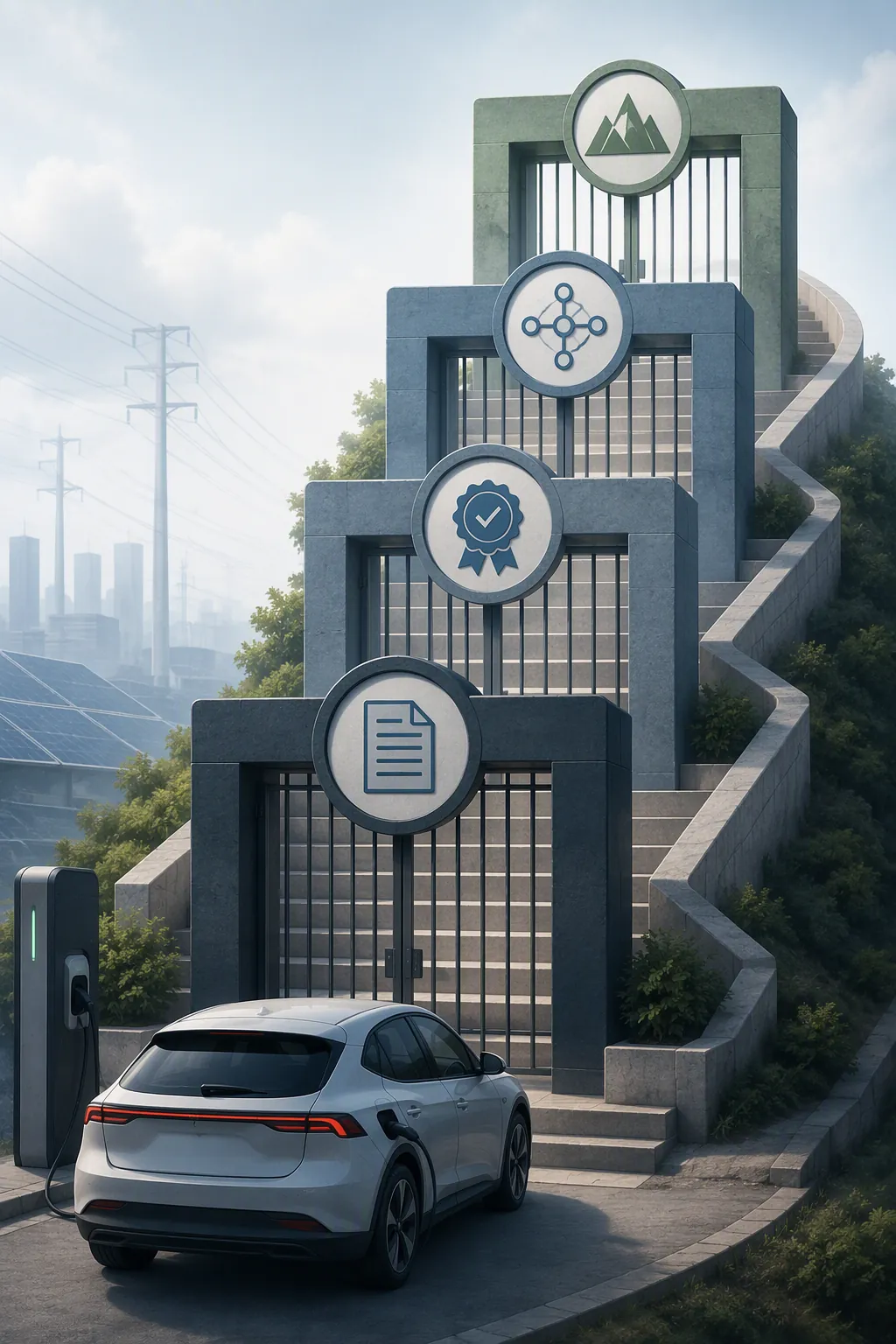
That distinction matters because Massachusetts is now past the stage where “no program exists” is the main answer. The state has DPU-approved utility EV program dockets, a MassCEC V2X demonstration, and a ConnectedSolutions pathway that public reporting says now includes vehicle-to-grid participation.[1][2][3] The hard part is no longer naming the technology. It is matching each authority to the moment when it actually binds: the utility’s program approval, the site’s interconnection agreement, the customer’s VPP enrollment, and any separate clean peak registration.
The DPU orders are necessary, but they are not a site license
The DPU program orders are the obvious place to start because they are large, formal, and utility-specific. In December 2022, Massachusetts approved major EV charging program investments for the investor-owned utilities: Eversource Phase II at about $188 million, National Grid Phase III at about $206 million, and Unitil Phase I at about $998,000, for a combined program scale commonly described as roughly $394 million.[1][2] For a developer, fleet operator, or school district, that looks like a green light. Administratively, it is only the first one.
Those approvals gave the utilities authority to run EV charging programs and spend approved funds under DPU oversight. They did not, on the information available in the cited public materials, create a blanket residential right to export vehicle battery power to the distribution system. That gap is why the July 2026 ConnectedSolutions modification matters: it is described in public reporting as adding V2G to an existing utility demand response and VPP structure, giving customers a more recognizable enrollment channel than a standalone V2G tariff would have provided.[2]
The distinction is not semantic. A DPU-approved utility program can authorize a utility to offer make-ready support, incentives, or a demand response product. A particular participant still has to show that the equipment can interconnect, that the meter can support the applicable accounting, and that the customer qualifies under the utility’s enrollment rules. If a residential customer with rooftop solar is excluded because the meter cannot distinguish exports, the DPU program approval has not failed; a different layer of the stack has stopped the deployment.
Interconnection is the point where V2G stops being an EV charger
The installation-level barrier is easy to understate because the same wall-mounted box may look like ordinary charging equipment. Once the equipment can discharge to the grid in parallel with the distribution system, the Massachusetts EV Charger Authority’s regulatory analysis treats the installation as a distributed generation resource requiring a separate interconnection agreement; standard EVSE interconnection treatment does not carry the project through V2G operation.[4]
That classification changes the work plan. The participant is no longer only installing load. The utility has to evaluate export capability, protection settings, equipment certification, and the effect of the system on the local circuit. For a single residential charger, that may be manageable if the program rules, meter configuration, and equipment listing all line up. For a school bus depot or fleet yard, the review can become a schedule item with its own risk.
The Mobility House’s account of Massachusetts V2X program installation work identifies a 200 kW AC capacity threshold: installations exceeding that level trigger a formal utility load study, adding an estimated 30 to 90 days. The report describes that timing as a real problem for school district participation because buses still have to be ready for transportation service within program deadlines.[5]
That is the kind of delay that does not show up in a broad program approval headline. A school district can be an eligible applicant, a charger vendor can have a bidirectional product, and a utility can have a DPU-approved EV program. If the interconnection study is not complete, the grid-parallel export function remains unavailable.
Certification is improving, but Massachusetts adoption is the separate question
Equipment certification is the other installation-level hinge. V2G equipment needs a certification path that lets the utility review the charger as a grid-interactive device without forcing every vehicle-and-charger pairing into a bespoke engineering argument. UL 1741 SC, published on May 21, 2026, establishes a certification pathway for AC bidirectional EVSE that does not require a specific vehicle-charger pair to be certified as one combined system.[6]
That is a significant development for review speed, but it should not be written as if it has already been imported into Massachusetts interconnection practice. The source materials support the narrower conclusion: UL 1741 SC now exists, and industry stakeholders view it as an important enabler. They do not establish that Massachusetts utilities are already required to accept UL 1741 SC-certified AC bidirectional chargers under a revised statewide interconnection rule.
ConnectedSolutions gives V2G a practical enrollment route
The July 2026 ConnectedSolutions expansion is important because it places V2G inside an existing utility demand response and VPP program rather than making every customer wait for a bespoke V2G construct. Public reporting on the expansion says adding V2G to the existing ConnectedSolutions model shortened the estimated regulatory approval-to-customer enrollment path from about 2 to 3 years for a standalone approach to about 6 to 12 months.[2]
That time saving is plausible for a simple administrative reason: the program already has utility administrators, customer enrollment procedures, dispatch logic, and payment machinery. A V2G resource still has to qualify, but it is being slotted into a known program architecture. For residential customers and small fleets, that is more useful than an abstract declaration that bidirectional charging is favored policy.
ConnectedSolutions enrollment should still be kept in its lane. It is not the interconnection agreement. It is not the equipment listing. It is not the meter configuration. It is the program layer that tells the customer how the utility will dispatch the resource and compensate performance once the other prerequisites have been satisfied.
The residential stress test is rooftop solar
The net metering gap is where the stack becomes concrete. A residential customer can be exactly the kind of participant a V2G program wants: an EV in the garage, a bidirectional charger, interest in dispatch payments, and a utility program open for enrollment. If that same customer already has rooftop solar behind a single residential meter, the program may not be able to tell whether exported electricity came from the solar array or the vehicle battery.
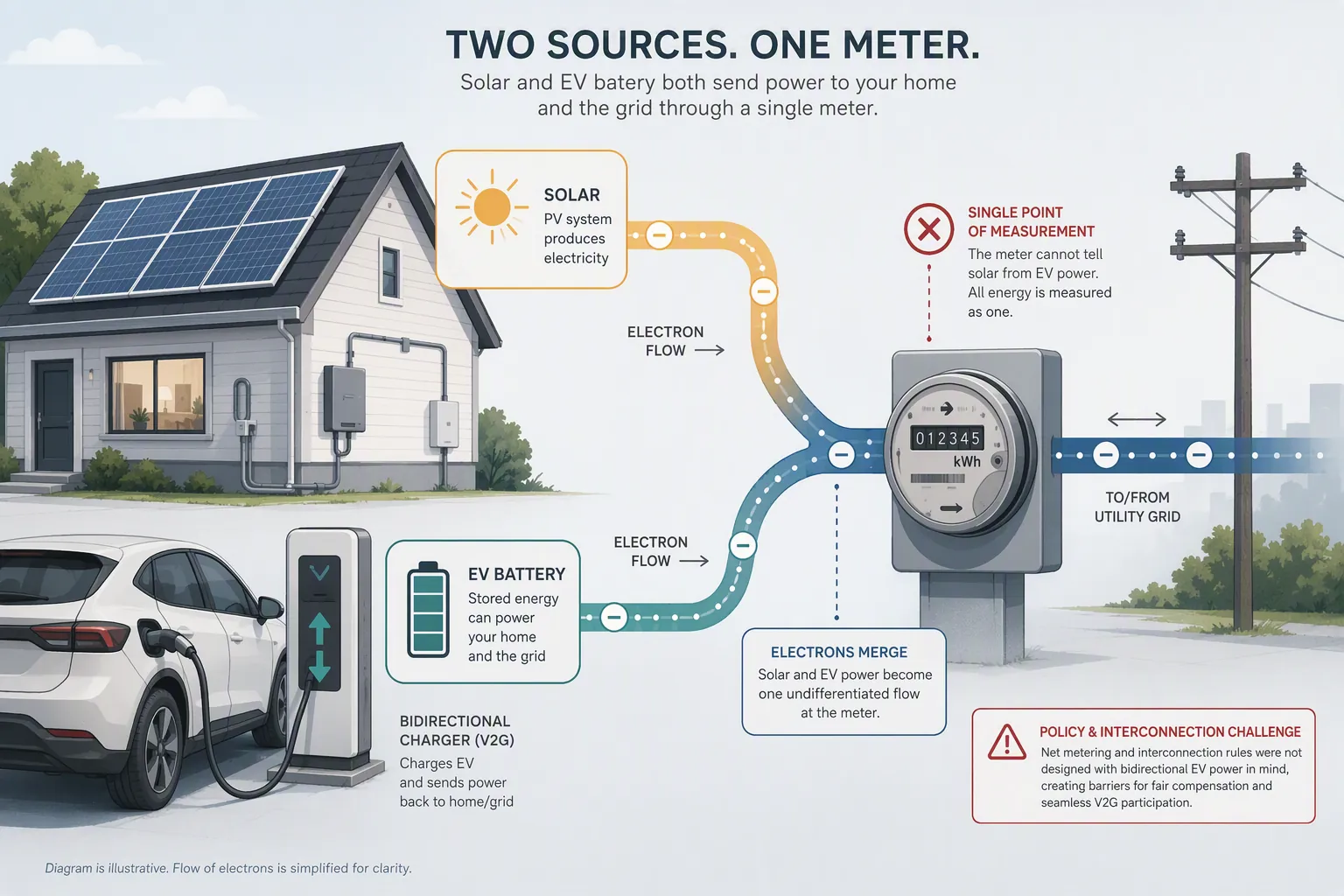
Autonocion reported in June 2026 that MassCEC disqualified roughly 75% of nearly 300 residential V2X demonstration applicants because they had pre-existing rooftop solar and Massachusetts investor-owned utility territories lacked a methodology to separate solar-generated exports from battery-discharge exports at a single meter.[7] That figure should be treated as a credible reported estimate attributed to a program-manager comment, not as a confirmed MassCEC published statistic. Even with that caveat, it identifies the practical cliff: the metering rule can erase most of the residential applicant pool before equipment or customer interest is the binding constraint.
The issue is not that rooftop solar makes V2G physically impossible. It is that compensation and eligibility rules need auditable export attribution. If the program pays for vehicle battery discharge but the meter records only a combined net export, the utility and program administrator cannot confidently assign the export to the compensated resource. Until that accounting problem is resolved, a residential participant with solar may be legally and administratively unavailable even if the charger works.
Backup-only V2H is a different permission
The backup-only carveout should not be confused with V2G approval. The Mobility House describes grid-isolated vehicle-to-home operation as able to coexist with net metering and avoid interconnection review because the system operates only as backup when the grid is down, not as a grid-parallel export resource.[5] That can be valuable for customers and for school bus operators that need a functional installation while waiting on export approval. It does not prove that the same site is cleared to send energy back to the distribution system during utility dispatch events.
Clean Peak Standard participation sits after the main gates
The Clean Peak Standard is worth tracking, but it is not the central approval for most V2G market entry questions. Canary Media reported clean peak energy certificate values around $65 per MWh in 2026, with estimated annual revenue of about $15 to $100 without discharge and more than $100 with discharge, materially lower than the payments available through ConnectedSolutions-style VPP participation.[8]
That makes Clean Peak a possible additional compensation layer, not a substitute for DPU program authority, interconnection approval, or VPP enrollment. A project that cannot export because it lacks an interconnection agreement, or cannot enroll because its meter cannot separate solar and vehicle discharge, does not become operational because a separate clean peak value stream exists.
What the approval file should show
For counsel or a compliance officer reviewing a Massachusetts V2G deployment, the file should not stop at the state pilot announcement or the utility program brochure. The documents should show where each permission attaches and who granted it.
- Program authority: the relevant DPU-approved utility program or tariff basis, including whether the customer is participating through ConnectedSolutions or another approved utility offering.
- Site interconnection: the executed or approved interconnection agreement for grid-parallel export, with any study requirements, protection settings, and utility conditions.
- Equipment certification: the charger’s applicable UL/IEEE certification status and how the utility is treating that certification in the interconnection review.
- Enrollment approval: the utility VPP enrollment confirmation, dispatch obligations, customer payment terms, and any aggregation or telemetry requirements.
- Metering and net metering status: a determination that exports can be measured and attributed in a way that satisfies the program, especially where rooftop solar is already present.
- Optional clean peak registration: documentation only if the project is pursuing Clean Peak Standard value in addition to utility VPP compensation.
Massachusetts now has a workable V2G pathway emerging through DPU-administered utility programs and ConnectedSolutions. It is still conditional. Grid-parallel operation depends on interconnection treatment, equipment certification acceptance, utility enrollment, and a fix for the residential net metering gap that now blocks many solar-equipped homes from participating.
References
- DPU’s electric vehicle charging resources — Mass.gov
- Vehicle-to-grid added to Massachusetts utilities’ ConnectedSolutions demand response VPP — Energy-Storage.News
- Vehicle-to-Everything Demonstration — MassCEC
- Utility Interconnection for EV Chargers in Massachusetts — Massachusetts EV Charger Authority
- Massachusetts V2X Program Installation — The Mobility House
- Articles — Vehicle Grid Integration Council
- Massachusetts pilot EVs — Autonocion, June 2026
- Massachusetts V2X grid batteries — Canary Media
Operationalizing workflow
No workflow has been explicitly linked to this obligation yet. See Workflows generally.
Illustrative cases
No illustrative case is currently tracked for this obligation. See Risk Digest for documented incidents generally.
← Back to RegulationReport a correction or tip
Spotted an outdated figure, a misstated fact, or a ruling this regulation entry should reflect? Public comments are disabled for this content given the professional cost of a misreported case outcome, penalty amount, or rule text — use the structured correction channel instead.
Report a correction or tip for this record →