
Medicaid Work Requirement Ruling Compresses AI Testing Window
- Authority
- U.S. District Court
- Rule type
- standing order
- Jurisdiction scope
- US federal
- Effective date
- Jul 30, 2026
- Source text
- Read primary rule text ↗
Implement Medicaid work verification by January 1, 2027 and notify enrollees by August 31, 2026
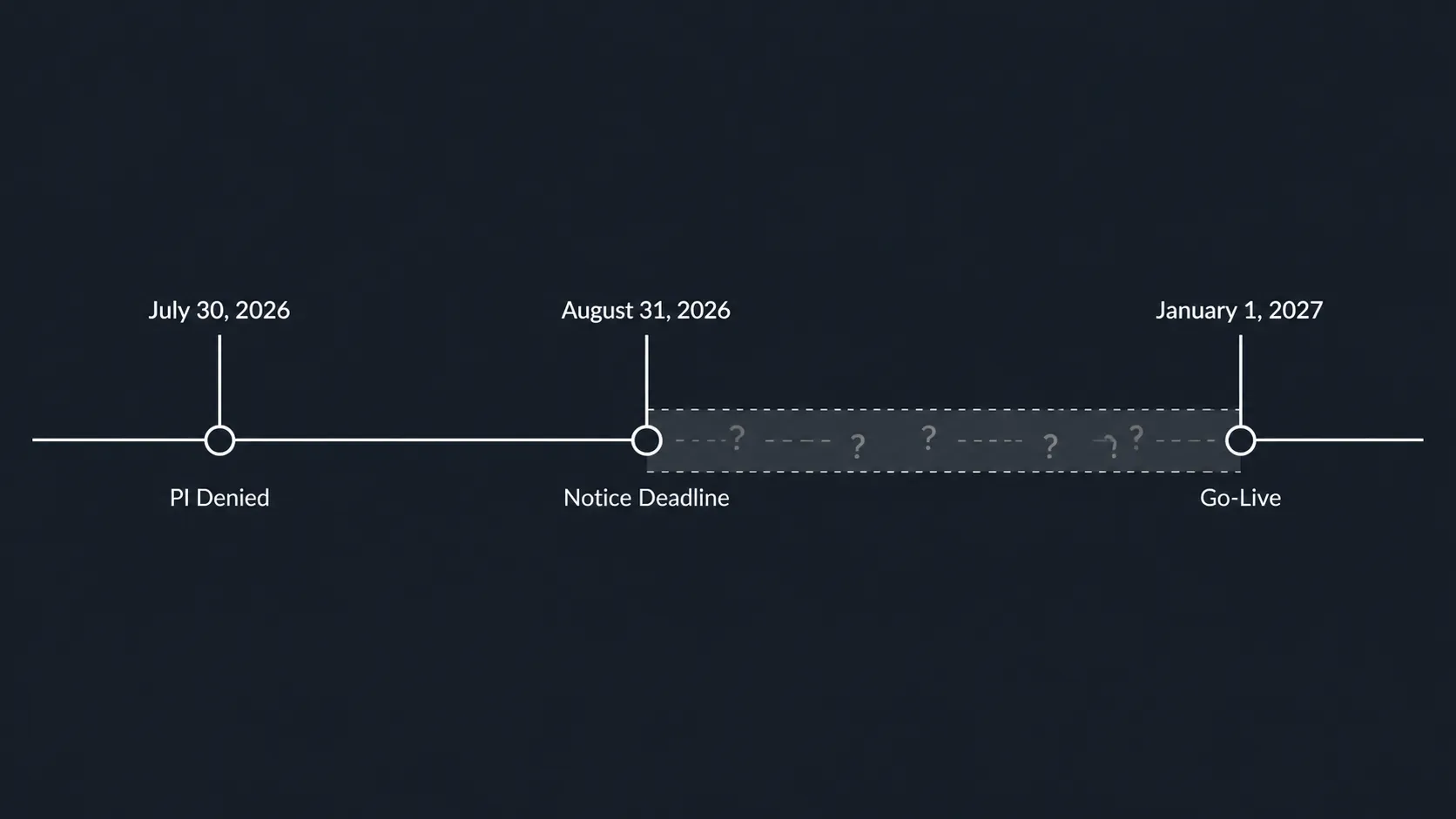
The July 30 denial of preliminary relief in Commonwealth of Massachusetts v. Oz did not decide the merits of Medicaid work requirements. It did something more immediate for the states, contractors, and lawyers building the record: it left the implementation clock running. States now face an August 31, 2026 enrollee-notice deadline and a January 1, 2027 go-live date for the work-requirement regime, with litigation continuing behind the operational schedule.[1][2]
That timing is what gives the Medicaid work requirement court ruling its AI significance. The legal exposure is not created by the word “AI” in a procurement document. It is created when automated systems are asked, on a compressed schedule, to classify exemptions, verify income, read documents, route appeals, and communicate eligibility consequences before there is a public record showing that the systems can do those tasks accurately and explainably.

The Ruling Turned Procedure Into an Implementation Record
A preliminary-injunction denial is often described as a litigation event. Here, it is also an evidence-preservation event. Every implementation memo, vendor assurance, testing exception, training script, chatbot transcript, and escalation rule generated between late July and January can become the record used later to test whether enrollees received adequate notice and meaningful review.
| Date | Operational consequence | AI-risk significance |
|---|---|---|
| July 30, 2026 | Preliminary injunction denied; case proceeds while implementation continues | States and vendors lose the practical pause that would have allowed more pre-launch validation |
| August 31, 2026 | States must notify affected enrollees | Notice language, chatbot scripts, exemption prompts, and documentation instructions begin creating reliance evidence |
| January 1, 2027 | Work-requirement implementation date | Eligibility systems must be ready to classify exemptions, process compliance data, and support adverse-action review |
CBPP has emphasized that federal guidance and implementation support arrived only months before go-live, while CMS committed to 90% federal reimbursement for qualifying IT costs.[2] That reimbursement may help states buy or configure systems. It does not, by itself, answer the question that later litigation will ask: what did the state know about the system’s failure modes before it used them to affect coverage?
The projected scale matters, but it should not obscure the mechanics. CBPP, citing Urban Institute projections, reports that the work requirement alone could lead to 3 million to 7 million coverage terminations in 2028.[2] A number that large will attract policy attention. The future record, however, is likely to be built out of smaller incidents: a frailty exemption screened out; a consent form abandoned; an income match treated as complete; a document misread; a chatbot response later contradicted by a termination notice.
The AI Exposure Is Not One System
The useful way to read the implementation risk is by function, not by vendor label. A state may say that no AI tool makes an adverse eligibility determination and still rely on automated tools that shape the evidence reaching the human reviewer. That distinction is where many “human reviewed” defenses become vulnerable.
- Medical-frailty and exemption screening: systems identify who may be excused from work-reporting obligations.
- Consent-based verification: systems seek enrollee authorization to obtain income or work-related information from outside sources.
- Document classification: systems read uploads, categorize proof, and decide whether a submission is complete enough for review.
- Chatbot and notice communications: systems tell enrollees what they must do, what counts, and what happens if they do not respond.
Missouri’s reported planning illustrates the point. The Beacon described a state implementation model involving AI-supported document processing, chatbot communications, and eligibility-workflow assistance, while also reporting the state’s position that no AI tool makes adverse eligibility determinations.[3] That representation is not trivial. It is the kind of statement that later becomes testable against routing logs, override rates, caseworker scripts, and examples where the human review accepted the automated classification without independent analysis.
The state count remains fluid. The Beacon reported six states through a Source NM account that was not available for independent review: Missouri, New Mexico, Maryland, Arkansas, Kansas, and Oklahoma.[3] That should be treated as an early signal, not a complete map. The stronger point is narrower: at least some states are moving from general modernization language into concrete AI-assisted work-requirement workflows before any public, independent accuracy audits of those tools have been published.
Medical Frailty Is Where Classification Becomes Legal
The exemption screen deserves more attention than it usually gets. Georgetown CCF reported that the interim final rule narrowed “medically frail” from five statutory categories to a single impairment standard.[4] That is not just a policy choice about the size of an exemption. It changes the system’s classification task.

A broader exemption category can tolerate more paths into human review: diagnosis, functional limitation, treatment status, disability-related evidence, or state-record indicators. A narrowed impairment standard asks the system to recognize something more legally specific. If the screening model, rules engine, or document classifier misses the signal, the enrollee may be treated as subject to work reporting before anyone has meaningfully reviewed whether the person belongs in the exempt population.
That matters because medical frailty is not a clean database field in many files. It may appear in prior eligibility records, managed-care data, provider statements, disability-related documentation, behavioral-health history, or a document uploaded by an enrollee who does not know which phrase the system expects. The risk is not that every automated screen will be wrong. The risk is that the agency’s own implementation design may make the error hard to see until after coverage is interrupted.
The evidentiary questions follow naturally. What training or validation set was used to test the exemption classifier? Did it include people with disabilities, limited English proficiency, behavioral-health conditions, or unstable documentation histories? What happened to cases the system marked as incomplete? Were reviewers shown the underlying document or only the extracted label? How often did humans reverse the tool’s classification? If the answer is that these questions were still being worked out in the fall of 2026, the implementation timeline becomes part of the liability theory.
Consent-Based Verification Has Already Produced a Warning Record
Consent-based verification can look administratively modest: ask the enrollee for permission, connect to outside income or work data, reduce paperwork, and spare the agency from manual processing. The Louisiana pilot of CMS’s “Emmy” tool is a useful caution because the failure point was not merely whether the technology existed. KFF Health News reported that only 894 of 13,000 enrollees completed the process, a completion rate of about 7%.[5]
That figure does not prove that every consent-based verification system will fail. It does show why completion data belongs in the legal record. If a state treats noncompletion as evidence that an enrollee failed to comply, the agency will need more than a vendor diagram showing that the workflow was available. It will need to show what the enrollee was told, whether the request was understandable, whether the consent flow worked on the devices people used, what happened after failed attempts, and whether nonresponse was separated from refusal.
Document handling creates a related problem. An uploaded pay stub, medical note, school schedule, caregiving statement, or employer letter may be legible to a person but poorly classified by an automated system. If the state’s workflow converts that misclassification into an incomplete-file status, and the notice later tells the enrollee only that proof was missing, the procedural problem is no longer abstract. The person cannot correct the real error because the state has not disclosed it.
The Deloitte/Texas Complaint Shows the Litigation Template
The closest comparison is not a work-requirement case; it is the record advocates assembled around Medicaid renewal automation in Texas. A Milbank Quarterly opinion piece discussing the NHeLP, EPIC, and Upturn FTC complaint against Deloitte’s Texas Medicaid system reported a 2.9% ex parte renewal success rate and 1.8 million people removed from the rolls.[6] Those figures were used to frame the problem as more than disappointing modernization. They supported an argument that system design, opaque automation, and mass removals could become consumer-protection and benefits-law issues.
The work-requirement implementation record invites the same style of proof. Plaintiffs and regulators will not need to show that a model was sentient, autonomous, or branded as artificial intelligence. They will look for the operational chain: the system failed to renew, classify, match, or communicate; the human reviewer did not catch the failure; the notice did not explain the real reason; the enrollee lost coverage or had to navigate reinstatement after the fact.
The FTC complaint also matters because it gives counsel a vocabulary for attacking the gap between a safeguard on paper and a safeguard in practice. If a vendor says a caseworker remains in control, the next question is what the caseworker actually sees. If the state says the system only recommends, the next question is how often the recommendation is accepted, overridden, or reviewed without meaningful source documents. If the notice says the enrollee failed to respond, the next question is whether the enrollee was ever given a usable way to respond.
Section 1557 Adds a Separate Route Into the Same Record
The 2024 HHS Section 1557 final rule is not a rule against public-benefits automation. It is more specific than that. The rule requires covered health programs and activities to assess patient-care decision support tools, including automated or AI-enabled tools, for nondiscrimination concerns.[7] For Medicaid work-requirement systems, that matters because the most legally sensitive functions are also functions that can distribute errors unevenly.
A medical-frailty classifier can miss disability-related evidence. A consent-based verification flow can fail more often for people with limited English proficiency, low digital literacy, unstable internet access, or distrust of data-sharing prompts. A document classifier can perform differently on handwritten notes, nonstandard employer letters, or translated materials. A chatbot can provide incomplete instructions to people who need accommodations or language assistance. None of those possibilities proves a Section 1557 violation by itself. They do explain why validation evidence cannot stop at aggregate accuracy.
The practical significance is that the same facts can serve more than one legal theory. A failed exemption screen may support a due-process argument if the notice and review process are inadequate. The same failure may support a nondiscrimination inquiry if the tool was not assessed for foreseeable disparate effects in a covered health program. The implementation record will decide whether the state can show that it looked for those risks before deployment, not merely after complaints arrived.
Best-Practice Work Is Still Chasing the Deployment Calendar
The Coalition for Health AI’s July 2025 announcement that it would convene a tiger team on AI best practices for Medicaid work requirements is useful mostly as a timestamp.[8] It signals that the need for implementation standards was recognized before state systems were deployed at scale. It does not establish that any state’s January 2027 system is safe, and it does not establish that the systems will fail.
The uncomfortable point is simpler: best-practice development, federal implementation pressure, vendor configuration, enrollee notice, and legal defense preparation are all occurring in the same narrow window. That is not how a careful administrative record is usually built. It is how a record later contains phrases such as “interim process,” “manual workaround,” “post-launch monitoring,” and “caseworker discretion,” each of which may be defensible in isolation and damaging in sequence.
What the January Record Will Have to Show
The next wave of disputes will likely turn less on whether a state used AI than on whether the state can reconstruct what the AI-assisted workflow did to a particular person’s file. Counsel will be looking for validation evidence, audit trails, exemption-review documentation, consent-based verification failure data, and the internal materials showing whether human review was substantive or decorative.
The danger is not automation as an abstraction. It is the deployment of still-untested systems in functions where erroneous classification, failed consent flows, misread documents, and misleading communications can deprive people of benefits without adequate notice or meaningful review. The July 30 ruling made that danger harder to manage because it turned the months before January 1 into both a launch period and an evidentiary record.
References
- Commonwealth of Massachusetts v. Oz litigation tracker, Georgetown Center for Children and Families, https://ccf.georgetown.edu/
- States Need More Time to Prepare for Medicaid Work Requirement, Center on Budget and Policy Priorities, https://www.cbpp.org/
- Missouri article on AI use in Medicaid work-requirement implementation, The Beacon, June 10, 2026, https://thebeaconnews.org/
- Georgetown CCF analysis of medically frail exemption in the interim final rule, Georgetown Center for Children and Families, July 2, 2026, https://ccf.georgetown.edu/
- KFF Health News investigation of CMS “Emmy” consent-based verification pilot, KFF Health News, https://kffhealthnews.org/
- Milbank Quarterly opinion piece on the NHeLP/EPIC/Upturn FTC complaint against Deloitte’s Texas Medicaid system, Milbank Quarterly, https://www.milbank.org/
- Nondiscrimination in Health Programs and Activities, Federal Register, May 6, 2024, https://www.federalregister.gov/
- CHAI coalition tiger-team announcement on AI best practices for Medicaid work requirements, STAT News, July 28, 2025, https://www.statnews.com/
Operationalizing workflow
No workflow has been explicitly linked to this obligation yet. See Workflows generally.
Illustrative cases
No illustrative case is currently tracked for this obligation. See Risk Digest for documented incidents generally.
← Back to RegulationReport a correction or tip
Spotted an outdated figure, a misstated fact, or a ruling this regulation entry should reflect? Public comments are disabled for this content given the professional cost of a misreported case outcome, penalty amount, or rule text — use the structured correction channel instead.
Report a correction or tip for this record →