
MediKids Act Explained: Healthcare Legislation for Lawyers
- Authority
- U.S. Senate
- Rule type
- statute
- Jurisdiction scope
- US federal
- Source text
- Read primary rule text ↗
Automatic Medicaid enrollment for U.S. residents under 26 via EPSDT, 100% federal funding, voluntary opt-out
Regulation & Ethics tracker status
For legal-risk purposes, the first answer is the least dramatic one: the MediKids Act does not change healthcare compliance obligations today. S. 5037 was introduced on July 21, 2026, referred to the Senate Finance Committee, and GovTrack currently gives it a 0% chance of enactment in the 119th Congress.[1]
The bill is sponsored by Sen. Andy Kim and was introduced with four Democratic co-sponsors: Sens. Cory Booker, Tammy Duckworth, Alex Padilla, and Ben Ray Luján.[1][2] The available tracker sources identify no Republican co-sponsors, and no public Republican statements on the bill were found in the sources reviewed here. As of July 30, 2026, the bill also has no Congressional Budget Office score; NOTUS reported that it “does not yet have a full cost estimate.”[3]
That status matters. This is useful legislation to track because it sets out a clean statutory model for universal coverage under age 26. It is not a basis for advising a provider, insurer, employer plan, state Medicaid agency, or family-services organization that a federal compliance deadline is approaching.
What the MediKids Act would change
The important drafting move is that the bill does not create a new children’s health insurance program from scratch. It uses Title XIX of the Social Security Act and extends Medicaid’s existing Early and Periodic Screening, Diagnostic, and Treatment benefit, usually shortened to EPSDT, to all U.S. residents under age 26.[4]
That distinction is easy to miss in political coverage and important in legal reading. A new federal entitlement program would raise one set of questions: new eligibility rules, new benefit definitions, new administrative machinery, new agency guidance, and new coordination rules. The MediKids Act instead proposes to widen the population attached to an existing Medicaid benefit structure. The eligibility ambition is broad; the statutory architecture is comparatively direct.

The core components described in the public summaries are: automatic enrollment at birth, continuous eligibility until age 26, eligibility regardless of income or immigration status, 100% federal medical assistance percentage funding, and a voluntary opt-out for families with creditable alternative coverage.[3][5]
| Component | Legal significance if enacted |
|---|---|
| EPSDT as the vehicle | Expands an existing Medicaid benefit framework rather than building a separate federal children’s coverage program. |
| Automatic enrollment at birth | Moves enrollment from an application-dependent model toward default coverage for newborns. |
| Continuous eligibility to age 26 | Reduces eligibility churn for the covered age group and makes age, rather than income redetermination, the main endpoint described in the summaries. |
| Eligibility regardless of income or immigration status | Makes the covered class residence- and age-based rather than means-tested for this benefit. |
| 100% federal FMAP | Places the benefit cost on the federal side and removes the state matching requirement for the covered MediKids population. |
| Voluntary opt-out for creditable alternative coverage | Keeps participation non-mandatory for families that have qualifying other coverage. |
Why EPSDT is the hinge
EPSDT is the piece a lawyer should underline first. Georgetown’s Center for Children and Families describes the bill as using Medicaid’s EPSDT benefit as the statutory vehicle for coverage of children and young adults, rather than creating a separate program.[4] In practical terms, the bill’s simplicity comes from borrowing an existing benefit category with an established Medicaid identity.
That does not mean implementation would be simple. If enacted, agencies would still need to administer enrollment, identify the covered population, coordinate with existing Medicaid systems, manage opt-outs, and address interaction with private or other public coverage. But the legal question starts with the amendment’s placement: it would operate inside Medicaid’s Title XIX framework.
The age line also matters. The bill is not described as a general Medicaid expansion for all adults. It targets U.S. residents under 26 and attaches that group to EPSDT coverage.[4] That makes it broader than traditional child-only framing but still bounded by age. Counsel reviewing the bill should therefore resist both overstatements: it is not merely a narrow pediatric adjustment, and it is not a universal healthcare bill for the whole population.
Automatic enrollment and opt-out are designed to work together
Automatic enrollment is the coverage engine. Instead of depending on a parent, guardian, hospital, school, or caseworker to trigger an application process, the model described in the public summaries enrolls children at birth and maintains eligibility through age 26.[3][5]
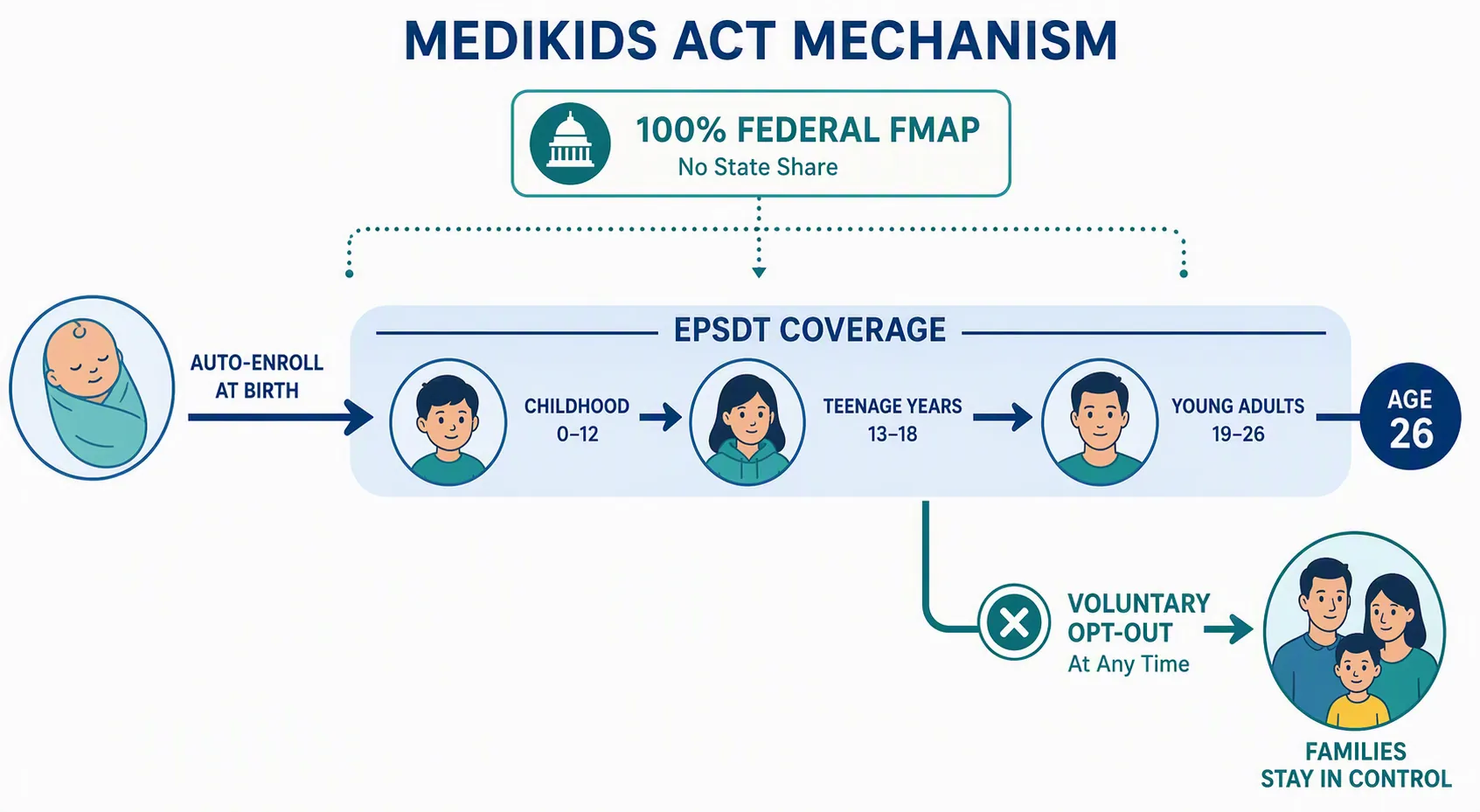
The opt-out provision is the limiting valve. The Hill and NOTUS both describe a voluntary opt-out for families with creditable alternative coverage, and the reporting frames that feature as a response to “government takeover” criticism.[3][5] The legally relevant point is narrower than the slogan: the proposal is not described as forcing every family to use MediKids coverage where creditable alternative coverage exists.
For compliance readers, that pairing is where operational questions would eventually concentrate if the bill moved. Who verifies creditable alternative coverage? How often is opt-out status updated? What happens when alternative coverage lapses? How would enrollment data move among birth records, Medicaid agencies, and coverage administrators? The available sources establish the structure, not the operational answers.
The 100% federal match is not a footnote
The bill’s 100% federal FMAP is a structural choice, not just a budget line. Medicaid normally depends on federal-state financing. By specifying full federal funding for the MediKids population, the proposal would eliminate state matching requirements for that coverage category.[3][5]
That choice does two things in the legal design. First, it reduces the state fiscal veto that often shadows Medicaid expansions. Second, it makes the missing CBO score more important, not less. A 100% federal match may simplify state participation, but it also means the federal cost is the unresolved number. As of July 30, 2026, the public sources do not provide an official CBO estimate.[3]
Until a score exists, cost claims should be treated as unpriced advocacy or opposition. The bill can be described accurately as federally funded under the summaries available. It cannot yet be described accurately as cheap, expensive, budget-neutral, or fiscally impossible on the basis of an official congressional estimate.
What legal effect would follow if it were enacted
If enacted in the form described, the bill would create a federal Medicaid eligibility pathway for all U.S. residents under 26 tied to EPSDT. State Medicaid agencies would not be deciding whether to finance that population with a state match, because the proposal provides 100% federal FMAP for the covered benefit.[3][5]
The likely legal work would sit in implementation rather than threshold entitlement design: enrollment mechanics, systems changes, coordination with other coverage, treatment of opt-outs, transition rules for people already under 26 on the effective date, and agency guidance on what counts as creditable alternative coverage. Those are not present-day obligations. They are the questions counsel would preserve for bill-text review, amendment tracking, and later rulemaking if the bill ever advanced.
Private plans and employer plan sponsors would also need a cautious reading if the bill moved, because the opt-out design assumes the continued relevance of alternative creditable coverage. But nothing in the current status requires plan redesign, notice changes, vendor contracting, or participant communication.
What it does now
At present, the MediKids Act functions as a legislative marker. It supplies a draftable model for age-based universal coverage through Medicaid’s existing architecture. It gives supporters a concrete bill number and mechanism. It may become a reference point in campaign materials, future negotiations, agency conversations, or state-level proposals. Those are real uses of a bill, but they are not the same as enactment.
The Senate Finance referral is the first procedural gate, and there is no indication in the sources reviewed that the bill has moved beyond referral.[1] In a divided 119th Congress, with no Republican co-sponsorship identified and a 0% GovTrack enactment estimate, the legal significance remains prospective.[1][2]
A prudent tracker entry would monitor four things: any Senate Finance action, any CBO score, any amendment changing the 100% federal FMAP, and any amendment narrowing or expanding the opt-out. Those are the places where the bill’s legal meaning would change fastest.
The political frame is secondary to the mechanism
Sen. Kim’s office frames the proposal as a counterpart to Medicare for seniors, a “bookend” concept that helps explain why the bill covers people at the other end of the age spectrum.[2] That framing is useful shorthand, but it should not substitute for the statutory description. Medicare is not the vehicle here; Medicaid EPSDT is.
Likewise, the opt-out provision should be read for what it does rather than made to carry an invented debate. The available reporting supports the conclusion that the opt-out is meant to make participation non-mandatory for families with creditable alternative coverage and to answer “government takeover” criticism.[3][5] It does not support broader claims about bipartisan negotiations, organized opposition, or likely vote counts.
Bottom line for counsel
The MediKids Act is sweeping in eligibility ambition and simple in statutory design: it would extend Medicaid’s existing EPSDT framework to U.S. residents under 26, pair automatic enrollment with voluntary opt-out, and fund the covered benefit through a 100% federal match. Because it sits in Senate Finance with no CBO score, no identified Republican co-sponsorship, and a 0% GovTrack enactment estimate, it belongs in a legislative-signaling tracker rather than a compliance calendar.[1][3]
References
- S. 5037: MediKids Act — GovTrack.us
- Senator Kim Introduces Landmark MediKids Legislation to Guarantee Healthcare for All Children — Office of U.S. Senator Andy Kim, July 21, 2026
- Andy Kim’s MediKids Act — NOTUS
- Senator Kim Introduces Bill to Cover All Children and Young Adults — Georgetown University Center for Children and Families, July 28, 2026
- Sen. Andy Kim MediKids proposal — The Hill
Operationalizing workflow
No workflow has been explicitly linked to this obligation yet. See Workflows generally.
Illustrative cases
No illustrative case is currently tracked for this obligation. See Risk Digest for documented incidents generally.
← Back to RegulationReport a correction or tip
Spotted an outdated figure, a misstated fact, or a ruling this regulation entry should reflect? Public comments are disabled for this content given the professional cost of a misreported case outcome, penalty amount, or rule text — use the structured correction channel instead.
Report a correction or tip for this record →