
Melilla Border Closure and the End of Sea Hot Returns
- Authority
- Spanish Supreme Court (Tribunal Supremo)
- Rule type
- Court ruling
- Jurisdiction scope
- Spain (Ceuta and Melilla border regime)
- Effective date
- Jun 29, 2026
- Source text
- Read primary rule text ↗
Sea interceptions cannot use the border-rejection fast-track; returns must follow Article 58.3 LO 4/2000 with an individual resolution, lawyer, interpreter, and asylum-related suspension.
The operative answer to the July 2026 Ceuta and Melilla return question is narrow and immediate: under STS 814/2026, Spain cannot use the Aliens Law’s border-rejection fast track for migrants intercepted at sea unless the legally relevant condition for that special regime is met — overcoming a physical border containment element. For sea interceptions, the controlling route is the ordinary Article 58.3 procedure under LO 4/2000: an individualized administrative return decision, legal assistance, interpretation, and suspension of return where asylum is requested before execution. [1][2]
| Item | Treatment |
|---|---|
| Jurisdiction | Spain; Ceuta and Melilla border-return regime under LO 4/2000. |
| Authority | Spanish Supreme Court, Administrative Litigation jurisdiction; statutory baseline in LO 4/2000. [1][2] |
| Ruling date and dissemination | STS 814/2026 was issued June 29, 2026, and disseminated by the CGPJ on July 8, 2026. [1] |
| Current source status | The Supreme Court press release and BOE statutory text are treated as primary for the legal rule; the July 30 Beni Enzar closure is treated as reported because no primary closure order was located in the materials reviewed. [1][2][3] |
| Last verified | July 31, 2026, UTC, against the sources listed in References. |
| Disclaimer | This is a legal-information obligations record, not legal advice for any individual case, detention, asylum claim, or return decision. |

What STS 814/2026 changed
The ruling’s practical importance lies in the court’s reading of the Tenth Additional Provision of LO 4/2000, the provision introduced by LO 4/2015 for “rechazo en frontera” at Ceuta and Melilla. That special regime does not attach to every attempted irregular entry near the enclaves. It attaches to the statutory situation the court identified: a person detected at the border line while attempting to overcome border containment elements. [1][2]
The facts before the court were not an abstract migration-policy dispute. The case concerned an Algerian national intercepted at sea on November 14, 2024. The administration had treated the interception as if the border-rejection fast track could apply. The Supreme Court confirmed that it could not, because the person had not overcome a physical containment element of the Ceuta or Melilla border. [1][4]
That physical-element point is doing the work. A fence, wall, or comparable barrier is a containment element. Drones and thermal cameras are surveillance tools, not containment. They can detect movement; they do not create the legal condition that activates the Tenth Additional Provision. Interception at sea therefore does not become “rechazo en frontera” merely because officers saw the swimmer approaching, tracked the person on equipment, or stopped the person before landfall. [1][4]

The distinction also keeps Ceuta and Melilla analysis from collapsing into a single border cliché. The land fence is not just scenery. It is the legal hinge on which the special regime turns. Once the event is a sea interception rather than an attempt to overcome that physical containment line, the file must move to the ordinary return route.
The file Spain needs before a sea return
For counsel advising after the July 2026 surge, the ruling changes the first classification question. The initial label is not “border rejection” simply because the person was intercepted near Ceuta or Melilla. If the person was intercepted at sea and did not overcome a physical containment element, the administration must process the return under Article 58.3 of LO 4/2000. [1][2]
- There must be an individual administrative resolution for the return, not a collective operational act treated as self-executing.
- The person must have legal assistance.
- The person must have interpretation where needed.
- If the person seeks asylum, execution of the return must be suspended while the asylum-access safeguard is engaged.
- Police custody for return purposes is subject to the 72-hour limit before judicial authorization is required.
Those are not ornamental guarantees. They determine who must be brought into the process and when: a duty lawyer before the return is executed, an interpreter before the person’s statement becomes procedurally meaningful, and an asylum channel before removal can lawfully proceed where protection is requested. [2]
That is why the Civil Guard reaction matters more than the usual party commentary. After the July surge, Civil Guard sources were reported as saying, “Right now we cannot return them,” pending usable Interior Ministry instructions. The statement converts the Supreme Court’s holding into an operational constraint: officers may intercept at sea, but interception does not itself supply the legal file needed for immediate return. [5]
The Interior Ministry’s reported explanation that smuggling networks were exploiting the ruling belongs in the record, but it does not alter the obligation. It may explain why sea attempts increased or why officers faced pressure at a particular moment; it does not turn surveillance at sea into a containment element or erase Article 58.3 safeguards. [5]
The reported Beni Enzar closure is the pressure test
Anadolu reported that Spain closed the Beni Enzar crossing between Melilla and Morocco late on July 30, 2026, after a mass entry attempt. The same report attributed an estimate of roughly 300 to 400 entries to Melilla president Juan José Imbroda. Because no primary closure order was located in the reviewed materials, the closure is treated here as reported, not independently verified. [3]
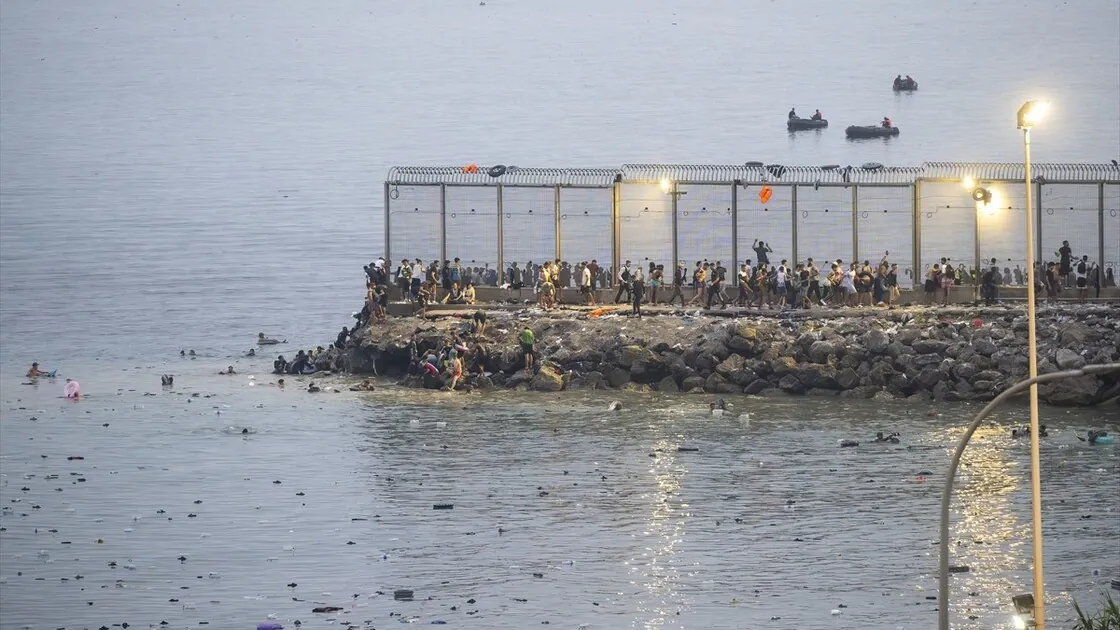
The casualty and entry record should be read with the same discipline. Anadolu attributed a death toll of 19 to a police source in its July 31 report. Other wire accounts in the materials reviewed used different figures at different points in the same news cycle, including lower July 30 tallies and later higher tallies, so the figures should not be harmonized into a single unsourced master number. [3]
The Ceuta record is fuller than the Melilla record. Reporting on sea arrivals, military support, or return preparations around Ceuta does not prove identical operational facts at Melilla. The legal rule is common because it turns on LO 4/2000 and the Supreme Court’s construction of the Tenth Additional Provision; the incident record is not equally developed for both enclaves.
A note on the judgment citation
This article cites STS 814/2026 because that is the citation used in the reviewed legal analysis and because the operative rule is checked against the CGPJ release on poderjudicial.es. A competing STS 2965/2026 shorthand has circulated outside the primary-source record reviewed here; it is not used as the authority for the holding. [1][4]
The two fronts that could still move
The first front is legislative. A Partido Popular organic-law proposal admitted by the Congress Bureau on July 23, 2026, would extend the special Ceuta and Melilla border regime to sea entries if it clears the required absolute-majority threshold. If enacted, counsel would have to read the new text against constitutional, EU, asylum, and human-rights constraints; until then, it is not the governing procedure for July 2026 sea interceptions. [6]
The second front is doctrinal. The Supreme Court left a dictum suggesting that future maritime containment elements could, in principle, reactivate the special regime at sea. EJIL:Talk! criticizes that opening, including the court’s treatment of the interceptions as occurring on the “high seas” and the absence of a fuller account of UNCLOS, SOLAS, and SAR rescue obligations. That critique is not the holding, but it is the argument practitioners should expect if Spain designs a new maritime-containment system and tries to attach the fast track to it. [4]
As the law stands on July 31, 2026, promised rapid returns from sea interceptions must be built on Article 58.3 safeguards. A different answer would require enacted legislative change, a new maritime-containment design tested in court, or a verified primary source that changes the present record.
References
- El Tribunal Supremo confirma que la ley no permite las devoluciones en caliente de inmigrantes interceptados en el mar — CGPJ / Poder Judicial, July 8, 2026.
- Ley Orgánica 4/2000, de 11 de enero, sobre derechos y libertades de los extranjeros en España y su integración social — BOE.
- Spain closes Melilla border crossing with Morocco after mass entry attempt — Anadolu Agency, July 31, 2026.
- The Spanish Supreme Court on Rejection at the Borders of Ceuta and Melilla: What About Human Rights at Sea? — EJIL:Talk!.
- Right now we cannot return them — Morocco World News / eldiario.es.
- The Supreme Court sets the limit for hot returns while Spain prepares returns from Ceuta — El Constitucional.
Operationalizing workflow
No workflow has been explicitly linked to this obligation yet. See Workflows generally.
Illustrative cases
No illustrative case is currently tracked for this obligation. See Risk Digest for documented incidents generally.
← Back to RegulationReport a correction or tip
Spotted an outdated figure, a misstated fact, or a ruling this regulation entry should reflect? Public comments are disabled for this content given the professional cost of a misreported case outcome, penalty amount, or rule text — use the structured correction channel instead.
Report a correction or tip for this record →