
Did Miami-Dade’s Board Follow the Law When It Ended Free School Lunch?
- Authority
- Florida State Legislature
- Rule type
- statute
- Jurisdiction scope
- US state
- Source text
- Read primary rule text ↗
Consider recommendations and fix meal prices under Florida Statutes §595.405
The first legal problem with Miami-Dade’s free school lunch eligibility changes is not that the district lost its districtwide free-meal status. On the available record, that appears to be the predictable result of a federal eligibility formula moving against the district. The sharper question is whether the School Board could implement the resulting meal-pricing transition through a consent-agenda item, reportedly without board discussion, when Florida law separately assigns local boards duties over school-food-service policy, recommendations, pricing, and certain public meal-access decisions.
That question starts with the July 22, 2026 meeting. Press accounts describe the meal-pricing change as Agenda Item D-71, placed on the consent calendar, with no board discussion and only Nancy Vega, identified as a PTA Council vice president, slated to speak.[1][2] The underlying agenda PDF is publicly linked, but because the document was not fully crawlable for this review, the fair way to frame the issue is procedural risk rather than a definitive record finding.[3]

Consent agendas are not unlawful merely because they are efficient. Large districts use them because school-board packets are enormous, staff deadlines are real, and some items are genuinely routine. But “routine” is doing too much work when the item changes who must apply for meals, who pays, which campuses remain covered, and what families must do before the school year begins.
For other Florida districts watching Miami-Dade, the legal analysis therefore has two parts. First, what did federal law make unavoidable? Second, what did Florida law still require the local board to consider and document before families were moved from universal access to application-based eligibility?
What Federal Policy Changed, And What It Did Not Decide
Miami-Dade’s districtwide status turned on the Community Eligibility Provision, commonly called CEP. CEP allows eligible schools or districts to serve meals at no charge without collecting individual household applications, but the federal reimbursement mechanism depends on the share of students who are directly certified through participation in programs such as SNAP.
That detail matters because direct certification is not the same thing as family need. It is an administrative match. When fewer households appear in SNAP or related benefit databases, the pool of directly certified students can shrink even if many children remain economically vulnerable. That is the legal hinge in Miami-Dade: the district’s direct-certification percentage reportedly fell from 64% in 2022 to 45.1% in 2026, below the 62.5% federal districtwide CEP threshold.[4]
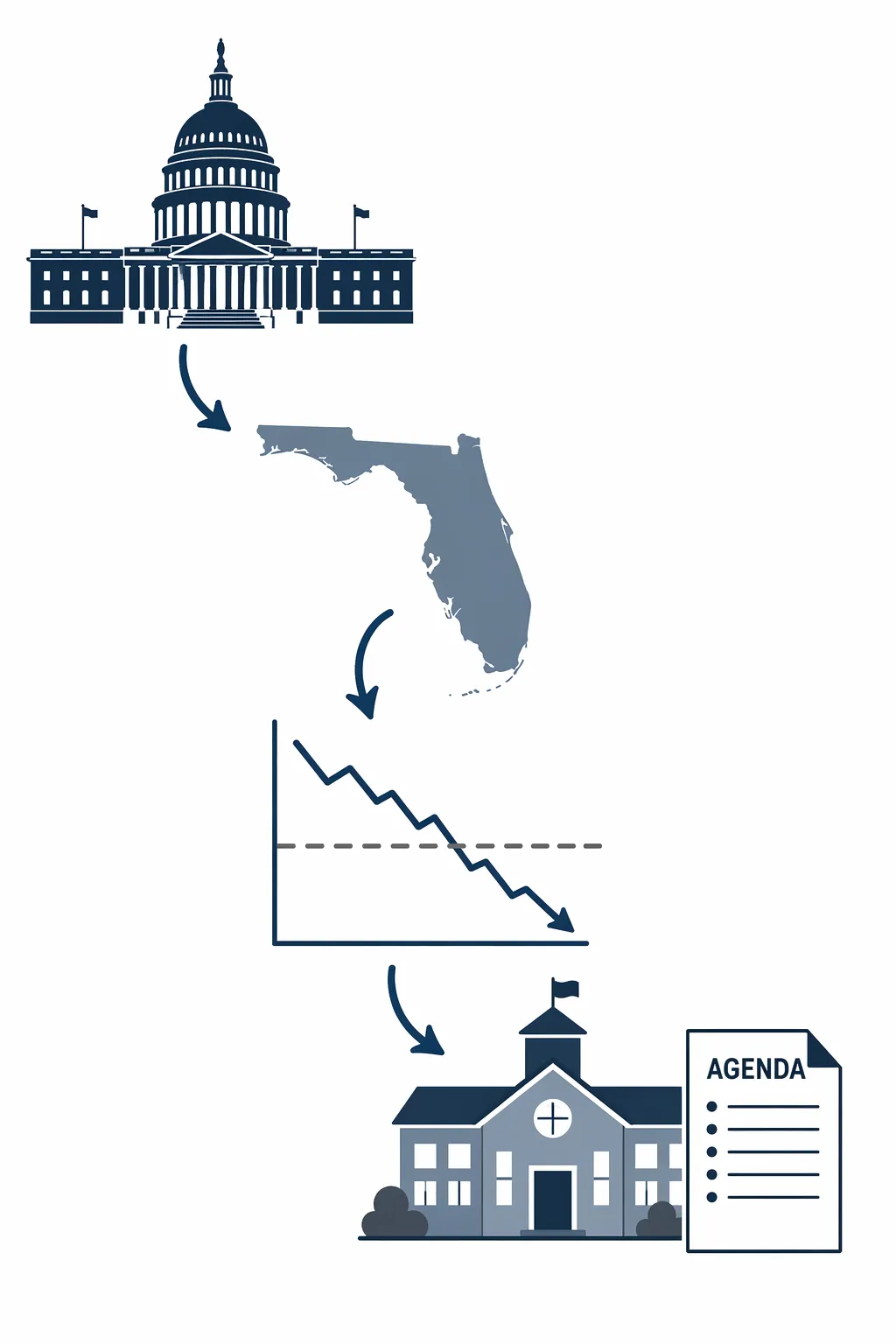
The upstream chain is not subtle. Analyses of H.R. 1, the One Big Beautiful Bill Act, describe a large SNAP reduction, followed by declining SNAP participation in Florida and Miami-Dade, which then reduces the population that can be directly certified for school meals.[5][6] Florida Policy Institute reported that SNAP participation in Florida fell by about 10%, or 277,513 people, from July through December 2025 after Congress enacted the program cuts.[5] The same line of reporting and analysis identifies a roughly 10% Miami-Dade SNAP decline over the relevant post-H.R. 1 period, with school-meal eligibility affected through the direct-certification mechanism.[5][6]
That sequence is important because it keeps the legal analysis honest. A school board does not control Congress’s SNAP eligibility choices. It does not control whether federal law reduces Medicaid or SNAP enrollment, and it does not control the mathematical consequence of falling below a federal districtwide CEP threshold. If Miami-Dade no longer qualified for districtwide CEP, the board could plausibly say it was not choosing to end universal lunch as a policy preference; it was adjusting to federal funding rules.
But that answer only resolves causation. It does not resolve compliance.
The Local Decision Was The Implementation Path
Once the districtwide CEP number fell below the threshold, Miami-Dade still had implementation choices to make. Which campuses remained individually eligible? What prices would be charged elsewhere? How would the district treat students during the transition? What notice would families receive? What application deadline would be operationally meaningful rather than merely announced?
The transition facts show why those choices are not clerical. Miami-Dade reportedly will continue free meals at 121 campuses that remain individually CEP-eligible, while families at other schools receive a 30-day grace period and must apply for benefits by Aug. 10, 2026.[7] That is a differentiated implementation plan, not a single automatic switch thrown by federal law.
A 30-day grace period may be sensible. Maintaining CEP at 121 campuses may be exactly what federal rules permit and local equity requires. The point is narrower: these are the sorts of administrative judgments that should leave a board record. When the record consists mostly of a consent item and press accounts of no discussion, the district has made later legal review harder for itself.
Chapter 595 Does Not Let The Board Vanish Behind The Formula
Florida Chapter 595 is not just a funding pass-through statute. Section 595.405(1) provides that each district school board “shall consider recommendations” from the district school superintendent and adopt policies necessary to provide food-service programs.[8] That language is modest, but it is affirmative. The board must consider recommendations; it is not merely a filing cabinet for staff’s federal-program calculations.
The statute also speaks directly to pricing. Section 595.405(3) requires school boards to fix prices for meals and food items so that the food-service program defrays costs without requiring allocations from the district operating fund, unless the board approves lower rates.[8] That provision matters in a CEP exit because the board is not simply announcing that free meals have ended. It is setting, approving, or accepting a pricing structure under a state statute that contemplates board action.
The best district response is obvious and not frivolous. Miami-Dade can argue that D-71 was ministerial in the practical sense: federal reimbursement rules changed the districtwide CEP position; staff identified the campuses that remained eligible; the board had to approve the resulting pricing schedule before school opened. Nothing in §595.405(1) says the board must debate every school-food-service recommendation aloud, and nothing in §595.405(3) says lunch pricing requires two meetings.
That argument may carry weight. Florida courts are not likely to invent a hearing requirement from thin air simply because a subject is important. But a consent-agenda vote with no apparent discussion creates a different problem: how does the district show that the board actually considered the recommendations required by §595.405(1), or made the pricing judgment contemplated by §595.405(3), rather than merely receiving a bundled administrative item?
The Breakfast Opt-Out Provision Is The Statutory Warning Light
The strongest procedural analogy sits in the same statute. Section 595.405(5) requires each elementary, middle, and high school in which 80% or more of students are eligible for free or reduced-price meals to make breakfast available at no charge, unless the district school board, after considering public testimony at two or more regularly scheduled board meetings, votes to opt out.[8]
That subsection does not directly govern districtwide lunch pricing. It would be too aggressive to say that a breakfast opt-out procedure automatically applies to every lunch-access change. The Legislature knew how to write a two-meeting public-testimony requirement, and it placed that requirement in a specific breakfast provision.
Still, the contrast is legally useful. Chapter 595 treats meal-access decisions affecting high-need student populations as board-level matters, not as invisible administrative housekeeping. When one subsection requires public testimony at two meetings before a board may retreat from universal free breakfast at qualifying schools, a district should be cautious about using an unexplained consent item for a lunch-pricing transition that affects families across many campuses.
That is not a settled violation theory. It is a process-risk theory. The risk is that a reviewing body, auditor, parent litigant, or state agency could ask whether the board record shows meaningful statutory consideration when a major meal-access change was adopted silently.
Why The Consent-Agenda Record Is Thin
A defensible record would not need speeches from every board member. It would need enough to show the required work was done. For a CEP exit, that work includes the direct-certification calculation, the campus-level CEP analysis, the pricing rationale, the treatment of the grace period, the family-notice plan, and the recommendation that the superintendent actually placed before the board.
Based on the reported July 22 posture, the public-facing process appears to have done little of that work in open session. The meal-pricing transition was reportedly placed on consent, drew no board discussion, and had only one PTA speaker slated.[1][2] If the staff memorandum behind D-71 contained the full analysis, that may help. But a packet item is not always the same thing as a board record demonstrating consideration, especially when the item is grouped with matters presented for noncontroversial approval.
This is where school-board lawyers tend to separate legality from optics. The problem is not that the board failed to perform public empathy. The problem is that the statutory verbs are active. “Consider recommendations” and “fix prices” are not dramatic requirements, but they are requirements. A silent consent vote may satisfy them in some circumstances; it is a weaker vehicle when the decision changes meal access for families who must now locate, complete, and trust an application process under deadline.
Family Impact Matters Because It Tests The Implementation, Not Because It Rewrites CEP
The national numbers explain why this issue will not stay in Miami-Dade. Center for American Progress reported that more than 700,000 children lost SNAP across 12 reporting states from July 2025 through May 2026.[6] Bread for the World, relying on its analysis of Congressional Budget Office material, reported an estimate that 96,000 children per month would lose access to school meals as a direct result of H.R. 1.[4]
Those figures do not prove that any particular Florida board violated Chapter 595. They do show why direct-certification deterioration is likely to recur. The problem is structural: when benefit enrollment falls, school-meal administration inherits the loss.
The future Medicaid piece points in the same direction, though it should be treated as a risk signal rather than a present Miami-Dade finding. New Medicaid work-reporting requirements effective Jan. 1, 2027 are expected, according to Congressional Budget Office estimates discussed by the Center on Budget and Policy Priorities, to cause 5.2 million people to lose Medicaid coverage by 2034.[9] If Medicaid loss reduces direct-certification matches in Florida districts, more boards may face the same CEP threshold problem.
That does not make every lunch-price transition unlawful. It makes the administrative record more important.
Due Process And Equal Protection Are Secondary, Not The Main Event
Some families may experience the shift as a benefits termination. That instinct is understandable, especially for households that never had to file an application while districtwide CEP was in place. But the cleaner legal vulnerability is not a broad federal constitutional claim. School-meal benefits are not usually treated as the kind of vested property interest that makes procedural due process the leading theory, and an equal-protection claim would have to overcome the usual problems of classification, intent, and rational-basis review.
Florida’s own statutory scheme is the better fit. Chapter 595 gives the board food-service duties, pricing responsibilities, and a statutory example of public-testimony protection for meal-access changes. That is enough to ask whether the district’s process was adequate without overclaiming that every affected student has a federal constitutional entitlement to universal lunch.
A Florida District Compliance Checklist For CEP Exits
Districts facing the same federal-to-local chain should treat Miami-Dade as a warning about record-building. The following checklist is not elaborate. It is the minimum work a board should want visible before families are moved from universal meals to priced meals and applications.
- Document the direct-certification calculation. The board packet should show the current identified-student or direct-certification percentage, the prior comparison point if relevant, and the federal CEP threshold that the district no longer meets.
- Identify which campuses remain individually CEP-eligible. A districtwide CEP exit does not answer the campus-level question. The record should show which schools keep free meals and why.
- Make pricing findings under §595.405(3). The board should have a clear statement of the proposed meal prices, the cost-defraying rationale, and whether any lower-rate approval is being requested.
- Create a record that recommendations were actually considered. A superintendent recommendation, staff memorandum, or presentation should be identified in the minutes or item materials in a way that maps to §595.405(1).
- Do not bury major meal-access changes in unexplained consent action. If the item remains on consent, the packet should be unusually complete; if the family impact is broad, a regular agenda item is safer.
- Use publicly noticed discussion when the statutory analogy or family impact makes silent adoption risky. Section 595.405(5) may not control lunch pricing, but its two-meeting public-testimony requirement is a useful warning about legislative expectations for meal-access decisions.
- Build the application transition into the approval. The grace period, deadline, notice method, language access, campus responsibility, and error-correction process should be part of the board record, not left as a press-release detail.
For Miami-Dade, the bottom line is narrow but significant. The district’s loss of districtwide CEP eligibility may have been federally driven. The July 22 implementation process, as reported, still creates a credible Chapter 595 compliance question because the public record may not show the board meaningfully considered recommendations and pricing before approving a meal-access transition on consent.
Other Florida districts should not repeat that posture without a stronger record.
References
- Miami-Dade school lunch coverage, Miami Herald
- Free school lunch meals Miami-Dade schools, WLRN
- Agenda Item D-71, Miami-Dade County Public Schools
- Impacts of H.R. 1 on School Meals, Bread for the World
- Participation in SNAP Falls Sharply Across Florida After Congress Makes Drastic Program Cuts, Florida Policy Institute, June 2026
- Congressional Republicans’ Big Beautiful Bill Threatens Access to Free School Meals, Center for American Progress
- Miami-Dade County Public Schools to continue free meals at 121 campuses; other families must apply for benefits, Local10, July 24, 2026
- Chapter 595, Florida Statutes, The Florida Senate
- 2025 Budget Stakes: Proposals Would Reduce Children’s Access to School Meals, Center on Budget and Policy Priorities
Operationalizing workflow
No workflow has been explicitly linked to this obligation yet. See Workflows generally.
Illustrative cases
No illustrative case is currently tracked for this obligation. See Risk Digest for documented incidents generally.
← Back to RegulationReport a correction or tip
Spotted an outdated figure, a misstated fact, or a ruling this regulation entry should reflect? Public comments are disabled for this content given the professional cost of a misreported case outcome, penalty amount, or rule text — use the structured correction channel instead.
Report a correction or tip for this record →