
Why Microsoft's AI data center buildout is a legal docket
- Authority
- European Union
- Rule type
- regulation
- Jurisdiction scope
- EU
- Effective date
- Aug 2, 2025
- Source text
- Read primary rule text ↗
GPAI model providers must document energy efficiency; grace period to 2027-08-02; penalties up to EUR 15M or 3% of turnover.
Last verified: August 4, 2026. This is a legal-operations reference, not legal advice. The legal industry impact of Microsoft AI data center investments is no longer captured by the investment headline alone. For counsel, the usable unit is now smaller and duller: source, actor, jurisdiction, deadline, filing, commitment, penalty cap, and verification status.

The spending numbers explain why the docket exists. Reuters reported that Microsoft planned to invest $80 billion in AI-enabled data centers in fiscal 2025, with more than half of that spending expected in the United States.[1] Later market coverage put Microsoft’s Q1 FY2026 capital expenditures at $34.9 billion, described FY2026 as tracking toward more than $120 billion, and tied an $80 billion unfulfilled Azure backlog to power constraints; those FY2026 figures should be treated as earnings-derived market analysis, not statutory facts.[2][3]
| Jurisdiction / source | Trackable item | Affected actor | Controlling date or deadline | Penalty / verification status |
|---|---|---|---|---|
| Microsoft capex baseline | $80B FY2025 AI-enabled data center plan; Q1 FY2026 capex reported at $34.9B; FY2026 described as tracking toward $120B+; $80B Azure backlog tied to power constraints.[1][2][3] | Microsoft as spending anchor; counsel tracking procurement, power, permitting, financing, and AI-governance exposure | FY2025; Q1 FY2026; FY2026 estimates | No direct legal obligation from the capex number itself. Use as context, not as a deadline. |
| Wisconsin / Fairwater | Microsoft increased Wisconsin data center spending to $7B.[4] | Microsoft; local and state permitting, utility, tax, and community-review stakeholders | Reported September 18, 2025 | Project-specific legal effect depends on local approvals and filings. Verify against state and local records. |
| United States / FTC 6(b) | FTC staff report on AI partnerships and investments identified agreement features including equity and revenue-sharing, exclusivity or consultation rights, cloud-spend commitments, and access to sensitive technical and business information.[5] | Parties to covered AI partnerships and investments; counsel reviewing cloud dependence, competitive information access, and partnership governance | FTC staff report issued January 17, 2025 | Information-access and competition-risk record, not an enforcement outcome by itself. |
| United States / Ratepayer Protection Pledge | White House pledge record lists Microsoft among seven signatory companies.[6] | Microsoft and other signatories; state utility commissions and public-power counterparties may become practical review points | March 4, 2026 | Public commitment record. Track against utility filings and approval conditions; not a substitute for tariff or commission orders. |
| United States / Microsoft community commitments | Microsoft stated community-first AI infrastructure commitments; coverage described vows to cover full power costs and reject local tax breaks.[7][8] | Microsoft; host communities; local economic-development and utility stakeholders | Microsoft post dated January 13, 2026 | Company commitment. Verify project-by-project against development agreements, tariff records, and local incentive documents. |
| United States / moratorium and local-permitting friction | Quinn Emanuel alert reported 11-state and 50-plus local moratorium tallies for data center restrictions.[9] | Developers, lenders, offtakers, utilities, and local governments | Alert dated March 13, 2026 | Risk map only. Counts and cases should be traced to Good Jobs First records and local dockets before reliance. |
| European Union / AI Act GPAI energy documentation | White & Case summarized GPAI energy-efficiency documentation obligations, including August 2, 2025 applicability, a grace period to August 2, 2027, and penalties up to EUR 15M or 3% of turnover.[10] | GPAI model providers, where the rule applies; Microsoft-specific only where Microsoft is in the regulated provider position | August 2, 2025; grace period to August 2, 2027 | Penalty cap stated as EUR 15M or 3% of turnover. Verify against final AI Act text and implementing guidance. |
| European Union / EED Article 12 | Commercial compliance summary states that data center operators at or above 500 kW must report annually by May 15 and provide 24 data points.[11] | Data center operators, not Microsoft specifically unless Microsoft or a Microsoft-controlled entity is the operator | Annual May 15 reporting date | Operator-level reporting obligation. Source is a vendor blog; cross-check official EED text and national implementation. |
| Germany / EnEfG | Commercial compliance summary states PUE 1.2 for new builds from July 2026 and 100% renewable-energy requirements from January 2027.[11] | Covered data center operators in Germany | July 2026; January 2027 | German statutory compliance issue. Verify thresholds, scope, and exemptions against official EnEfG materials. |
The capex figure is the trigger, not the legal answer
A capital expenditure disclosure does not tell a lawyer who must file what, when, or with whom. It does, however, explain why regulators, utilities, and local governments have become unavoidable. Microsoft’s reported $80 billion FY2025 AI-enabled data center plan, the larger FY2026 run-rate estimates, and the Wisconsin Fairwater expansion all point to the same operational constraint: AI infrastructure now has to be converted into power procurement, interconnection planning, land-use approvals, tax positions, customer commitments, and AI-governance records.

That is why the Wisconsin number matters legally. Reuters reported that Microsoft boosted Wisconsin data center spending to $7 billion.[4] The legal question is not whether $7 billion sounds large. It is which parcels, grid upgrades, local approvals, incentive documents, environmental reviews, construction contracts, and community commitments attach to that buildout. The public investment story can be read in one sitting; the legal record will be scattered across agencies and local bodies.
The same distinction applies to the FY2026 figures. The Q1 FY2026 capex number and the $120 billion-plus trajectory are useful for explaining scale, but counsel should keep their status straight. They come through market and analyst coverage that traces back to Microsoft earnings material, and they function here as estimates or earnings-derived reporting rather than independent legal obligations.[2][3] They justify closer docketing; they do not create the docket.
United States: fewer clean statutes, more records counsel cannot ignore
The U.S. side is messier than the EU side because much of the relevant material is not a single federal compliance calendar. It is an antitrust information record, public ratepayer pledges, company-specific community commitments, utility proceedings, local moratoriums, and permitting friction. That makes it easier to under-docket. It also makes it easier to overstate. The FTC record is not the same thing as an enforcement judgment, and a company pledge is not the same thing as a commission order.
FTC 6(b): a competition-risk record, not an outcome
The FTC’s January 17, 2025 staff report is the most concrete U.S. antitrust source in this record. The agency described findings from its AI partnerships and investments study, including agreement features such as equity and revenue-sharing arrangements, exclusivity or consultation rights, cloud-spend commitments, and access to sensitive technical and business information.[5]
That record should be used carefully. It gives counsel a regulator-authored map of issues that may matter in partnership review, procurement review, cloud-dependence analysis, and competitive-information governance. It does not, by itself, establish that Microsoft or any other party violated antitrust law. Treating the 6(b) report as a completed enforcement outcome would be as unhelpful as treating the capex number as a permit.
For legal operations, the practical move is to attach the FTC report to any AI infrastructure or cloud partnership file where the agreement allocates compute access, restricts alternative cloud use, creates consultation rights, or gives one party unusual visibility into another party’s technical or business information. The point is not to predict a specific agency action. The point is to keep the document available when a partner, board committee, or procurement team asks why a cloud-credit clause or exclusivity provision has antitrust review priority.
The Microsoft-OpenAI relationship is relevant only to that extent. Stanford CodeX’s chronology of the OpenAI-Microsoft saga frames the partnership as a lesson in AI partnerships beyond formal control, and Microsoft and OpenAI later issued a joint statement on their continuing partnership.[12][13] Those materials help explain why partnership structure, cloud dependence, and governance rights draw attention. They do not replace the FTC source, and they should not be used as shorthand for a live antitrust finding.
Ratepayer and power-cost commitments need to be tracked against utility records
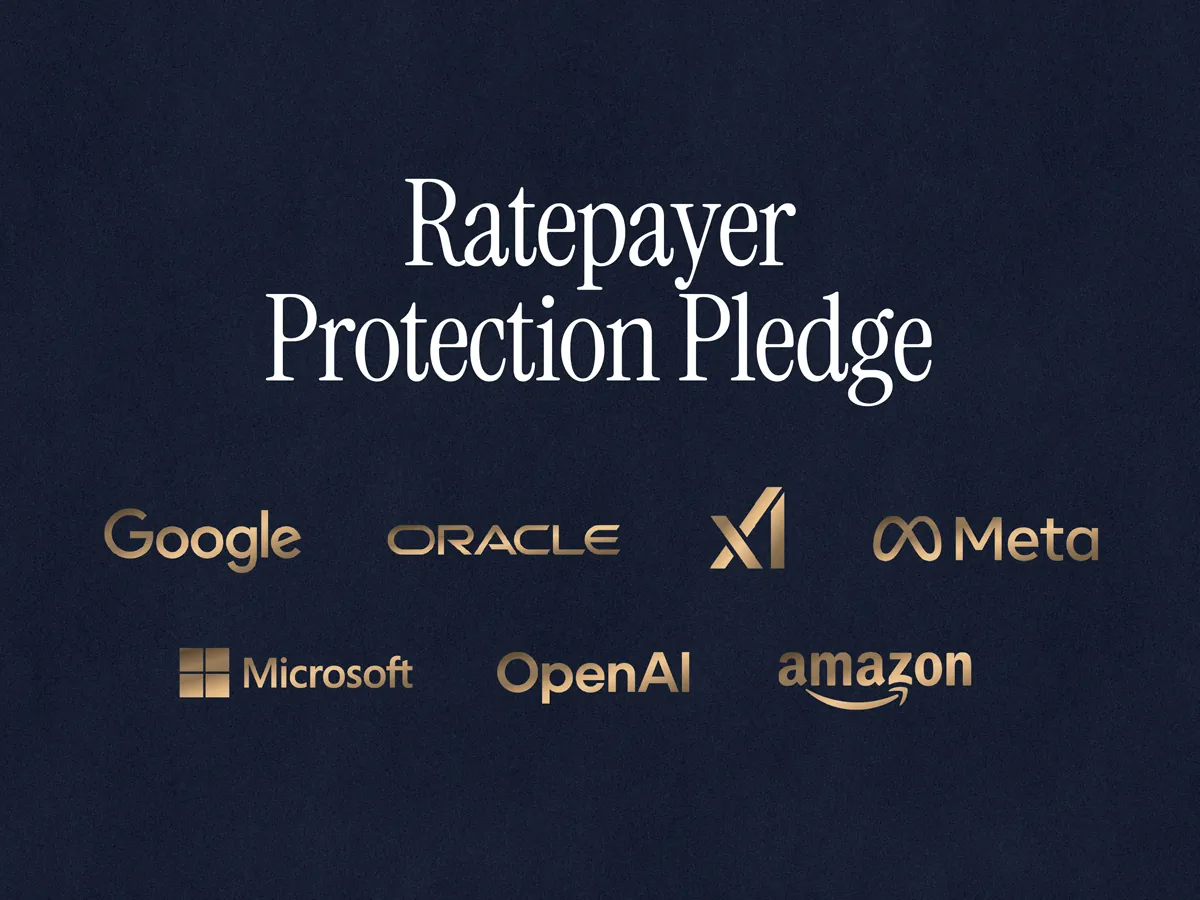
The White House Ratepayer Protection Pledge is a different kind of record. It is not an antitrust record and not a state utility tariff. It is a public pledge record, dated March 4, 2026, that lists Microsoft among seven signatory companies.[6] For counsel, the docketing value is that Microsoft’s name is attached to a public ratepayer-protection commitment at the same time its AI data center program is creating large power-demand questions.
Microsoft’s own January 2026 community-first infrastructure post belongs in the same file, but with a different label. Microsoft published commitments around community-first AI infrastructure, and GeekWire’s coverage described the company as vowing to cover full power costs and reject local tax breaks.[7][8] Those are company commitments. They should be tested against project documents, power-supply arrangements, local incentive agreements, and utility commission materials, not cited as if they automatically bind every downstream proceeding in the same way.
This is where local and ratepayer disputes become legally important rather than merely political. If a data center project requires grid upgrades, new generation, special service arrangements, or local development approvals, the question becomes who pays, who bears delay risk, and whether public commitments are reflected in enforceable instruments. A pledge can become relevant in testimony, public-comment responses, procurement diligence, or reputational-risk review even when it is not itself the operative tariff.
Moratorium tallies are a risk map, not a docket substitute
Quinn Emanuel’s March 2026 client alert reported data center moratorium activity across 11 states and more than 50 localities.[9] That is useful as a screening tool. It is not enough for reliance in a client memo without tracing the cited restrictions to the local ordinance, planning-board record, state legislation, agency action, or litigation docket.
A moratorium count also needs jurisdictional separation. A temporary local pause on new applications, a state-level study bill, a zoning amendment, a noise ordinance, and a grid-interconnection dispute may all be described in business coverage as resistance to data centers. They do not create the same obligation. For lenders and offtakers, the first question is whether the restriction affects closing, construction start, energization, or only future expansion.
The better internal process is to treat broad moratorium coverage as an intake flag, then assign a docket owner to verify the local source. Risk teams already tracking data center litigation should cross-link these flags to the Risk Digest record set, including named records such as MCEA v. Pine Island, NAACP v. xAI, the Southaven, Vineland, and Dowagiac noise class actions, and the Oracle/CoreWeave financing suits as indexed. The public alert tells the team where to look; the docket tells the team what changed.
European Union: the cleaner calendar is not necessarily Microsoft-specific
The EU side has the cleaner compliance architecture, but it requires a different caution. Some obligations attach to GPAI model providers. Some attach to data center operators. Some may affect Microsoft directly, depending on the entity and role; others matter because Microsoft’s capex and cloud infrastructure sit inside the same market and supply chain. The Microsoft investment program is the anchor for why counsel cares, not proof that every EU data center rule is Microsoft-specific.
AI Act GPAI energy documentation
White & Case summarized the EU AI Act’s energy-efficiency requirements for GPAI models as including documentation obligations, with August 2, 2025 as an applicability date, a grace period running to August 2, 2027, and potential penalties up to EUR 15 million or 3% of turnover.[10] This is the cleanest penalty architecture in the materials reviewed.
The important boundary is scope. The AI Act item is not a general data center siting rule. It is a model-governance obligation that pulls energy and compute information into GPAI documentation. It matters to Microsoft where Microsoft is acting in a regulated provider role or where contract, procurement, audit, or vendor-management processes need to collect energy-related information from the infrastructure layer to support an AI Act file.
For a legal team, the docket entry should not say “Microsoft data centers must comply with the EU AI Act” without more. It should identify the regulated product or model, the Microsoft entity or counterparty role, the documentation owner, the energy-information source, the August 2, 2027 grace-period endpoint where applicable, and the penalty-cap reference. The source is legal analysis from White & Case, so the final file should also retain the underlying statutory and guidance materials.
EED Article 12: operator-level annual reporting
The EED Article 12 item is more operational. ModulEdge’s March 2026 compliance guide states that data center operators at or above 500 kW must report annually by May 15 and provide 24 data points.[11] Because that source is a commercial vendor blog, the numbers should be checked against the official Energy Efficiency Directive text and national implementation before they are used in a formal advice product.
Even with that caveat, the obligation is worth docketing now because it has the shape legal operations can manage: operator, threshold, annual date, required data fields, and evidence owner. The Microsoft-specific question is not whether Microsoft is spending heavily on AI infrastructure. It is whether the relevant Microsoft entity, joint venture, colocation provider, or other counterparty is the operator for a covered facility, and whether the contract allocates reporting support, metering access, audit cooperation, and data-retention duties.
This is also where procurement teams can create avoidable gaps. A cloud or colocation agreement may discuss capacity, uptime, security, sustainability, and audit rights without assigning responsibility for regulatory energy reporting. If the operator must report annually, the contract file should show who collects the data, who verifies it, who preserves it, and who responds if the national authority asks for support.
Germany’s EnEfG dates need local statutory verification
ModulEdge’s guide also states that Germany’s EnEfG imposes PUE 1.2 requirements for new builds from July 2026 and 100% renewable-energy requirements from January 2027.[11] Those dates are too concrete to leave in a slide deck without source-checking. They should be verified against official German materials, including scope thresholds, transitional rules, and any exemptions or interpretive guidance.
For a Microsoft-anchored obligations file, the German entry should be written by role. If Microsoft owns or operates the covered German facility, the obligation may sit directly in the Microsoft-controlled compliance file. If Microsoft buys capacity from another operator, the issue may sit in vendor diligence, contractual allocation, sustainability reporting, and service-continuity review. If Microsoft is only the market context for a third-party operator’s buildout, the entry belongs in the client or counterparty file, not in a Microsoft-specific compliance register.
What should be marked unresolved
Several entries in this docket are useful precisely because they are not finished. The FY2026 capex trajectory and backlog figures should remain labeled as market or analyst reporting tied to earnings material, not converted into an official Microsoft commitment unless the underlying Microsoft disclosure is in the file.[2][3] The moratorium tallies should be treated as a lead list pending local-source verification.[9] The EED and EnEfG entries should not rest solely on a vendor guide in a final legal memo.[11]
The distinction matters because data center legal work often moves through handoffs. A partner may ask for a quick view of Microsoft’s AI buildout. A procurement lawyer may ask whether a cloud agreement needs energy-reporting language. A finance lawyer may ask whether a moratorium affects conditions precedent. An AI-governance lawyer may ask whether compute energy belongs in a GPAI documentation file. If the source label is wrong at intake, every downstream answer becomes harder to clean up.
The phrase “legal industry impact” should also stay in its lane. It is a synthesis from the obligations and workflows described here, not a sourced statistic about the legal market. The supportable claim is that Microsoft’s AI data center buildout has created a trackable legal-operations workload across antitrust review, utility and ratepayer records, local-permitting monitoring, EU AI Act documentation, EED reporting, and German energy-efficiency compliance. That is enough without inventing a market-size number.
The practical stopping point for counsel
A usable internal file should separate Microsoft-specific items from operator-level and market-context items. Microsoft’s reported FY2025 and FY2026 spending belongs in the context tab. The FTC 6(b) report belongs in the antitrust and partnership-governance tab. The White House pledge and Microsoft community commitments belong in the ratepayer, utility, and local-approval tab. Moratorium alerts belong in an intake queue until matched to ordinances, agency materials, or dockets. AI Act GPAI energy documentation, EED Article 12, and EnEfG entries belong in the EU regulatory calendar, with actor and entity fields filled in before anyone treats them as Microsoft-specific.
For knowledge-management teams, the file should sit inside the Regulation & Ethics lane, cross-linked to Risk Digest records for related data center litigation and to Verification Workflows for source-checking. The legally relevant object is no longer “Microsoft is investing billions in AI data centers.” It is the verified deadline, docket, commitment, actor, jurisdiction, and penalty record.
References
- Microsoft plans to invest $80 billion on AI-enabled data centers in fiscal 2025, Reuters, January 3, 2025
- AI Capex 2026: The $690B Infrastructure Sprint, Futurum, February 12, 2026
- Microsoft's AI Datacenter Expansion: A Game Changer for the Stock?, Zacks via Yahoo, November 12, 2025
- Microsoft boosts Wisconsin data center spending to $7 billion, Reuters, September 18, 2025
- FTC Issues Staff Report on AI Partnerships & Investments Study, Federal Trade Commission, January 17, 2025
- Ratepayer Protection Pledge, The White House, March 4, 2026
- Building Community-First AI Infrastructure, Microsoft On the Issues, January 13, 2026
- Microsoft responds to AI data center revolt, vowing to cover full power costs and reject local tax breaks, GeekWire
- Client Alert: Emerging Litigation Risks in Financing AI Data Centers Boom, Quinn Emanuel, March 13, 2026
- Energy efficiency requirements under the EU AI Act, White & Case, April 14, 2025
- EU Data Center Regulations 2026: PUE, Reporting & Compliance Guide, ModulEdge, March 11, 2026
- AI Partnerships Beyond Control: Lessons from the OpenAI-Microsoft Saga, Stanford CodeX, March 21, 2025
- Microsoft and OpenAI joint statement on continuing partnership, Microsoft Blog, February 27, 2026
Operationalizing workflow
No workflow has been explicitly linked to this obligation yet. See Workflows generally.
Illustrative cases
No illustrative case is currently tracked for this obligation. See Risk Digest for documented incidents generally.
← Back to RegulationReport a correction or tip
Spotted an outdated figure, a misstated fact, or a ruling this regulation entry should reflect? Public comments are disabled for this content given the professional cost of a misreported case outcome, penalty amount, or rule text — use the structured correction channel instead.
Report a correction or tip for this record →