
The Legal Framework Behind Military Base Renaming
- Authority
- U.S. Congress
- Rule type
- statute
- Jurisdiction scope
- US federal
- Source text
- Read primary rule text ↗
As of July 29, 2026, the legal requirements for military base renaming cannot be reduced to a list of current gate signs. The controlling framework starts with two statutes: FY2020 NDAA §1749, which prohibits certain Department of Defense assets from being named for the Confederacy or for people who voluntarily served it, and FY2021 NDAA §370, which created the Naming Commission process and required implementation by January 1, 2024. That commission process ended; the executive branch then reversed the reversals in 2025, relying on general Secretarial authority and a same-surname compliance theory; no federal court has resolved the resulting separation-of-powers issue. The FY2027 NDAA is now the next live legislative vehicle, with the House passing a version that would restore the Naming Commission names and Senate action still pending at this article’s timestamp.[1][2]
This is a source-linked obligations tracker, not legal advice. For contracts, facility credentials, badge systems, insurance schedules, delivery locations, maps, procurement databases, and agency notices, the practical question is not whether a name feels final. It is which instrument currently tells the recordkeeper what to write, which official had authority to issue it, and what caveat belongs in the file if Congress or a court later rejects the 2025 workaround.
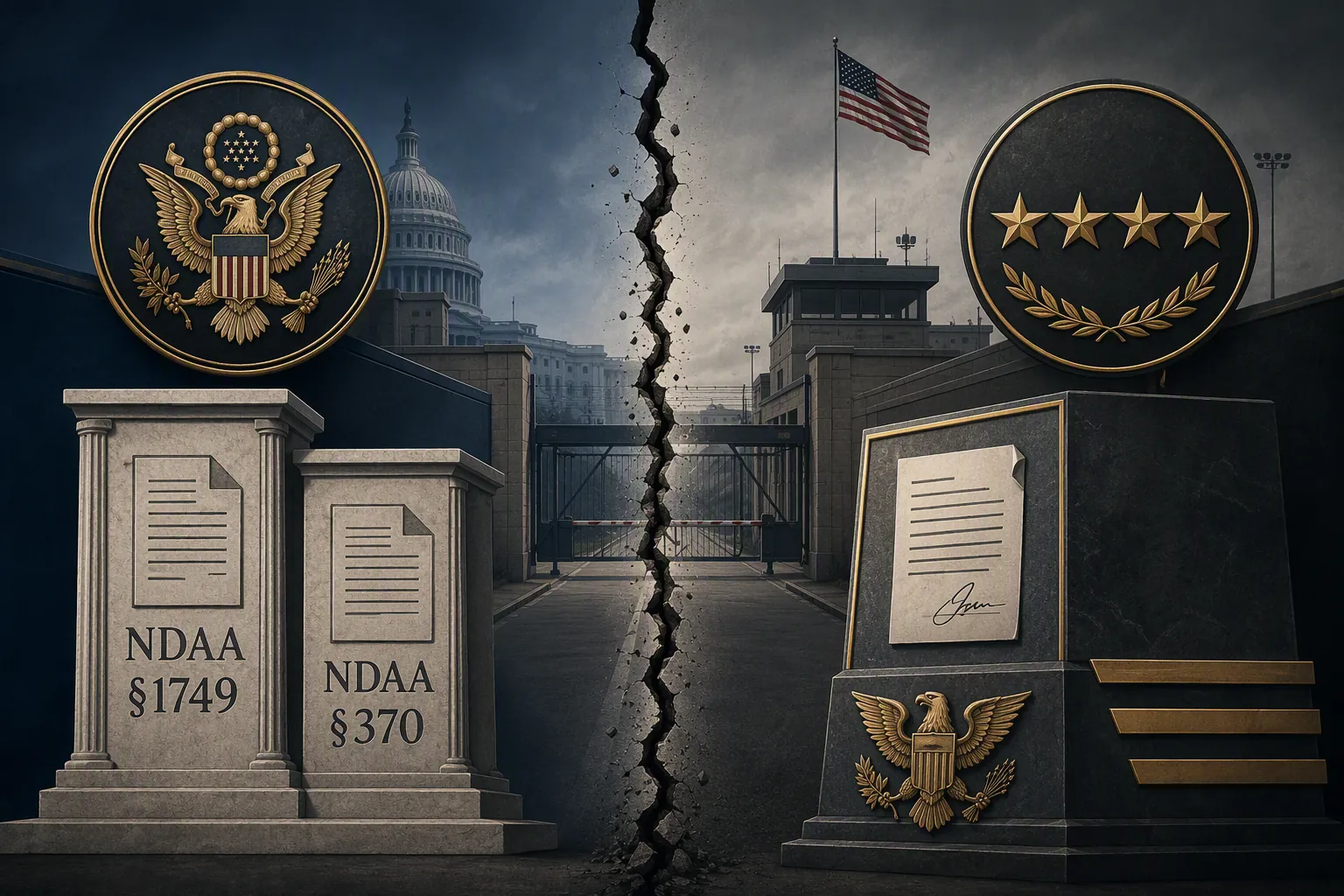
The present rule stack
The cleanest starting point is the difference between a continuing prohibition and a completed mandate. FY2020 NDAA §1749 remains relevant because it prohibits naming covered Department of Defense assets after the Confederacy or after any person who voluntarily served with the Confederacy. FY2021 NDAA §370 did something different: it created the Naming Commission, assigned it statutory duties, and set an implementation deadline of January 1, 2024.[1][3]
For compliance purposes, that distinction matters. A prohibition can continue to constrain later naming decisions. A completed implementation mandate may still matter as the product of a congressional process, but it does not function like an open agency rulemaking docket that administrators can casually reopen, revise, and close again.
| Source of authority | What it does for obligations tracking | Current caveat |
|---|---|---|
| FY2020 NDAA §1749 | Supplies the continuing Confederate-name prohibition for covered DoD assets. | The scope of that prohibition is central to the 2025 same-surname theory. |
| FY2021 NDAA §370 | Created the Naming Commission process and implementation deadline. | The commission’s designations were implemented, then later displaced by executive action. |
| Service-branch naming rules | Provide ordinary naming procedures for memorialization, dedication, and similar decisions. | They do not erase the special congressional statutes. |
| 10 U.S.C. §113(b) | Was cited in 2025 as general Secretarial administrative authority. | It is not a naming-specific statute. |
| 2025 memoranda and Army notices | Supply the operative executive-branch basis for current installation names. | Their legal durability remains unresolved. |
| FY2027 NDAA | Is the active legislative vehicle for Congress to accept, revise, or reject the 2025 result. | House and Senate outcomes are not settled as of July 29, 2026. |
Congress did not merely express a preference
The Naming Commission was not a staff memo dressed up as reform. It operated from March 2021 through October 2022 with a $2 million budget, identified more than 1,100 Department of Defense assets, and received roughly 33,000 to 34,000 public suggestions.[3] A National Guard Association of the United States report put the estimated cost of full implementation across all branches at $62.5 million, including $21 million for nine Army bases.[4]
The nine Army base renamings were completed by October 27, 2023, before the January 1, 2024 statutory deadline.[3] That timing is a modest but important compliance fact. It means the executive branch was not dealing in 2025 with an unfinished statutory assignment. It was acting after the congressionally designed process had already produced implemented names.
That does not automatically make a later Secretarial renaming unlawful. It does make the later action harder to treat as routine housekeeping. When Congress creates a temporary commission, defines its task, funds the work, requires implementation, and the Department implements it on time, a subsequent administrative reversal needs more than a database update note. It needs a theory of authority.
Ordinary military naming rules still exist, but they answer a narrower question
Outside the Confederate-name statutes, the services retain their own naming procedures. The Army’s AR 1-33 distinguishes memorialization for deceased individuals, dedication for living individuals in exceptional cases, and event-based naming tied to battles or campaigns. Navy OPNAV 5030.12H, Marine Corps MCO 5750.1H, and Air Force DAFI 36-2880 likewise preserve service-specific naming processes.[1]
Those manuals matter in ordinary naming work. They tell a records office whether an installation, vessel, facility, range, building, or other asset has moved through the correct service channel. They also help counsel distinguish a memorial decision from a dedication or an event name. But they do not resolve the special problem created by §§1749 and 370: Congress singled out Confederate commemoration, created a commission, and required implementation.
That is why a compliance file should avoid treating service naming manuals as if they are the entire legal universe. They may validate the ordinary naming pathway. They do not, by themselves, answer whether a later executive action can produce the same public-facing name that Congress directed the Department to remove.
The 2025 reversal rested first on general authority
The February 10, 2025 memorandum renaming Fort Liberty to Fort Bragg cited 10 U.S.C. §113(b), the Secretary of Defense’s general authority to administer the Department of Defense, rather than a naming-specific statute.[5] The same general-authority theory was used for later 2025 action covering additional installations, according to CRS’s account of the episode.[1]
The Army’s June 10, 2025 release then framed seven installation name changes as compliant with FY2020 NDAA §1749 because the new names honored different service members who shared surnames with the Confederate figures associated with the earlier names.[6] In that formulation, the name at the gate could return, while the honored person of record would change.
That is the core of the same-surname workaround. It does not say §1749 is invalid. It does not say the Naming Commission never mattered. It says the current honoree is not the prohibited Confederate honoree, even if the installation name appears identical or nearly identical to the pre-commission name.
For an obligations tracker, the legal issue is not whether that theory is clever or offensive. The issue is whether it supplies a durable answer to three questions: what does §1749 prohibit, who decides whether a same-surname designation complies, and what remains of Congress’s §370 implementation design after the Secretary uses general administrative authority to reach the pre-commission public result.
The unresolved separation-of-powers question
CRS’s April 3, 2026 report framed the 2025 actions as raising a “significant separation of powers question”: whether the executive branch can effectively nullify a congressional mandate through nominally distinct renaming decisions that produce the same outcome.[1] That framing is useful because it avoids overstating the present law. CRS did not report a controlling court decision resolving the issue, and no federal court ruling identified in the research materials has supplied one.
Senator Jack Reed’s response captured the intuitive objection: he said the order “has not violated the letter of the law, but has violated its spirit.”[7] Representative Don Bacon’s later description of the maneuver as a “finger in the eye of Congress” was politically revealing in a different register.[8] Neither statement decides the legal question. Both show why Congress may view the issue as institutional, not merely commemorative.
The statutory text and the legislative design point to different argumentative centers. A text-focused defense of the 2025 action emphasizes the identity of the newly honored service members and the continuing formal observance of §1749’s Confederate-name prohibition. A purpose-focused challenge emphasizes that Congress created a removal-and-replacement process and that the executive branch later restored the visible naming outcome Congress had displaced. Compliance counsel do not need to predict which theory would prevail; they need to record that the conflict exists.
What remains actionable for contracts and records
Until Congress or a court supplies a cleaner answer, the safest records practice is to separate operational naming from legal finality. The current agency-designated installation name may control where a shipment is delivered, which badge office issues credentials, what appears in an access roster, or how an invoice is routed. That operational fact should not be written as though the statutory dispute has been resolved.
- Use the current official installation name for live operational references, but preserve a former-name crosswalk where contracts, permits, maps, facility clearances, property schedules, or insurance documents still contain earlier designations.
- Identify the authority for a name change in the file. A useful entry says which memorandum, Army release, contract modification, agency notice, or branch database update caused the record change; it should not simply say “base renamed.”
- Distinguish the current honoree from the public-facing name. The same-surname theory depends on that distinction, so records that omit it may obscure the very compliance rationale the Army invoked.
- Keep service-specific naming rules in view for ordinary naming approvals, but do not cite them as a complete answer to the Confederate-name statutory issue.
- Flag FY2027 NDAA dependency in risk registers and matter updates. The House process is not the endpoint if Senate action and conference negotiations remain unresolved.
The June 5, 2026 House Armed Services Committee vote illustrates why the legislative track cannot be treated as background noise. The committee voted 29-27 to reinstate the Naming Commission names through an amendment associated with Representative Marilyn Strickland.[2] By this article’s July 29, 2026 timestamp, the House version of the FY2027 NDAA had passed, but Senate action remained pending. That is not a stable endpoint for contracts that may run across fiscal years, option periods, or installation support transitions.
A well-drafted compliance note should therefore read more like a chain of authority than a political conclusion. It can say that the Department implemented Naming Commission designations before the statutory deadline, that the Secretary later issued 2025 renaming actions relying on general administrative authority, that the Army described the same-surname changes as §1749-compliant, and that CRS has identified an unresolved separation-of-powers issue. That sequence is more useful than a confident sentence announcing that a base name is simply “changed back.”
The endpoint for now
As of July 29, 2026, the executive branch has produced operative name changes that administrators and contractors must account for in current records. The statutory meaning of FY2020 NDAA §1749, the continuing force of the FY2021 NDAA §370 Naming Commission implementation design, and Congress’s response to the same-surname workaround remain unsettled. The next answer is likely to come from the FY2027 NDAA process or from litigation that squarely tests whether general administrative authority can be used to reach the naming outcome Congress had required the Department to replace.
References
- CRS Report R48894, EveryCRSReport.com, April 3, 2026
- House panel votes to reinstate non-Confederate base names and adopt Department of War, Military Times, June 5, 2026
- Naming Commission, Wikipedia
- Report: Erasing Confederacy from U.S. Military to Cost $62.5 Million, National Guard Association of the United States
- Secretary of Defense Pete Hegseth Renames Fort Liberty to Fort Bragg, U.S. Department of War, February 10, 2025
- Army to change names of seven installations, U.S. Army, June 10, 2025
- Reed Denounces Hegseth's Order to Rename Fort Liberty to Fort Bragg, Office of Senator Jack Reed, February 11, 2025
- Senate, House NDAAs address Confederate military names, Roll Call, July 17, 2025
Operationalizing workflow
No workflow has been explicitly linked to this obligation yet. See Workflows generally.
Illustrative cases
No illustrative case is currently tracked for this obligation. See Risk Digest for documented incidents generally.
← Back to RegulationReport a correction or tip
Spotted an outdated figure, a misstated fact, or a ruling this regulation entry should reflect? Public comments are disabled for this content given the professional cost of a misreported case outcome, penalty amount, or rule text — use the structured correction channel instead.
Report a correction or tip for this record →