
The Legal Impact of Missouri Amendment 5's Tax Phase-Out
- Authority
- Missouri General Assembly
- Rule type
- statute
- Jurisdiction scope
- US state: Missouri
- Effective date
- Aug 4, 2026
- Source text
- Read primary rule text ↗
If adopted, requires the income-tax phase-out, suspends Hancock Amendment limits for five years, and bars income-tax reinstatement.
Scope and current posture
This is a legal-impact record for Missouri Amendment 5 as it appears on the Aug. 4, 2026 statewide ballot, last checked against the ballot materials and reported litigation posture as of Aug. 1, 2026. It is not tax advice, election advice, or a prediction about which implementing bill would pass if voters approve the amendment.
The ballot title voters will see asks whether the Missouri Constitution should be amended to “Require legislative phase-out of the individual state income tax based on revenue growth, and authorize the expansion of sales and use taxes; Curtail constitutional limits on taxing goods and services; and Require local tax rate cuts without reducing school funding if local sales tax revenue increases.” [1]
That ballot title is a useful index, but it is not the legal engine. The operative question behind the search for “Missouri Amendment 5 income tax elimination legal impact” is not simply whether the individual income tax goes down. It is which actor receives authority to replace that revenue, which constitutional voter protections are suspended or narrowed, and which decisions are left for statutes that do not yet exist.
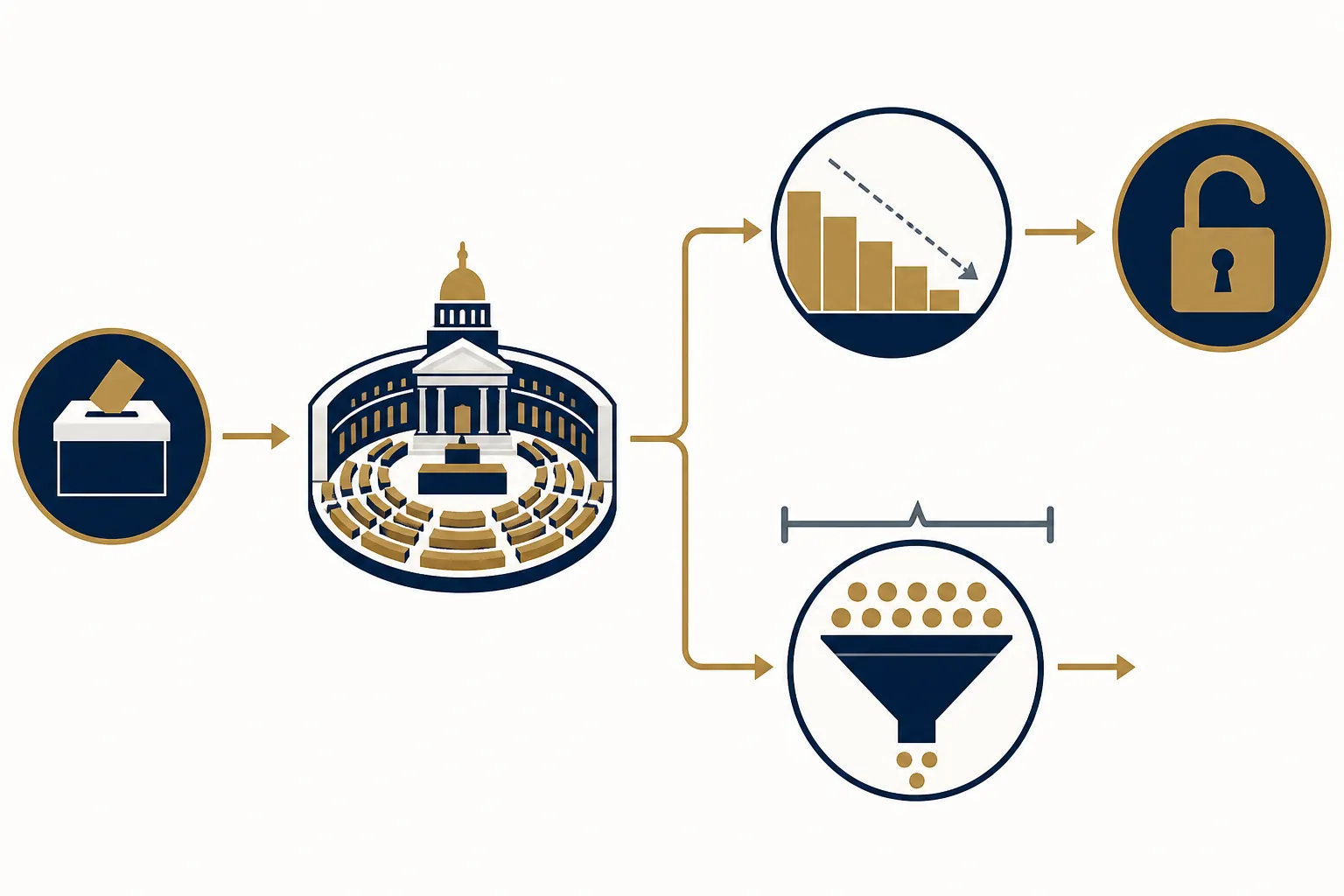
Read that way, Amendment 5 is better understood as a constitutional transfer of taxing authority from voters to the legislature than as a standalone tax cut. The phase-out direction is constitutionalized; the sales and use tax opening is time-limited but broad; and the reinstatement ban makes the income-tax side harder to reverse after the fact. The real tax mix would still depend on the laws the General Assembly later enacts under the authority the amendment creates.
Provision-level ledger
The most efficient way to read the measure is provision by provision: ballot-title phrase first, operative mechanism second, then the constitutional protection or decision point that moves. The full HJR text is the load-bearing source for the mechanics; the ballot title and fiscal materials verify what the public-facing summary says and does not say. [1][2]
| Ballot-title phrase or related provision | Operative mechanism | Constitutional protection or decision point affected | Actor newly empowered or constrained | Legal consequence |
|---|---|---|---|---|
| “Require legislative phase-out of the individual state income tax based on revenue growth” | Requires the legislature to phase out the individual state income tax using revenue-growth mechanics set in the amendment text. [1][2] | Existing legislative discretion over whether to continue, reduce, or replace the individual income tax. | General Assembly gains a constitutional mandate to reduce the tax when the trigger conditions are met. | The amendment points the tax system away from the individual income tax, but it does not itself supply every implementing statute needed to administer the transition. |
| Dollar-for-dollar pairing requirement | Links income-tax reductions with replacement taxing authority described in the amendment text. [2] | The ordinary separation between an income-tax cut and a later revenue-raising bill. | General Assembly receives authority to pair reductions with other taxes inside the constitutional framework. | The phrase matters because it connects the phase-out to replacement revenue authority rather than leaving the income-tax reduction as an isolated constitutional instruction. |
| “Authorize the expansion of sales and use taxes” | Allows broader sales and use tax authority during the amendment’s implementation window. [1][2] | Current constitutional limits that otherwise constrain the expansion of taxes on goods and services. | General Assembly is the central replacement-tax actor. | The amendment does not identify a final sales-tax base or rate in the ballot title; those choices would be made through later legislation. |
| “Curtail constitutional limits on taxing goods and services” | Suspends specified Hancock Amendment limits for five years. [1][2] | Voter-protection rules that ordinarily operate as veto points or limits on state taxing authority. | General Assembly gains a temporary opening to legislate in an area where voter protections would otherwise constrain it. | This is the core authority transfer: a constitutional protection is not merely interpreted differently; it is suspended for a defined period. |
| State auditor rate-reset power for parks, soils, and conservation taxes | Gives the state auditor rate-reset authority over the Article IV, Section 47(a) parks and soils sales tax and the Article IV, Section 43(a) Conservation sales tax. [2] | Dedicated constitutional sales-tax rates tied to specific public purposes. | State auditor receives a rate-reset function; the dedicated programs are affected through rate mechanics rather than abolished by the ballot title. | The amendment changes who can adjust certain dedicated rates, which is a separate legal move from the income-tax phase-out. |
| “Require local tax rate cuts without reducing school funding if local sales tax revenue increases” | Requires local tax adjustments when local sales tax revenue increases, while preserving school-funding protection. [1][2] | Local fiscal discretion and local rate-setting choices. | Local governments are constrained; school funding is protected from the required reduction mechanism. | The rule narrows local flexibility, but the effect in any city or county depends on that jurisdiction’s tax structure and what counts as adjustable. |
| Income-tax reinstatement ban | Bars reinstatement of the individual income tax after the phase-out reaches elimination. [2] | Future legislative ability to restore the tax as an ordinary revenue option. | Future General Assemblies are constrained by a constitutional lock-in. | This is why the phase-out cannot be evaluated only as a rate reduction; the amendment also limits later reversal. |
| Official fiscal note | Reports an unknown impact on state and local revenue, plus specific administrative and check-off effects. [1] | Fiscal forecasting boundary. | Auditor and implementing agencies must account for costs and effects, but the fiscal note does not write the replacement-tax statutes. | The unknown-impact label is not a loophole in the analysis; it marks the point where the constitutional text stops and future legislation begins. |
The income-tax phase-out is a mandate, not a complete rate schedule
The income-tax provision does not merely express a preference that the legislature consider tax relief. The ballot title says “require,” and the HJR text supplies the operative phase-out framework tied to revenue growth. [1][2] That distinction matters after Election Day. A permissive tax-cut amendment would leave future legislators with political discretion. A mandatory phase-out provision changes the baseline against which later budgets and tax bills are drafted.
The size of that baseline is not small. The Missouri Budget Project describes the individual income tax as about $8.5 billion per year and roughly 64% of state general revenue; it also describes the current individual income-tax structure as a graduated range from 2% to 4.7%, with the top rate applying to income over $9,191. [4] Those figures do not prove what Amendment 5 would raise or lose after implementation. They identify the revenue stream the amendment tells lawmakers to move away from.
The revenue-growth trigger is the public-facing limiting principle. It means the amendment is not framed as an immediate one-day abolition of the individual income tax. But the legal direction is still mandatory: when the constitutional conditions are satisfied, legislative action is required. The harder drafting questions then become timing, measurement, certification, and the relationship between each reduction and replacement tax authority.
The reinstatement ban is the quieter clause with the longer memory. If the phase-out reaches elimination, future lawmakers would not be free to restore the individual income tax as a routine budget instrument. [2] That is a lock-in provision, not a campaign slogan. It moves the income tax from “available unless repealed” toward “unavailable unless the Constitution changes again.”
The five-year Hancock suspension is the main voter-protection transfer
The sales and use tax side is where the amendment does its most consequential work on voter protections. The ballot title says the measure would authorize expansion of sales and use taxes and curtail constitutional limits on taxing goods and services. [1] The HJR text does that by suspending specified Hancock Amendment limits for five years. [2]
A five-year suspension is not the same thing as a permanent repeal, and it should not be described as one. But it is also not a minor drafting detail. During the suspension window, the legislature would have room to legislate replacement sales and use taxes without the same constitutional constraints that would otherwise apply. The operative legal event is the temporary removal of a voter-protection veto point.
That is why the amendment’s practical effect cannot be derived by subtracting current income-tax collections and then assuming a fixed replacement amount. The amendment opens authority; it does not itself enact the full sales and use tax code that would follow. A lawyer asked what the measure authorizes can answer from the constitutional text. A lawyer asked what every household, vendor, or city will pay after implementation needs the later statutes.
The fiscal note marks the boundary
The official fiscal materials report an “unknown impact” on state and local revenue, a $57,000 annual reduction in income-tax check-off donations, and implementation costs of at least $100,000. [5] The first item is the most legally useful one. “Unknown impact” is not an admission that the amendment has no effect; it is a warning that the effect depends on implementation choices the amendment authorizes but does not fully specify.
That uncertainty should keep both sides of the public argument within the text. Supporters cannot fairly treat the amendment alone as a fully priced tax cut. Opponents cannot fairly assign a precise replacement-tax result without identifying the assumed implementing statutes. The constitutional document creates direction, authority, suspensions, and locks; the fiscal outcome comes later.
Dedicated-tax resets and local adjustments are separate legal moves
The amendment also reaches two dedicated state sales taxes: the Article IV, Section 47(a) parks and soils tax and the Article IV, Section 43(a) Conservation sales tax. The HJR text gives the state auditor rate-reset authority over those taxes. [2] That is not the same legal move as giving the legislature an open-ended power over all dedicated funds. It is a particular reassignment of rate mechanics to a named statewide official.
The local provision works differently. The ballot title says local tax rate cuts would be required if local sales tax revenue increases, without reducing school funding. [1] The legal point is not merely that some local governments might see changed revenue flows. It is that the Constitution would impose an adjustment rule while protecting school funding from that required reduction mechanism. [2]
Kansas City shows why the local effect cannot be read from the statewide summary alone. The city’s 1% earnings tax has been described as about 45% of its general-fund revenue, voter-renewed through 2031, and not adjustable in the same way as some other local taxes; local property-tax adjustments would also be constrained by the school-funding protection. [6] That does not make Kansas City the whole story. It is an example of the local-law problem: the amendment may require an adjustment, but the available adjustment points depend on the jurisdiction’s existing tax structure.
Litigation status fixes the ballot language, not the later statutes
The litigation history matters because it tells readers which summary controls, not because it answers the implementation questions. The reported sequence is compact: Gov. Mike Kehoe announced the special-election measure on May 22, 2026; Cole County Circuit Judge Christopher Limbaugh upheld the measure; the Western District, in a unanimous June 5, 2026 opinion by Judge Thomas Chapman, kept the measure on the ballot but rewrote the summary; the Missouri Supreme Court refused to hear an appeal on June 8, 2026; and June 9 was the statutory deadline for final ballot changes. [3][7]
The Western District ruling is also useful for what it did not do. It did not remove the measure on single-subject grounds. The court accepted that the challenged provisions related to taxation, while still finding the prior summary insufficient and requiring revised ballot language. [3] That leaves voters with a rewritten title and lawyers with the same next task: read the operative constitutional text.
What remains unresolved until implementation
If Amendment 5 passes, several questions move from campaign argument to legislative drafting and, potentially, litigation. The amendment would establish the constitutional direction and authority, but it would not by itself settle every administrative or fiscal consequence.
- How the legislature structures the sales and use tax expansion within the five-year suspension window.
- How revenue growth is measured, certified, and translated into each required income-tax reduction.
- How the dollar-for-dollar pairing requirement is implemented in ordinary tax legislation.
- How the auditor’s rate-reset authority is applied to the parks, soils, and conservation taxes.
- Which local taxes are practically adjustable when local sales tax revenue increases, and how the school-funding protection limits those adjustments.
- How courts treat any post-election disputes over whether implementing statutes stay inside the amendment’s authority.
Those unresolved items are not defects in the ballot title; they are the consequence of using a constitutional amendment to authorize a future tax replacement system. The ballot summary tells voters the surface map. The operative text tells counsel which powers move, which protections pause, and which locks are added. The fiscal note tells everyone where the map runs out.
The defensible legal conclusion is narrow but important: if adopted, Amendment 5 would constitutionalize the phase-out direction for Missouri’s individual income tax, suspend specified Hancock Amendment limits for five years to permit expanded sales and use tax authority, assign new rate-reset authority to the state auditor, constrain local tax adjustments while protecting school funding, and bar reinstatement of the individual income tax after elimination. Its practical revenue and taxpayer effects would depend on the implementing statutes passed afterward.
References
- 2026 Ballot Measures — Missouri Secretary of State.
- House Joint Resolution No. 173 — Missouri House of Representatives.
- Missouri appeals court keeps tax overhaul on Aug. 4 ballot with revised summary — Missouri Independent, June 5, 2026.
- Amendment 5 Summary May 2026 — Missouri Budget Project, May 2026.
- Missouri Amendment 5 income tax — Springfield Daily Citizen.
- Kansas City left with uncertainty on state income tax elimination plan — The Beacon, June 2, 2026.
- Missouri Amendment 5 income tax sales use ballot language — KCUR, June 6, 2026.
Operationalizing workflow
No workflow has been explicitly linked to this obligation yet. See Workflows generally.
Illustrative cases
No illustrative case is currently tracked for this obligation. See Risk Digest for documented incidents generally.
← Back to RegulationReport a correction or tip
Spotted an outdated figure, a misstated fact, or a ruling this regulation entry should reflect? Public comments are disabled for this content given the professional cost of a misreported case outcome, penalty amount, or rule text — use the structured correction channel instead.
Report a correction or tip for this record →