
Mullin v. Doe Supreme Court TPS Ruling Explained
- Authority
- Supreme Court of the United States
- Rule type
- statute
- Jurisdiction scope
- US federal
- Source text
- Read primary rule text ↗
Non-constitutional challenges to TPS termination determinations are barred; constitutional claims may remain but are narrowly limited.
The short version for litigators is this: non-constitutional attacks on TPS terminations now run into a jurisdictional wall. The Court read 8 U.S.C. § 1254a(b)(5)(A)’s bar on review of a “determination” to cover the procedural and substantive predicates to the Secretary’s final decision, not merely the last agency act labeled termination. Constitutional claims may still be pleaded, at least under the governing majority opinion, but equal-protection theories face a hard Arlington Heights problem after the Court treated the administration’s across-the-board TPS termination policy as a race-neutral explanation.
This is an editorial explanation, not legal advice. The holding, vote breakdown, and quoted material here are reconstructed from SCOTUSblog, Just Security, NPR, The Guardian, and Wikipedia summaries and quotations because the slip opinion itself was not directly crawled for this article.
The holding is about the courthouse door
The Court divided 6-3. Chief Justice Roberts and Justices Alito, Gorsuch, Kavanaugh, Barrett, and Thomas were in the majority; Justices Sotomayor, Kagan, and Jackson dissented.[1] That alignment matters, but the more immediate litigation fact is not the split. It is what the majority did with the word “determination.”
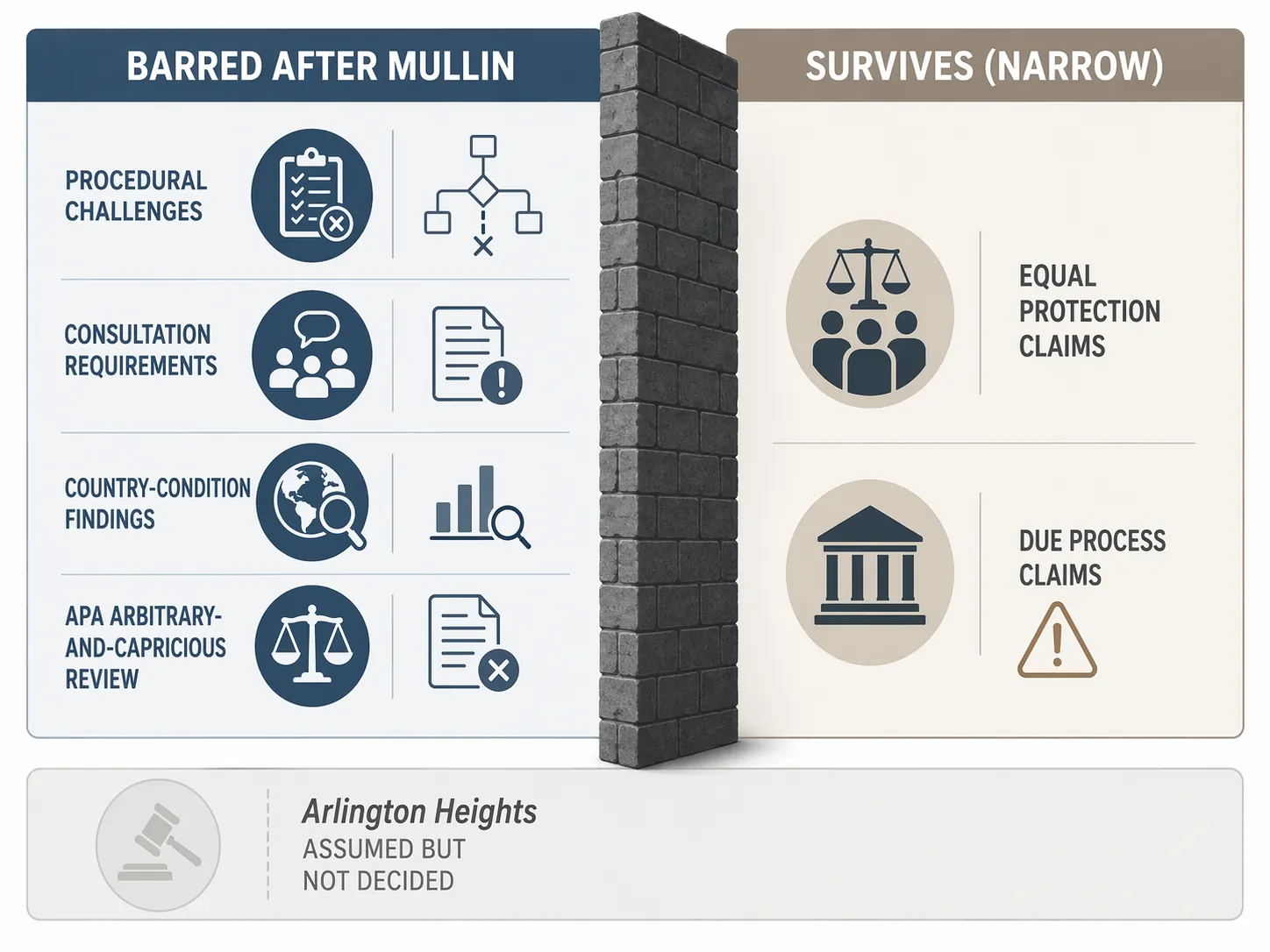
Section 1254a(b)(5)(A) bars judicial review of “any determination” by the Secretary concerning TPS designation, extension, or termination. The plaintiffs’ path depended on narrowing that term. If “determination” meant only the final termination decision, then antecedent legal defects—failure to consult, failure to consider country conditions, arbitrary-and-capricious reasoning under the APA—could still be reviewed as collateral procedural violations. The majority rejected that move and held that the statutory bar reaches the predicate procedural and substantive steps leading to the final TPS decision.[1]
That is why the decision is not just another case about deference or immigration administration. It changes the filing analysis. A complaint that says DHS reached the wrong country-condition conclusion, skipped required consultation, or acted arbitrarily in terminating TPS is now vulnerable before the court ever reaches whether the claim sounds sensible on the merits.
What “determination” now absorbs
The plaintiffs’ best jurisdictional distinction was familiar: final agency outcomes may be unreviewable, but general collateral challenges to the agency’s procedures can remain reviewable. McNary v. Haitian Refugee Center supplied the template. In that case, the Court allowed certain systemic procedural challenges despite a statutory limit on review of individual determinations. In Mullin, the majority refused to carry that distinction over. On the SCOTUSblog summary, the Court held that “determination” in the TPS statute covers all procedural and substantive predicate steps, rejecting the McNary-style distinction between final determinations and the processes that precede them.[1]
The consequence is severe because TPS termination decisions are built out of exactly the materials plaintiffs usually attack: consultation with appropriate agencies, country-condition analysis, statutory eligibility findings, and the agency’s stated reasoning. Once those components are treated as part of the unreviewable “determination,” a non-constitutional plaintiff cannot evade the bar by relabeling the alleged defect as procedural.
| Claim theory after Mullin | Likely jurisdictional treatment | Practical pleading consequence |
|---|---|---|
| DHS failed to consult before terminating TPS | Barred as a predicate procedural step within the determination | The court may dismiss before testing whether consultation actually occurred |
| DHS misread or ignored country conditions | Barred as a substantive predicate to the determination | The dispute over country evidence is unlikely to become a merits issue |
| The termination was arbitrary and capricious under the APA | Barred when directed at the TPS determination and its predicates | APA framing does not by itself preserve review |
| The termination violated equal protection | Assumed reviewable by the majority, but difficult under Arlington Heights | The plaintiff must plead and prove more than disagreement with policy or offensive statements |
| The termination violated due process | Potentially within the constitutional corridor, depending on theory | The claim must be classified and pleaded as constitutional, not merely procedural APA review in another form |
Justice Kagan’s dissent targeted this point because it is the place where the case stops being abstract. Her warning, as summarized in the cited materials, was that after the ruling a Secretary could “announce to the world that she didn’t consult with anyone” before terminating TPS and “courts will be powerless to intervene.” That is not a quibble about labels. It is a remedial gap: the more completely a statutory prerequisite is folded into the unreviewable determination, the less usable the prerequisite becomes in court.
For motions practice, the dissent’s concern is also a warning against over-pleading the wrong theory. A complaint can recite detailed failures in process and still fail at the threshold if those failures are non-constitutional predicates to the Secretary’s TPS decision. The majority’s rule gives defendants a clean Rule 12 path: identify the challenged act as part of the TPS determination, invoke § 1254a(b)(5)(A), and argue that the court lacks power to review it.
The constitutional corridor remains, but it is narrow
The majority did not close every door. It assumed, without deciding, that equal-protection claims challenging TPS terminations could proceed under the Arlington Heights framework. That phrasing matters. “Assumed without deciding” is not a holding that all such claims are reviewable, nor is it a signal that they are likely to win. It means the majority could resolve the case by taking the plaintiffs’ legal framework as available and still concluding that the record did not justify relief.[2]
Under the Just Security analysis, the Court found the plaintiffs unlikely to prevail because the administration had terminated “every TPS designation that came up for review,” which supplied a race-neutral explanation for the challenged action.[2] That is the part some quick accounts flatten too much. Saying “constitutional claims survive” is formally true under the majority’s approach, but it does not tell a lawyer whether the complaint can survive the next motion. After Mullin, the answer depends on whether the pleaded facts plausibly show discriminatory purpose despite an agency policy that applied across TPS designations coming up for review.
The dissent’s equal-protection theory leaned in part on presidential statements. Justice Kagan reproduced statements about Haiti, including “shithole countries,” “poisoning the blood,” and the Springfield pet-eating hoax; the majority did not print those statements and characterized the material more generally as “heated language.”[3] Those statements explain why the equal-protection claim was not frivolous. They do not, by themselves, answer the majority’s Arlington Heights analysis.
The useful distinction is between evidence of animus and causation under the pleaded constitutional theory. Arlington Heights asks courts to evaluate whether discriminatory purpose was a motivating factor, drawing from the historical background, sequence of events, departures from normal procedure, substantive departures, and legislative or administrative history. In Mullin, the majority treated the across-the-board termination policy as a non-discriminatory explanation that made the plaintiffs unlikely to prevail on the record described in the available summaries.[2]
That leaves room for future fights, but not much comfort. A future plaintiff would need facts that do more than show harsh immigration policy, offensive political speech, or serious consequences for nationals of a particular country. The claim has to connect the termination decision to a constitutionally forbidden purpose in a way that overcomes the agency’s neutral account. The more uniform the policy appears across countries, the more work the complaint must do.
Due process should not be treated as a magic label
Due process remains part of the possible constitutional corridor in broad terms, but Mullin does not turn every procedural objection into a due-process claim. That matters because many of the barred theories sound procedural in ordinary language. A failure to consult, a failure to consider conditions, or a failure to explain reasoning may feel like process. Under the majority’s jurisdictional rule, however, those objections are barred when they are statutory or APA attacks on the TPS determination itself.
A viable due-process theory would need to identify the protected interest, the process constitutionally required, and the way the government deprived the plaintiff of that process. Merely importing the TPS statute’s consultation and country-condition requirements into constitutional vocabulary invites dismissal as repackaged review of the determination.
Justice Thomas’s concurrence is not the rule, but it is not noise
Justice Thomas wrote separately to go further. His concurrence argued that even constitutional claims should be barred and that the Fifth Amendment does not contain an equal-protection component binding the federal government.[1][3] No other Justice joined that position, so it is not the governing rule in Mullin. A plaintiff can still point to the majority opinion’s assumption that an equal-protection challenge may be considered, while a defendant cannot honestly treat Thomas’s concurrence as controlling law.
Still, the concurrence is a marker. In a future case, a litigant defending an immigration-related jurisdictional bar may cite it as the cleanest version of the no-review position. A plaintiff should not brief Mullin as though the only live fight is Arlington Heights. There is now at least one vote for a more absolute rule: statutory bars mean what they say even when the claim is constitutional, and federal equal-protection doctrine under the Fifth Amendment should be rejected.
What happens to pending and future TPS litigation
The immediate practical effect is that injunctions were lifted and DHS may implement TPS terminations for Haiti, Syria, and potentially other countries.[4][5] NPR and The Guardian reported that pending litigation involving Venezuela, Afghanistan, Ethiopia, Honduras, Nepal, and Nicaragua is now likely to be resolved against plaintiffs on jurisdictional grounds.[4][5] That “likely” deserves to stay in the sentence. Lower courts still have cases to process, pleadings to classify, and constitutional theories to separate from statutory ones. But the gravitational pull of Mullin is obvious.
For pending cases, the first defense motion will probably not be a long merits brief about country conditions. It will be a jurisdictional motion that asks whether the claim challenges the TPS determination or a predicate to it. If the answer is yes and the claim is non-constitutional, the case is in trouble. If the plaintiff insists the claim is constitutional, the court then has to decide whether the theory is genuinely constitutional or only an APA claim wearing constitutional clothing.
For future complaints, the pleading order should change. Counsel should classify each count before drafting the factual narrative:
- If the count challenges consultation, country-condition findings, timing, reasoning, or evidentiary support, assume the government will characterize it as a barred predicate to the determination.
- If the count invokes the APA, ask whether it is doing anything other than requesting review of the TPS decisionmaking process. If not, Mullin likely forecloses it.
- If the count invokes equal protection, plead the Arlington Heights theory with discipline: discriminatory purpose, relevant sequence of events, departures from normal practice if supported, and a response to the government’s race-neutral explanation.
- If the count invokes due process, identify the constitutional interest and constitutionally required procedure rather than relying on statutory TPS procedures as the source of the right.
- If emergency relief is sought, brief jurisdiction first. A temporary restraining order package that saves the best jurisdictional argument for reply risks losing the only issue the court needs to decide.
The hard part is that the most human facts in a TPS case often support consequences, reliance, and urgency better than jurisdiction. Those facts may matter to equities if the case gets that far. After Mullin, many cases will not. The pleading has to earn a forum before it can ask for a remedy.
The post-Mullin filing question
Mullin does not say TPS terminations are always lawful. It says courts generally may not review non-constitutional challenges to the Secretary’s TPS determination, including challenges to the procedural and substantive steps that produced it. That is a different proposition, and for plaintiffs it may be worse. A strong statutory objection is of limited use if Congress has withdrawn the court’s power to hear it as part of the termination determination.
Constitutional claims remain theoretically available under the majority’s assumed posture, but equal-protection plaintiffs now have to litigate against both Arlington Heights and the Court’s acceptance of an across-the-board termination policy as race-neutral. Thomas’s broader no-review concurrence is not controlling, but it shows where a future argument may go. The post-Mullin strategy is therefore blunt: classify the claim before investing in the merits. If the theory is non-constitutional, it is largely gone. If it is constitutional, it must be pleaded as more than a relabeled objection to the Secretary’s unreviewable determination.
References
- Noem v. Doe, SCOTUSblog, https://www.scotusblog.com/cases/noem-v-doe-3/
- Supreme Court Mullin Doe TPS, Just Security, https://www.justsecurity.org/144302/supreme-court-mullin-doe-tps/
- Mullin v. Doe, Wikipedia, https://en.wikipedia.org/wiki/Mullin_v._Doe
- Temporary Protected Status program explainer Supreme Court, NPR, June 29, 2026, https://www.npr.org/2026/06/29/g-s1-130942/temporary-protected-status-program-explainer-supreme-court
- Supreme Court TPS immigration, The Guardian, July 7, 2026, https://www.theguardian.com/us-news/2026/jul/07/supreme-court-tps-immigration
Operationalizing workflow
No workflow has been explicitly linked to this obligation yet. See Workflows generally.
Illustrative cases
No illustrative case is currently tracked for this obligation. See Risk Digest for documented incidents generally.
← Back to RegulationReport a correction or tip
Spotted an outdated figure, a misstated fact, or a ruling this regulation entry should reflect? Public comments are disabled for this content given the professional cost of a misreported case outcome, penalty amount, or rule text — use the structured correction channel instead.
Report a correction or tip for this record →