
Mullin v. Doe Blocks Judicial Review of Haitian TPS Termination
- Authority
- Supreme Court of the United States
- Rule type
- statute
- Jurisdiction scope
- US federal
- Effective date
- Jun 25, 2026
- Source text
- Read primary rule text ↗
Only constitutional equal-protection claims are reviewable; non-constitutional TPS termination challenges are barred.
The practical answer after Mullin v. Doe is narrower than most headlines suggest. On June 25, 2026, the Supreme Court ruled 6–3 that 8 U.S.C. § 1254a(b)(5)(A) bars judicial review of non-constitutional challenges to TPS termination decisions, including challenges to the procedure DHS used before ending Haiti’s designation.[1][2] The Court did not merely say DHS may terminate TPS. It said federal courts generally may not review the administrative path DHS took to get there.
That distinction now matters for families and counsel. APA arbitrary-and-capricious claims, inadequate-consultation claims, and other non-constitutional attacks on the termination process are effectively out. Equal-protection claims technically remain available under the clear-statement rule for constitutional claims, but the majority’s merits signal was blunt: the claim “will likely fail.”[1][2]
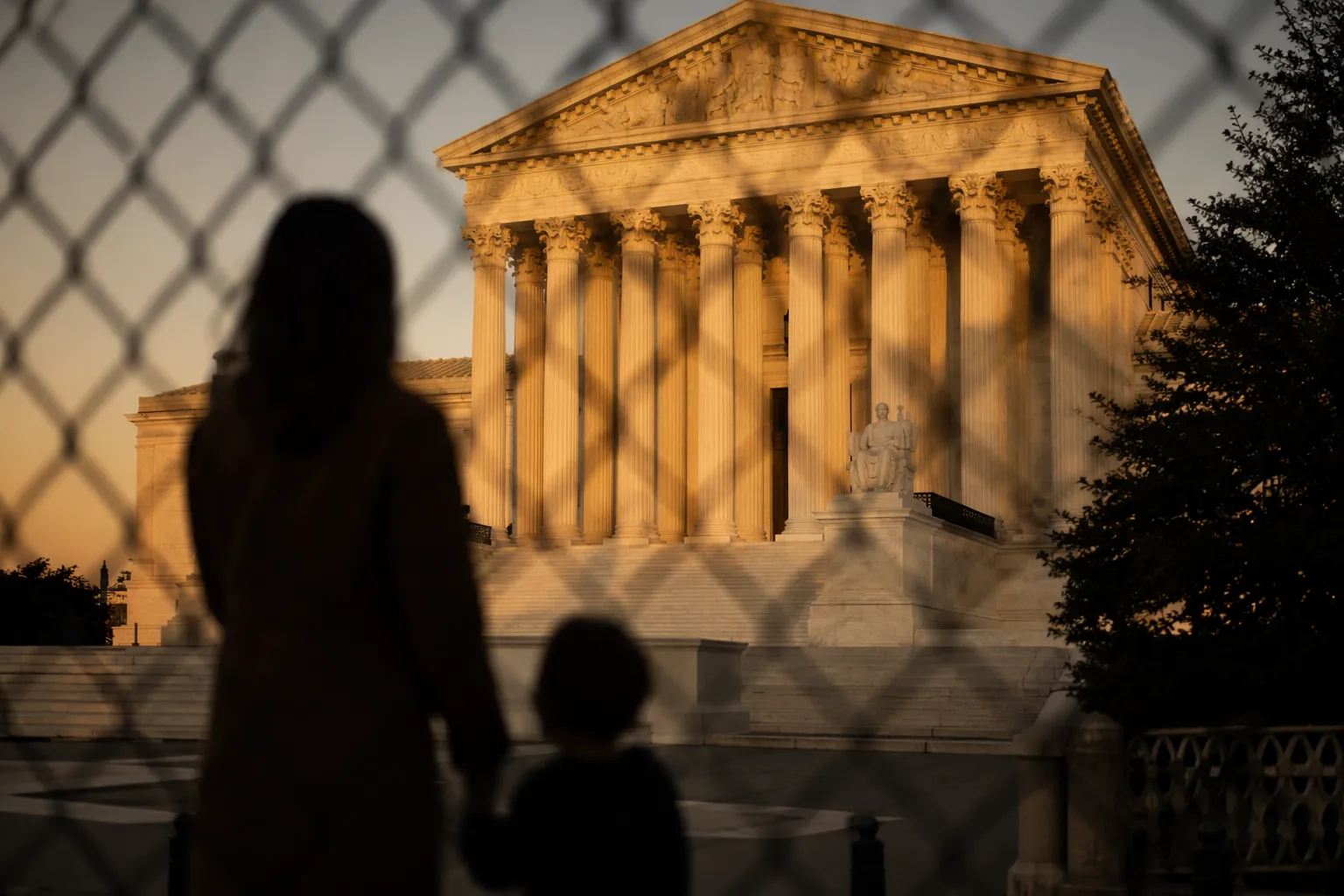
As of July 27, 2026, there is also a status caveat. The record available for this analysis identifies a D.C. Circuit temporary block that was set to last only until at least July 27, with the matter returning to the court today. Protections may therefore have expired, or may remain temporarily preserved depending on further court action. Either way, Mullin is now the controlling Supreme Court framework for what courts can hear.
What Mullin actually blocks
Section 1254a(b)(5)(A) provides that there is no judicial review of “any determination” concerning designation, termination, or extension of TPS. The fight in Mullin turned on how much work the word “determination” does. The majority read it broadly, not as the final signature on a termination notice, but as encompassing the chain of events leading up to that decision.[2]
Once “determination” includes that chain, the usual procedural routes narrow sharply. A plaintiff cannot avoid the jurisdictional bar simply by saying the final TPS termination is not the target and that the agency’s consultation, reasoning, or record-building process is. If the requested review would require the court to inspect how DHS arrived at the termination decision, Mullin treats the claim as part of the barred determination.[1][2]
| Claim type after Mullin | Reviewability posture |
|---|---|
| APA arbitrary-and-capricious challenge to the TPS termination | Barred as a non-constitutional challenge to the termination determination |
| Claim that DHS inadequately consulted other agencies before terminating TPS | Barred when framed as a procedural attack on the chain leading to termination |
| Statutory or regulatory procedural challenge that would require review of how DHS reached the termination | Likely barred under the majority’s broad reading of “determination” |
| Equal-protection claim alleging unconstitutional discrimination | Not barred by the statute, but the majority signaled the merits are weak |
This is why describing the case as simply “TPS termination was upheld” is too loose. Mullin is a reviewability decision with merits consequences. The Court did not conduct ordinary APA review and then bless DHS’s reasoning. It held that Congress had closed the courthouse door to non-constitutional review of the decision and its lead-up.
The majority’s chain-of-events reading sweeps in the process claims
The most important move in the majority opinion is its treatment of process. TPS terminations do not emerge from a single sentence in the Federal Register. The agency consults, assesses country conditions, evaluates whether statutory conditions remain, and publishes a notice. Lawyers naturally look for defects inside that sequence. Mullin makes that sequence difficult to litigate.
The plaintiffs’ procedural theories included challenges to whether the administration had satisfied statutory consultation requirements before terminating protections. Justice Kagan’s dissent, joined by Justices Sotomayor and Jackson, would have allowed at least some procedural consultation claims to proceed because they attacked compliance with a separate statutory command rather than the ultimate termination itself.[1]
The majority rejected that carveout. Its view was that a challenge to the consultation leading to termination is still a challenge to the TPS determination. That is the point that does the most damage to ordinary administrative-law litigation: it prevents counsel from recasting a blocked merits challenge as a reviewable process challenge when the process being reviewed is part of the termination chain.[1][2]
For immigration counsel, the result is not a small pleading adjustment. A complaint alleging that DHS overlooked evidence, failed to adequately explain changed conditions, used a defective consultation process, or acted arbitrarily in weighing the country record runs into the same statutory wall if the claim is non-constitutional and tied to the termination determination.
Miot shows the kind of review Mullin largely displaces
Miot v. Trump is useful not because it survives Mullin intact, but because it shows what lower-court review looked like before the Supreme Court tightened the jurisdictional frame. In February 2026, Judge Reyes issued an 83-page opinion halting Haiti’s TPS termination and finding the plaintiffs’ equal-protection claim likely to succeed.[3]
The evidence identified in that ruling included a pattern of terminating all 12 TPS designations since 2025, a State Department consultation described as consisting of a single email, and presidential statements that the court viewed as reflecting anti-Black and anti-Haitian animus.[3] Those facts mattered because equal protection asks a different question from the APA: not merely whether the agency reasoned adequately, but whether the government acted with unconstitutional discriminatory purpose.
Mullin did not erase constitutional claims. The majority applied the clear-statement rule: Congress must speak clearly before courts treat a jurisdiction-stripping statute as cutting off constitutional review. Section 1254a(b)(5)(A) did not contain that kind of clear statement, so equal-protection claims remain judicially cognizable.[2]
But the survival of a courthouse entrance is not the same as a viable merits path. The majority’s warning that the equal-protection theory “will likely fail” is a litigation signal that cannot be wished away.[1][2] Justice Kagan’s dissent treated the racial-animus evidence as far stronger, saying the record “fairly shout[s]” discriminatory motive.[1] That dissent now supplies arguments, not governing law.
The remaining claim must be constitutional, and that changes the case
After Mullin, a lawyer challenging Haiti’s TPS termination cannot treat equal protection as a decorative count added to a conventional APA complaint. It is the surviving judicial path. That means the pleadings, record, and requested relief must be organized around discriminatory purpose and constitutional injury, not simply administrative sloppiness or inadequate country-condition analysis.
The difficulty is that much of the evidence that may make a termination look irregular also sounds procedural. A rushed consultation, a sudden departure from prior practice, or a thin record may help tell a constitutional story only if it is tied to discriminatory purpose. Standing alone, those facts are vulnerable to being characterized as barred process objections.
That is the post-Mullin squeeze. The Court preserves constitutional review in principle, while reading the statute to block the administrative-law claims that often supply the most direct way to slow a termination before removals and work-authorization losses become operational realities.
How a reviewability ruling reaches U.S.-citizen children
The Supreme Court did not order any parent separated from any child. The family-separation risk follows through a more mechanical route: if courts cannot review non-constitutional challenges to the termination process, DHS’s termination becomes harder to stop; if the termination becomes operative, TPS holders lose the protection and work authorization attached to that status; once that happens, mixed-status families face choices that immigration law makes formally individual but practically collective.
The scale is not abstract. The November 28, 2025 Federal Register termination notice identified 352,959 Haitian TPS holders.[4] FWD.us estimates, using augmented 2024 American Community Survey data analyzed by Dr. Phillip Connor of Princeton University, that 50,000 U.S.-citizen children have at least one Haitian TPS parent.[5] That child figure is an estimate from survey-based data, not a census count of every affected household.

The Center for American Progress describes three recurring outcomes when TPS is ended for parents of U.S.-citizen children: the parent is deported without the child; the parent takes the child to the country of removal; or the parent remains in the United States without status.[6] Those are not three neat legal options. They are the practical shapes a lost status can take.
- If the parent leaves without the child, the child remains in the United States but loses daily care, income, and family stability.
- If the parent takes the child to Haiti, the child keeps the parent but leaves the country of citizenship for conditions the TPS designation had treated as unsafe enough to justify temporary protection.
- If the parent remains without status, the household may stay physically intact while living with the risk of arrest, removal, job loss, and reduced access to ordinary institutions.
CAP also cites evidence of trauma to children from parental separation, including depression, anxiety, and disrupted development.[6] That evidence does not convert a jurisdictional statute into a family-law statute. It does explain why a decision about reviewability has consequences outside the courthouse even when the Court’s opinion speaks in statutory verbs.
Collateral harms are real, but they do not reopen the barred claims
The economic record underscores the breadth of the consequences. A Public Rights Project amicus filing on behalf of 47 local governments reported that TPS-eligible Haitians contribute $4.4 billion annually to the U.S. economy; it also reported that in Florida alone, 93,000 TPS holders pay $300 million in federal and payroll taxes and $306 million in state and local taxes.[7]
A January 2026 Haitian Bridge Alliance and FWD.us factsheet estimated that 25,000 U.S.-citizen children could be pushed into poverty if Haitian TPS parents lose work authorization.[8] That figure belongs in the legal analysis because work authorization is one of the immediate practical incidents of TPS, and its loss changes household income before any final removal actually occurs.
Still, these collateral harms do not create a free-standing exception to § 1254a(b)(5)(A). They may shape equities, emergency motions, public-law arguments, and the factual record for constitutional claims. They do not revive an APA claim that Mullin places inside the barred termination determination.
The posture on July 27
The immediate operational status of Haiti TPS is unsettled as of this writing because the temporary D.C. Circuit block was set to run only until at least July 27, 2026. That uncertainty matters for affected families, employers, and counsel, but it does not change the Supreme Court rule now governing reviewability.
The controlling framework is therefore stark. Non-constitutional challenges to Haiti’s TPS termination process are barred. Equal-protection claims survive only because constitutional claims require a clearer jurisdiction-stripping statement, and the majority has already indicated skepticism on the merits. The family-separation risk follows from that narrowed litigation posture: when procedural challenges cannot be heard, DHS’s termination becomes materially harder to stop before the consequences reach U.S.-citizen children.
References
- Supreme Court allows Trump administration to end removal protections for Syrian and Haitian nationals, SCOTUSblog, June 2026
- CRS Legal Sidebar LSB11446, Congressional Research Service, updated July 10, 2026
- Late Minute Reprieve: Court Halts Haiti TPS Termination, Seyfarth Shaw LLP
- Termination of the Designation of Haiti for Temporary Protected Status, Federal Register, November 28, 2025
- Haitian TPS holders make the U.S. stronger, FWD.us
- Ending TPS Will Hurt U.S.-Citizen Children, Center for American Progress
- Miot v. Trump, Public Rights Project
- New Data Reveals the Immense Human and Economic Cost of Terminating Haiti’s Temporary Protected Status, Haitian Bridge Alliance, January 2026
Operationalizing workflow
No workflow has been explicitly linked to this obligation yet. See Workflows generally.
Illustrative cases
No illustrative case is currently tracked for this obligation. See Risk Digest for documented incidents generally.
← Back to RegulationReport a correction or tip
Spotted an outdated figure, a misstated fact, or a ruling this regulation entry should reflect? Public comments are disabled for this content given the professional cost of a misreported case outcome, penalty amount, or rule text — use the structured correction channel instead.
Report a correction or tip for this record →