
Can anyone prosecute Myanmar's airstrike war crimes?
- Authority
- International Criminal Court; International Court of Justice; universal-jurisdiction courts; Independent Investigative Mechanism for Myanmar; UN Security Council
- Rule type
- statute
- Jurisdiction scope
- International; national universal-jurisdiction proceedings
- Effective date
- Aug 11, 2026
- Source text
- Read primary rule text ↗
Do not direct attacks at civilians or protected civilian objects, and do not conduct indiscriminate attacks.
Last verified: Q3 2026. Legal-background review: Elena Marquez, J.D. This article is a legal-information record, not legal advice. Its status statement is narrow: the airstrike evidence is now substantial; the international-humanitarian-law classification depends on proof of targeting, civilian status, and military necessity in each incident; and the power to prosecute is split across institutions that do very different things.
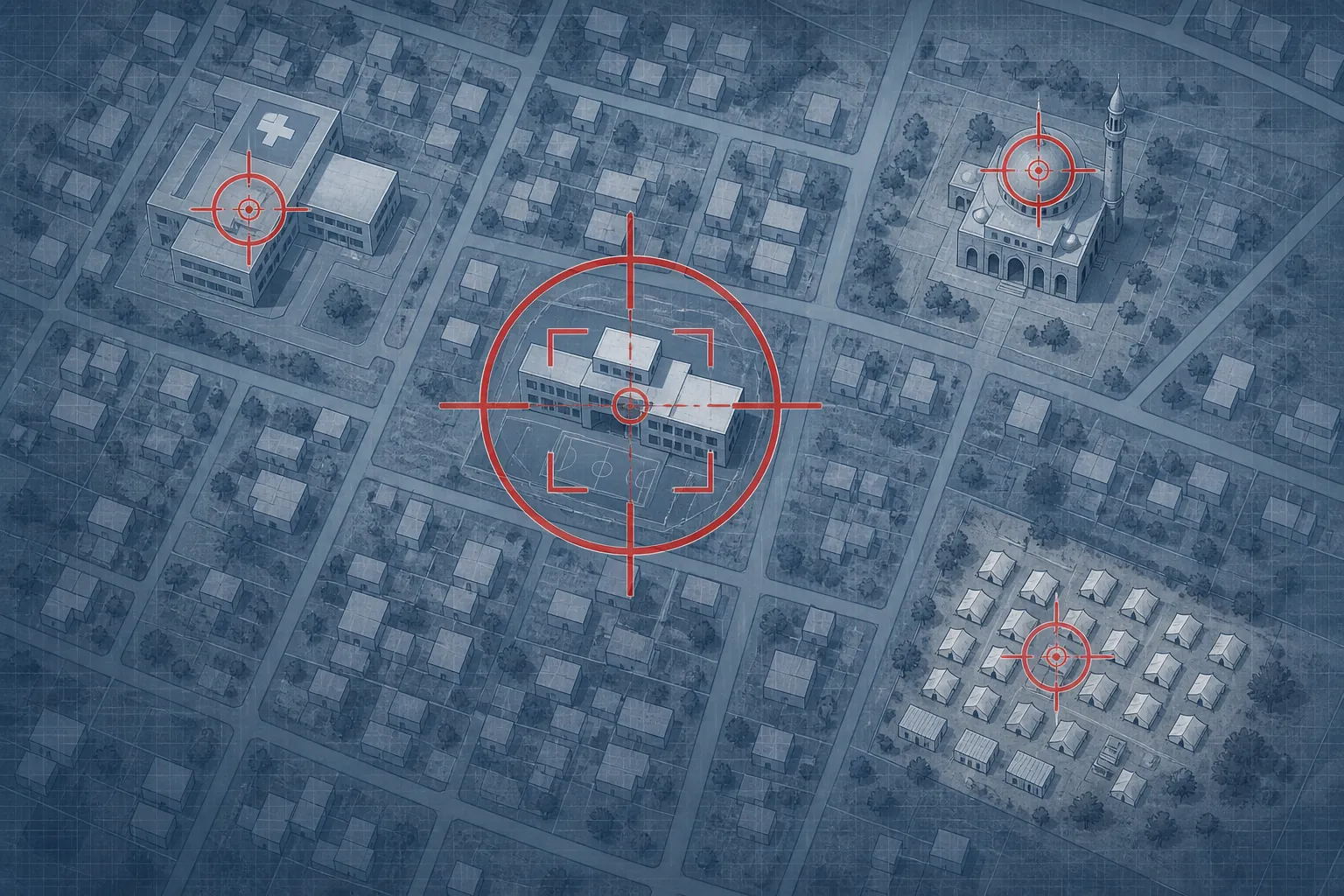
The live problem in Myanmar is no longer whether there is a serious record to examine. On 11 August 2026, the Independent Investigative Mechanism for Myanmar reported a pattern of deliberate aerial attacks on homes, schools, medical facilities, religious buildings, and internally displaced persons camps, drawing on more than 1,600 sources and more than 750 witness accounts.[1] That kind of source discipline matters before anyone reaches for a court name. It makes the legal question harder, not easier: which forum can convert that record into charges, judgments, or warrants?
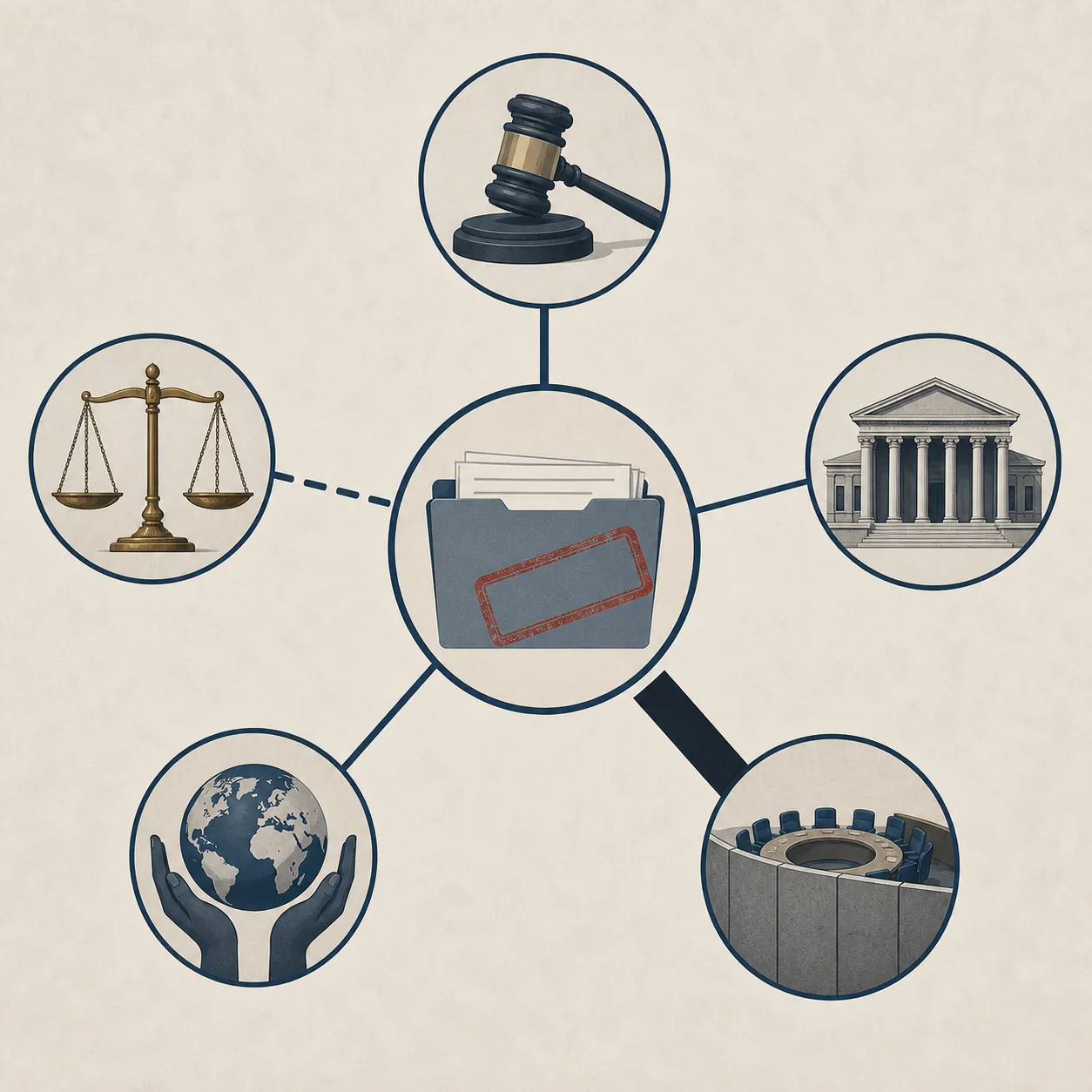
The accountability map, as of Q3 2026
| Mechanism | What it can do | What it cannot do | Current status |
|---|---|---|---|
| IIMM | Collect, preserve, analyze, and prepare case files for possible criminal proceedings. | It cannot itself indict, issue arrest warrants, or conduct trials. | Its 11 Aug. 2026 report documents deliberate aerial attacks on civilian locations, supported by 1,600+ sources and 750+ witness accounts.[1] |
| ICC Bangladesh/Myanmar situation | Investigate crimes within the authorized territorial theory: crimes committed at least partly on Bangladesh territory from 1 June 2010.[3] | It is not a general Myanmar war-crimes docket and does not automatically cover post-coup airstrikes inside Myanmar. | The 27 Nov. 2024 Prosecutor application seeks an arrest warrant for Min Aung Hlaing for 2017 crimes against humanity of deportation and persecution; no public decision was identified in the cited Q3 2026 materials.[4] |
| ICJ, The Gambia v. Myanmar | Determine Myanmar’s state responsibility under the Genocide Convention. | It does not prosecute individuals or issue criminal convictions against commanders or pilots. | Merits hearings were held from 12–29 Jan. 2026, with 11 intervening states; judgment was expected later in 2026.[5][6] |
| Universal jurisdiction | Allow national prosecutors or courts, depending on domestic law, to pursue certain international crimes without the territorial link that limits the ICC Myanmar track. | It is uneven, state-dependent, and often constrained by presence, immunity arguments, resources, and prosecutorial discretion. | The IIMM tracker, updated 23 July 2026, lists activity in Argentina, Germany, Türkiye, the Philippines, Indonesia, Australia, Timor-Leste, and the UK.[7] |
| UN Security Council referral | Could refer the broader Myanmar situation to the ICC, potentially overcoming the current territorial limit. | It is a political route, not a standing legal entitlement. | China and Russia have blocked referral efforts through veto power.[8] |
This table is the answer in compressed form. Myanmar airstrike war crimes can in principle be prosecuted under international law, but not every institution that appears in the Myanmar accountability conversation has jurisdiction over the same conduct. The most common error is to treat “the ICC,” “the ICJ,” and “the UN” as interchangeable destinations. They are not.
Why the airstrike record fits the war-crimes question
International humanitarian law does not prohibit every airstrike. It prohibits direct attacks on civilians, direct attacks on protected civilian objects, and indiscriminate attacks. The ICRC’s formulation of indiscriminate attacks covers attacks that are not directed at a specific military objective, use a method or means that cannot be directed at a specific military objective, or use a method or means whose effects cannot be limited as required by international humanitarian law.[2]
That legal test makes the IIMM’s 2026 findings central. A pattern of deliberate aerial attacks on homes, schools, medical facilities, religious buildings, and IDP camps, if proven in case-specific proceedings, is not merely evidence of civilian harm. It is evidence pointed at the elements that prosecutors would have to prove: civilian or protected-object status, intent or knowledge, absence or misuse of a military objective, and the operational pattern behind repeated strikes.[1][2]
Other UN reporting describes the same direction of travel, with casualty figures that should be kept source-specific. UN News reported in October 2025 that OHCHR had documented at least 6,764 civilian deaths and more than 29,000 political arrests since the coup, and that nearly half of all verified civilian deaths between April 2024 and May 2025 resulted from aerial attacks.[9] Those numbers do not replace incident-level proof. They show why the air campaign is not a marginal feature of the post-coup violence.
Fortify Rights adds a narrower tactical record. It documented 304 paramotor and gyrocopter attacks from December 2024 to 11 January 2026, including the 6 October 2025 Chaung-U attack, which it reported killed 24 people and injured 61.[10] UN News separately reported 24 killed and more than 45 wounded in that attack.[11] The difference is not a drafting inconvenience to be smoothed over. It is exactly why atrocity records need attribution, not averaged certainty.
The ICC track is real, but it is not a general Myanmar airstrike case
The ICC’s Myanmar-related jurisdiction is often described too broadly. The Court authorized investigation of the Bangladesh/Myanmar situation on 14 November 2019 for alleged crimes within its jurisdiction committed at least in part on the territory of Bangladesh, or on the territory of another state party, from 1 June 2010.[3] That territorial hook matters because Myanmar is not treated in the cited materials as a state party that has opened the entire post-coup conflict to ICC jurisdiction.
The pending Min Aung Hlaing application should be described with the same restraint. On 27 November 2024, the ICC Prosecutor announced an application for an arrest warrant for Min Aung Hlaing for crimes against humanity of deportation and persecution of the Rohingya, arising from the 2017 events.[4] That is grave. It is also not a charge sheet for airstrikes in Sagaing, Chin, Kayah, Karen, Rakhine, or other post-coup locations where non-Rohingya communities have been attacked from the air.
So the practical ICC answer is limited. If alleged conduct has the Bangladesh territorial connection recognized in the authorized situation, it may fall within the existing track. Post-2021 airstrike crimes committed wholly inside Myanmar do not become ICC cases merely because the perpetrator is a Myanmar official or because the underlying conduct would amount to a war crime. For the broader enforcement problem, that distinction is not a technicality; it is the doorframe.
The site has treated this kind of enforcement gap in other contexts, including the limits on acting under an ICC warrant in Why New York City Cannot Arrest Netanyahu Under the ICC Warrant and the forum inventory in Ortega's Election Cancellation Triggers Multiple Legal Consequences. The Myanmar problem is not that international criminal law has no vocabulary for the alleged crimes. It is that vocabulary and jurisdiction do not travel together.
The ICJ case is important, but it is the wrong place to look for individual prosecutions
The ICJ case, The Gambia v. Myanmar, concerns Myanmar’s responsibility under the Genocide Convention.[5] The Court can decide whether a state has breached treaty obligations. It does not try Min Aung Hlaing, air force commanders, pilots, or ground officers. It does not impose prison sentences. It does not substitute for an international criminal tribunal.
That does not make the case irrelevant. Merits hearings ran from 12 to 29 January 2026, with 11 intervening states, and judgment was expected later in 2026.[6] A merits judgment could shape the legal record, state obligations, and diplomatic pressure. But for the specific question of prosecuting post-coup airstrike war crimes, the ICJ remains a state-responsibility forum. Treating it as a criminal accountability mechanism confuses the very thing victims need kept clear.
Universal jurisdiction is the live prosecutorial terrain
For post-coup airstrike crimes that do not fit the ICC’s Bangladesh territorial theory, universal jurisdiction is the most concrete active route identified in the Q3 2026 materials. It is imperfect in the ordinary ways criminal jurisdiction is imperfect: domestic law differs; prosecutors may decline; suspects may be absent; immunity arguments may be raised; and investigations can move slowly. But unlike a Security Council referral, it is not waiting on the consent of China and Russia.
The IIMM’s universal-jurisdiction tracker, updated 23 July 2026, lists several national proceedings or complaints. Argentina opened an investigation in November 2021; a prosecutor petition followed in June 2024; and arrest warrants were issued in February 2025 for 25 suspects. Germany rejected a complaint in September 2023 on presence and duplication grounds. Türkiye accepted a complaint and the matter remained ongoing, with further evidence submitted in September 2025. The tracker also lists activity in the Philippines, Indonesia, Australia, Timor-Leste, and the UK, including an April 2026 complaint in Indonesia against Min Aung Hlaing and UK Metropolitan Police structural investigations.[7]
The important point is not that every listed jurisdiction will produce a trial. It is that these filings can receive IIMM case files and test specific suspects, incidents, command structures, and evidentiary chains. That is closer to prosecution than a general demand that “the ICC should act” where the ICC’s current Myanmar jurisdiction does not reach the conduct being discussed.
Justice in Conflict’s January 2026 analysis usefully frames universal jurisdiction as a way to leverage available national courts for Myanmar accountability, while also recognizing the limits of selectivity, enforcement, and political will.[12] Those limits are not reasons to ignore the route. They are reasons to track filings by jurisdiction, suspect, alleged crime base, and procedural stage.
The Security Council route is legally broad and politically blocked
A UN Security Council referral could, in principle, give the ICC a broader Myanmar situation than the current Bangladesh/Myanmar track. That would be the cleanest way to align the scale of the alleged post-coup crimes with an international criminal forum capable of issuing warrants and trying individuals.
It is also the route least honest to mention without the veto. Human Rights Watch’s November 2024 account of the ICC warrant application noted the long-standing barrier created by Chinese and Russian opposition to a Security Council referral.[8] In practical terms, a referral remains the broadest formal path and the one most visibly blocked.
What changes after Min Aung Hlaing’s 2026 presidency?
Min Aung Hlaing was voted president on 3 April 2026. Amnesty International’s position was that the presidency must not shield him from accountability, including in relation to the ICC arrest-warrant application and other proceedings.[13] That is not the same as saying every court will treat immunity questions identically. Immunity arguments depend on forum, office, charge, domestic law, and the type of proceeding.
For a prosecution map, the presidency is therefore a complication to verify in each forum, not a reason to rewrite the underlying jurisdictional structure. The ICC application identified in the cited materials still concerns 2017 Rohingya deportation and persecution crimes. Universal-jurisdiction complaints still depend on domestic law and prosecutorial action. The ICJ still concerns state responsibility, not individual criminal punishment.
How to read casualty and incident records without flattening them
The Myanmar record contains multiple reputable casualty and incident accounts, but they measure different things. OHCHR’s figures reported through UN News describe verified civilian deaths and arrests across a defined post-coup period.[9] Fortify Rights’ paramotor and gyrocopter record describes a specific mode of attack over a narrower window.[10] BBC reporting on election-period airstrikes adds another time-bound account of violence around a political event.[14]
Those records can sit next to each other. They should not be merged into a single invented master total. A prosecutor would not prove an indiscriminate attack by averaging public casualty figures; she would prove the location, the weapon or aircraft, the intended target if any, the civilian presence known or knowable to the attackers, the casualties, the command link, and the absence or insufficiency of a lawful military objective.
That is also why the IIMM’s role is more important than its institutional modesty suggests. It does not prosecute, but it builds the files that a prosecutor needs: source comparison, witness accounts, linkage evidence, pattern evidence, and preservation before memories fade or digital material disappears.[1]
So, can anyone prosecute Myanmar’s airstrike war crimes?
Yes, in principle. Direct attacks on civilians, attacks on protected civilian objects, and indiscriminate attacks are prosecutable war crimes if the facts and mental elements are proven. The IIMM, OHCHR, HRW, Fortify Rights, and media records cited here provide a substantial documentary base for that inquiry.
But the existing ICC Myanmar track should not be described as the forum for post-coup airstrike crimes generally. It is anchored to crimes committed at least partly on Bangladeshi territory from 1 June 2010, and the pending 27 November 2024 Min Aung Hlaing application identified in the cited materials concerns the 2017 Rohingya deportation and persecution crimes.[3][4]
The ICJ case matters for Myanmar’s state responsibility under the Genocide Convention, with judgment expected later in 2026, but it is not an individual criminal prosecution.[5][6] The IIMM is building files, not trying defendants. Universal-jurisdiction proceedings are the live prosecutorial terrain for post-2021 airstrike crimes that fall outside the ICC’s current territorial path.[7] The broadest route, a Security Council referral to the ICC, remains politically blocked by China and Russia.[8]
References
- Myanmar Mechanism investigations reveal deliberate attacks on civilians by Myanmar military in Annual Report, Independent Investigative Mechanism for Myanmar, 11 Aug. 2026
- Indiscriminate attacks, ICRC Casebook
- Bangladesh/Myanmar, International Criminal Court
- Myanmar: ICC Prosecutor Requests Arrest Warrant, Human Rights Watch, 27 Nov. 2024
- Application of the Convention on the Prevention and Punishment of the Crime of Genocide (The Gambia v. Myanmar), International Court of Justice
- Myanmar genocide case opens at World Court, UN News, Jan. 2026
- Universal Jurisdiction, Independent Investigative Mechanism for Myanmar, updated 23 July 2026
- Myanmar: ICC Prosecutor Requests Arrest Warrant, Human Rights Watch, 27 Nov. 2024
- UN News coverage of OHCHR reporting; Myanmar: Four years after coup, leaders ramp up violations to unprecedented levels, OHCHR
- Myanmar: Investigate Paramotor, Gyrocopter Attacks as War Crimes, Fortify Rights, 26 Jan. 2026
- Myanmar Mechanism investigations reveal deliberate attacks on civilians by Myanmar military, UN News, Aug. 2026
- Dreaming of Justice, Part 2: Leveraging Universal Jurisdiction for Accountability in Myanmar, Justice in Conflict, 15 Jan. 2026
- Myanmar: Presidency must not shield Min Aung Hlaing from being held accountable, Amnesty International, Apr. 2026
- BBC election-period airstrike toll, BBC
Operationalizing workflow
No workflow has been explicitly linked to this obligation yet. See Workflows generally.
Illustrative cases
No illustrative case is currently tracked for this obligation. See Risk Digest for documented incidents generally.
← Back to RegulationReport a correction or tip
Spotted an outdated figure, a misstated fact, or a ruling this regulation entry should reflect? Public comments are disabled for this content given the professional cost of a misreported case outcome, penalty amount, or rule text — use the structured correction channel instead.
Report a correction or tip for this record →