
What the N-ESRS Exposure Draft Means for Foreign Companies
- Authority
- EFRAG
- Rule type
- regulation
- Jurisdiction scope
- EU
- Effective date
- Jul 23, 2026
- Source text
- Read primary rule text ↗
Non-EU parent companies meeting €450M EU turnover and qualifying EU presence must report sustainability impacts per N-ESRS draft.
EFRAG published the ESRS-40a exposure draft for certain non-EU undertakings on July 23, 2026, opening a 100-day consultation that closes on October 31, 2026.[1] For foreign-company counsel, the immediate answer is practical: test the revised EU turnover and EU presence thresholds first, then treat the draft N-ESRS as a provisional reporting floor rather than a final safe harbor.
This briefing is for issue-spotting and planning, not legal advice. Application will turn on group-specific revenue, branch and subsidiary structures, local implementing law, and the final text adopted after EFRAG’s consultation and Commission process.
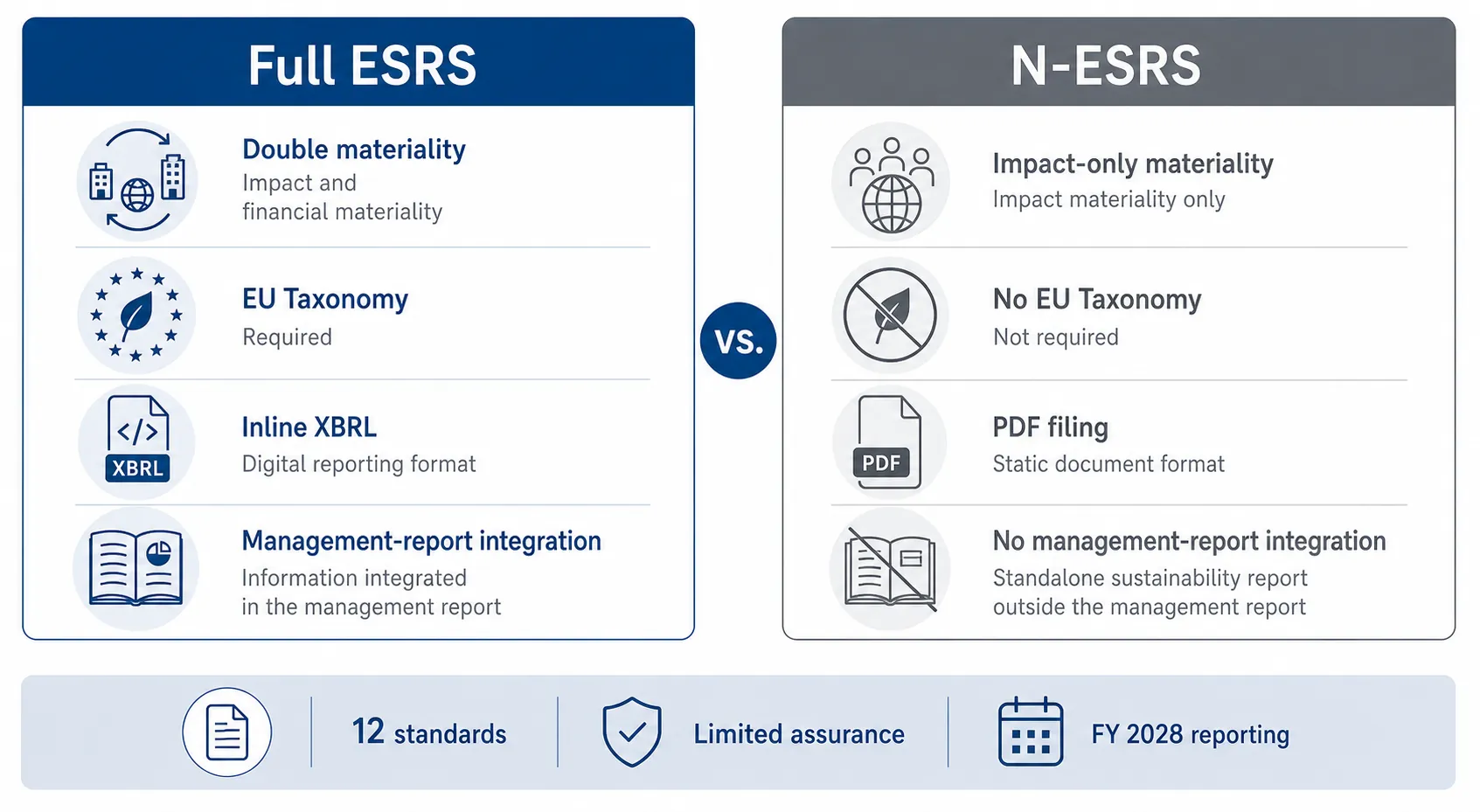
The headline for foreign companies is not that EU sustainability reporting compliance has disappeared. It has narrowed. The draft drops several features that made full ESRS replication especially difficult for non-EU groups, including double materiality, EU Taxonomy disclosures, Inline XBRL, and management-report integration. But the largest foreign groups remain the audience: the relevant scoping test now points to non-EU parents with at least €450 million in EU turnover in each of the last two consecutive years and an EU subsidiary or branch meeting the applicable EU presence threshold, including a branch threshold of at least €200 million turnover.[2]

The first triage question is still scope
Article 40a matters because it reaches beyond EU-incorporated reporting companies. It is aimed at sustainability reporting by certain non-EU parent undertakings with substantial EU activity. Omnibus I changed the practical audience by raising thresholds and narrowing the number of companies expected to be caught. One estimate put the affected population down from roughly 10,000 foreign entities to about 1,200, while noting that the 12-standard architecture remains.[3]
That reduction is material, but it should not be read as a general exemption for multinational groups. A non-EU parent that sells heavily into the EU and has a meaningful EU subsidiary or branch still needs a documented scoping analysis. The legal team should not let the word “reduced” substitute for an entity chart.
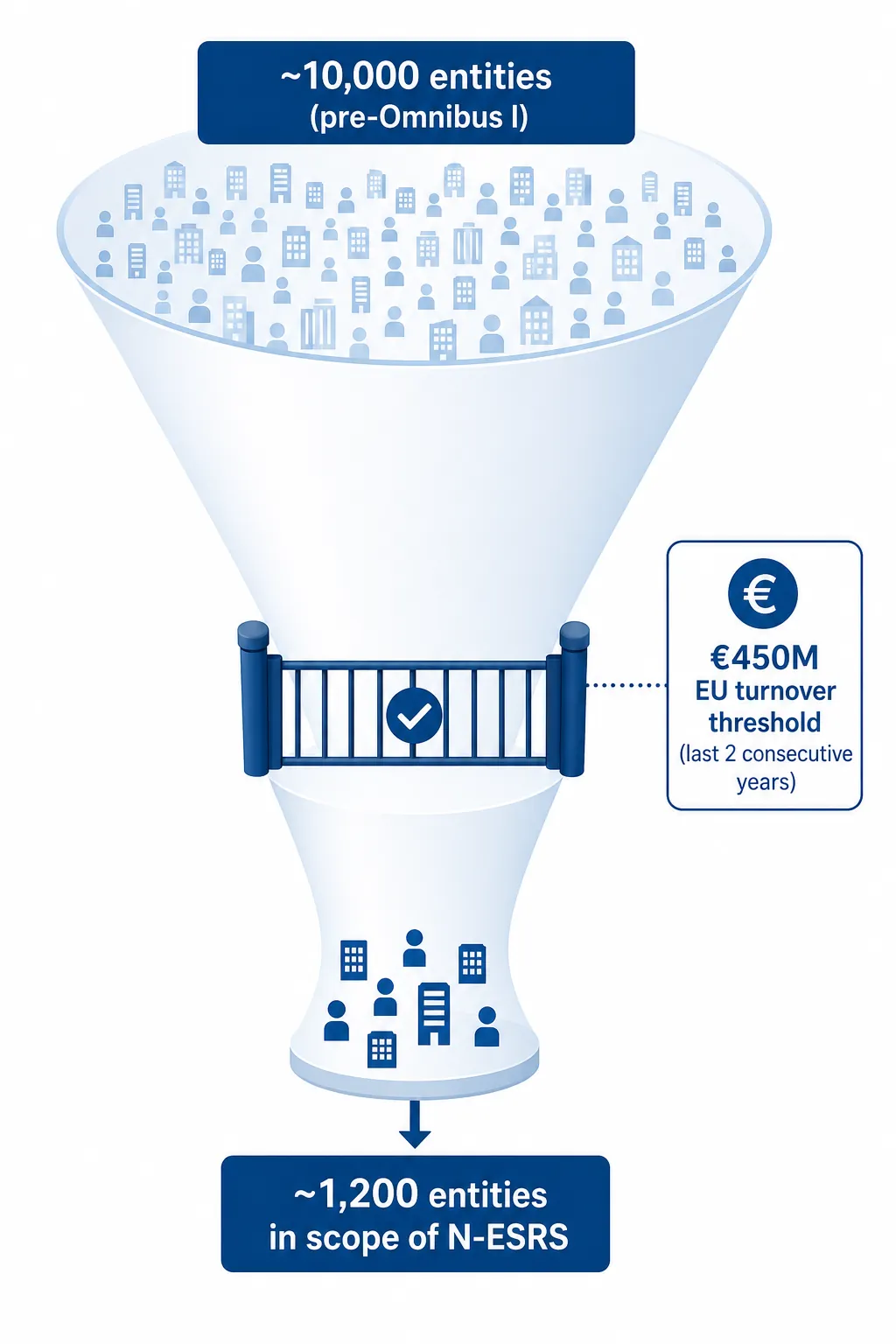
The working scope review should start with three files: EU revenue by year, EU legal presence, and the reporting parent’s consolidation perimeter. The €450 million EU turnover test is not a single-year snapshot; it is measured over the last two consecutive years.[2] Counsel should therefore ask finance for the calculation method, currency treatment, intra-group eliminations if relevant to the analysis, and a clear record of which entities or branches contributed to the EU turnover number.
The second side of the test is EU presence. The briefest version is easy to say and risky to rely on: there must be an EU subsidiary or qualifying EU branch, with the branch threshold identified by PwC as at least €200 million turnover.[2] The more useful version asks which legal entity sits in which Member State, whether it is a subsidiary or branch, what local filings it already makes, and who would be responsible for publication if the parent is brought within Article 40a reporting.
| Triage point | Counsel’s working question |
|---|---|
| EU turnover | Did the non-EU parent group meet at least €450 million EU turnover in each of the last two consecutive years?[2] |
| EU presence | Is there an EU subsidiary or qualifying branch, including a branch with at least €200 million turnover?[2] |
| Reporting period | Is the planning file aligned to FY 2028 reporting to be published in 2029?[2] |
| Reporting standard | Is the gap assessment mapped to the draft N-ESRS rather than full ESRS? |
| Draft status | Are assumptions marked provisional pending the consultation close on October 31, 2026 and later Commission action?[1] |
For groups near the line, the answer may not be stable until finance and legal reconcile the revenue and structure facts. That is where many late-stage compliance surprises begin: sustainability or finance assumes the group is out because “EU operations are small,” while the legal test turns on turnover into the EU and a qualifying local presence.
Timing: FY 2028 is the planning year, but 2026 is the consultation year
The current planning marker is group-level reporting for financial year 2028, with publication in 2029.[2] That gives large foreign groups time, but not the kind of time that supports waiting for every detail to settle. A group that is plausibly in scope will need data ownership, internal controls, assurance readiness, and subsidiary coordination well before the first report is due.
The open procedural date is closer: October 31, 2026. EFRAG’s exposure draft is under consultation, with submission to the European Commission expected in January 2027.[1] The useful posture now is not full implementation as if the draft were law, and not passivity as if nothing can be planned. It is a controlled gap assessment against the draft, with assumptions labeled.
What the N-ESRS asks for
The draft N-ESRS keeps a 12-standard structure: two cross-cutting standards and 10 topical standards.[3] That matters because counsel should not present the proposal as a short-form sustainability questionnaire. It is a reporting framework, just a narrower one than full ESRS for EU companies.
The most important narrowing is materiality. Under the draft N-ESRS, the foreign parent applies impact-only materiality, rather than the double-materiality approach used in full ESRS.[2] In practical terms, the reporting file is focused on the undertaking’s impacts on people and the environment, not the separate financial-materiality lens that asks how sustainability matters affect enterprise value. That change removes a substantial layer of analysis, evidence collection, and internal debate.
There are also format and filing simplifications. PwC describes the draft as permitting PDF filing, with no Inline XBRL requirement, and no requirement to integrate the sustainability statement into the management report.[2] For a non-EU parent, those details change the project plan. They reduce dependence on EU-style digital tagging workflows and avoid forcing the foreign parent’s sustainability disclosures into a management-report architecture that may not exist in the same form outside the EU.
The draft also removes EU Taxonomy disclosures for these non-EU parent reports.[2] That is one of the clearest budget-line simplifications. Taxonomy reporting can require granular activity mapping, eligibility and alignment analysis, technical-screening criteria, and finance-sustainability coordination. Its removal does not make the N-ESRS light, but it changes the scale of the first gap assessment.
| Issue | Full ESRS reference point | Draft N-ESRS position for non-EU parents |
|---|---|---|
| Materiality lens | Double materiality | Impact-only materiality[2] |
| EU Taxonomy | Taxonomy disclosures may be part of the broader EU reporting package | EU Taxonomy disclosures removed[2] |
| Digital format | Inline XBRL is part of the full digital reporting direction | PDF filing permitted; no Inline XBRL requirement[2] |
| Location of report | Integrated management-report approach | No management-report integration required[2] |
| Standards architecture | ESRS standards architecture | 12 standards retained, with reduced datapoints[3] |
| Assurance | Assurance requirement under the CSRD framework | Limited assurance still required[2] |
What the simplifications do not remove
Limited assurance remains part of the obligation.[2] That single point should keep the reporting project out of the “communications exercise” category. Once an assurance provider is involved, the company needs evidence trails, process owners, and defensible judgments about material impacts. Legal should expect questions about governance, controls, sign-off, and the basis for excluding topics or datapoints.
The 12-standard structure also means the topical scan remains broad. Climate, workforce, value chain, business conduct, and other sustainability topics may still need to be assessed through the N-ESRS lens. The reduction in datapoints changes the depth and mechanics of reporting; it does not authorize a company to skip the materiality process.
Nor does the draft eliminate enforcement exposure. PwC’s guide describes possible consequences in terms that should be recognizable to legal and audit teams: “fines, criminal sanction and prosecution, audit failure, public censure, and reputational risk and exposure to litigation.”[2] The precise route will depend on implementing law and enforcement practice, but the compliance file should be built on the assumption that publication choices can later be reviewed.
The reporting perimeter is the unresolved issue to watch
Once the simplifications are understood, the uncomfortable question is perimeter. EFRAG’s consultation materials include formal reservations from the EFRAG Sustainability Reporting Board Chair regarding the Commission-directed mixed approach to reporting-perimeter options.[1] That is not a side note for lawyers. Reporting perimeter is where a multinational decides which operations, subsidiaries, value-chain information, and group-level impacts sit inside the report.
Perimeter methodology affects scoping confidence. A counsel advising that the group is out of scope, or that only a narrow file is needed, must be able to defend the assumptions later. If the final approach changes how the non-EU parent’s reporting boundary is drawn, early gap assessments may need revision. That does not mean work should stop. It means the work should be version-controlled, with a visible assumption log.
A practical assumption log should identify the parent undertaking used for the analysis, the EU revenue years tested, the EU subsidiary or branch relied on for presence, the draft perimeter method applied, and any areas where the legal or sustainability team made an interpretive call. If the company later submits comments to EFRAG, that same log can help turn internal uncertainty into concrete consultation feedback.
Member State implementation will still matter
The EU-level draft is not the entire operating environment. Member States must transpose the Omnibus I directive by March 19, 2027.[4] Local implementation can affect process, enforcement posture, filing mechanics, and the practical expectations of regulators and auditors. A group with significant operations in more than one Member State should avoid assuming that one local answer resolves all implementation questions.
This is also where CSRD and CSDDD should be kept separate. Omnibus I discussions often cover both corporate sustainability reporting and due-diligence reforms, but the N-ESRS file is about CSRD Article 40a reporting for certain non-EU undertakings. CSDDD may matter to the same corporate group, but it is not the authority for deciding whether the N-ESRS reporting obligation applies.
What counsel should do before October 31, 2026
For a plausibly in-scope group, the next step is a focused draft-N-ESRS gap assessment, not a full ESRS implementation project by default. The assessment should begin with impact materiality, expected topical coverage, current data owners, assurance readiness, and the likely publication path. It should separately track items that the draft removes, such as EU Taxonomy disclosures, Inline XBRL, and management-report integration, so the project is not accidentally overbuilt.
- Document the €450 million EU turnover analysis for each of the last two consecutive years.
- Map the EU subsidiary or branch that creates the relevant EU presence, including turnover support for any branch analysis.
- Create a draft N-ESRS gap matrix rather than using full ESRS as the default checklist.
- Mark perimeter assumptions as provisional and monitor changes after consultation.
- Decide whether the company or trade association should submit comments before October 31, 2026.
For a group that appears out of scope, the better answer is a preserved scoping memo, not an email saying the issue is closed. The memo should record the revenue years reviewed, the EU entities and branches considered, the data sources used, and the draft-status caveat. That record protects the legal team if thresholds, entity structures, Member State implementation, or final Commission action later change the analysis.
The N-ESRS exposure draft is meaningfully lighter than full ESRS. It is also still a real reporting regime for the largest foreign groups. Until the perimeter question and final text settle, counsel should plan from the draft, document the assumptions, and use the consultation window while it is still open.
References
- ESRS for certain non-EU undertakings in accordance with Article 40a of the Accounting Directive, EFRAG, July 23, 2026, link
- NESRS: CSRD reporting standards for non-EU companies, PwC Netherlands, link
- European Union Release Draft Sustainability Reporting Standards For U.S. Businesses, Forbes, June 16, 2026, link
- EU Sustainability Reporting Revamp: Key Updates to the CSRD and the CS3D from the Omnibus I Directive, Crowell & Moring, March 10, 2026, link
Operationalizing workflow
No workflow has been explicitly linked to this obligation yet. See Workflows generally.
Illustrative cases
No illustrative case is currently tracked for this obligation. See Risk Digest for documented incidents generally.
← Back to RegulationReport a correction or tip
Spotted an outdated figure, a misstated fact, or a ruling this regulation entry should reflect? Public comments are disabled for this content given the professional cost of a misreported case outcome, penalty amount, or rule text — use the structured correction channel instead.
Report a correction or tip for this record →