
Massachusetts DPU Orders National Grid's 2025 Rate Case Deadlines
- Authority
- Massachusetts DPU
- Rule type
- regulation
- Jurisdiction scope
- US state
- Source text
- Read primary rule text ↗
Track DPU rate case deadlines and public participation requirements
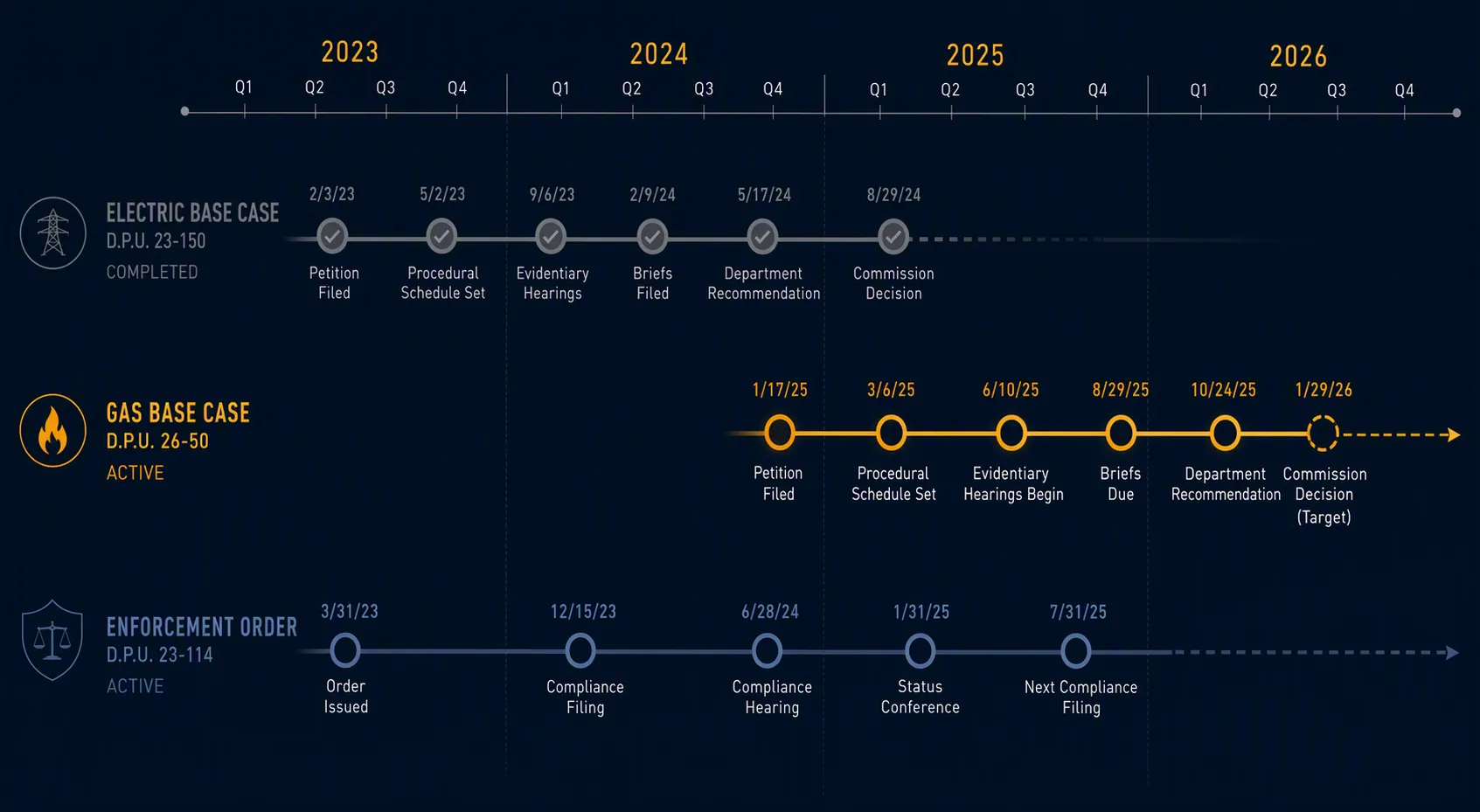
Current as of Q3 2026, this is a regulatory-obligations tracker, not legal advice. The “2025 National Grid rate increase” label is best read as a cluster of DPU activity, not as one clean rate case. The active base-rate proceeding is the 2026 gas distribution case, D.P.U. 26-50; the electric base distribution case was filed in 2023 and resolved in 2024; the 2025–2027 electric supply-rate movements run on a separate track; and the March 31, 2025 order was an enforcement and billing-remedy action, not an approval of the pending gas revenue request.
That distinction matters because Massachusetts rate regulation is calendar-driven. Under the DPU framework, a rate filing can trigger a statutory suspension period, public hearings, written-comment deadlines, discovery and evidentiary process, and a final agency order. In D.P.U. 26-50, National Grid’s gas base distribution request was filed on January 16, 2026, suspended until December 1, 2026, set for eight public hearings, and paired with an April 30, 2026 written-comment deadline.[1]
| Proceeding or rate movement | What it is | Procedural posture as of Q3 2026 |
|---|---|---|
| D.P.U. 26-50 | National Grid gas base distribution rate case; $342M revenue request including $198M capital transfer to base rates and about $144M net increase | Filed January 16, 2026; suspended until December 1, 2026; eight public hearings in March–April 2026; written comments due April 30, 2026.[1] |
| D.P.U. 23-150 | National Grid electric base distribution rate case | Filed November 2023; final order September 2024; $90.2M year-one revenue increase approved at 9.35% allowed ROE.[2] |
| Electric supply-rate adjustments | Customer-facing basic service supply price changes | 14.67¢/kWh for February–July 2025, 15.48¢/kWh for August 2025–January 2026, 15.37¢/kWh for February–July 2026, and 17.19¢/kWh for August 2026–January 2027.[3][4] |
| March 31, 2025 DPU order | Billing-remedy and service-quality enforcement order | $15M service-quality penalty for 2023 failures, 60-day back-billing cap, and required payment-plan terms for affected customers.[5] |
The governing clock: G.L. c. 164, § 94 and 220 CMR 5.00
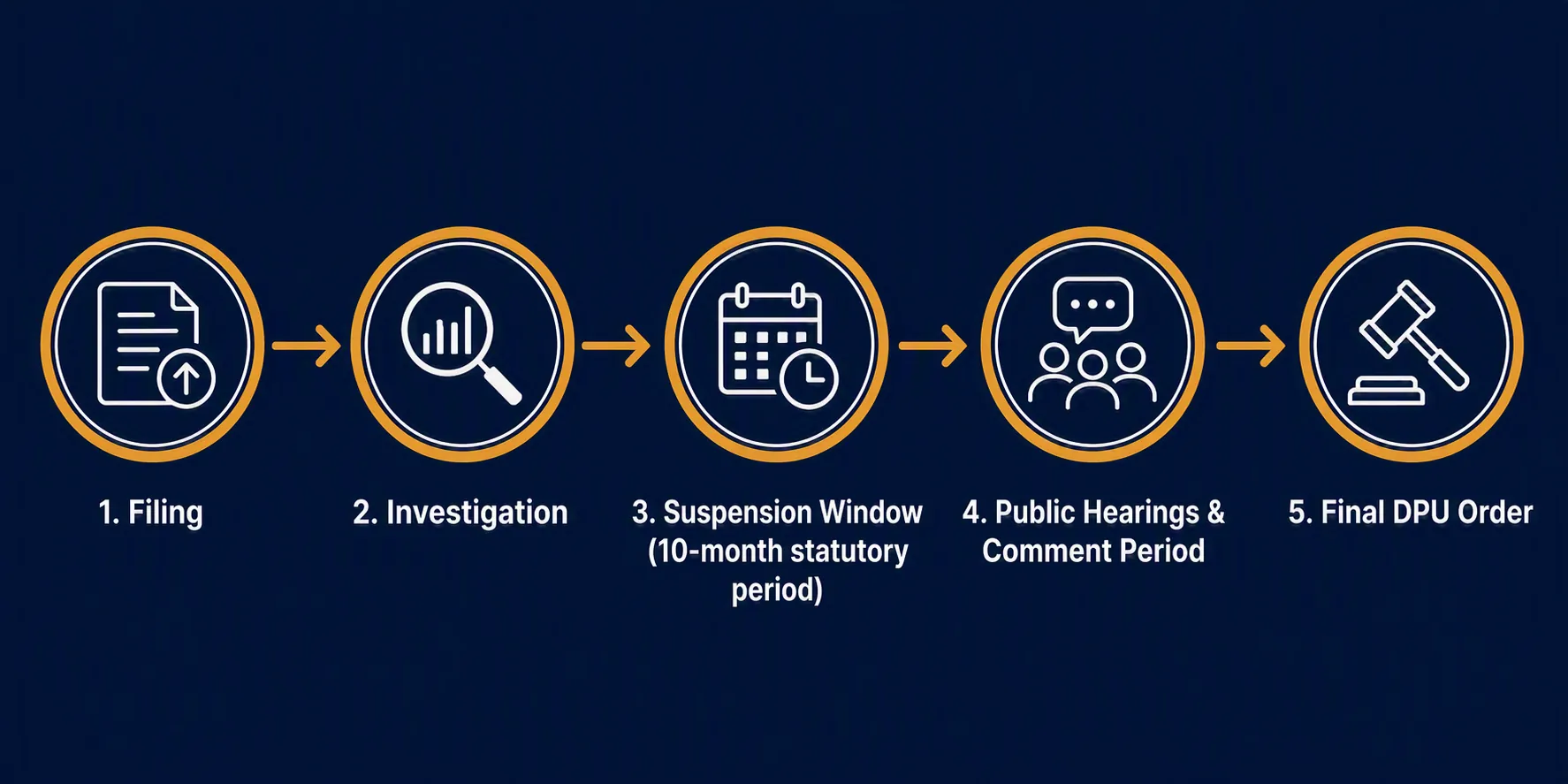
The controlling frame for a Massachusetts base distribution rate case is not the press release announcing a dollar request. It is the statutory and regulatory sequence administered by the Department of Public Utilities: a utility filing under G.L. c. 164, § 94, procedural rules under 220 CMR 5.00, an investigation docket, suspension of the proposed rates while the agency reviews the record, public hearings, written comments, and final DPU action.
For counsel and regulatory-affairs staff, the practical issue is the suspension clock. Once the DPU suspends proposed rate changes, the proceeding becomes a managed calendar. The relevant questions are no longer only “how large is the increase?” They are also: when does the suspension expire, which public hearings are set, what is the written-comment cutoff, what filings or notices are due before final agency action, and which obligations survive after the order.
That same docket-level discipline appears in other Massachusetts utility contexts, including Four Regulatory Hurdles for Massachusetts V2G Programs. The common feature is not the technology involved; it is the need to separate jurisdiction, clock, participation rights, and consequences before reducing the matter to a price headline.
D.P.U. 26-50 is the live base-rate proceeding
National Grid’s pending gas case is the proceeding that carries the most current rate-case obligations. The company filed D.P.U. 26-50 on January 16, 2026. The DPU suspended the proposed rate changes until December 1, 2026, creating the operative window for review.[1]
The request is commonly described as a $342M gas rate increase. That shorthand is directionally useful but incomplete. The filing includes a $198M transfer of capital costs into base rates, producing an estimated net increase of about $144M. The DPU materials also identify estimated residential winter bill impacts of 8.4% to 9.4%.[1] Those are different measurements: gross revenue request, capital transfer component, net increase, and customer bill impact should not be collapsed into one number.
The public-participation dates are compliance facts
D.P.U. 26-50 also illustrates why public hearings are not merely community-relations events. The DPU scheduled eight public hearings in March and April 2026 and set April 30, 2026 as the written-comment deadline.[1] By Q3 2026, that comment period has closed, but it remains part of the procedural record and part of the obligation history that any internal tracker should preserve.
For an in-house team, the consequence of missing this structure is not limited to losing narrative control. Hearing notices, public-comment windows, filing deadlines, and suspension dates drive who inside the company must review statements, prepare responses, validate bill-impact descriptions, and maintain consistency between docket testimony, public materials, and customer communications.
What the case has not yet done
As of Q3 2026, the gas case should not be treated as an approved rate increase. The DPU suspension runs until December 1, 2026, and the agency has not been identified in the supplied materials as having issued a final order in D.P.U. 26-50.[1] The safest description is therefore procedural: filed, suspended, publicly noticed, heard, commented on, and pending within the suspension window.
The completed comparator: electric base distribution in D.P.U. 23-150
The electric base distribution case belongs in the same tracker because it shows the completed version of the process, but it should not be mislabeled as a 2025 rate case. National Grid filed D.P.U. 23-150 in November 2023, and the DPU issued its final order in September 2024. The order approved a $90.2M year-one revenue increase, allowed a 9.35% return on equity, and adopted a five-tier low-income discount structure ranging from 32% to 71%.[2]
That completed electric docket is useful mainly as a comparator. It shows that a base distribution case produces an agency order with authorized revenue, capital-structure and return findings, and customer-class consequences. It does not supply the procedural status of the 2026 gas filing, and it should not be merged with the later electric supply-rate adjustments simply because all three affect customer bills.
The low-income discount structure in D.P.U. 23-150 also shows why rate orders are not just arithmetic exercises. A final order can approve revenue while also changing distributional rules among customer groups. That is a different kind of obligation from posting a new supply rate or remediating a billing failure.
Supply-rate changes move faster and should stay in a separate lane
The 2025 electric supply-rate adjustments are real customer-facing rate movements, but they are not the same thing as base distribution rate litigation. National Grid’s residential basic service rate was reported at 14.67¢/kWh for February through July 2025 and 15.48¢/kWh for August 2025 through January 2026, a 5.53% increase between those periods.[3] The later reported sequence was 15.37¢/kWh for February through July 2026 and 17.19¢/kWh for August 2026 through January 2027, an 11.8% increase over the prior period and a 17.2% cumulative increase over 18 months.[4]
Those figures help explain why customers may experience “National Grid rate increase” as one continuous event. From a regulatory-management perspective, however, supply-price periods should be tracked separately from base distribution dockets. They have different source documents, different timing, and different legal consequences.
| Issue | Base distribution rate case | Electric supply-rate adjustment |
|---|---|---|
| Primary regulatory function | DPU review of utility distribution revenue requirement and rate design | Customer-facing change in supply price for a stated service period |
| Example in this tracker | D.P.U. 26-50 gas case; D.P.U. 23-150 electric case | February 2025–January 2027 National Grid basic service rate periods |
| Why the distinction matters | Triggers a formal docket with suspension, hearings, comments, and final order | Can materially change bills without being the same procedural event as a base-rate case |
The March 2025 order is the consequence layer
The DPU’s March 31, 2025 order belongs in this article because it shows what happens when the agency is not only setting prospective rates but policing service quality, billing, customer remedies, and reporting conduct. It should not be described as approval of the 2026 gas revenue request. It was an enforcement and remedy order addressing billing-system failures and service-quality performance.
The order imposed a $15M service-quality penalty for 2023 failures, which the DPU described as proposed for a one-time customer credit.[5] It also required a 60-day back-billing limit and payment-plan terms that included 10% down and a minimum nine-month repayment period for affected customers.[5] Reporting on the order described billing-system problems affecting about 35,000 gas customers, with some customers unbilled for five to six months.[6]
The self-reporting point is not cosmetic. The DPU characterized National Grid’s failure to self-report the billing problem as “inexcusable.”[6] For a regulated entity, that language is operationally important because it identifies a failure upstream of the customer remedy: the agency objected not only to the billing condition but to the company’s handling and disclosure of it.
The enforcement order also has a live-rate-case echo. WCVB reported that $14M in waived winter charges were included in National Grid’s D.P.U. 26-50 rate request.[7] That does not convert the penalty order into the gas rate case, but it does show why billing remedies, waived charges, and new revenue requests cannot be managed in separate institutional silos.
Why the public record is crowded
The broader rate context is not the legal spine of these proceedings, but it explains the pressure around hearings and comments. Third Way reported that Massachusetts had the third-highest electricity rates nationally, that rates grew 70% over 2015–2025, and that National Grid customers averaged $200–$300 per month.[8] Those facts do not decide D.P.U. 26-50. They do explain why public participation windows become consequential parts of the administrative record rather than procedural decoration.
For lawyers and regulatory staff, the point is not to turn the docket into a generalized cost-of-living article. It is to understand why a public hearing transcript, a written-comment deadline, a bill-impact estimate, and a customer-remedy term may all matter in the same quarter even when they arise from different procedural sources.
What an obligations tracker has to keep apart
The National Grid calendar shows the minimum separation a regulated entity needs in its internal tracker. Base rate cases, supply-rate changes, enforcement orders, billing remedies, and public-comment deadlines should not be stored as one undifferentiated “rate increase” matter.
| Track separately | Why it needs its own field |
|---|---|
| Docket number | D.P.U. 26-50, D.P.U. 23-150, and the March 2025 enforcement order do not carry the same procedural status or consequence. |
| Authority and procedural rule | A base distribution rate case under G.L. c. 164, § 94 and 220 CMR 5.00 has a different posture from a supply-rate period or billing-remedy directive. |
| Suspension date | For D.P.U. 26-50, December 1, 2026 is the operative suspension endpoint in the supplied materials. |
| Public hearing and comment obligations | The eight public hearings and April 30, 2026 written-comment deadline in D.P.U. 26-50 are part of the procedural history even after the comment window closes. |
| Penalty and remedy mechanics | The $15M service-quality penalty, 60-day back-billing cap, payment-plan terms, and self-reporting criticism belong to the enforcement layer, not the revenue-request headline. |
| Customer-facing rate movement | Supply-rate periods from 2025 through 2027 affect bills but should not be mistaken for a final order in the pending gas base case. |
That is also the logic behind deadline-focused regulatory trackers such as Tracking Pentagon AI data center energy regulation through the NDAA and What SAVE Plan’s Demise Means for Student Loan Repayment. Different regulatory systems use different statutes, but the work product is similar: preserve the clock, name the governing authority, separate active obligations from completed history, and do not let a public-facing label erase procedural distinctions.
No outcome should be predicted for D.P.U. 26-50 from the cited materials. The compliance conclusion is narrower and more useful: National Grid’s overlapping Massachusetts proceedings show why docket-level tracking is financially material. A company can face a pending base-rate case, sequential supply-rate movements, public-hearing and comment obligations, customer-remedy directives, and penalty exposure at the same time. Treating those items as administrative housekeeping is how deadlines, reporting duties, and back-billing limits become enforcement risk.
References
- National Grid 2026 Gas Base Distribution Rate Case, Mass.gov
- DPU 23-150: National Grid Electric Base Distribution Rate Case, Mass.gov
- National Grid Electricity Rates Rising August 2025, ElectricityRates.com
- National Grid Rate Increase August 2026, ElectricityRates.com
- DPU Issues Order to National Grid, Mass.gov, March 31, 2025
- Mass. DPU takes action against National Grid over billing and service issues, NBC Boston
- DPU public hearing National Grid gas rate increase, WCVB
- Why Does Massachusetts Have Some of the Highest Electricity Prices in the Country, Third Way
Operationalizing workflow
No workflow has been explicitly linked to this obligation yet. See Workflows generally.
Illustrative cases
No illustrative case is currently tracked for this obligation. See Risk Digest for documented incidents generally.
← Back to RegulationReport a correction or tip
Spotted an outdated figure, a misstated fact, or a ruling this regulation entry should reflect? Public comments are disabled for this content given the professional cost of a misreported case outcome, penalty amount, or rule text — use the structured correction channel instead.
Report a correction or tip for this record →