
Does NDAA Section 219 Bypass the Treaty Power?
- Effective date
- Jul 23, 2026
The hard question in the Section 219 controversy is not whether the United States may cooperate with Israel on defense technology. It plainly may, and already does. The question is narrower and more institutional: what changes when Congress creates a Department of Defense executive agent for technology and supply-chain integration with one named foreign country, then gives that agent precedence over other DoD components in an area ordinarily filtered through technology-transfer controls?
That distinction matters because ordinary defense cooperation leaves the usual risk gates in place. A reordered decision hierarchy changes who can say no. If the Defense Technology Security Administration normally manages defense technology-transfer risk, and a country-specific executive agent can overrule or outrank that judgment, the legal issue is no longer cooperation in the abstract. It is the creation of a durable channel inside the executive branch for a particular foreign government relationship.
This analysis is limited by the available record. As of July 23, 2026, the exact final text of Section 219 as numbered was not obtainable from congress.gov. The discussion here relies on the House Armed Services Committee Chairman’s Mark, congressional summaries, and sourced reporting and analysis. The FY2027 NDAA is also still in process: the House has passed its version by a 216-212 vote, while the Senate has not yet passed its version; the Senate companion is identified as Section 1217. The provision may change before enactment.
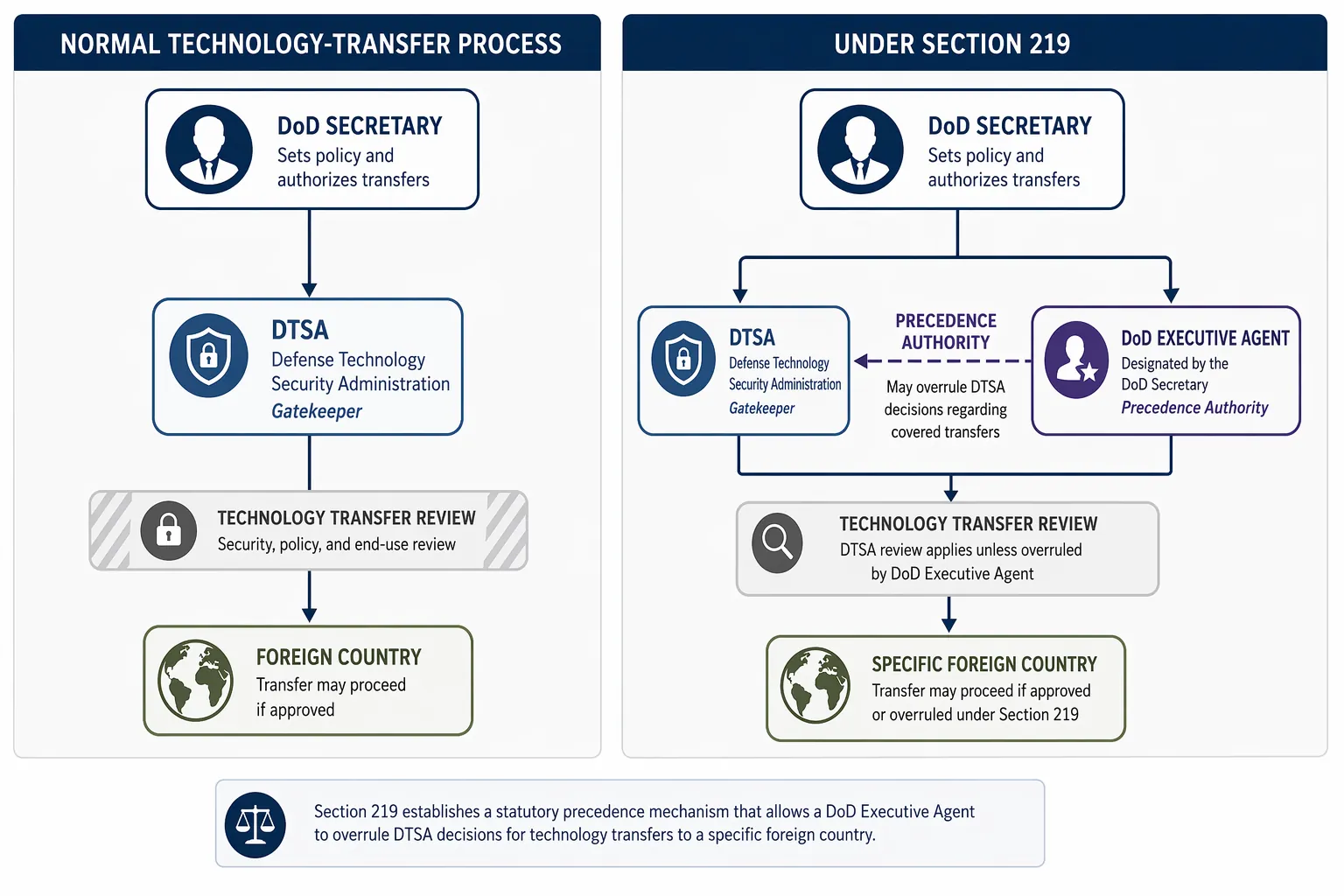
The Legal Weight Is in the Executive-Agent Verb
The central mechanism is the DoD executive-agent framework under DoD Directive 5101.01. The Quincy Institute’s analysis of the United States-Israel Defense Technology Cooperation Initiative describes Section 219 as using that framework to create an executive agent with “precedence authority” for U.S.-Israel technology and supply-chain integration. In the Quincy account, that authority would allow the executive agent to overrule the Defense Technology Security Administration on technology-transfer decisions involving Israel.[1]
That is not a housekeeping detail. DTSA’s role is not ceremonial; it is the defense-security risk screen for sensitive technology transfer. A provision that puts another DoD actor above DTSA for one bilateral relationship does not merely speed paperwork. It changes the internal constitutional fact pattern: the risk gatekeeper remains visible, but its practical authority is subordinated when the Israel-specific executive agent invokes precedence.
The comparison is also unusually stark. The Quincy analysis says no other bilateral defense relationship has this arrangement.[1] That does not, by itself, make the structure unconstitutional. Congress often legislates specifically, and foreign-defense relationships are not fungible. But a bespoke decision hierarchy for a single foreign country is different from a program authorization, a funding line, or a general cooperation authority. It has the character of an institutional commitment: future technology-transfer disputes are routed through a country-specific priority rule rather than through the ordinary DoD process.
Rep. Thomas Massie’s objection becomes legally sharper against that background. The Intercept reported his statement that the provision “requires a treaty to effect, not an amendment buried in a law.”[2] The quoted claim is not that every military-cooperation measure must be a treaty. It is that this particular measure does something treaty-like: it settles, in advance, a preferred institutional channel for defense-technology integration with a foreign state.
Why Precedence Over DTSA Changes the Separation-of-Powers Analysis
The constitutional question is not answered by calling Section 219 domestic legislation. Congress can enact statutes that implement foreign commitments; it can also approve congressional-executive agreements in some settings. The difficulty is functional. If a statutory provision creates a standing decision structure that binds U.S. defense-technology administration to a single foreign-country integration project, the label “NDAA section” does not exhaust the analysis.
Treaty-power concerns arise when the arrangement behaves like a durable international commitment. Here, the alleged commitment is not a promise to deploy forces or merge command structures. The available materials do not establish that Section 219 creates command integration, intelligence fusion, or operational subordination. Those claims are disputed in public commentary and should remain attributed rather than assumed. The stronger legal point is narrower: Section 219 appears to entrench a decision-making hierarchy for defense technology and supply-chain integration with Israel, and it does so in a way that can displace the normal DTSA screen.
That is where the phrase “precedence authority” carries more weight than the surrounding political debate. An interagency priority rule can be harmless when it coordinates work that everyone already agrees should proceed. It becomes constitutionally salient when it allocates practical veto power. If DTSA says a transfer raises security concerns and the executive agent has authority to prevail because the matter falls within the Israel-specific initiative, the operative legal fact is not cooperation; it is override.
The concern is heightened because the override is country-specific. A general rule for technology-transfer coordination would raise one set of administrative-law questions. A special rule for one foreign state raises a different separation-of-powers question: whether Congress is using an authorization bill to create the functional equivalent of a bilateral defense-technology undertaking without the procedural form normally associated with international commitments of that kind.
Existing Authorities Undercut the Claim That Section 219 Merely Enables Cooperation
The best defense of Section 219 would be necessity: without it, useful U.S.-Israel research, production, supply-chain, or technology access would be legally blocked. The available sources point the other way. The Quincy analysis identifies existing authorities that already permit the relevant kinds of activity, including 22 U.S.C. § 2767(j)(1) for cooperative research and development, 10 U.S.C. § 2350a for defense cooperation, and Arms Export Control Act channels for Foreign Military Sales and Direct Commercial Sales.[1]
| Claimed Need | Existing Channel Identified in the Available Sources | Why It Matters |
|---|---|---|
| Cooperative research and development | 22 U.S.C. § 2767(j)(1) | The issue is less about whether cooperation is possible than whether a new hierarchy is being entrenched. |
| Defense cooperation | 10 U.S.C. § 2350a | Ordinary cooperation authorities already provide a statutory route without creating a country-specific executive agent. |
| Defense sales and commercial transfers | Arms Export Control Act FMS and DCS channels | Existing transfer channels preserve established review structures rather than subordinating DTSA through precedence authority. |
Those citations do not prove that every proposed technology-sharing decision could proceed under current law. They do support a more limited and more important inference: Section 219 is not needed simply to make U.S.-Israel defense cooperation legally possible. The United States already has statutory channels for cooperative R&D, defense cooperation, and arms-transfer activity. Section 219’s distinctive contribution is the executive-agent structure and the priority it gives that structure inside DoD.
That distinction is often lost in public descriptions of defense-cooperation provisions. A bill can be described as “facilitating” cooperation while doing something more consequential: changing the institutional answer to a future dispute. If the legal path already exists, the new law’s function is not access alone. It is entrenchment, acceleration, and displacement of ordinary review.
This is why the absence of a comparator matters. No other bilateral defense relationship is described in the cited materials as having an NDAA-created executive agent with this kind of precedence authority.[1] That singularity does not answer the treaty question, but it rebuts the suggestion that Section 219 is merely another instance of familiar alliance management.
The Legislative Path Deepens the Form Problem
Legislative history cannot convert a valid statute into an invalid treaty bypass by itself. But it can clarify what institutional problem the provision’s sponsors were trying to solve and why they chose a defense authorization vehicle. The record here is not reassuring.
The standalone FUTURES Act did not advance as an independent bill, according to the available sources. The same concept then appeared inside the NDAA, a legislative vehicle built to carry thousands of defense-policy and procurement judgments at once. Responsible Statecraft and Military.com reported that the House Rules Committee blocked the Massie-Khanna amendment to strip Section 219, preventing a floor debate on the amendment.[3][4]
There is nothing inherently illegitimate about placing defense-policy provisions in the NDAA. That is what the bill is for. The constitutional discomfort comes from the mismatch between form and effect. If a provision structures a foreign-state-specific technology-transfer hierarchy that no other bilateral relationship has, its burial in a must-pass authorization bill makes ordinary political accountability weaker precisely where the constitutional stakes are higher.
The foreign-origination evidence adds another layer, though it should not be overstated. The Quincy Institute and The Intercept report that Israeli Prime Minister Benjamin Netanyahu characterized the shift as “my plan.”[1][2] A foreign leader’s characterization is not dispositive evidence of legal origin, and it does not prove that Congress abdicated judgment. It does make the structure harder to defend as a routine internal Pentagon management reform. A domestic management reform is usually designed around domestic administrative needs; this one is described by a foreign head of government as his plan for the bilateral defense-technology relationship.

What the Treaty-Power Argument Can and Cannot Prove
The treaty-power argument is strongest when kept within the evidence. Section 219 has not been shown, on the available record, to create a formal treaty text, mutual defense obligation, joint command, or automatic transfer of specified technologies. Claims about data fusion, intelligence-sharing limits, or command integration are publicly disputed between supporters and opponents and should not be treated as established legal facts without the underlying text.
Nor does the Constitution require every significant foreign-defense statute to pass through Article II’s treaty process. Congress has long legislated in the national-security field, and congressional-executive agreements are part of the modern foreign-relations landscape. The better objection is not formalist in the shallow sense. It is functional: Section 219 appears to do the work of a bilateral international commitment while avoiding the procedural visibility normally expected for such a commitment.
That functional concern has three parts. First, the provision is country-specific. Second, it allegedly gives a DoD executive agent precedence over the component that normally manages technology-transfer risk. Third, the practical subject matter is not ceremonial cooperation but access to defense technology and supply-chain integration. Together, those features make the provision look less like a funding instruction and more like a binding administrative architecture for a bilateral relationship.
If Congress wants to approve such an architecture, the constitutional question becomes what form that approval must take. Article II treaties require presidential action and two-thirds Senate consent. Congressional-executive agreements require bicameral approval and presidential signature, but they are still ordinarily identifiable as agreements or authorizations of international commitments. Section 219, by contrast, appears in the available materials as a domestic statutory directive to the Pentagon. That packaging may be sufficient for ordinary internal organization. It is far less satisfying when the directive creates a special decision hierarchy for a foreign state and alters the effect of technology-transfer risk review.
The Better Reading
On the current record, Section 219 should be understood as more than a cooperation facilitator. Existing authorities already support cooperative R&D, defense cooperation, and arms-transfer channels. The new legal work performed by Section 219 is structural: it establishes a named executive agent for one bilateral relationship and, under the DoD executive-agent framework described in the cited analysis, gives that agent precedence over other DoD components in technology-transfer matters.[1]
That structure carries the weight of a binding international commitment even if it is drafted as a domestic instruction. The commitment is not necessarily a promise to fight, share all intelligence, or merge operational command. It is a commitment about who inside the U.S. defense establishment will drive and prevail in a particular foreign-country integration process. In technology-transfer law, that is not a trivial allocation.
The constitutional problem is therefore not that Section 219 mentions Israel. It is that no other bilateral defense relationship is identified as having this bespoke precedence structure, that the ordinary DTSA risk gate appears to be subordinated, and that the arrangement was inserted into the NDAA after a standalone bill failed to advance and an amendment to remove it was blocked from floor debate.[1][3][4] Those facts do not conclusively establish invalidity. They do support serious treaty-power and congressional-executive-agreement concerns.
If enacted in this form, Section 219 would be best understood as a treaty-level or agreement-level change dressed in the grammar of a defense authorization directive. The constitutional issue is not whether the United States may cooperate closely with Israel. It is whether a durable, country-specific override for defense-technology decisions can be created through a buried statutory mechanism rather than through the constitutional forms reserved for binding international commitments.
References
- Cooperation Without Oversight: The United States-Israel Defense Technology Cooperation Initiative, Quincy Institute.
- The Intercept coverage of NDAA Section 219 and Rep. Massie’s treaty-power objection, The Intercept, July 22, 2026.
- Massie Israel integration coverage, Responsible Statecraft.
- Massie Revives Effort to Strip NDAA Section 219 Combining US, Israeli Defense, Military.com.
Operationalizing workflow
No workflow has been explicitly linked to this obligation yet. See Workflows generally.
Illustrative cases
No illustrative case is currently tracked for this obligation. See Risk Digest for documented incidents generally.
← Back to RegulationReport a correction or tip
Spotted an outdated figure, a misstated fact, or a ruling this regulation entry should reflect? Public comments are disabled for this content given the professional cost of a misreported case outcome, penalty amount, or rule text — use the structured correction channel instead.
Report a correction or tip for this record →