
How Neuromancer's AI Regulation Maps Onto 2026's Legal Reality
- Authority
- European Commission
- Rule type
- regulation
- Jurisdiction scope
- EU
- Effective date
- Aug 2, 2026
- Source text
- Read primary rule text ↗
Classify AI systems by risk, document governance, and avoid prohibited practices.
On July 27, 2026, the cleanest way to read the coming Neuromancer adaptation is not as nostalgia. It is as timing. The EU AI Act’s next high-risk enforcement milestone arrives on August 2, 2026, with potential penalties reaching €35 million or 7% of global annual turnover for the most serious violations.[1] Apple TV+’s Neuromancer series is already dated for January 22, 2027, with Apple having announced the adaptation as a drama based on William Gibson’s novel.[2][3] The cultural artifact is arriving just after the compliance machinery starts to harden.
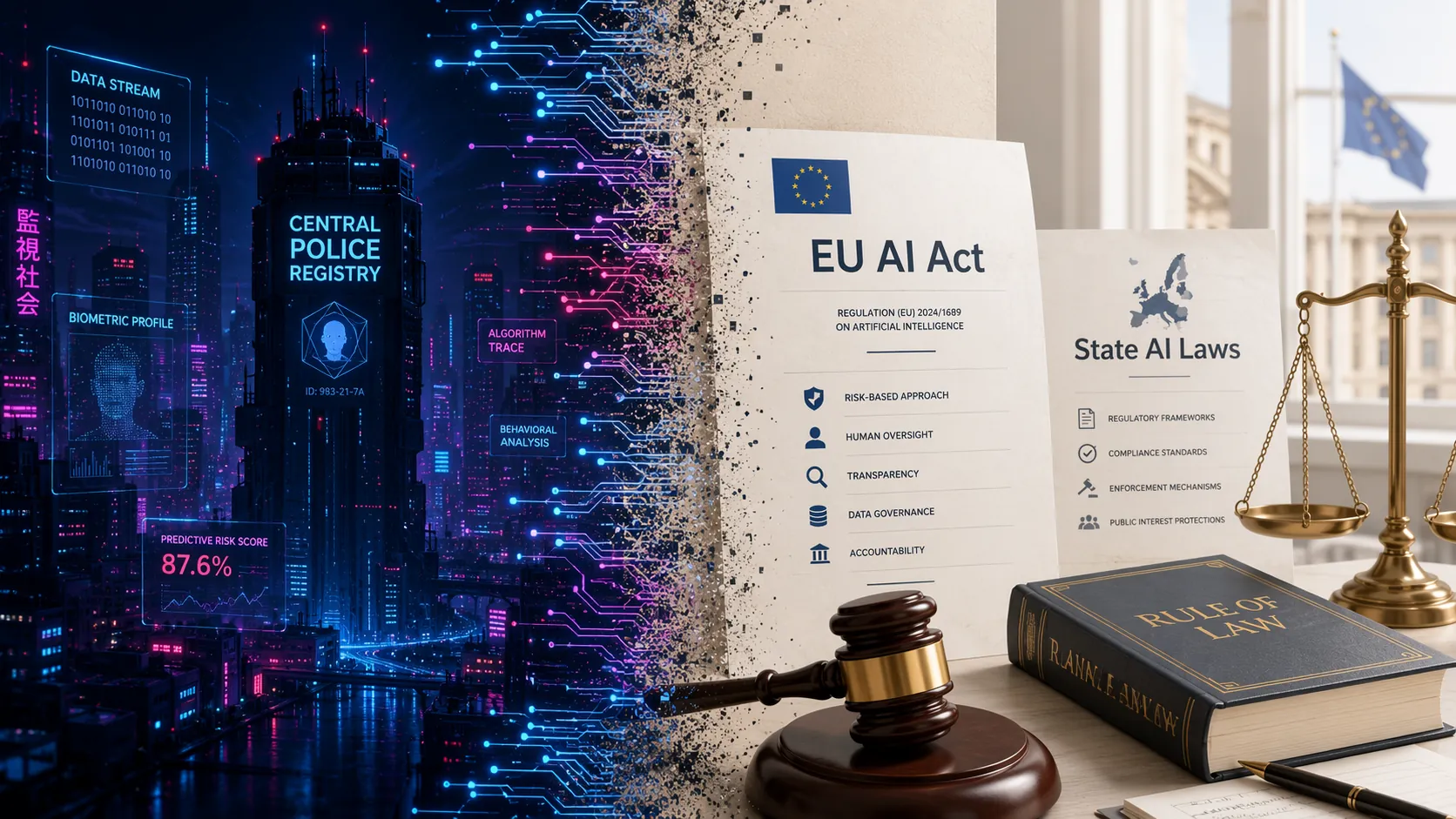
That timing matters for readers looking at the Neuromancer Apple TV series through AI ethics and legal implications. Gibson’s fictional world gave readers a memorable enforcement model: the Turing Police, a body that registers and constrains artificial intelligences. The famous image is still blunt enough to do its work: “every AI ever built has an electromagnetic shotgun wired to its forehead.”[4] It is also exactly where the comparison can become sloppy if it is allowed to run too far.
No current regulator has become Gibson’s Turing Police in institutional form. There is no single global AI registry with total jurisdiction, no unified switchboard for approved cognition, and no practical way to erase a distributed model everywhere it has been copied. What has arrived is the function: registration-like obligations, prohibited uses, categorical status rules, agency enforcement, state bills, federal preemption efforts, and the spreadsheet work required to prove that a system stayed inside the line.
The useful map is not one police force
The real 2026 architecture is layered. Each layer answers a different legal question, and none of them fully controls the others. That is why the Turing Police analogy is useful only after it is broken apart.
| Regulatory layer | What it controls | Why it resembles the Turing Police function | What it cannot do |
|---|---|---|---|
| EU AI Act | Risk classification, banned practices, high-risk system obligations, and penalties | It constrains AI systems before and during deployment through duties tied to risk categories | It does not create one global registry or physically disable models outside its jurisdiction |
| U.S. state AI non-personhood laws | Legal status: whether AI systems can be treated as persons, sentient beings, or holders of rights | It caps what an AI can be in law, regardless of what vendors or users claim about capability | It does not evaluate model safety, accuracy, or operational risk by itself |
| Federal preemption effort | The boundary between national AI policy and state-by-state AI regulation | It tries to centralize authority over an increasingly fragmented legal field | Its effect remains uncertain until courts test the preemption theory |
For legal teams, the distinction is not academic. A model can be lawful under one layer and still create risk under another. A company might comply with a risk-management process under the EU AI Act while still needing to monitor state statutes declaring that an AI system is not a legal person. A federal policy statement may signal pressure against state variation without eliminating the immediate need to track that variation.
The EU layer: risk-tiered control before the system causes the case
The EU AI Act is the closest real-world analogue to the Turing Registry’s regulatory function, though not its fictional form. Its structure does not ask whether an AI is dramatic, uncanny, or close to consciousness. It asks what the system is used for, what risk category it falls into, what duties attach, and what penalties apply if the provider or deployer fails to comply.
The August 2, 2026 date is the immediate reason this is a legal story before it is a television story. Guidance tracking the 2026 AI regulatory calendar identifies that date as the point when high-risk obligations become a live compliance concern under the EU AI Act, alongside the Act’s penalty structure for serious violations.[1] For law departments already maintaining an AI inventory, the question is not whether an internal tool feels like science fiction. It is whether the organization can identify its role, classify the system, document governance, and show the work.
The resemblance to Gibson is strongest in the banned-practices category. The Act’s prohibited practices include uses such as social scoring and cognitive manipulation, categories that sound less like ordinary software regulation than a legal boundary around machine influence.[1][5] Neuromancer’s fictional enforcement regime polices AI that exceeds permitted bounds; the EU approach polices defined practices and high-risk deployments before they become enforcement exhibits.
That difference matters. A Turing Police model implies an authority watching for rogue intelligence. The EU model places the first burden on actors who put systems into use. Someone inside the organization has to know which systems exist, who owns them, whether they are covered, what documentation supports them, and which vendors supplied the components. The enforcement object is not an awakened machine; it is a deployment chain.
This is why AI governance programs built around general ethics principles are already too loose for the EU portion of the map. A useful control file needs operational fields: system purpose, user group, jurisdiction, risk category, vendor representations, human oversight process, incident escalation, and review date. The legal team that waits for a philosophical consensus about machine consciousness will still have to answer a regulator asking why a high-risk use was not classified on time.
For a deadline-oriented view of the same calendar, see Track These AI Compliance Deadlines in 2026. The point here is narrower: the Neuromancer comparison becomes useful only when it directs attention to actual obligations, not when it turns the Act into cyberpunk decoration.
The state-law layer: non-personhood becomes copyable
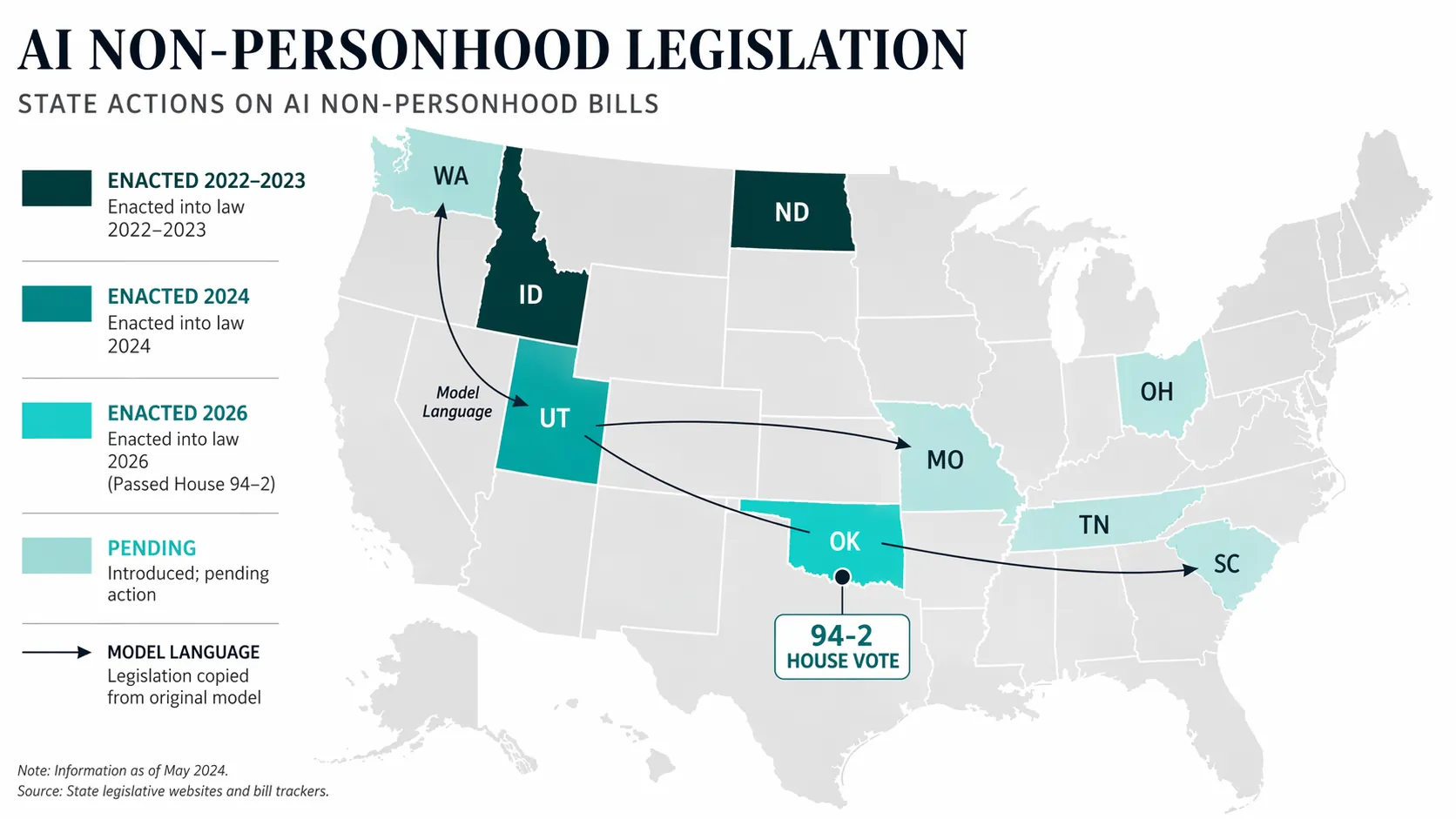
The state-law movement is less technically ambitious than the EU AI Act, but it is legally revealing. It does not try to classify every AI use by operational risk. It draws a categorical boundary around status: an AI system is not sentient, not a person, and not a rights-bearing legal subject.
Tony Rost’s June 2026 Regulatory Review analysis identifies nine states that had enacted or introduced AI non-personhood bills: Idaho in 2022, North Dakota in 2023, Utah in 2024, Oklahoma in 2026, and pending bills in Ohio, Tennessee, South Carolina, Washington, and Missouri.[6] The count should be read carefully. It includes enacted laws and pending bills, and pending bills can move, stall, or be amended. But even with that caution, the pattern is not theoretical anymore.
Oklahoma is the cleanest example of the idea becoming operational. Its House vote was 94-2.[6] That margin does not prove that lawmakers understand model architecture, safety evaluation, or downstream compliance costs. It does show that “AI is not a legal person” has become politically legible enough to move through a chamber with almost no visible resistance.
The copied-language detail is more important than it may look. Rost reports that Washington, South Carolina, and Missouri copied Utah’s 2024 bill language verbatim, including identical 11-category prohibited lists.[6] That is how a regulatory idea travels when it is easy to paste into a bill file. A compliance team cannot treat each state development as an isolated curiosity if the same architecture is being replicated across jurisdictions.
The legal function here is different from the EU’s. A non-personhood statute does not tell a company how to test a model, conduct human oversight, or document a high-risk deployment. It fixes a premise for courts, agencies, and private actors: however persuasive an AI system becomes, it does not cross into legal personhood. In litigation, that premise could matter when parties frame agency, authorship, liability, deception, standing, contractual capacity, or claims about AI autonomy.
That is also where the Gibson comparison changes shape. The fictional Turing Police regulate artificial intelligence by controlling its permitted level of development. These state bills regulate by denying a legal status category in advance. They are less like a shotgun and more like a locked courthouse door.
For law firms comparing state obligations beyond the non-personhood bills, Which State AI Laws Affect Law Firms in 2026? is the more practical companion question. Non-personhood is only one type of state intervention; the compliance burden comes from tracking how those interventions stack.
The federal layer: preemption as an anti-patchwork strategy
The federal preemption layer is the least settled and potentially the most disruptive. The Trump administration’s December 2025 Executive Order, “Ensuring a National Policy Framework for AI,” attempts to push against state-level fragmentation. The policy instinct is easy to understand: if every state can define AI status, duties, disclosures, and liabilities differently, national developers and national law firms inherit a compliance map that changes by border.
But an executive order is not a magic solvent for state statutes. The preemption theory still has to survive institutional resistance and, eventually, litigation. That uncertainty is the point, not a footnote. Until a court decides the scope of federal authority, counsel must treat federal policy as a live variable rather than a completed override.
The state-federal conflict is already visible in the preemption debate covered in Ron DeSantis Says an Executive Order Cannot Preempt State AI Laws. The practical takeaway is not that one side has already won. It is that legal teams need to preserve both views in their risk analysis: the federal government may pressure uniformity, while states may continue to enact and defend their own AI rules.
The same federal context includes the AI Litigation Task Force, which belongs in a compliance officer’s watch file because it signals enforcement and litigation coordination rather than mere policy branding. For a broader look at why federal AI policy does not automatically simplify law-firm operations, see Why the Trump AI Action Plan Won't Simplify Law Firm Compliance.
This is the point in the map where the Turing Police analogy is least literal but still useful. Fiction imagines a centralized authority capable of disciplining AI directly. The federal preemption effort is a fight over which human institution gets to discipline the field: states, federal agencies, Congress, courts, or some combination of them.
Where the Turing Police analogy breaks
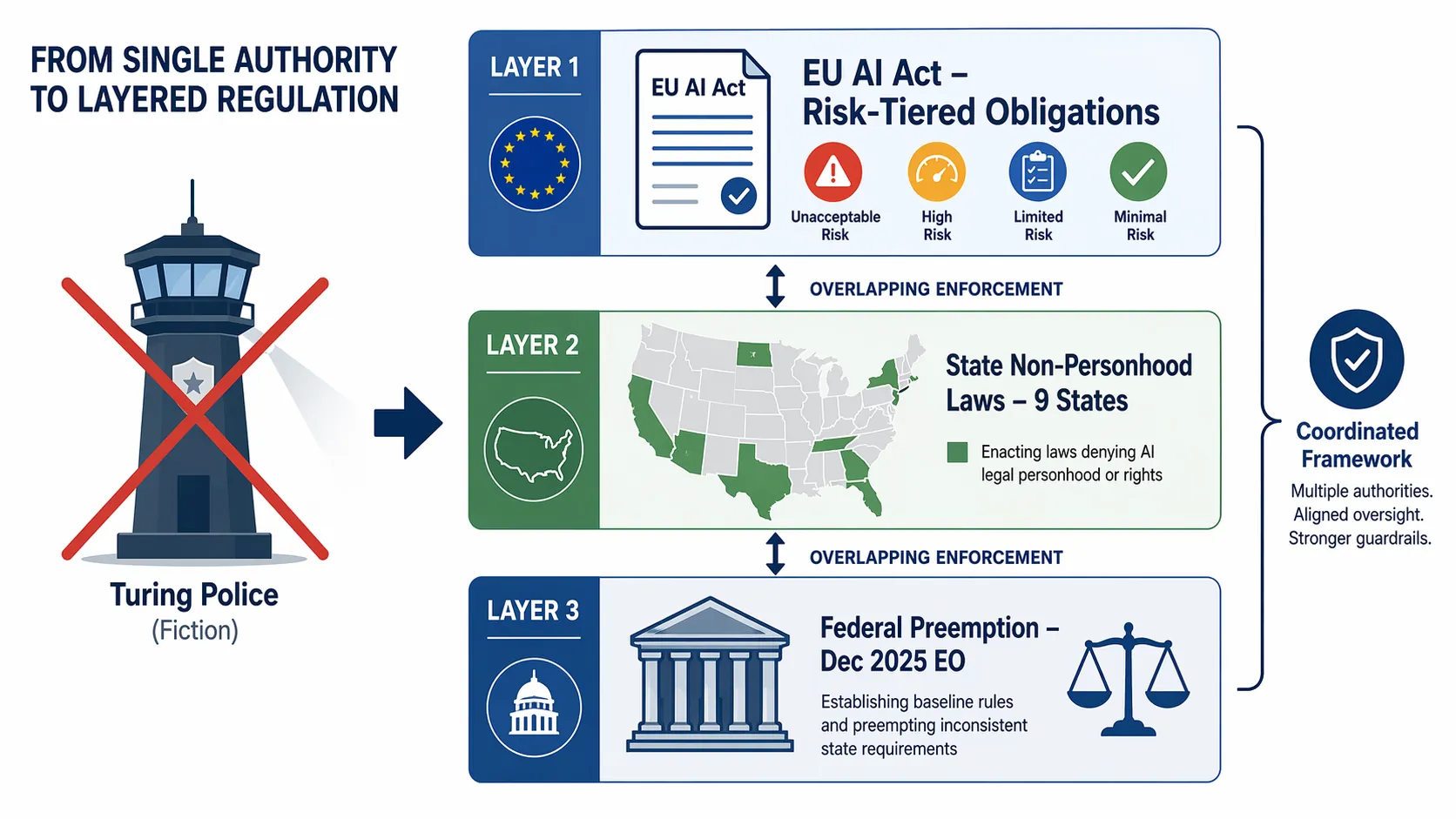
The necessary correction comes after the legal map, not before it. Gibson’s fiction depends on a more centralized control problem than modern AI presents. The ITPro discussion of whether it is time to “call in the Turing Police” draws the distinction directly: fictional enforcement can imagine a system being found, capped, or shut down; contemporary large language models and AI systems operate across cloud infrastructure, open-source repositories, and local devices.[4]
That architecture changes the enforcement problem. A regulator can prohibit a use, fine a provider, require documentation, investigate a deployment, or order a company to stop offering a product in a jurisdiction. It cannot realistically retroactively erase every copy of a model once weights, derivatives, prompts, fine-tunes, or local deployments have spread beyond a single controlled environment.
The result is a shift from fictional shutdown to real-world prevention. Compliance work moves upstream: inventory the systems, classify uses, restrict prohibited practices, manage vendors, prepare incident procedures, and decide who signs off before a tool reaches employees or customers. Enforcement becomes less cinematic and more durable because it attaches to organizations, officers, processes, procurement, and records.
This also explains why claims that “the Turing Police are here” need qualification. Their function has arrived in fragments, but the fragments are administered by different legal actors with different remedies. The European Commission, national competent authorities, state legislatures, state attorneys general, federal agencies, courts, and private litigants do not merge into one registry just because they all touch AI governance.
The Apple TV+ series is a marker, not an evidence source
The Neuromancer adaptation deserves attention because it will give a broad audience a fresh image for AI control at the same time lawyers are sorting real duties. Apple announced the series in 2024 as a drama based on Gibson’s multi-award-winning novel, and the television listing identifies a July 2026 SDCC teaser trailer and a January 22, 2027 premiere date.[2][3]
That is all the legal analysis can safely use. No episode content is available to support claims about how the show will portray AI governance, enforcement, corporate power, or machine autonomy. The premise and timing are enough. Anything more would turn a compliance map into trailer speculation.
What legal teams should track before January 2027
A useful tracking framework does not need to predict the show. It needs to separate the authorities and duties that are already moving.
| Track | Why it matters | Compliance question |
|---|---|---|
| EU AI Act high-risk obligations | The August 2, 2026 milestone turns classification and documentation into immediate operational work | Which systems are in scope, who owns the file, and what evidence supports the classification? |
| EU prohibited practices | Bans such as social scoring and cognitive manipulation create bright-line exposure before ordinary risk balancing begins | Could any product feature, customer use, or internal workflow be characterized as prohibited? |
| State AI non-personhood bills | The nine-state pattern shows a status rule spreading through enacted and pending legislation | Do pleadings, contracts, policies, or marketing claims imply agency, personhood, sentience, or rights that state law rejects? |
| Model-language replication | Copied bill text can accelerate multi-state convergence faster than bespoke legislative drafting | Is the legal team tracking bill language, not just bill titles? |
| Federal preemption litigation risk | The December 2025 federal position may affect state-law durability, but it has not eliminated state tracking duties | Are risk memos preserving both state-law compliance and federal-preemption arguments? |
| Distributed model enforcement limits | No regulator can assume Gibson-style centralized shutdown across cloud, open-source, and local deployments | Does the control plan focus on access, deployment, procurement, logging, and vendor governance rather than retroactive erasure? |
The main risk for counsel is category error. Treating AI regulation as a single field obscures who has authority. Treating it as only an ethics issue obscures effective dates and penalties. Treating it as only a federal-policy issue obscures the state bills already moving. Treating it as only a state issue ignores the preemption fight. Treating it as only a technical governance issue misses legal status rules that may not depend on model capability at all.
By the time Neuromancer premieres in January 2027, the better question will not be whether Gibson anticipated AI regulation. He gave readers a durable image, and that image still helps. The harder question for litigators, in-house counsel, and compliance officers is which regulator, court, or legislature is controlling which part of the machine.
References
- 2026 AI Laws Update: Key Regulations and Practical Guidance, Gunderson Dettmer LLP
- Neuromancer (TV series), Wikipedia
- Apple TV+ announces “Neuromancer,” new drama based on the multi-award-winning science fiction novel by William Gibson, Apple TV Press, February 2024
- Is it time to call in the Turing Police?, ITPro
- AI regulatory compliance in 2026: EU AI Act, US orders and state laws and how to operationalize, Collibra
- Legislating AI Consciousness Without an Exit, The Regulatory Review, June 29, 2026
Operationalizing workflow
No workflow has been explicitly linked to this obligation yet. See Workflows generally.
Illustrative cases
No illustrative case is currently tracked for this obligation. See Risk Digest for documented incidents generally.
← Back to RegulationReport a correction or tip
Spotted an outdated figure, a misstated fact, or a ruling this regulation entry should reflect? Public comments are disabled for this content given the professional cost of a misreported case outcome, penalty amount, or rule text — use the structured correction channel instead.
Report a correction or tip for this record →