
New Asylum Rule’s Direct Deportation Impact in 2025
- Authority
- USCIS
- Rule type
- regulation
- Jurisdiction scope
- US federal
- Effective date
- Jul 28, 2026
- Source text
- Read primary rule text ↗
USCIS may refer affirmative asylum cases to immigration court without asylum officer interview or request for evidence.
The operative change in the July 28, 2026 USCIS rule is not subtle: affirmative asylum cases may now be referred to immigration court without an asylum officer interview and without a request for evidence. For applicants, that removes the non-adversarial appointment where confusion, trauma, missing documents, and deadline problems could be addressed before the case moved into removal proceedings. For lawyers, it changes what lands on the desk next: a court case that may have skipped the very step that once helped clarify the record before adversarial litigation began. That is the direct impact behind searches for the new US asylum rule deportation direct impact after 2025—not a measured deportation outcome yet, but a faster procedural handoff into the court system that can order removal.[1]
Two cautions matter at the start. The rule is only two days old as of July 29, 2026, so there are not yet reliable outcome data showing how many additional removal orders it will produce. And the Federal Register’s acknowledgment that applicants had “become accustomed” to the interview does not, by itself, prove that every interview prevented error. The narrower point is stronger: USCIS has removed a long-standing, in-person procedural checkpoint and has authorized referral based on the written record alone.[1]
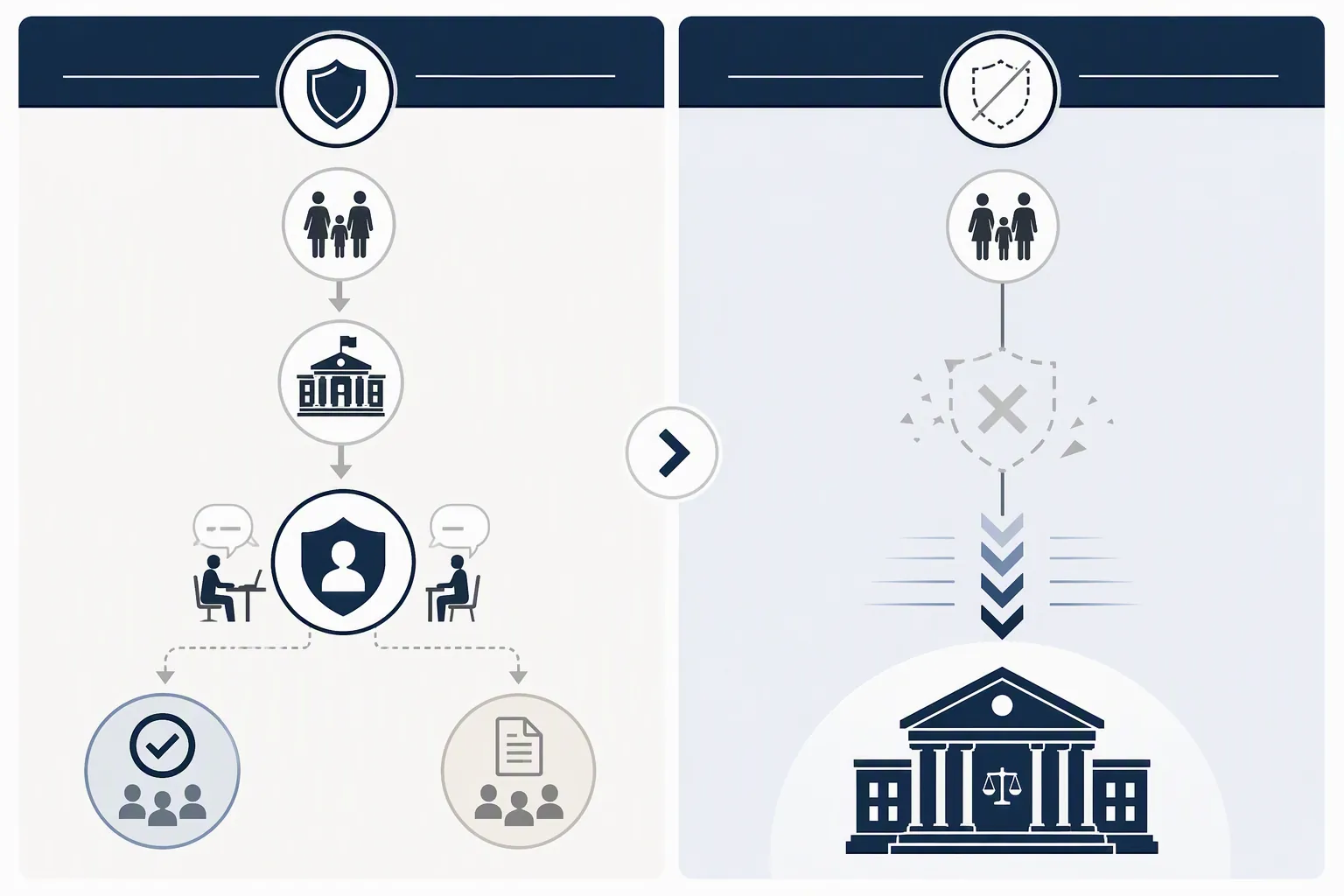
The handoff is where the burden moves
Before the rule, the affirmative asylum process put USCIS asylum officers in the first adjudicatory position. The interview was not a trial. It was not a guarantee of relief. But it gave the applicant a chance to answer questions before referral and gave the government a chance to test eligibility without immediately placing the person before an immigration judge. The new rule permits USCIS to bypass that interview and send the case directly to EOIR if the written record is treated as enough for referral.[1]
That matters most when the issue is not whether the applicant fears harm in the abstract, but whether the file is procedurally clean enough to survive court. One especially exposed category is the one-year filing deadline. The research record indicates that, before the rule, approximately 77% of untimely filed asylum applications referred after interview were referred on the one-year-filing-deadline basis alone. The new process allows USCIS to make that kind of referral from the written record without the interview that might have elicited facts about changed circumstances, extraordinary circumstances, confusion about filing, or representation gaps.[1]
None of this means the applicant has already lost. Immigration court still provides a venue for presenting claims and contesting removability. But the posture is different. The applicant is no longer trying to persuade an asylum officer in a non-adversarial setting; the applicant is defending the claim in removal proceedings, often with more formal consequences attached to missed deadlines, incomplete records, and credibility problems.
The volume is not a background fact
USCIS framed the rule as a backlog-reduction measure. The scale is large enough that “backlog” cannot be treated as scenery. The agency materials identify 444,724 pending cases affected by the rule, described as 31% of a 1,434,145-case backlog, and estimate 132,167 future annual filings that may move through this changed referral path.[1]
| Pressure point | What changes downstream |
|---|---|
| USCIS may refer without interview or RFE | The first in-person asylum-specific screening step can disappear before EOIR receives the case |
| 444,724 pending cases identified in agency materials | Existing files may arrive in court without the interview record practitioners previously expected |
| 132,167 estimated future annual filings | The changed workflow is not limited to a one-time inventory cleanup |
| One-year-deadline referrals can be made from the written record | Counsel may have to reconstruct deadline exceptions after referral rather than develop them before it |
The important consequence is remedial labor. A missing interview does not simply save USCIS time; it pushes clarification work into a later, more adversarial forum. Attorneys may have to identify what the written record failed to capture, obtain declarations explaining omissions, rebuild filing-date histories, and prepare clients to explain inconsistencies that might have been narrowed before referral. If the client appears pro se, that same burden falls on someone with the least capacity to perform it.
EOIR receives the cases with a thinner bench
The referral rule would be consequential even in a stable court system. It is more consequential because EOIR is not stable. Acacia Center for Justice reports that the permanent active immigration judge count fell from 735 at the end of FY2024 to 557 by December 31, 2025. The same analysis says more than 100 judges were fired, while up to 600 military lawyers were authorized to serve as temporary immigration judges without a requirement of prior immigration-court experience.[2]
There is some reporting variance on the exact judge-loss count. Acacia and the Los Angeles Times use “more than 100”; NPR reported at least 70 termination notices. The 735-to-557 figure comes from EOIR data cited by Acacia and may shift as hiring and departures continue. But the narrower institutional point does not depend on choosing the highest number: the court system receiving faster referrals has lost a substantial amount of experienced adjudicatory capacity.[2]
Temporary adjudicators are not automatically incapable adjudicators. Military lawyers may bring trial experience, command discipline, and comfort with formal proceedings. Immigration court, however, is a specialized docket: asylum credibility, country-conditions evidence, one-year-deadline exceptions, particular social group analysis, interpreter issues, and trauma-influenced testimony are not incidental details. If the front-end interview is removed at the same time that the back-end court system relies more heavily on less specialized or newly appointed judges, the margin for record-development error narrows.

The AI policy makes reliability a professional-responsibility issue
EOIR’s August 8, 2025 generative-AI policy, PM 25-40, sits directly in this workflow. The policy does not impose a blanket prohibition on generative AI in EOIR proceedings. It also does not create a mandatory disclosure requirement for AI use. At the same time, it warns that hallucinated citations may “likely violate professional conduct obligations” and may trigger referral to the EOIR Attorney Discipline Program and Anti-Fraud Program.[3]
That combination is awkward in the precise way lawyers should care about. EOIR permits the tool category, warns about one of its known failure modes, and leaves the verification architecture largely to the user. The policy does not tell counsel that every AI-assisted draft must be disclosed. It also does not give a safe harbor for counsel who relied on a model, reviewed the output casually, and missed a nonexistent case, misstated quote, or invented regulation. “No blanket prohibition” is not the same thing as “safe to use.”[3]
In ordinary civil litigation, an AI hallucination may waste court time, damage credibility, and create sanction exposure. In asylum litigation, the same error may also distort the record in a proceeding where the client’s removal is at issue. A fabricated country-conditions citation, a wrong circuit standard, or an invented procedural exception can harm the client and put the lawyer under discipline scrutiny at the same time.
Cross-practice AI sanction trackers already give legal risk managers reason to treat hallucination as an active litigation hazard, though those trackers should not be mistaken for immigration-court-specific sanction counts. The better use of that broader sanction record is as a warning about failure mode, not as proof that EOIR is already sanctioning immigration lawyers at the same frequency.
What verification has to cover now
The changed workflow makes source control less optional. A lawyer using generative AI in a referred asylum case has to verify more than citations. The factual chronology must match the client’s declaration. Filing-date analysis must be tied to actual receipts, notices, entries, or credible testimony. Country-conditions support must come from real materials. Quotations must be checked against the original source. Procedural statements must be current for the court, circuit, and agency posture.
- Every case citation in an AI-assisted draft should be opened in an authoritative database before filing.
- Every quoted passage should be checked against the original source, not against the model’s restatement.
- Every country-conditions assertion should be traceable to a real report, article, declaration, or exhibit.
- Every deadline argument should be rebuilt from the client’s actual procedural history rather than generated from a generic asylum template.
- Every internal AI-use policy should specify who performs verification and how that review is documented.
Disclosure is the harder question. PM 25-40 does not impose a universal disclosure requirement, so a lawyer should not represent that EOIR currently requires disclosure in every AI-assisted filing. But absence of a blanket disclosure rule does not end the ethics analysis. If AI use affects the accuracy, provenance, or confidentiality of the work product, counsel still has to evaluate professional obligations under applicable rules, court orders, client consent requirements, and supervisory duties.[3]
Grant-rate data is context, not a shortcut
The court environment has also become less favorable to asylum applicants in the available grant-rate data. TRAC reported that immigration-court asylum grant rates fell from 38.2% in August 2024 to 19.2% in August 2025.[4] Los Angeles Times reporting, citing Mobile Pathways data, said denial rates reached about 79.6% nationwide by early 2026 and that fewer than 3% of cases were approved in January 2026.[5]
The January 2026 figure deserves caution. It comes through press and nonprofit reporting and may not match EOIR’s official methodology. It should not be used as if it were a final agency statistic. Still, the direction of the available data supports a narrower proposition: applicants referred into court after 2025 are entering a system where asylum outcomes were already tightening before the July 2026 referral rule took effect.[4][5]
That is why the deportation question should be framed carefully. The rule does not itself order deportation. It changes the path by which a case reaches the body that can order deportation. The likely consequence is not visible first in final removal statistics; it is visible in the loss of a pre-court interview, the acceleration of referral, and the transfer of ambiguity into a court system already under strain.
Press accounts capture the direction, but not yet the outcome
The Los Angeles Times described the rule as sending hundreds of thousands of asylum cases to immigration courts and pushing migrants toward deportation.[5] The Washington Post similarly reported that asylum seekers could be sent directly to deportation court under the new federal rule.[6] Those formulations capture the practical direction of travel: from USCIS screening to EOIR removal proceedings. They should not be stretched into a completed empirical finding that the rule has already increased deportations by a measurable amount.
Litigation may still change the rule’s implementation. As of July 29, 2026, the research record does not identify a reported stay, merits ruling, or resolved Administrative Procedure Act challenge. Any legal challenge analysis therefore belongs in the category of forward-looking risk, not settled procedural status.
Where the attorney’s exposure sits
The lawyer inheriting one of these cases may be tempted to treat AI as a triage tool: summarize the file, draft a declaration, build a country-conditions chart, identify deadline arguments, prepare a hearing memo. Some of that may be useful if supervised tightly. The danger is that the case’s procedural posture already contains missing safeguards. If the lawyer uses an unreliable tool to repair a record that skipped an interview, the repair process can introduce the next error.
The exposure is not limited to a dramatic hallucinated case citation. A model can flatten chronology, overstate documentary support, omit facts that complicate a one-year-deadline exception, or convert a client’s uncertain memory into a falsely polished assertion. In asylum work, polish can be dangerous. The record often needs careful explanation of ambiguity, not confident prose that hides it.
Supervision also becomes a firm-management issue. If a junior lawyer, paralegal, or contract drafter uses AI to process direct-referral cases, the responsible attorney needs a way to know what entered the draft from the model and what came from the client file. A policy that says “check your citations” is too narrow for this docket. The verification burden includes legal authority, factual fidelity, exhibit provenance, deadline analysis, confidentiality, and client communication.
EOIR’s discipline warning gives that burden a sharper edge. If hallucinated citations may trigger referral to the Attorney Discipline Program and Anti-Fraud Program, a lawyer cannot safely treat verification as a preference or a billing luxury. The professional question becomes whether counsel can explain the review process if challenged: who checked the authorities, who compared factual assertions to the file, who approved the final filing, and what safeguards prevented model output from becoming client testimony or legal argument without scrutiny.[3]
The risk has already changed
The July 2026 rule’s direct deportation impact cannot yet be measured by final outcomes. It is too new, and the available record does not support a precise claim about how many additional removal orders will result. The immediate impact is procedural: USCIS can send affirmative asylum cases to immigration court without the interview and without an RFE; EOIR receives those cases with fewer permanent experienced judges than it had at the end of FY2024; and practitioners operate under an AI policy that permits generative tools while warning that hallucinated citations may create discipline exposure.[1][2][3]
Those are not three separate developments that happen to share a news cycle. Together, they change who must catch mistakes and when. The applicant loses a non-adversarial opportunity to explain the file before court. The judge corps receives more work while its experienced permanent ranks have thinned. Counsel may use AI to cope with volume, but must do so in a forum where an unverified citation or unsupported factual assertion can harm the client and the lawyer. That is the bounded risk judgment as of July 29, 2026: the measurable deportation effect is still ahead, but the procedural risk environment has already shifted.
References
- USCIS Announces Rule Change to Asylum System to Reduce Backlog, USCIS.
- The Hollowing of the Experienced Immigration Judge Corps and Risks to Due Process, Acacia Center for Justice.
- EOIR Acting Director Issues PM 25-40 Guidance on the Use of Generative AI in EOIR Proceedings, Immigration Policy Tracking Project, August 8, 2025.
- TRAC Reports report 766, TRAC Reports.
- New federal rule sends asylum cases to immigration courts, pushing migrants toward deportation, Los Angeles Times, July 27, 2026.
- Asylum seekers could be sent directly to deportation court under new rule, Washington Post, July 28, 2026.
Operationalizing workflow
No workflow has been explicitly linked to this obligation yet. See Workflows generally.
Illustrative cases
No illustrative case is currently tracked for this obligation. See Risk Digest for documented incidents generally.
← Back to RegulationReport a correction or tip
Spotted an outdated figure, a misstated fact, or a ruling this regulation entry should reflect? Public comments are disabled for this content given the professional cost of a misreported case outcome, penalty amount, or rule text — use the structured correction channel instead.
Report a correction or tip for this record →