
How Quraishi's Ruling Treats the New Jersey Voter Roll Error
- Authority
- U.S. District Court for the District of New Jersey
- Rule type
- court order
- Jurisdiction scope
- US federal
- Effective date
- Jul 29, 2026
- Source text
- Read primary rule text ↗
Block automatic voter registration on a negative citizenship answer and require documented eligibility adjudication before creating a registration record
The failure starts with a contradiction that should not survive a competent eligibility workflow: applicants using New Jersey’s motor-vehicle registration process reportedly answered “no” to the citizenship question, yet their information still moved through the MVC-to-voter-registration channel. The result was about 6,600 affected registrations during a June 2023–June 2024 error window, with fewer than 400 ballots cast from that group in a state with more than 6.6 million registered voters.[1]
That is the operational fact the New Jersey voter rolls lawsuit and Judge Quraishi’s ruling do not erase. The court later held that the episode had “no bearing” on whether the U.S. Department of Justice was entitled to New Jersey’s statewide voter database, but the registration pipeline still did something no eligibility system should do: it let a disqualifying answer travel past the point where the system should have stopped, diverted, or escalated the record.

The failure point was the handoff, not the existence of automation
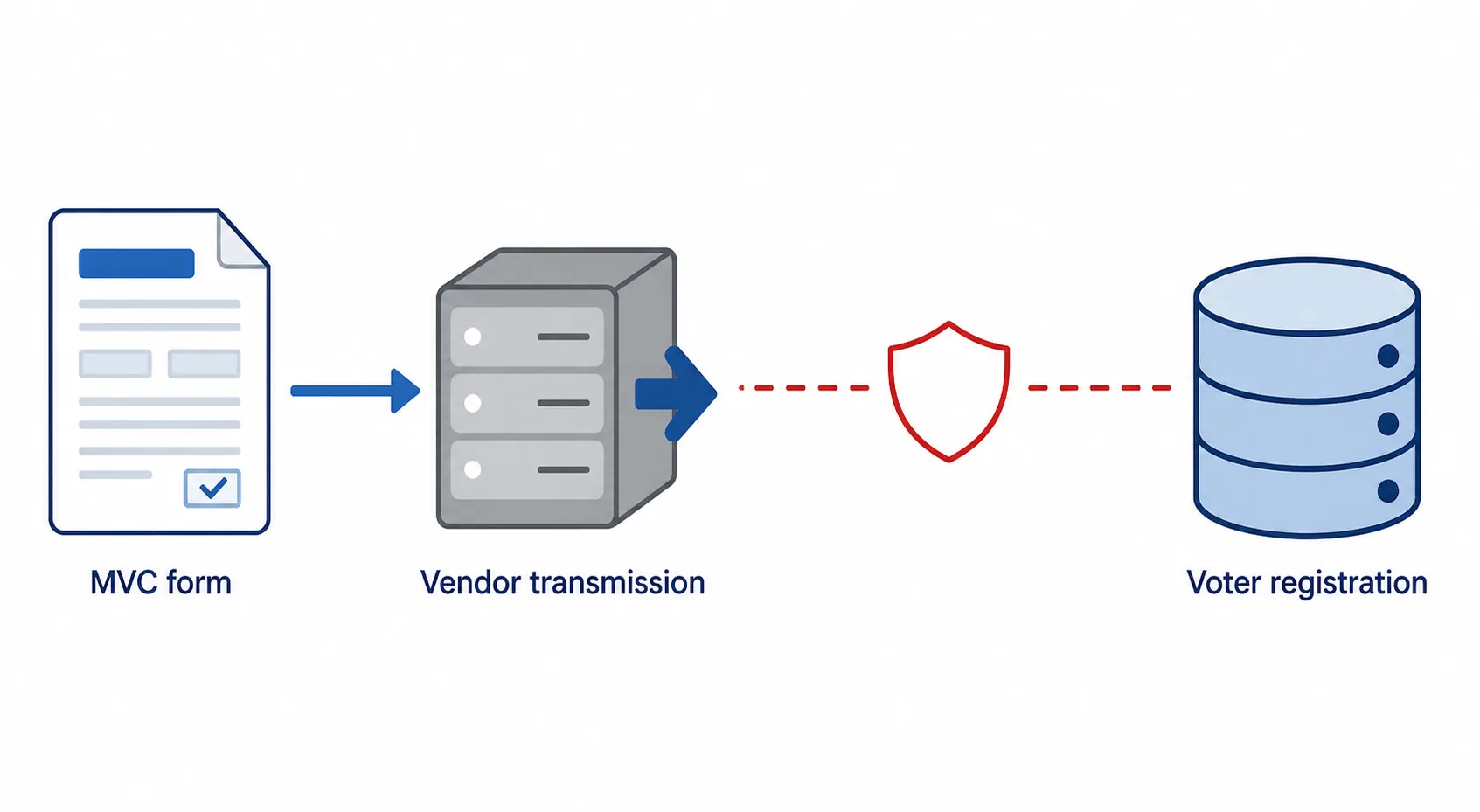
Motor-voter systems are supposed to reduce friction. A clean intake channel can prevent lost paper, duplicate entry, inconsistent county processing, and clerical drift. The problem in New Jersey was not that data moved electronically. The problem was that data apparently moved after the eligibility answer should have changed the record’s path.
Votebeat reported that the applicants at issue answered “no” to the citizenship question in the MVC system, while data transmitted through IDEMIA still reached the voter-registration side. IDEMIA described its role as transmission and said the submissions “must still be validated and adjudicated by the Division of Elections,” which matters because it leaves the precise breakdown between vendor transmission and state adjudication unresolved.[1]
That distinction should not be softened into a generic “glitch.” If a vendor sent records it should not have sent, the contract and testing record matter. If the state received records that should have been exception-queued and instead treated them as registration-ready, the state control failed. If both happened, the handoff was not governed tightly enough. The compliance question is not which actor can produce the better press statement; it is which system event converted a “no” answer into a registration stream.
What the public record shows about the New Jersey run
The known sequence is short, but it is enough to locate the risk. The error ran for roughly a year, was fixed in June 2024, and was not disclosed publicly until July 21, 2026, when Gov. Mikie Sherrill announced the problem.[2] For the people wrongly placed on the rolls, that delay matters. They did not design the system, negotiate the vendor contract, or decide how a negative citizenship answer should be encoded. Yet they were the ones placed in possible criminal, immigration, and civil jeopardy once the state later identified the records.
| Point in the record | What is currently supported |
|---|---|
| Error window | The reported window ran from June 2023 to June 2024.[1] |
| Affected records | About 6,600 registrations were tied to the error.[1] |
| Ballots cast | Fewer than 400 ballots were cast from the affected group.[1] |
| Total registration context | New Jersey had more than 6.6 million registered voters.[1] |
| Fix date | The state said the software problem was fixed in June 2024.[2] |
| Public disclosure | The issue was publicly disclosed on July 21, 2026.[2] |
The smaller ballot number should be kept in view without being misused. It cuts against claims that the episode proves broad voter fraud. It does not cure the registration failure. Registration is itself a legally meaningful system state, and an automated path that creates that state after a negative citizenship answer has already failed before anyone discusses turnout.
The delay between the June 2024 fix and the July 2026 public disclosure is also part of the control record. A defect can be corrected technically while remaining unresolved institutionally. Administrators still have to identify affected records, notify or coordinate with counties, decide what can lawfully be removed, preserve evidence, and explain why the original stop did not work.
Remediation moved from software repair to roll cleanup
New Jersey’s response did not stop at saying the error had been fixed. Reporting described IDEMIA as being phased out, about 4,500 removals initiated, and about 2,000 records sent to county review, with the important caveat that some of those people may in fact be citizens. The state also hired former New Jersey Attorney General Jeff Chiesa to conduct an independent bipartisan investigation.[3]
Those remediation steps are not admissions that every affected person acted unlawfully. They are evidence that the state had a live data-quality and eligibility problem to unwind. County review is slow because a registration database is not a spreadsheet that can simply be filtered and purged. Each record has a person attached to it, and the consequence of a mistaken removal is not symmetrical with the convenience of batch correction.
Vendor replacement also has a narrow meaning. It may be the right procurement response, but it does not by itself prove where the defect sat. A replacement vendor can inherit the same risk if the state’s acceptance criteria still allow a record with a disqualifying answer to become a registration payload before adjudication. The repair has to be tested at the transition point, not just announced at the vendor level.
Why Quraishi could say the error had “no bearing”
The federal lawsuit was not a root-cause proceeding about MVC software, IDEMIA transmission logic, or county remediation. It concerned the Justice Department’s attempt to obtain New Jersey voter-roll data. After the July 21 disclosure, DOJ filed the error as an additional basis for its demand. Judge Zahid Quraishi rejected that move, holding in the July 29, 2026 opinion that the software error had “no bearing” on whether DOJ was entitled to the voter database.[4]
That sentence has been asked to do too much in the public argument. It does not mean the registration failure was harmless. It does not mean the state’s pipeline was well designed. It means the defect did not supply the missing legal entitlement in that separate data-demand case. The court’s order dismissed the action, which is a litigation result, not an engineering certificate.[5]
This separation matters for compliance teams because courts often decide the question in front of them, not the operational question everyone else wants answered. A database demand can fail under the governing legal theory while the underlying agency still faces vendor accountability questions, privacy exposure, data-minimization concerns, record-correction duties, and potential harm to people who were pulled into a system they were not eligible to use.
The same separation applies to New Jersey’s reported refusal to turn over personal information about the affected registrants on privacy-law grounds. That refusal was part of the conflict between federal demand and state-held voter data; it was not a substitute for the state’s obligation to understand how the MVC workflow produced the bad records in the first place.[3]
The pattern is not confined to New Jersey
The New Jersey case is concrete, but it is not exotic. Votebeat placed it alongside other DMV-driven registration errors: Oregon identified more than 1,700 registrations in 2024, Arizona dealt with a 218,000-person classification error, and Pennsylvania in 2017 sent more than 11,000 verification letters after a programming error.[1]
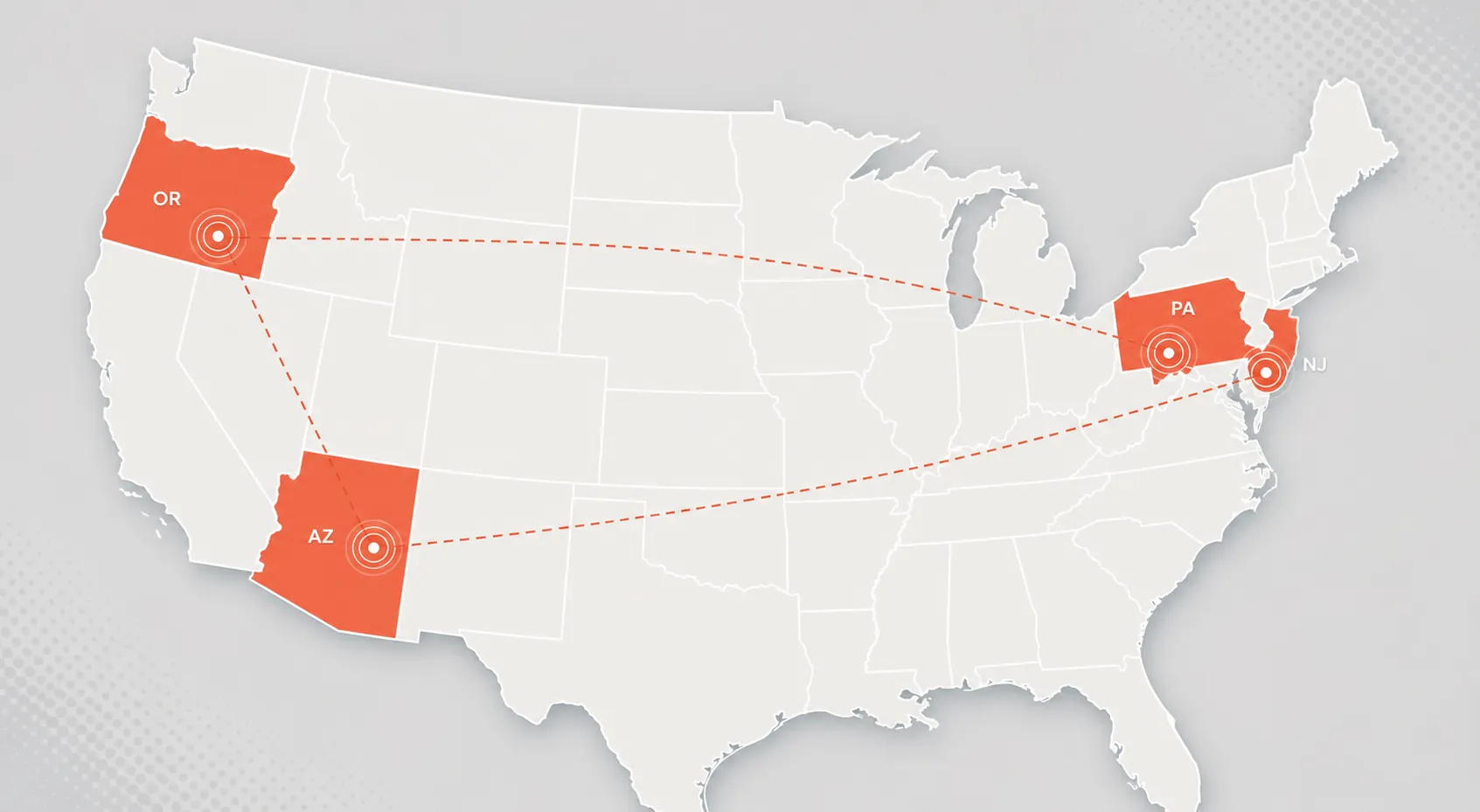
Those examples should be handled carefully. They do not prove the same root cause in every state, and they do not establish a national rate of noncitizen voting. What they do show is that DMV-to-election pipelines repeatedly create risk at the same kind of boundary: a person provides identity or eligibility information in one government context, and a downstream system uses that information to create or classify voting records.
That boundary is attractive to automation because it is repetitive. It is dangerous for the same reason. Once the state treats an upstream answer as structured data, the system needs a rule for every legally decisive value. “No” on citizenship is not a weak signal. It is the kind of answer that should change the workflow immediately.
What an eligibility pipeline has to prove before it is trusted
A motor-voter system does not need to become paper-based to be safer. It needs to prove that legally decisive fields cannot pass silently from intake to enrollment. In practical terms, the citizenship-confirmation step should be treated as a hard control, not a label attached to a record that may already be moving downstream.
- A negative citizenship answer should block automatic registration or route the record into a documented exception queue before any voter-registration record is created.
- The vendor contract should identify which system event creates a registration payload, which fields are disqualifying, and which party is responsible for suppressing, flagging, or transmitting exceptions.
- The state system should log the status change from application intake to eligibility review to registration, with enough detail to reconstruct who or what approved the transition.
- Post-fix testing should replay records with disqualifying answers, not merely confirm that ordinary eligible applications still move through the system.
- Incident response should minimize unnecessary disclosure of personal data while still giving counties and investigators the information needed to correct the rolls lawfully.
The hardest of these controls is the first one because it is where automation meets legal consequence. A human-in-the-loop gate would not resolve every factual dispute now surrounding New Jersey’s incident. It would, however, force a record with a negative citizenship answer to stop before registration, require a documented eligibility decision, and leave an audit trail if someone overrode the stop.
For procurement and compliance reviewers, IDEMIA’s transmission-versus-adjudication position is exactly the clause to examine in the next contract. If the vendor says it only transmits, the state still needs to know whether the vendor transmits all records, only eligible records, or records tagged by eligibility state. If the state says it adjudicates, the state needs to show where adjudication occurs before a registration record is activated. A responsibility split is not a control unless the data state changes at the split.
Current status as of July 31, 2026
As of July 31, 2026, the federal data-demand case had been dismissed, and the public tracker updated July 30 did not show a DOJ appeal notice in the New Jersey case.[6] The operational record remains open in the way that matters for technology governance: the state is cleaning affected records, replacing the vendor, and awaiting the results of the Chiesa investigation.
Quraishi’s ruling made the tainted registration data legally irrelevant to DOJ’s separate statewide database demand. It did not make the pipeline trustworthy. The compliance lesson is narrower and more durable: an automated eligibility system that cannot prove a hard verification stop at citizenship confirmation is not ready to carry the legal consequence of registration.
References
- Noncitizen voters discovered in New Jersey fuel nationwide debate, Votebeat, July 23, 2026
- Serious software error leads to 400 non-citizens voting in New Jersey, NBC New York, July 21, 2026
- Federal judge dismisses Trump administration's lawsuit seeking New Jersey voter records, The Philadelphia Inquirer, July 29, 2026
- Opinion PDF, United States v. Caldwell, Doc. 107, July 29, 2026
- Order of Dismissal PDF, Doc. 108
- DOJ Lawsuits Seeking States’ Sensitive Voter Data, Wisconsin State Democracy Research Initiative, updated July 30, 2026
Operationalizing workflow
No workflow has been explicitly linked to this obligation yet. See Workflows generally.
Illustrative cases
No illustrative case is currently tracked for this obligation. See Risk Digest for documented incidents generally.
← Back to RegulationReport a correction or tip
Spotted an outdated figure, a misstated fact, or a ruling this regulation entry should reflect? Public comments are disabled for this content given the professional cost of a misreported case outcome, penalty amount, or rule text — use the structured correction channel instead.
Report a correction or tip for this record →