
NHTSA Tesla FSD Investigations Fuel Federal AV Preemption Debate
- Authority
- NHTSA
- Rule type
- regulation
- Jurisdiction scope
- US federal
- Source text
- Read primary rule text ↗
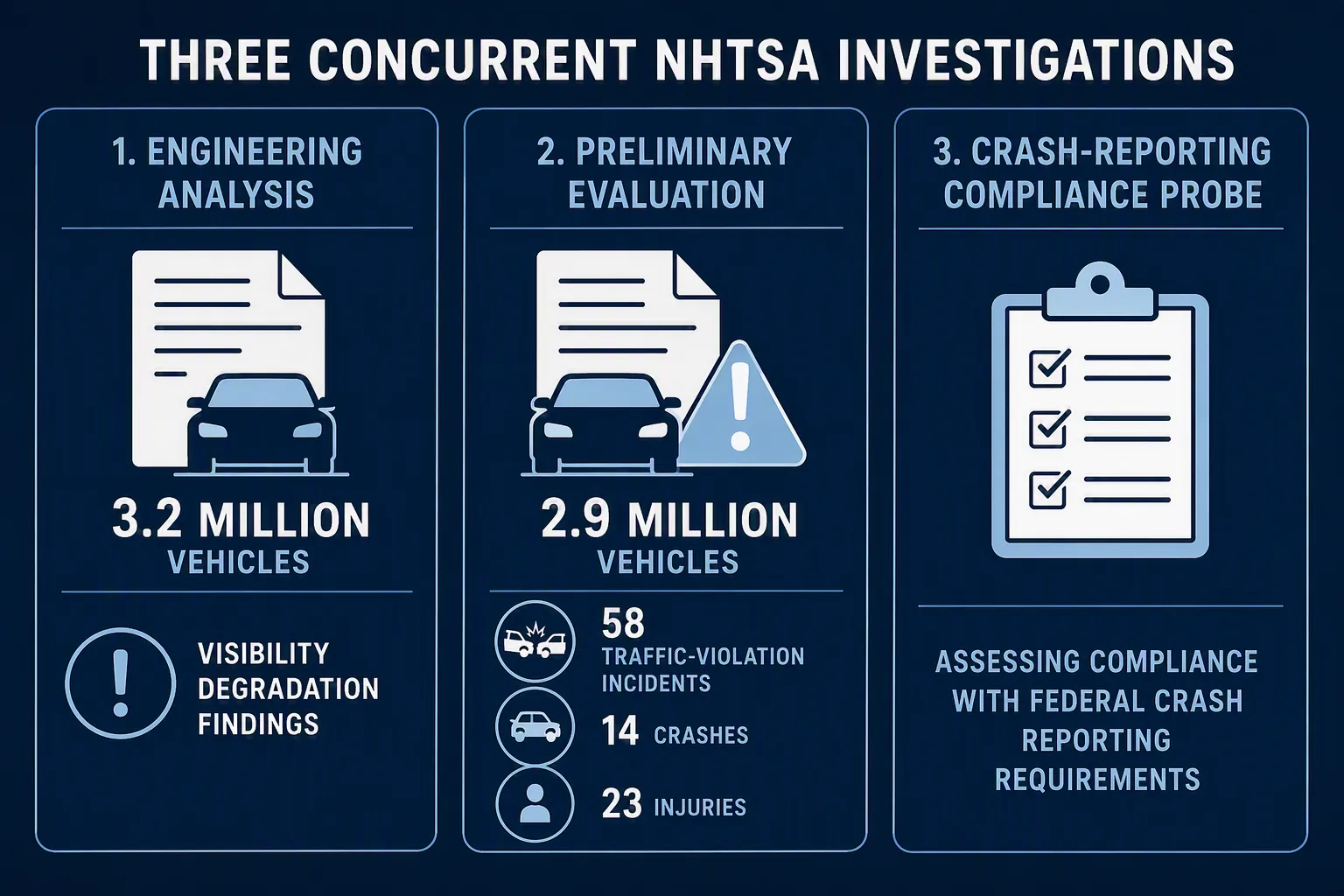
The regulatory implications of NHTSA’s Tesla Full Self-Driving investigations are now doing work that ordinary autonomous-vehicle hypotheticals cannot. The same record supports two competing claims in Congress: that automated driving needs a national safety-case regime and common data repository, and that federal preemption is premature if the federal regulator expected to police that regime is still struggling to obtain, test, and enforce against the relevant facts. NHTSA’s current Tesla file includes an engineering analysis covering 3.2 million vehicles and visibility-degradation concerns, a preliminary evaluation covering 2.9 million vehicles and 58 traffic-violation incidents including 14 crashes and 23 injuries, and a separate crash-reporting compliance issue that has become inseparable from the legislative debate over data transparency.[1][2][3]
That is why Tesla’s record is more useful than the usual preemption talking points. It is not a clean exhibit for either side. It shows why a state-by-state approach can become unmanageable for nationally deployed driver-assistance software, and it also shows why a federal-only approach depends on more than statutory elegance.
The Tesla investigations are not one regulatory event
The shorthand “Tesla FSD investigation” obscures the important legal point: NHTSA is looking at different kinds of problems through different procedural vehicles. For a company trying to understand its own exposure, those distinctions matter. A performance concern in a defined driving condition is not the same thing as a pattern of traffic-law behavior, and neither is the same thing as a reporting-compliance question.
| NHTSA matter | Stated scope | Regulatory significance |
|---|---|---|
| EA26002, engineering analysis | 3.2 million Tesla vehicles; visibility-degradation concerns | Moves the low-visibility performance issue into a deeper defect-investigation stage and tests how NHTSA evaluates system behavior under degraded environmental conditions.[1] |
| PE25012, preliminary evaluation | 2.9 million Tesla vehicles; 58 traffic-violation incidents, including 14 crashes and 23 injuries | Centers on alleged traffic-law behavior while FSD is engaged, making it directly relevant to claims about real-world operational safety rather than only system design theory.[2] |
| Separate crash-reporting probe | Crash-reporting compliance connected to advanced driver-assistance incident reporting | Goes to the reliability of the data stream Congress would rely on if a national AV repository formalizes existing reporting obligations.[3] |
EA26002 is the easiest to misread politically because an engineering analysis sounds final when it is not. It is still an investigative stage, not a court judgment and not a completed rulemaking. But it is not casual scrutiny either. The scale alone—3.2 million vehicles—means NHTSA is reviewing a deployed consumer technology at fleet size, not a limited pilot. The visibility-degradation focus also matters because automated-driving claims often become vague at the edge of a system’s operating conditions. If the system’s performance changes materially in glare, fog, darkness, precipitation, or other degraded conditions, the legal problem is not only whether a human driver should have remained attentive. It is also whether the product, warnings, release process, and post-deployment monitoring were built around those limitations.
PE25012 has a different function in the debate. It gives lawmakers a concrete incident set: 58 traffic-violation incidents, 14 crashes, and 23 injuries within a 2.9 million-vehicle scope.[2] Those numbers do not prove, by themselves, how Tesla’s system compares with human driving across all conditions. They do, however, make it harder to treat Level 2+ automation as merely an incremental driver-assistance feature. When the alleged conduct is framed around traffic violations, Congress is no longer discussing only whether a vehicle component failed. It is discussing how a software-enabled driving function behaves in the rule-bound environment that states traditionally police through traffic codes, licensing rules, and local enforcement.
The crash-reporting issue is narrower but may be the most important for future legislation. A safety-case regime depends on the regulator’s ability to compare a manufacturer’s claims against incident data. If the reporting channel is incomplete, delayed, inconsistently classified, or too opaque to permit meaningful review, the statutory promise of “human-level” or better safety becomes difficult to administer. That is where Tesla’s file bleeds directly into the SELF DRIVE Act debate.
What SELF DRIVE would change
The SELF DRIVE Act of 2026, H.R. 7390, is not simply a permission slip for autonomous vehicles. As described in congressional and legal analyses, it would preempt certain state and local AV regulations where manufacturers submit a documented safety case showing at least human-level safety performance. It would also create a National Automated Vehicle Safety Data Repository, effectively moving NHTSA’s existing Standing General Order 2021-01 crash-reporting architecture toward a more formal statutory footing.[3][4]
That architecture explains why Tesla’s investigations have become so central. Supporters of federal legislation can point to Tesla and say: this is exactly why the country needs one federal review path, one national data framework, and one regulator responsible for evaluating safety cases across state lines. A vehicle software release does not stop at a state border. If each state imposes its own AV design, reporting, or operational conditions, compliance can become a map exercise rather than a safety exercise.
But the preemption case is not complete unless it identifies who reviews the safety case, what happens when post-deployment data contradicts the manufacturer’s submission, and how quickly NHTSA can compel a correction, recall, warning revision, reporting change, or enforcement resolution. Preemption is tolerable only if the displaced authority is replaced by something operationally stronger than the patchwork it supersedes.
For counsel inside an AV or Level 2+ company, that means the safety case is not just a future legislative artifact. It is already the organizing document regulators will expect to see in substance: system capability, operational limits, driver-engagement assumptions, validation evidence, update governance, incident escalation, claims substantiation, and the process for reconciling field data with prior safety assertions. Tesla’s current posture is a warning that post-deployment facts will be used to test the whole chain.
Markey and Blumenthal press the uncomfortable version of the anti-preemption case
Senators Edward Markey and Richard Blumenthal have supplied the cleanest version of the argument against moving too quickly from Tesla’s record to federal preemption. Their June 16, 2026 letter asked NHTSA to review Tesla’s Full Self-Driving safety data and cited a Reuters investigation alleging that Tesla exaggerated FSD safety comparisons, including by comparing airbag-deployment crashes to all U.S. crashes including minor crashes, and by comparing newer Teslas with an older average vehicle fleet.[5]
That is a different allegation from a defect investigation, but it belongs in the same regulatory file for legislative purposes. If safety comparisons are framed in a way that overstates the system’s relative performance, the problem is not limited to advertising. It affects the safety-case premise itself. A national regime would have to decide what comparisons are acceptable, what exposure denominators matter, how to handle driver-supervision assumptions, and whether a manufacturer’s public safety claims match the data it provides to NHTSA.
The same senators have also criticized gaps in transparency around automated-vehicle remote operations. Their March 2026 report, as summarized in the SELF DRIVE debate, described “serious safety gaps and lack of transparency,” especially around remote-operator qualifications and data reporting.[3] That position does not reject federal data collection. It asks whether NHTSA would have enough authority, information, and resources to make federal data collection meaningful before states are pushed aside.
There is a tension in that position, and it should not be skipped. Markey and Blumenthal were also part of the opposition that helped stop the 2017–2018 AV START Act, and similar objections have reappeared around SELF DRIVE preemption language.[3] If federal legislation fails again, manufacturers will continue to face the same patchwork argument that has animated AV policy for years. A lawyer responsible for product deployment still has to answer which state rules apply, what local requirements are preempted by existing federal motor-vehicle law, and how to document a release decision when the legal map is unsettled.
The stronger anti-preemption argument is therefore not that states are always better regulators of automated driving. It is that NHTSA must be visibly capable of replacing state oversight before Congress strips away significant portions of it.
BUILD America 250 points in the same direction, but on a different road
BUILD America 250 deserves mention because it shows that Congress is not only debating passenger-vehicle autonomy through SELF DRIVE. In May 2026, the House Transportation and Infrastructure Committee advanced H.R. 8870 on a 62-2 bipartisan vote, and the bill has been described as the first federal regulatory framework for autonomous commercial motor vehicles, including a safety-case demonstration requirement.[4]
That is not the Tesla FSD problem in another form. Commercial motor vehicles bring different regulators, duty cycles, operators, insurance structures, and interstate-commerce considerations. But the safety-case architecture is common enough to matter. Congress is increasingly drawn to a model in which manufacturers or operators document why an automated system should be allowed to operate, rather than waiting for prescriptive federal motor vehicle safety standards to anticipate every design.
The institutional question follows the model wherever it goes: who audits the case, who checks the data after deployment, and what happens when the case no longer describes the system on the road?
The capacity caveat cannot be treated as atmospherics
NHTSA’s authority is not merely theoretical. The Tesla matters show an agency capable of opening fleet-scale investigations, asking system-specific questions, and placing a consumer-facing automation product under sustained scrutiny. But preemption changes the burden on the agency. It is one thing to investigate after incidents accumulate; it is another to serve as the central gatekeeper for safety cases, incident reporting, data repositories, exemption conditions, and enforcement responses across a growing automated-driving market.
That is why staffing evidence matters, even if it should be handled carefully. A Foley & Lardner analysis, citing Reuters and Department of Transportation workforce data, described an approximately 25 percent reduction in NHTSA staffing, from about 780 employees to about 575. The exact current headcount may differ, and headcount alone does not measure technical capacity, but those figures are relevant when Congress is considering whether to give NHTSA a larger exclusive role in automated-vehicle oversight.[6]
A credible federal framework would need more than a repository and a submission requirement. It would need engineers and lawyers able to test the submission against field data, data scientists able to identify reporting anomalies, investigators able to move quickly when incidents cluster, and enforcement officials willing to treat misleading safety representations as part of the safety problem. Without that, preemption risks becoming a jurisdictional trade: states lose tools before the federal government demonstrates that its replacement tools can reach the conduct at issue.
The international benchmark is useful, but not controlling
The U.S. debate is not occurring in isolation. The January 2026 adoption of the first UNECE global regulation for Level 4 and higher automated driving systems gives policymakers an outside benchmark for safety-case-style regulation.[3] It is relevant because it confirms that safety-case thinking is not a purely domestic lobbying invention.
It should not be overused. UNECE regulation, U.S. federal motor-vehicle authority, state traffic-law authority, and NHTSA defect investigations operate in different legal systems. The comparison helps identify the direction of regulatory travel; it does not answer the U.S. preemption question. Congress still has to decide what power NHTSA receives, what state authority remains, and what evidence a manufacturer must maintain after deployment.
What Level 2+ developers should take from Tesla
For companies developing Level 2+ systems, the lesson is not to wait for SELF DRIVE, BUILD America 250, or any successor bill to settle the compliance model. Tesla’s investigations show the categories of evidence that will matter even before Congress acts.
- Define the system’s operating limits in a way that engineering, marketing, legal, and incident-response teams can all use. If degraded visibility changes performance, the limitation should not live only in a technical file.
- Treat traffic-law behavior as a safety and compliance issue, not only as a driver-responsibility issue. A supervised system can still generate regulatory exposure if the deployment record suggests predictable violations while the feature is engaged.
- Build incident-reporting governance around auditability. The company should be able to explain how it identifies covered events, who reviews them, when they are reported, and how field data changes the safety case.
- Substantiate public safety comparisons before they become part of an enforcement file. A comparison that uses a favorable denominator may be persuasive in marketing and still fragile under regulatory review.
- Assume that software updates will be judged against prior claims. If an update narrows, expands, or materially changes system behavior, the safety rationale should move with it.
This is where the preemption debate becomes practical. A company arguing for national uniformity should be prepared to live under a national record: consistent safety-case submissions, transparent incident data, disciplined public claims, and a regulator with enough information to challenge the company’s conclusions. The Tesla record makes the case for federal uniformity stronger because it exposes the limits of fragmented oversight. It also makes that case harder to win because it forces Congress to confront whether NHTSA has the authority and capacity to police the uniform system it would inherit. For Level 2+ developers, the debate is now less theoretical and less forgiving: federal rules may be the right destination, but the argument for displacing state oversight will remain vulnerable unless it is paired with credible safety-case review, reliable data reporting, and visible enforcement capacity.
References
- NHTSA ODI Resume EA26002 (Engineering Analysis) — National Highway Traffic Safety Administration.
- NHTSA ODI Resume PE25012 (Preliminary Evaluation) — National Highway Traffic Safety Administration.
- Contextualizing Current Congressional Efforts on Autonomous Vehicles — Eno Center for Transportation, April 2026.
- House Passes Autonomous Vehicles Framework for Commercial Motor Vehicles — Holland & Knight, June 2026.
- 2 senators want NHTSA to review Tesla's Full Self-Driving safety data — Detroit News, June 16, 2026.
- Driving Into 2026: The State of NHTSA and the Future of Vehicle Safety Regulation — Foley & Lardner, November 2025.
Operationalizing workflow
No workflow has been explicitly linked to this obligation yet. See Workflows generally.
Illustrative cases
No illustrative case is currently tracked for this obligation. See Risk Digest for documented incidents generally.
← Back to RegulationReport a correction or tip
Spotted an outdated figure, a misstated fact, or a ruling this regulation entry should reflect? Public comments are disabled for this content given the professional cost of a misreported case outcome, penalty amount, or rule text — use the structured correction channel instead.
Report a correction or tip for this record →