
Can Software Error Shield Noncitizen Voters from Prosecution?
- Authority
- U.S. Congress
- Rule type
- statute
- Jurisdiction scope
- US federal
- Source text
- Read primary rule text ↗
The legally important fact in the New Jersey noncitizen voter registration error is not the headline number. It is the answer reportedly preserved inside the Motor Vehicle Commission process: applicants answered “No” to the citizenship question, yet the registration data still moved forward into the voter-registration system. IDEMIA, the contractor involved in the MVC system, said in July 2026 that the system accepted registrations even when applicants indicated they were not citizens, and that the MVC records for the roughly 6,600 affected individuals showed “No” citizenship answers rather than affirmative citizenship attestations.[1]
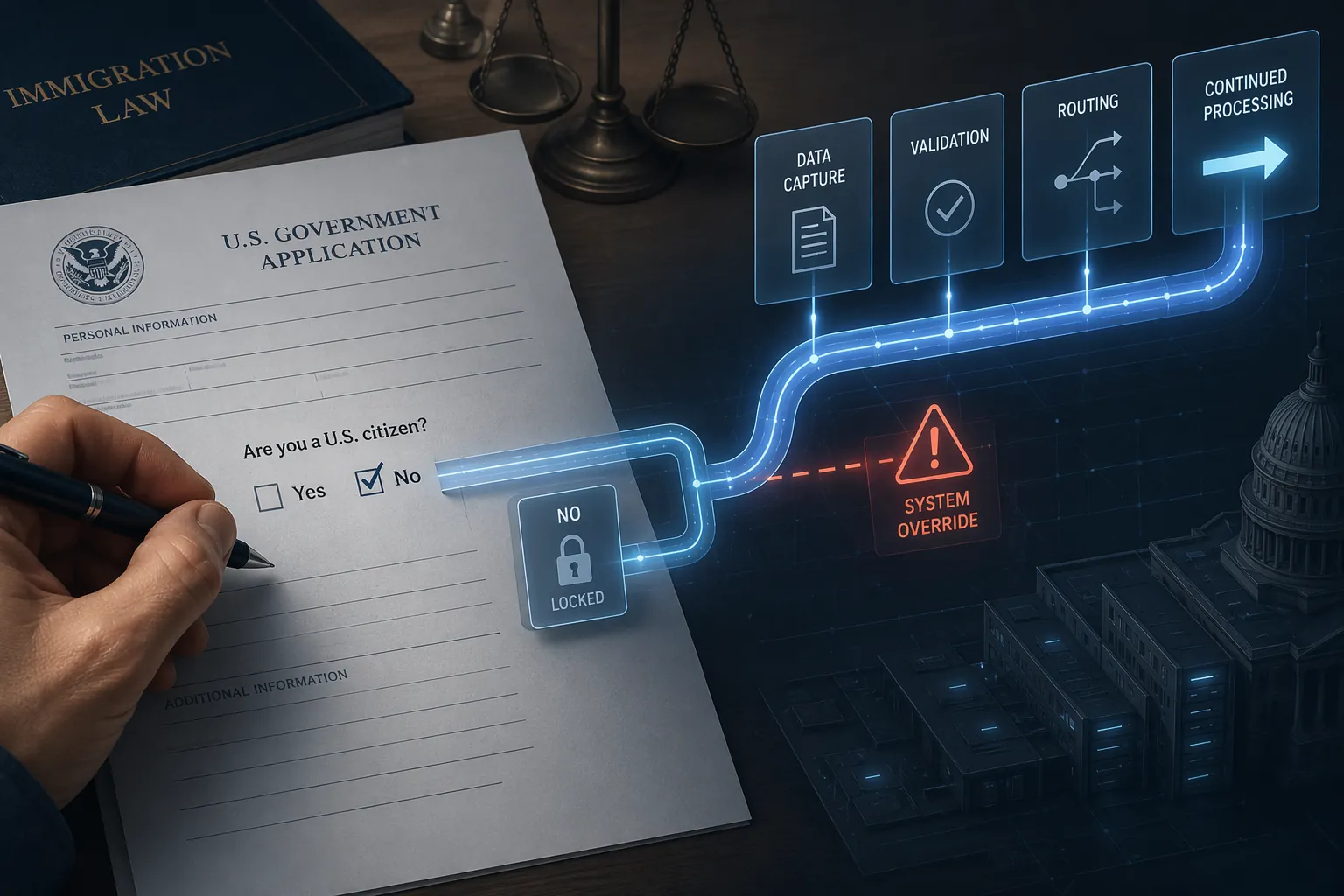
That distinction matters because the federal criminal exposure does not turn simply on whether a noncitizen appeared on the rolls. For the roughly 400 noncitizens reported to have cast ballots after the motor-voter error, prosecutors would still have to prove the elements of a federal offense against an individual defendant. As of July 26, 2026, the Department of Justice posture was not that the whole cohort had been charged. Assistant Attorney General Harmeet Dhillon said prosecutions were under consideration, and the U.S. Attorney’s Office for the District of New Jersey had separately announced charges against multiple noncitizens for allegedly voting illegally in federal elections and making false statements.[2]
The two federal theories most likely to matter are 18 U.S.C. § 611 and 18 U.S.C. § 1015(f). Section 611 addresses noncitizen voting in federal elections and carries possible punishment including a fine, imprisonment of up to one year, and removal. Section 1015(f) addresses a false claim of U.S. citizenship for voting or registration purposes and carries possible punishment including a fine and imprisonment of up to five years. The factual problem for the government is different under each statute, but both routes run into the same basic question: what did this person know, say, and do?
The Registration Error Is Not the Same as a False Citizenship Claim
Section 1015(f) is the more strained theory if the only evidence is the MVC transaction described by IDEMIA. A false-claim case normally requires proof that the defendant represented himself or herself to be a U.S. citizen for a voting or registration purpose. A preserved “No” answer to the citizenship question points in the opposite direction. It is not merely an absence of proof; it is affirmative evidence that the applicant gave the disqualifying answer.
That does not make every possible § 1015(f) case disappear. A prosecutor could look for another form, another attestation, a later correction, a signature block that independently certified eligibility, or an in-person exchange contradicting the MVC data. But if the government’s theory is that the defendant became registered because the motor-voter software treated a “No” citizenship answer as compatible with transmission, the case no longer looks like a conventional false citizenship prosecution. It looks like a state-administered registration pathway malfunctioning after the applicant supplied the very answer that should have stopped the process.
That is why the contractor statement is not a side dispute about blame between New Jersey and a vendor. For a defendant, it goes directly to mens rea. If the government must prove a willful false citizenship claim, the preserved “No” answer is likely to become exhibit one for the defense. The applicant did not need to know the back-end architecture of the MVC system. The applicant needed only to answer the citizenship question, and according to the reported contractor account, the system recorded the noncitizenship answer anyway.[1]
Voting Creates a Harder Question Than Registration
The stronger prosecution theory, if one is brought, is more likely to focus on the later act of voting. Section 611 is not a registration statute. It asks whether a noncitizen voted unlawfully in a federal election, and the mens rea fight will center on whether the person knew he or she was not permitted to vote.
The original software error still matters, but it does not automatically answer the § 611 question. A person can be erroneously registered and later know voting is unlawful. A person can also be erroneously registered, receive ordinary official signals of eligibility, and plausibly believe the government has approved participation. The difference is not rhetorical. It is the difference between a chargeable voting act and a serious proof problem.
In a real prosecution, the government would want facts that move beyond the database entry. Did the voter receive a registration card? Did election mail arrive in the ordinary way? Did a polling-place worker check the person in without warning? Did the person ever receive a notice saying noncitizens cannot vote? Did the person complete any later form that repeated the citizenship requirement? Did the person have prior immigration filings, naturalization denials, or prior warnings making the voting prohibition unmistakable? Those facts would matter more than the public size of the cohort.
For defense counsel, the first file review should separate the registration path from the voting path. The MVC record may undercut a false-statement count. It may also help explain why the person thought he or she was registered. But § 611 exposure turns on the voting moment, and the government can try to prove knowledge from surrounding circumstances. A clean MVC “No” answer is powerful evidence. It is not a universal factual stipulation that no defendant knew anything later.
What the Government Would Need to Prove
The proof problem is easiest to see if the case is reduced to the two federal theories prosecutors may consider.
| Potential charge | Government proof problem after the MVC error |
|---|---|
| 18 U.S.C. § 1015(f) | The government would need evidence of a false citizenship claim for voting or registration. A recorded “No” citizenship answer makes that theory difficult unless another statement supplies the false claim. |
| 18 U.S.C. § 611 | The government would need evidence that the noncitizen knowingly voted unlawfully. Erroneous state-created registration may defeat or weaken knowledge, but later notices, forms, warnings, or other facts could change the analysis. |
The central defense theory is not that a software error legalizes noncitizen voting. It is that Congress required a culpable mental state, and the state-contractor process may have supplied the defendant with official signals inconsistent with criminal knowledge. If a person truthfully answered “No” to citizenship, was nevertheless placed on the rolls, and later received the ordinary mechanics of voter participation, the government may have trouble proving beyond a reasonable doubt that the person knew the vote was unlawful.
That theory is especially strong where the government cannot identify any affirmative lie. It weakens where the file contains repeated eligibility warnings, signed certifications, prior immigration advice, prior voting-related contacts, or evidence that the defendant understood the mistake and used it anyway. The analysis is individualized or it is not criminal analysis at all.
The Bigger Numbers Do Not Prove the Individual Cases
The public figures are politically significant: roughly 6,600 transmitted registrations and roughly 400 ballots cast. They do not, by themselves, establish that 400 people committed provable federal crimes. They establish the scope of the administrative failure and the pool of cases prosecutors may review.
Governor Mikie Sherrill said the people who voted were registered across Democratic, Republican, and unaffiliated categories and that there was “no evidence that any elections were swayed.”[3] That point may matter to charging discretion. It may reduce an aggravating narrative that the conduct changed an election outcome or moved in one partisan direction. It is not, standing alone, a mens rea defense. A vote can be unlawful even if it does not affect the result.
The converse is also true. Public outrage about election integrity does not fill an evidentiary gap in a defendant’s case file. Federal prosecutors still need admissible proof that maps onto the statute charged. In these cases, that proof will likely depend less on the press-conference number and more on what the state sent, what the person received, what forms were signed, and what warnings were visible.
Charging Risk Is Real Even If the Defense Is Strong
The Department of Justice has already signaled interest, and filed cases in the District of New Jersey show that prosecution is possible.[2] It would be a mistake to tell affected voters that the software explanation makes the matter disappear. Charging discretion is not a law-school exam. A marginal case can still be charged, negotiated, or used to pressure a plea if prosecutors believe later voting conduct supplies enough evidence.
At the same time, prior federal enforcement history counsels against assuming that every identified person will become a defendant. Federal prosecutions for noncitizen voting have historically been rare, with the Department of Justice bringing only a handful of such cases per year according to Election Law Blog’s 2025–2026 discussion of enforcement patterns.[4] That rarity does not bar a new enforcement push, especially in a politically salient election-administration failure. It does set a baseline: mass criminal treatment of an error-generated registration cohort would be a significant escalation, not routine housekeeping.
The existing District of New Jersey cases also should not be read too broadly without the charging documents in hand. Some defendants may have facts that are materially worse than the motor-voter error cohort: different forms, different statements, different histories, or different warnings. The fact that one noncitizen voting case can be charged does not answer whether a person who said “No” to citizenship inside the MVC process can be convicted under the same theory.
Identification Data Deserves Its Own Caution
There is also a separate reliability problem around larger noncitizen-registration lists. Public materials identify a figure of 35,152 potential noncitizen registrants and note criticism of DHS SAVE-based matching methods for high false-positive risk.[5] A ProPublica and Texas Tribune investigation in February 2026 likewise reported problems with using immigration-data matches to flag potential noncitizen voters.[6]
That caution should not be stretched past its support. A flawed matching methodology does not prove that the roughly 400 New Jersey voters were citizens, noncitizens, innocent, or guilty. It means the larger identification universe should not be treated as a clean defendant list. Before anyone’s case is evaluated, counsel needs the source records: MVC transaction data, voter-registration history, ballot history, notices, SAVE or other immigration-status queries, and any human review notes.
For criminal defense purposes, the matching issue is a screening problem before it is a trial defense. A false positive may end the case because the person is not actually a noncitizen or was not ineligible at the relevant time. If the person was a noncitizen and did vote, the analysis returns to knowledge, statements, and official signals.
The Separate Immigration Track

The criminal defense and immigration analyses overlap, but they do not collapse into one another. A successful mens rea defense to a federal criminal charge may prevent conviction. It does not necessarily prevent immigration agencies from examining the same conduct under the Immigration and Nationality Act.
Two immigration provisions matter in particular: inadmissibility under INA § 212(a)(6)(C)(ii) for false claims of U.S. citizenship, and removability under INA § 237(a)(3)(D).[7] Those provisions create their own hazards for noncitizens who are seeking adjustment, naturalization, reentry, or other immigration benefits. The absence of a criminal conviction is helpful, but it is not the same as an immigration safe harbor.
Here again, the “No” citizenship answer is important. If preserved records show that the person did not claim citizenship during the motor-voter transaction, that evidence may be valuable in immigration proceedings as well as criminal court. But immigration consequences can turn on agency standards, benefit applications, admissibility questions, and later statements. A defense strategy that treats the criminal case as the only problem is incomplete.
How Counsel Should Triage These Cases
The first useful division is not between sympathetic and unsympathetic clients. It is between provable and unprovable elements. A triage review should start with the documents that show what the person said and what the government later communicated.
- Obtain the MVC transaction record, including the citizenship-question response and any electronic signature or certification language.
- Compare the MVC record with the voter-registration record to identify whether the registration was transmitted automatically or supplemented by a later voter-facing form.
- Collect every official notice, registration card, sample ballot, mailer, polling-place interaction, and online status confirmation the person received before voting.
- Review immigration history for prior warnings, benefit applications, naturalization filings, or advice that could affect knowledge of voting ineligibility.
- Separate criminal exposure from immigration exposure before any interview, proffer, or corrective filing.
The defense value of the software error is highest where the record is internally consistent: the person disclosed noncitizenship, the state system registered the person anyway, and later government conduct looked like ordinary confirmation of eligibility. It is lower where the person signed later citizenship language, ignored direct warnings, or has a history showing clear knowledge that voting was prohibited.
Counsel should also be careful about remedial contact with election officials. Correcting a registration record may be necessary. Explaining the vote without privilege, preparation, or immigration advice may create statements that did not previously exist. The safest sequence is document collection, criminal assessment, immigration assessment, then any corrective communication.
The Narrow Answer
The New Jersey noncitizen voter registration error creates real criminal exposure, but not a clean mass-prosecution theory. Section 1015(f) is difficult to fit where the preserved record shows a “No” citizenship answer rather than a false citizenship claim. Section 611 remains more plausible because voting is a separate act, but the government would still need to prove the person knew the vote was unlawful despite state-created registration status and any official signals that followed.
That makes the software error neither a blanket shield nor a footnote. It is the fact that may prevent the government from proving the mental state Congress required. For some defendants, later facts may overcome it. For others, it may be the difference between an administrative failure with immigration consequences and a federal criminal conviction.
References
- Contractor disputes Mikie Sherrill's claims of NJ voter registration software error, Politico, July 23, 2026
- Multiple Aliens Charged with Illegally Voting in Federal Elections and Making False Statements, U.S. Attorney’s Office for the District of New Jersey
- Noncitizens on New Jersey voter rolls not our fault, contractor says, NorthJersey.com, July 24, 2026
- Federal prosecutions for noncitizen voting are historically rare, Election Law Blog, 2025–2026
- DHS SAVE database false-positive problem, Institute for Responsive Government, July 2026
- ProPublica/Texas Tribune investigation on immigration-data voter matching, ProPublica and The Texas Tribune, February 2026
- Immigration and Nationality Act §§ 212(a)(6)(C)(ii), 237(a)(3)(D)
Operationalizing workflow
No workflow has been explicitly linked to this obligation yet. See Workflows generally.
Illustrative cases
No illustrative case is currently tracked for this obligation. See Risk Digest for documented incidents generally.
← Back to RegulationReport a correction or tip
Spotted an outdated figure, a misstated fact, or a ruling this regulation entry should reflect? Public comments are disabled for this content given the professional cost of a misreported case outcome, penalty amount, or rule text — use the structured correction channel instead.
Report a correction or tip for this record →