
No 2025 Law Changed LGBTQ Blood Donation Eligibility
- Authority
- U.S. Food and Drug Administration (FDA)
- Rule type
- guidance
- Jurisdiction scope
- US federal
- Effective date
- May 11, 2023
- Source text
- Read primary rule text ↗
Blood: follow 2023 individual risk-based screening; HCT/P: keep 5-year MSM deferral until 2025 draft finalized.
Status as of July 31, 2026
There was no 2025 LGBTQ blood donation eligibility law change in the United States. The operative federal blood-donor policy is the FDA’s May 11, 2023 final guidance adopting individual risk-based donor assessment for blood and blood components. The 2025 regulatory activity that is being confused with a blood-rule change concerned human cells, tissues, and cellular and tissue-based products—HCT/Ps—including tissue and cornea donation—and those HIV/HBV/HCV guidances were draft, not in effect. [1][2]
| Donation category or document | What happened | Compliance status |
|---|---|---|
| Blood and blood components | FDA issued final guidance on May 11, 2023, replacing categorical MSM screening with individual risk-based questions. [1] | In effect for blood donation; not a 2025 law change. |
| HCT/Ps, including tissue and cornea donation | FDA issued a January 2025 draft package proposing a parallel individual risk-based approach for HCT/P donor eligibility. [2] | Draft, not for implementation; existing HCT/P donor rules still govern. |
| Federal Register notice for the HCT/P drafts | The notice appeared at 90 FR 1166 on January 7, 2025, with comments due February 6, 2025. [3] | Open-comment draft process, not a final eligibility change. |
| Final HCT/P guidances on Mtb and sepsis | Separate final guidances were affected by the January 20, 2025 regulatory freeze, with a revised implementation date of May 4, 2025. [4] | The freeze changed those final-guidance dates; it did not finalize the HIV/HBV/HCV HCT/P drafts. |
That distinction is not clerical. A blood center updating its donor-history questionnaire is operating under one federal status. A tissue bank or eye bank evaluating whether it may remove a 5-year MSM deferral is operating under another. A public-facing sentence that says “the ban ended in 2025” is therefore both too late for blood and too early for tissue.
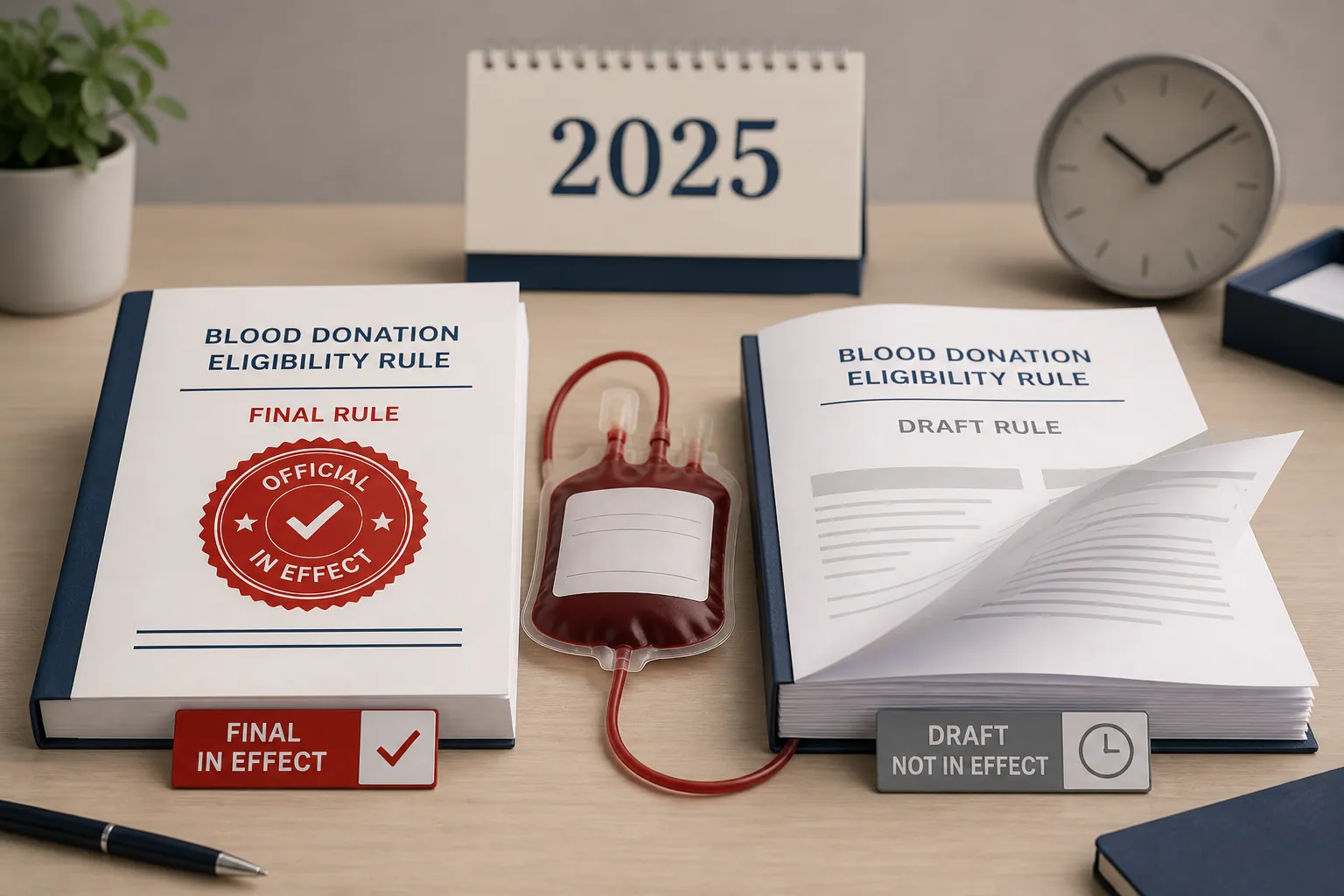
The timeline behind the 2025 confusion
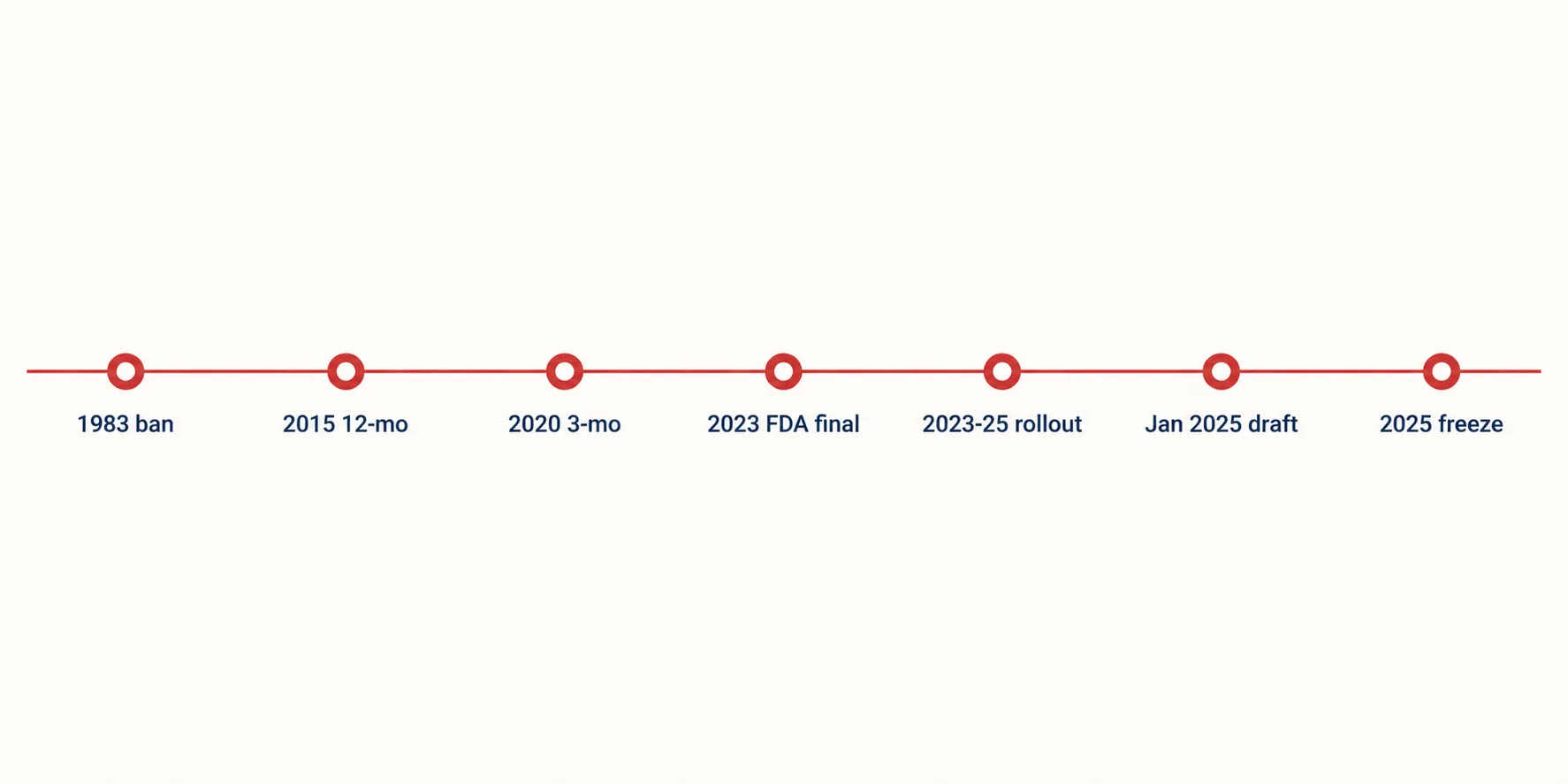
The U.S. blood-donor path moved from categorical exclusion to time-based deferrals and then to individual assessment. The earlier policy history is usually summarized as a 1983 lifetime ban, a December 2015 move to a 12-month deferral, an April 2020 move to a 3-month deferral, and then the May 2023 final FDA guidance. [5][1]
The May 2023 guidance is the key date for blood. After that, implementation had to happen through the machinery that actually screens donors: revised donor-history questionnaires, staff training, blood-establishment procedures, computer-system changes, medication-deferral lists, and public eligibility pages. That center-by-center rollout explains why some donors saw practical changes in 2023, some in 2024, and some later, but it does not convert 2025 into the governing legal date for blood donation.
The AABB donor-history questionnaire materials reflect that operational layer. AABB’s blood donor history questionnaire page includes DHQ v4.0 materials and the July 2025 Medication Deferral List update, which added lenacapavir, marketed as Yeztugo, to the donor-screening medication framework. [6]
What the current blood-donor screening rule asks
For blood donation, the 2023 FDA model does not ask a donor’s eligibility question by first assigning a category such as gay, bisexual, or MSM. It asks individual risk-based questions of all donors. The central sexual-history trigger is whether, in the past 3 months, the donor has had a new sexual partner or more than one sexual partner and has had anal sex. If both conditions are present, the donor is deferred for 3 months. [1]
The medication rules matter just as much as the sexual-history question. The FDA guidance includes deferrals for donors who have taken HIV pre-exposure prophylaxis or post-exposure prophylaxis: 3 months after the last oral dose and 2 years after the last injection. America’s Blood Centers emphasized the same PrEP/PEP deferral structure when explaining the final guidance and its operational impact. [1][7]
Anyone who has taken antiretroviral therapy to treat HIV remains permanently deferred from blood donation under the FDA framework. That point is often where a donor-facing explanation needs careful wording. “Undetectable equals untransmittable” is an important sexual-health and HIV-treatment principle, but transfusion policy does not treat a person taking ART for HIV as eligible to donate blood. The Red Cross’s LGBTQ donor eligibility page presents the current individual-assessment approach while separately addressing HIV medication and treatment-related ineligibility. [1][8]
So the practical blood-donor answer is narrower than many headlines: gay and bisexual men are no longer categorically deferred from blood donation because of their identity or sex with men alone, but a donor can still be deferred based on the current 3-month sexual-history question, PrEP/PEP timing, or HIV treatment history.
The document to change is the questionnaire
For a compliance team, the policy does not become real because a press release says inclusion improved. It becomes real when the donor-history questionnaire, standard operating procedure, training file, software rule, medication list, and public eligibility page all say the same thing. That is why the AABB DHQ and Medication Deferral List updates are more useful than a generic “ban lifted” formulation: they show the screening questions and medication categories that staff and donors actually encounter. [6]
The January 2025 FDA package was about HCT/Ps
The genuine 2025 event was an HCT/P donor-eligibility package. AABB described the FDA’s January 2025 release as six documents: four draft guidances addressing general HCT/P donor eligibility and transmission-risk recommendations for HIV, HBV, and HCV, plus two final guidances addressing Mycobacterium tuberculosis and sepsis. [9]
The HIV HCT/P guidance was not a final rule quietly changing tissue-donor eligibility. It was a draft guidance, and the Federal Register notice placed it in a comment process with a February 6, 2025 comment deadline. The FDA draft also matters because it shows the agency’s proposed direction: extending individual risk-based assessment into HCT/P donor eligibility. But proposed direction is not implementation authority. [2][3]
The effect is blunt. Until the relevant HCT/P drafts are finalized, tissue and cornea donor eligibility has not moved into the same status as blood donation. The existing 5-year MSM deferral for HCT/P donors remains the rule to account for, a point also reflected in AMA criticism of the continued tissue-donor policy. [2][10]
Eye banks had a direct reason to watch the January 2025 package because corneal tissue falls inside the HCT/P world. The Eye Bank Association of America’s RestoreSight alert treated the documents as HCT/P donor-eligibility guidance activity, not as a completed blood-donation law change. [11]
What the January 2025 regulatory freeze did—and did not do
The January 20, 2025 regulatory freeze added another date that is easy to misread. FACT reported that the freeze affected the implementation dates for the final Mtb and sepsis HCT/P guidances, pushing the revised implementation date to May 4, 2025. [4]
That freeze did not transform the HIV, HBV, or HCV HCT/P drafts into final guidance. It also did not reopen the blood-donor policy that had already been finalized in May 2023. The freeze is part of the 2025 HCT/P timeline, but it is not the missing 2025 LGBTQ blood-donation law change.
Why the same person may get different answers for blood and tissue
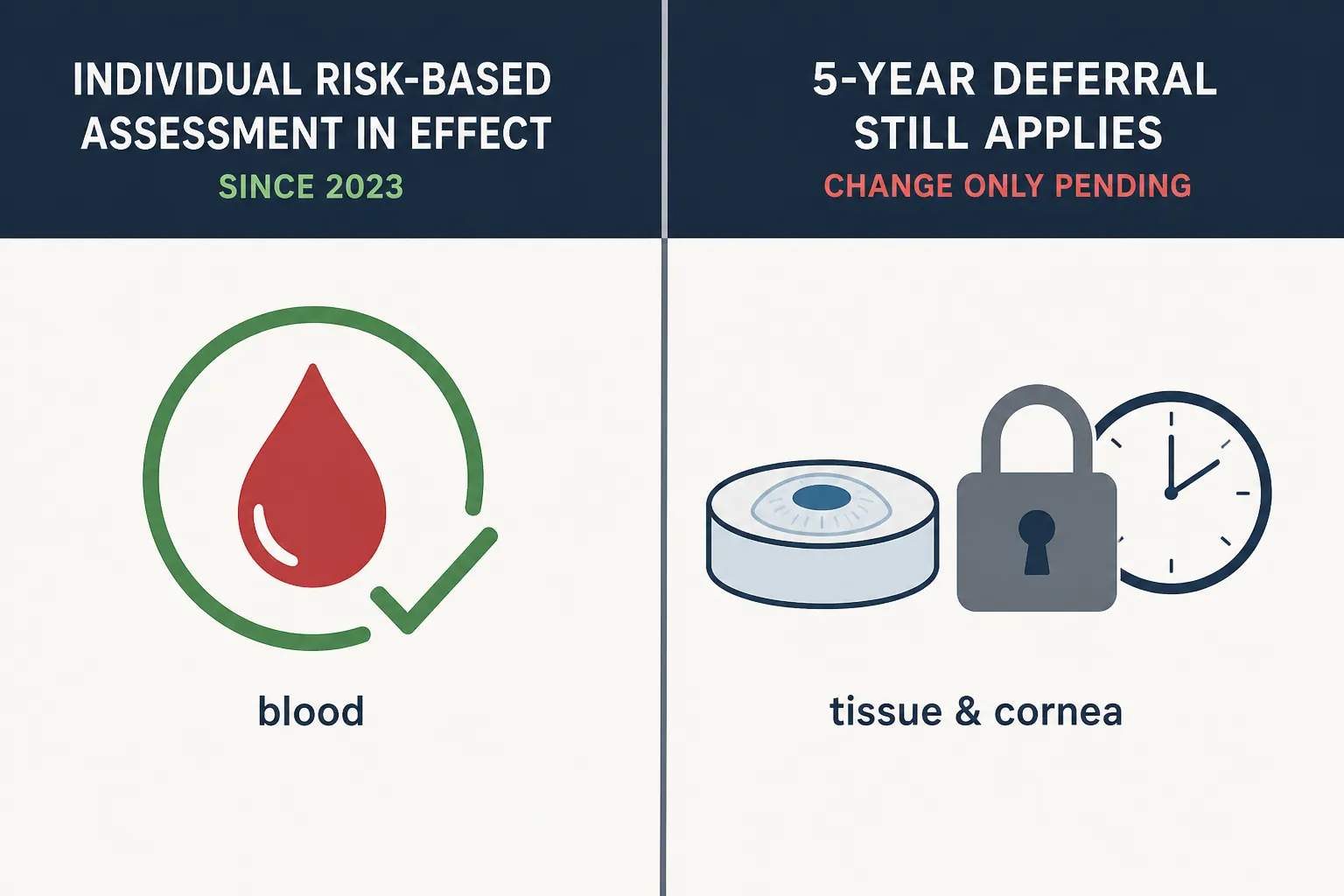
This is the part many short explainers flatten. Blood donation and HCT/P donation are not the same regulatory bucket. Blood is already under the FDA’s May 2023 individual risk-based model. HCT/P donor eligibility, including tissue and cornea donation, is still waiting on finalization of the January 2025 drafts before the same basic move can be relied on for HIV/HBV/HCV donor-screening purposes. [1][2]
A hypothetical donor can therefore be assessed individually for blood donation and still face a different result when evaluated as a tissue or cornea donor. That is not a moral distinction between the donation types; it is a status distinction between finalized blood guidance and unfinished HCT/P guidance.
The operational consequence is predictable. Blood centers should not preserve obsolete categorical blood-donor language. Tissue banks and eye banks should not remove the HCT/P 5-year MSM deferral as though the January 2025 draft package had already been finalized. Public eligibility pages that cover more than one donation type need to say which product they are talking about.
Safety monitoring after individual assessment
The 2023 change did not remove blood-safety controls. Blood donation still depends on layered safeguards: donor screening, required infectious-disease testing, donor deferrals, product handling, and surveillance. The National Bleeding Disorders Foundation’s FAQ describes the blood-safety processes and testing framework used to explain the FDA policy change to affected communities. [12]
The freshest post-implementation data point in the materials is an AABB 2025 conference abstract reported by Transfusion News. In 21.7 million donations during the 18 months after individual donor assessment, the abstract reported HIV prevalence rising from 2.2 to 2.7 per 100,000 donations, with p=0.02, and syphilis prevalence rising from 34.5 to 44.4, with p=0.01; HCV fell and HBV remained stable. [13]
That abstract should not be used as more than it is. It is preliminary conference-abstract evidence, not a final peer-reviewed safety verdict and not proof that a particular policy change caused each observed movement. It does support the unglamorous compliance point: after a screening model changes, monitoring obligations continue.
Bottom line for July 31, 2026
As of July 31, 2026, the phrase “LGBTQ blood donation eligibility law change 2025” describes a common confusion, not an actual U.S. blood-donation law change. Blood donation eligibility changed under FDA final guidance dated May 11, 2023. The meaningful 2025 development was the FDA’s unfinished HCT/P draft package, which, if finalized, would extend individual risk-based assessment to tissue and cornea donors and remove the current 5-year MSM HCT/P deferral. Until that finalization occurs, blood and tissue eligibility must be described separately. [1][2]
References
- Recommendations for Evaluating Donor Eligibility Using Individual Risk-Based Questions to Reduce the Risk of HIV Transmission by Blood and Blood Products, FDA, May 2023
- Recommendations to Reduce the Risk of Transmission of HIV by HCT/Ps, FDA, January 2025
- Federal Register 90 FR 1166, Federal Register, January 7, 2025
- FDA Publishes Several Guidance Documents Related to Donor Eligibility Determination, FACT, January 30, 2025
- LL on FDA Blood Ban Changes, Lambda Legal, January 27, 2023
- Blood Donor History Questionnaires, AABB
- FDA Finalizes Shift to Individual Donor Assessments, America’s Blood Centers
- LGBTQ+ Donors, American Red Cross
- Regulatory Update: FDA Releases HCT/P Guidance Documents Related to Donor Eligibility, AABB, January 7, 2025
- FDA must lift its discriminatory blood donor policy, American Medical Association
- Regulatory Alert: FDA Releases HCT/P Guidance Documents, RestoreSight
- Answering Your Questions on the Change to the FDA’s Blood Donation Policy, National Bleeding Disorders Foundation
- Brief: Impact of Individual Donor Assessment Deferral Changes on Donor HIV, HBV, HCV and Syphilis Prevalence, Transfusion News, October 29, 2025
Operationalizing workflow
No workflow has been explicitly linked to this obligation yet. See Workflows generally.
Illustrative cases
No illustrative case is currently tracked for this obligation. See Risk Digest for documented incidents generally.
← Back to RegulationReport a correction or tip
Spotted an outdated figure, a misstated fact, or a ruling this regulation entry should reflect? Public comments are disabled for this content given the professional cost of a misreported case outcome, penalty amount, or rule text — use the structured correction channel instead.
Report a correction or tip for this record →