
Noncitizen Voter Glitch Raises Criminal and Immigration Risks
- Authority
- U.S. Congress
- Rule type
- statute
- Jurisdiction scope
- US federal
- Source text
- Read primary rule text ↗
Noncitizens must not vote in any election that includes a federal candidate; a narrow affirmative defense requires reasonable belief of U.S. citizenship plus specific parentage and residence conditions.
Last verified: July 26, 2026, UTC. This article is legal-risk analysis for counsel and advocates, not legal advice for any individual voter, registrant, or client.
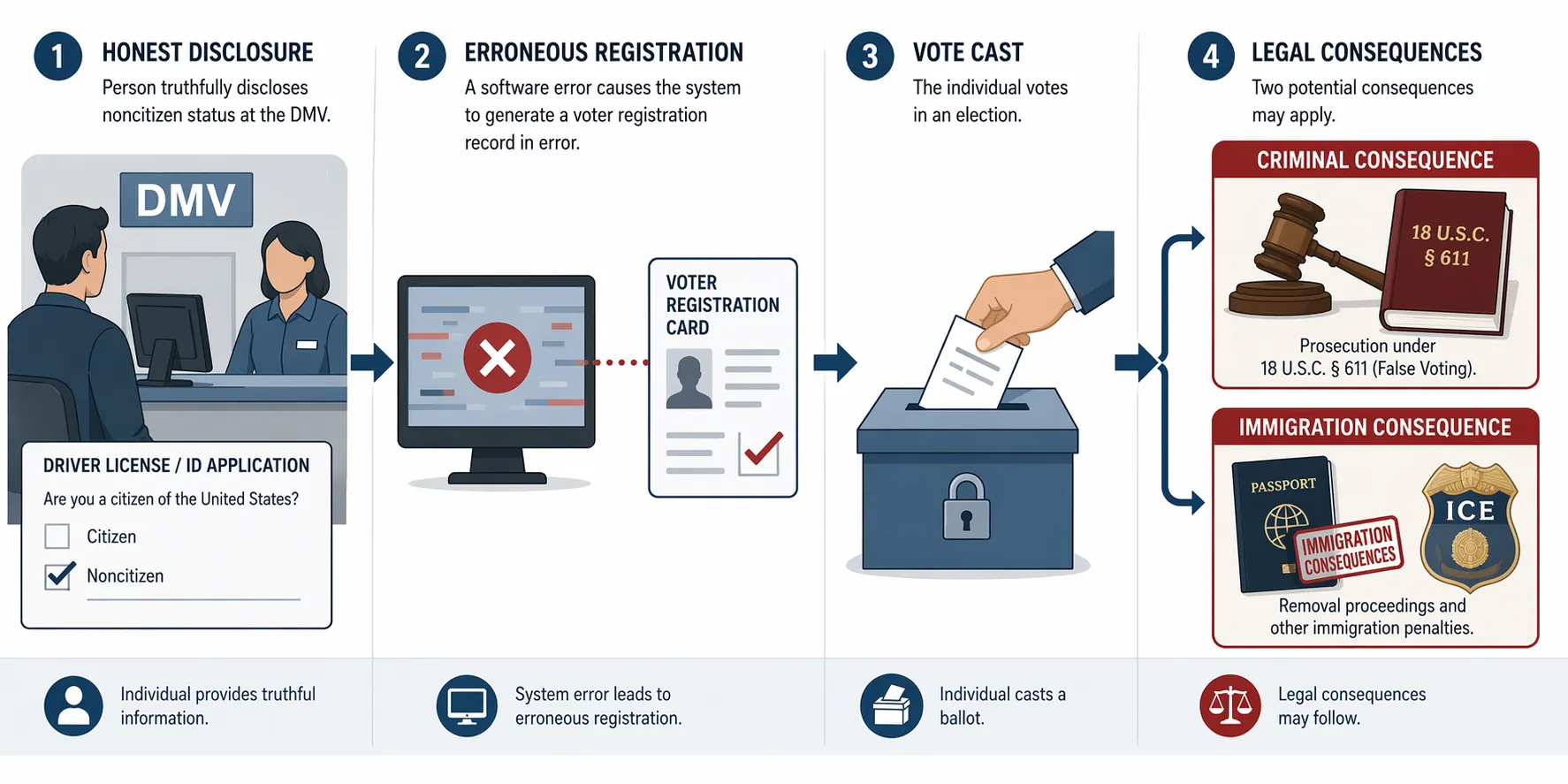
The hard case in the New Jersey noncitizen voter registration software glitch investigation is not the person who lied on a form. It is the person who reportedly told the Motor Vehicle Commission that they were not a citizen, was still placed on the voter rolls through the MVC-IDEMIA error, later cast a ballot, and now may need to explain that ballot in three different rooms: a criminal interview, a removal proceeding, and a naturalization exam.
Governor Mikie Sherrill has said a preliminary state analysis found about 6,600 noncitizens were erroneously registered and about 400 voted, and that the affected people had truthfully disclosed noncitizen status on DMV forms.[1] Those numbers are still preliminary. They should not be treated as an audited final count. But they are enough to frame the client-screening problem: a state error may explain how the registration happened, while federal criminal and immigration law may still attach consequences to the act of voting.
Start With the Vote, Not the Glitch
For defense screening, the decisive first division is not between blame and no blame. It is between registration and voting. Erroneous registration creates a record, a political controversy, and possibly naturalization complications if a client later repeats or relies on that record. A cast ballot creates a more direct federal criminal and immigration event.
That distinction matters because 18 U.S.C. § 611 does not criminalize being mistakenly added to a state voter list. It applies to an alien who votes in an election held solely or partly to elect federal candidates, subject to statutory exceptions and a narrow affirmative defense.[2] The reported New Jersey figure that should make counsel stop is therefore not only the roughly 6,600 registrations. It is the roughly 400 ballots.
The sympathetic facts remain important. If the client checked a noncitizen box, did not forge a citizenship claim, and relied on a government-generated voter record, those facts belong in any defense presentation. They go to equities, charging discretion, sentencing, prosecutorial judgment, and credibility. They do not, by themselves, erase statutory exposure.
| Counsel should separate | Why it matters |
|---|---|
| Truthful DMV disclosure | Supports factual equities and may rebut a claim of intentional deception, but does not automatically defeat statutes that do not require intent. |
| Erroneous voter registration | May be state-created and involuntary, but the principal federal voting statute targets voting rather than mere placement on the rolls. |
| Cast ballot | Creates the clearest criminal and immigration risk under the authorities discussed here. |
| Federal access to identities | May determine whether exposure becomes an actual prosecution, removal case, or naturalization obstacle. |
The Federal Misdemeanor Problem
Section 611 is short, which is part of the problem. It makes it unlawful for an alien to vote in an election held solely or partly to elect a federal candidate. The penalty can reach one year of imprisonment and a $100,000 fine.[2] The statute contains exceptions for certain local elections where noncitizen voting is authorized and voting is conducted independently of federal elections, but those exceptions do not fit a federal general-election ballot.
The uncomfortable hinge is what the text does not say. Section 611 does not expressly require the government to prove that the voter knew noncitizen voting was illegal. It does not say the voter must have intended to violate federal law. It does not make state administrative fault an element-negating defense. Counsel can and should argue reliance, mistake, and government-created confusion where the facts support them, but those arguments are not the same as pointing to a missing statutory element.
The statute’s affirmative defense is also narrower than many affected people will expect. Under § 611(c), a defendant has an affirmative defense only if each natural or adoptive parent is or was a U.S. citizen, the defendant permanently resided in the United States before age 16, and the defendant reasonably believed at the time of voting that they were a U.S. citizen.[2] A person who accurately marked noncitizen status at the MVC will usually have trouble saying they reasonably believed they were a citizen at the time of voting. A software glitch does not obviously supply the missing parentage, residence, or belief requirements.
No reported court decision identified in the available sources has tested whether state-caused registration changes the § 611(c) analysis. That uncertainty should be stated cleanly. It is not the same as a defense. The statutory defense Congress wrote is about mistaken citizenship, not mistaken eligibility produced by a state database.
The prosecution record also counsels against assuming that mistaken belief keeps these cases out of court. Reuters reported 129 federal § 611 prosecutions since 1996, 73 convictions, and 40 convicted defendants who believed they had a legal right to vote.[3] Those figures do not prove that every New Jersey ballot will be prosecuted. They do show that § 611 has not been reserved only for people who set out to commit deliberate election fraud.
That Reuters dataset is useful for a narrow purpose. It is not proof that noncitizen voting is common. It is not proof that DOJ will win any particular New Jersey case. It is evidence against a dangerously comforting screening assumption: that a client’s honest belief, standing alone, makes federal prosecution implausible.
What a Charging Theory Would Need
In a typical § 611 analysis for this cohort, the government would look for proof that the person was an alien, that the election included a federal race, and that the person voted. The state’s own registration error would likely become the defense’s central factual equity rather than a straightforward element failure. If a ballot was cast in a federal election, counsel should assume the government will try to treat the voting act as complete regardless of how the registration record came into being.
That does not mean counsel has nothing to work with. The strongest mitigation record begins before any law-enforcement contact: copies of MVC forms, screenshots or notices showing how voter registration was presented, any mailers or sample ballots received, language-access facts, immigration history, prior attempts to comply with government forms, and evidence that the client never claimed citizenship elsewhere. Those materials may matter to declination, diversion, plea posture, sentencing, or immigration discretion even if they do not defeat the charge.
Immigration Law Is Less Forgiving Than the Facts
The immigration consequences are not a side issue. For many affected people, they may be more serious than the misdemeanor itself. National Immigration Lawyers’ analysis describes unlawful voting exposure under INA § 212(a)(10)(D), the inadmissibility ground, and INA § 237(a)(6), the deportability ground, and notes that intent is irrelevant to the unlawful-voting consequence.[4]
That is the fairness gap. A person may be able to say, truthfully, that the government caused the registration, that they disclosed noncitizenship, and that they never meant to break the law. Under the immigration framework described in the cited analysis, the adjudicator may still focus on whether the person voted unlawfully, not whether the person was morally culpable. Counsel should treat the ballot as a potential immigration event from the first intake.
Inadmissibility under INA § 212(a)(10)(D) can matter when a client seeks admission, adjustment of status, or another benefit requiring admissibility. Deportability under INA § 237(a)(6) can matter after admission if DHS initiates removal proceedings. The practical consequence is that two clients with the same ballot may face different immediate risks depending on posture: one may be defending against removal, another may be trying to adjust status, and another may be applying for naturalization with a voting record now sitting in a file.
Good moral character is a separate problem. The available immigration analysis identifies loss of good-moral-character eligibility for naturalization as a serious consequence of unlawful voting.[4] Even where DHS does not file a notice to appear, a naturalization examiner can ask about registration, voting, and claims to citizenship. A client who cast a ballot because the state told them, directly or indirectly, that they were on the rolls still needs a careful, documented answer before signing immigration forms under penalty of perjury.
The safest counseling posture is not to promise that the MVC error fixes the immigration problem. It is to preserve the error evidence while preventing new misstatements. A later denial, minimization, or inconsistent explanation can become a second and more damaging issue. If a client has already voted, counsel should know who has seen the record, whether any federal agency has requested it, whether the client has pending immigration filings, and whether any application asks about voting or citizenship claims.
The Defense Record Should Be Built Before the Subpoena Fight Ends
The immediate practical question is whether federal authorities can obtain the identities behind the reported 400 ballots. DOJ has already signaled an enforcement posture. Fox News reported that Assistant Attorney General Harmeet Dhillon sent New Jersey a letter demanding names, precincts, and identifying information within five days, and that Dhillon made public statements tying the matter to prosecution and removal.[5]
Governor Sherrill has refused to release the data. Democracy Docket reported that New Jersey will not give DOJ the affected noncitizen voter data, that Attorney General Jennifer Davenport backed the refusal, and that DOJ had lost 17 of 17 similar voter-roll access lawsuits at the time of that reporting.[6] That reported 0-17 record matters because it may define the enforcement bottleneck. Without names and linked voting records, federal criminal and immigration exposure can remain legally real but operationally harder to pursue.
Counsel should not confuse a bottleneck with immunity. Litigation over voter-roll access can change. State officials can lose, settle, produce narrower data, or disclose records through another channel. Separate agencies may already possess fragments of the same information. A client’s immigration file may contain self-disclosed voter-registration history even if New Jersey never hands DOJ a spreadsheet.
The political pressure track is also real, though it should not be allowed to crowd out individual exposure. Fox News reported that House Republicans sent a letter confronting the governor over the 6,600 registrations and demanding compliance by August 21, 2026.[7] That does not establish criminal liability for any person. It does signal that federal and congressional actors may keep pressing for the records long after the initial five-day deadline.
A Practical Intake Sequence
For a nonprofit clinic or defense office, the intake should be organized around consequences rather than politics. The same client may need a criminal lawyer, an immigration lawyer, and careful coordination so that a statement made to solve one problem does not create another.
- Confirm status at the time of voting: lawful permanent resident, visa holder, applicant, undocumented person, or other noncitizen category.
- Identify the election: whether the ballot included federal candidates, because § 611 turns on voting in an election held solely or partly for federal office.
- Separate registration from voting: collect proof of MVC disclosure and registration notices, but determine whether a ballot was actually cast.
- Preserve state-error evidence: forms, mailings, portal records, correspondence, language-access documents, and any notice suggesting eligibility.
- Screen immigration posture: pending adjustment, removal proceedings, naturalization, travel, renewal applications, or prior statements about citizenship.
- Avoid unsupervised corrections: do not let the client contact election officials, DHS, or law enforcement without counsel if a cast ballot may be at issue.
The hardest conversations will be with clients who did exactly what government paperwork appeared to ask of them. They may hear “software glitch” and reasonably think the legal system will assign the entire problem to the vendor or agency. Counsel has to be more precise. The glitch may be the reason the client reached the ballot box. The vote is the event prosecutors and immigration authorities may try to use.
What the Available Defenses Can and Cannot Do
The defense themes are strong on fairness and weaker on categorical statutory protection. Government-created registration, truthful noncitizen disclosure, lack of fraudulent intent, reliance on official communications, and confusion caused by automated voter-registration systems can all matter. They may support a declination request. They may make a prosecution unattractive. They may affect sentencing. They may support discretion in immigration proceedings or benefit adjudications.
But counsel should be careful with three claims.
- “The state registered them, so there is no § 611 case.” The statute targets voting by aliens in covered elections; it does not make voluntary self-registration the only route to liability.
- “They did not know it was illegal, so immigration court cannot use it.” The available immigration analysis treats intent as irrelevant to the unlawful-voting grounds.
- “The affirmative defense covers mistaken eligibility.” Section 611(c) is drafted around a reasonable belief of U.S. citizenship plus specific parentage and residence conditions.
There may be constitutional, administrative-law, due-process, entrapment-by-estoppel, or reliance arguments in individual cases. The available sources do not establish that any of those theories has already succeeded on these New Jersey facts. They should be developed as case-specific defenses, not advertised to clients as safe harbors.
The Risk Posture as of July 26, 2026
As of this writing, the verified public picture is still incomplete: a preliminary state count, a reported MVC-IDEMIA software error, roughly 6,600 erroneous registrations, roughly 400 votes, truthful noncitizen disclosure on DMV forms, a DOJ demand for identifying records, and a state refusal to provide them.[1][5][6] That is enough to treat each affected voter as exposed, but not enough to assume each will be charged, placed in removal proceedings, or denied naturalization.
The strongest equities do not eliminate the statutory problem. Section 611 lacks an express intent element, the § 611(c) affirmative defense is unlikely to fit most people who knew they were noncitizens, and the immigration consequences described by the cited immigration analysis do not turn on ordinary blameworthiness. The enforcement question now depends heavily on data access, DOJ follow-through, DHS priorities, and what individual files already reveal.
For counsel, the responsible posture is neither panic nor reassurance. Preserve the state-error record. Screen for the cast ballot. Coordinate criminal and immigration advice before any disclosure. Assume the legal exposure is real unless and until a court, prosecutor, or immigration authority says otherwise in a form that protects the client.
References
- Software glitch allowed about 400 noncitizens to vote in New Jersey, governor says, NPR, July 22, 2026.
- 18 U.S.C. § 611 - Voting by aliens, Cornell Legal Information Institute.
- Trump claims voting by noncitizens is rampant — the numbers tell another story, Reuters, July 19, 2026.
- National Immigration Lawyers analysis, National Immigration Lawyers.
- DOJ gives New Jersey 5 days to hand over noncitizen voter records, Fox News, July 2026.
- New Jersey won't give DOJ data on noncitizens erroneously registered to vote, Democracy Docket, July 2026.
- House Republicans confront NJ governor over 6,600 noncitizens registered to vote, Fox News, July 2026.
Operationalizing workflow
No workflow has been explicitly linked to this obligation yet. See Workflows generally.
Illustrative cases
No illustrative case is currently tracked for this obligation. See Risk Digest for documented incidents generally.
← Back to RegulationReport a correction or tip
Spotted an outdated figure, a misstated fact, or a ruling this regulation entry should reflect? Public comments are disabled for this content given the professional cost of a misreported case outcome, penalty amount, or rule text — use the structured correction channel instead.
Report a correction or tip for this record →