
New Jersey's Noncitizen Voting Glitch: Penalties Under Federal Law
- Authority
- U.S. Congress
- Rule type
- statute
- Jurisdiction scope
- US federal
- Source text
- Read primary rule text ↗
Noncitizens must not knowingly vote in federal elections.
Readers searching for “noncitizens voting illegally New Jersey 2024 law” may be looking for a New Jersey statute passed in 2024. On the available materials, that is not the law doing the work. The operative criminal exposure appears to be federal: 18 U.S.C. § 611, which makes it unlawful for a noncitizen to vote in a federal election, requires that the person “knowingly” vote, and carries a maximum penalty of five years in federal prison.[1] The “2024” part of the search phrase is better understood as the period in which some affected registrations and votes occurred, not as a standalone New Jersey enactment located in the current record.
That distinction matters because this is not a clean case of someone falsely claiming citizenship to get onto the rolls. The reported New Jersey fact pattern starts with people who disclosed noncitizen status on Motor Vehicle Commission forms, then were registered anyway through a downstream system failure. If federal prosecutors treat the official registration record as the beginning and end of the case, they collapse three separate questions: whether the person was erroneously registered, whether the person actually voted, and whether the person knew the vote was unlawful despite having already told the government they were not a citizen.
What New Jersey Says Happened
The central New Jersey incident is narrow and mechanical. About 6,600 noncitizens were improperly registered to vote through the state motor vehicle system, and approximately 400 of them voted in elections during the June 2023 to June 2024 window.[2][3] The reported cause was not an applicant fraud scheme but a software transmission problem involving the state’s motor vehicle registration workflow and contractor IDEMIA.[2][3]
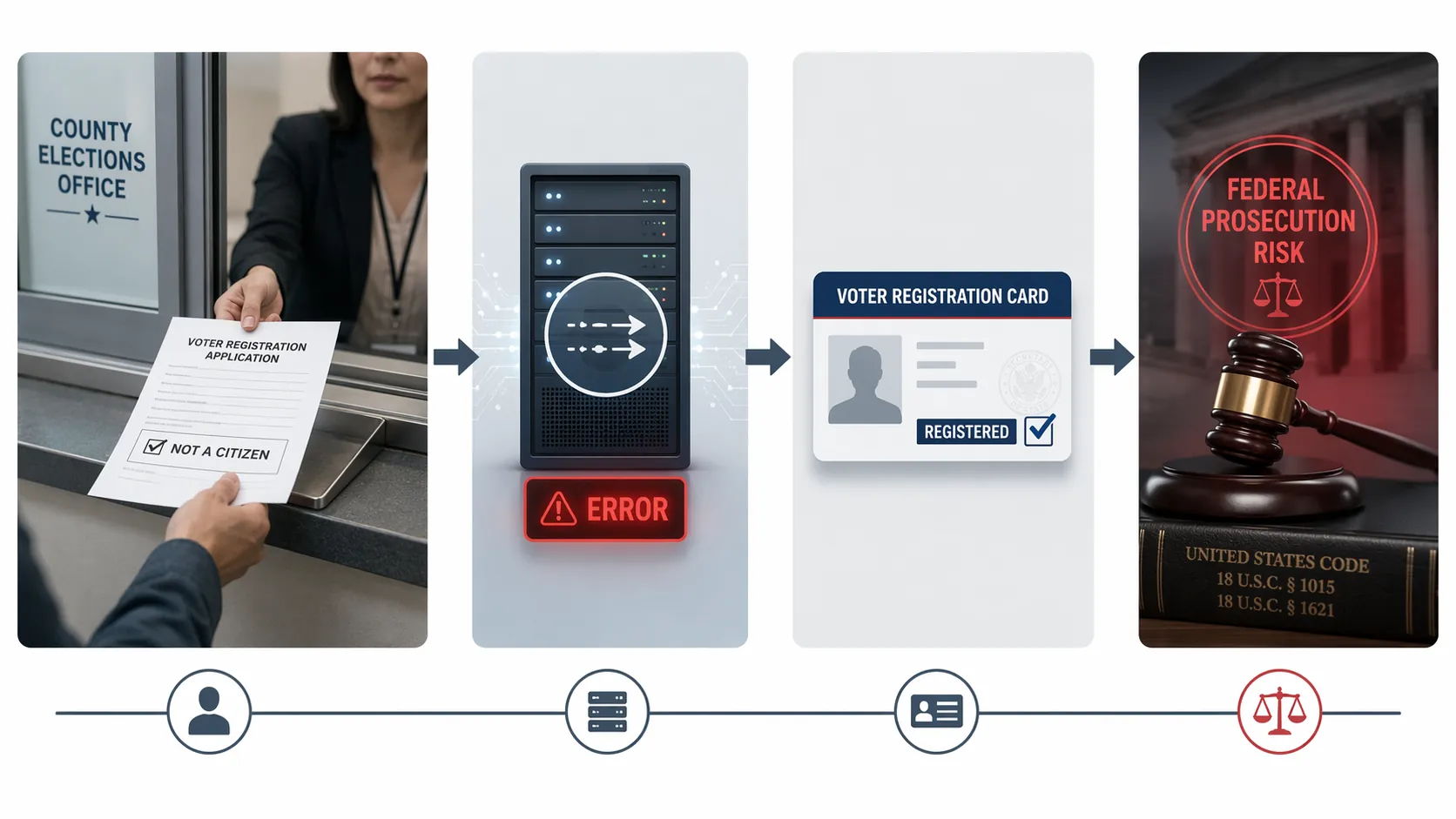
The important fact for criminal exposure is the applicants’ disclosure. The state’s account, as reported, is that affected people indicated they were not citizens on MVC paperwork. The system nevertheless transmitted records in a way that led to registration. That makes the usual election-fraud narrative a poor fit. The state record itself may contain the defense’s best fact: the person did not hide noncitizenship at the point of government intake.
The responsibility chain is already contested. IDEMIA has denied that the error was its responsibility, which means any later enforcement decision would likely have to work through a record that is not settled even on the administrative side.[4] For a prosecutor, that may not be fatal. For defense counsel, it matters because the government would need to prove the defendant’s knowledge, not merely point to a bad handoff between a state agency and a vendor.
The Statute Does Not Punish Mere Erroneous Registration
Section 611 is about voting, not simply being placed on a voter list by mistake. Erroneous registration can create investigative exposure, immigration anxiety, and public accusation, but it is not the same as casting a ballot. On the reported numbers, most of the approximately 6,600 improperly registered noncitizens did not vote during the relevant window.[2][3]
For the approximately 400 who did vote, the next question is still not just whether a ballot was cast. The federal statute requires knowing conduct.[1] In ordinary language, that means the government must do more than show that a noncitizen’s name appeared on the rolls and that a ballot was later recorded. It must connect the voting act to the defendant’s awareness of the facts that made the vote unlawful.
That is where New Jersey’s facts become unusually difficult for the government. A person can knowingly go to a polling place, knowingly sign in, and knowingly mark a ballot. But the harder statutory question is whether that person knowingly voted while ineligible after having already disclosed noncitizenship to the same government system that later produced an official registration. The state’s error does not automatically erase knowledge. It does, however, undercut the easiest route to proving it.
Why the Disclosure Fact Carries So Much Weight
In many noncitizen voting prosecutions, the government looks for affirmative misstatements, naturalization warnings, prior immigration forms, voter-registration attestations, or other proof that the person had been told citizenship was required. The New Jersey pattern, at least as publicly described, begins with the opposite: the applicant checked or otherwise indicated that they were not a citizen, and the state processed the person into the voter system anyway.
That fact does not produce an automatic defense. A registered noncitizen may still have received later notices, ballot materials, polling-place warnings, or instructions that bear on knowledge. Some individuals may have different immigration histories or prior election interactions. A serious analysis cannot treat all 400 voters as one defendant. But the truthful disclosure changes the prosecutorial posture. It forces the government to explain why a person who told the state “not a citizen” should nevertheless be treated as knowingly violating federal voting law when the state’s own process generated the registration.
The distinction is not technical hair-splitting. Erroneous registration is an administrative failure. Actual voting is conduct. Knowingly unlawful voting is a criminal accusation. Only the third category supports punishment under the federal theory now being discussed.
Weak Conviction Facts Can Still Produce Real Exposure
The litigation risk is not imaginary just because the known facts are poor for conviction. Assistant Attorney General Harmeet Dhillon has said the Justice Department intends to prosecute noncitizens who voted and that they are “subject to both prosecution as well as removal from the United States.”[5] That public posture matters. A weak case can still mean subpoenas, interviews, data fights, immigration consequences, and defense costs before any court reaches the knowledge element.
The data-access fight is therefore not a side issue. Governor Sherrill has refused to release personally identifying information for the 6,600 affected people, saying her administration has “seen them weaponize it.”[6] Whatever one thinks of that political framing, the procedural consequence is concrete: without personally identifying data, federal authorities have a harder time moving from public incident to individual investigation. With it, the question shifts from whether the state made a mistake to which noncitizens become named subjects.
Democracy Docket has reported that the Justice Department sued 30 states and the District of Columbia for unredacted voter rolls and lost all 17 decided cases, including 11 before Republican-appointed judges.[5] That record is useful but should not be overused. It is a litigation-tracking claim from one organization and should be checked against the underlying dockets before anyone treats it as a final scorecard. It also does not decide what happens if DOJ obtains New Jersey-specific data through another route or brings a more tailored demand.
Counsel should separate three layers of risk. Conviction risk turns on proof of knowing unlawful voting. Investigation risk turns on access to names, records, and ballot-history data. Immigration-adjacent risk turns on how federal authorities use a voting allegation once a person is identified. The first may be weak on the known facts; the second and third can still be disruptive.
Rarity Helps Calibrate the Case, But It Does Not End It
Historic enforcement data supports caution against exaggeration. Votebeat, citing the Heritage Foundation database, reported only 23 noncitizen voting cases nationally from 2003 through 2022.[7] Brookings has likewise explained why intentional noncitizen voting is rare, emphasizing the low payoff and high personal risk for noncitizens who try to vote unlawfully.[8]
Those sources are useful for scale, not for immunity. They show that noncitizen voting prosecutions have historically been uncommon and that the broad claim of widespread intentional noncitizen voting is not well supported. They do not answer whether a more aggressive DOJ in 2026 will try to make an example out of a state-system failure.
The DHS record review points in the same direction. PBS reported that DHS reviewed 68 million records and confirmed that 99.96% represented documented citizens, while the remaining 0.04% were not proven to be noncitizens.[9] That is calibration against panic, not a defense brief for any individual New Jersey voter.
Where the Known Facts Leave the Federal Case
On the public record, the strongest defense fact is also the simplest: the affected applicants reportedly told the state they were not citizens. If that remains true across individual files, a prosecution under § 611 would have to do more than recite the registration and voting records. It would need individualized proof that the voter knew the facts making the vote unlawful despite the state having placed them on the rolls after a truthful disclosure.
The government might look for later notices, signed attestations, language on voting materials, prior immigration warnings, or evidence that a particular person understood the registration was erroneous. The defense would focus on the MVC form, the noncitizen disclosure, the state-generated registration, any official communications that reasonably suggested eligibility, and the unresolved vendor-agency transmission record. The case would likely become less about abstract election integrity and more about what one person was told, saw, signed, and understood.
That is why the New Jersey matter is a poor factual fit for confident prosecution rhetoric. It is not why it can be ignored. Federal exposure often begins before a charge is filed, and immigration consequences can be threatened or investigated even where the ultimate criminal case is contestable. The practical legal risk comes from the gap between a weak mens rea theory and an enforcement apparatus currently signaling that it wants names.
The monitoring points are narrow: primary-source confirmation of DOJ voter-data litigation outcomes, any actual charging decisions, any clarified MVC or IDEMIA record showing where the transmission failure occurred, and any court treatment of knowledge under § 611 in this state-error setting. Until those records develop, the safest judgment is also the least dramatic one: the known facts make conviction difficult, but the data-access fight may determine who has to defend that point in the first place.
References
- Noncitizen Voting in U.S. Elections, Migration Policy Institute
- Noncitizen Voting New Jersey Error, The New York Times, July 21, 2026
- Software glitch allowed about 400 noncitizens to vote in New Jersey, governor says, NPR, July 22, 2026
- New Jersey voter registration contractor denies fault, USA Today, July 24, 2026
- New Jersey Won’t Give DOJ Data on Noncitizens Erroneously Registered to Vote, Democracy Docket, July 2026
- New Jersey voter registration snafu fuels national debate, Votebeat, July 23, 2026
- Noncitizen voting is rare, research shows, but SAVE Act would make it harder to register, Votebeat, April 28, 2025
- Why do so few noncitizens try to vote?, Brookings
- 6,600 noncitizens registered to vote by New Jersey motor vehicle system error, Gov. Sherrill says, PBS, July 2026
Operationalizing workflow
No workflow has been explicitly linked to this obligation yet. See Workflows generally.
Illustrative cases
No illustrative case is currently tracked for this obligation. See Risk Digest for documented incidents generally.
← Back to RegulationReport a correction or tip
Spotted an outdated figure, a misstated fact, or a ruling this regulation entry should reflect? Public comments are disabled for this content given the professional cost of a misreported case outcome, penalty amount, or rule text — use the structured correction channel instead.
Report a correction or tip for this record →