
NVIDIA's $100B OpenAI deal raises antitrust foreclosure concerns
- Authority
- U.S. Department of Justice Antitrust Division
- Rule type
- statute
- Jurisdiction scope
- US federal
- Source text
- Read primary rule text ↗
As of Q3 2026, the NVIDIA-OpenAI data center arrangement is still most important legally because of what it may become, not because of what has already closed. The announced structure was an up-to-$100 billion NVIDIA investment, including non-voting shares, tied to a planned 10 GW data center buildout for OpenAI, with NVIDIA positioned as the exclusive GPU supplier; no definitive agreement had been signed as of the later public status reporting on the deal.[1][2]
That is enough for counsel to care now. The legal and regulatory implications of the NVIDIA-OpenAI data center deal do not turn on the headline investment amount alone. They turn on whether a dominant supplier of a scarce AI input can use a financing-and-supply arrangement to lock in preferential access for one major AI developer while rivals wait, pay more, or build on inferior terms.

There is no announced formal antitrust case against the arrangement, and the transaction remains a moving target. That matters. A stalled or unsigned letter of intent is not the same thing as a binding exclusive-supply agreement. But if the exclusivity survives into definitive documents, the arrangement gives enforcement lawyers and private plaintiffs a coherent vertical foreclosure theory under Sherman Act Section 2, and potentially a Clayton Act Section 7 theory if the investment and contractual restraints are treated as a transaction that may substantially lessen competition.
The antitrust issue is not size; it is control over a critical input
Large strategic investments are not presumptively unlawful. Neither is vertical integration. A chip supplier can finance a customer; a model developer can seek guaranteed compute; a data center project can involve preferred vendors. The problem begins when those ordinary commercial moves are layered onto a market-power premise.
Reuters reported that NVIDIA holds more than 90% of the data center GPU market, a fact that changes the legal character of exclusivity.[3] If a firm with that position becomes the exclusive GPU supplier for a 10 GW buildout by OpenAI, the issue is no longer simply whether OpenAI got a favorable procurement deal. The harder question is whether rival AI developers are being denied access to the chips they need to compete at comparable scale.
That is the center of a Section 2 foreclosure theory. Plaintiffs or agencies would not need to argue that NVIDIA’s investment is too large in the abstract. They would argue that NVIDIA has monopoly power, or at least durable market power, in a critical input; that the OpenAI arrangement gives one downstream AI developer preferential access to that input; and that the combined financing and supply path tends to exclude rival model developers from meaningful competition.
Andre Barlow of Doyle, Barlow & Mazard put the practical concern plainly: “if you want to get the best chips and another company has preferential access to them, that is a problem.” Rebecca Haw Allensworth of Vanderbilt Law drew a comparison to Standard Oil’s railroad rebates, a useful analogy because it focuses on access to a bottleneck channel rather than on corporate size as such.[3]
The Standard Oil analogy should not be stretched beyond its use. GPUs are not railroads, and the present arrangement is still unsigned. But the comparison does the right legal work: it asks whether a powerful firm can use control over an input or route to make rivals’ access worse. In AI infrastructure, that question translates into a few discoverable facts: who receives high-end GPUs first, whether rivals are forced into longer lead times, whether pricing or allocation worsens after the agreement, and whether alternative chips or clouds are competitively equivalent in practice.
What foreclosure would have to look like
Foreclosure is not established by saying that OpenAI received capacity. The evidence would need to show that the arrangement materially impaired rival access to a necessary input. That can be a narrower and stronger claim than the broader complaint that the AI market is becoming expensive.
| Issue counsel would test | Why it matters |
|---|---|
| Is NVIDIA contractually exclusive for the 10 GW buildout? | A true exclusive-supplier term is more legally sensitive than a preferred-vendor or volume-commitment structure. |
| Does OpenAI receive priority allocation or better delivery timing? | Preferential access is the practical mechanism by which rival AI developers could be delayed or disadvantaged. |
| Are comparable GPUs available to rivals on commercially reasonable terms? | A foreclosure theory weakens if rivals can obtain equivalent compute without material delay, degradation, or price disadvantage. |
| Is NVIDIA capital effectively recycled into NVIDIA GPU purchases? | Circular financing may support an inference that the arrangement captures demand while appearing as infrastructure finance. |
| Do downstream rivals lose customers, model-training windows, or financing because of compute scarcity? | Private litigation needs injury, not just a theory of market structure. |
The first row is the hinge. An LOI that never becomes binding creates monitoring work, not a mature foreclosure case. A definitive agreement that gives NVIDIA exclusivity, allocation priority, and long-duration demand capture would look very different. It would give agencies something concrete to investigate and private plaintiffs something more plausible to plead.
The strongest version of a complaint would likely avoid abstractions about “AI dominance” and instead trace capacity. It would show that OpenAI’s buildout absorbed a material portion of high-end GPU supply, that NVIDIA had discretion over scarce allocation, and that the exclusive path made competing model developers worse off in timing, cost, or technical capability. In antitrust litigation, that kind of fact pattern tends to matter more than the indignation attached to a $100 billion number.
The enforcement signal is real, but not a filed case
The most important public enforcement signal is Gail Slater’s September 2025 Fordham Law School keynote. Slater, then head of the DOJ Antitrust Division, said enforcement “must focus on preventing exclusionary conduct over the resources that are needed to build competitive AI systems.”[3] That sentence is unusually well matched to the NVIDIA-OpenAI structure because it does not require the agency to object to AI investment generally. It identifies exclusionary control over inputs as the concern.
The agency map also matters. The DOJ and FTC’s 2024 AI-competition jurisdictional split made AI competition a shared priority area, with data centers and AI infrastructure drawing antitrust compliance attention as energy, compute, and cloud capacity become constraints on market entry.[4] That does not mean either agency will challenge this arrangement. It does mean that counsel should not treat AI infrastructure exclusivity as a procurement footnote.
The Trump administration’s posture complicates the forecast. Pro-business signals can reduce the appetite for aggressive structural intervention, especially where a transaction is framed as accelerating domestic AI infrastructure. At the same time, Slater’s statement points to an enforcement theory that fits conservative and progressive antitrust vocabularies alike: do not let control of an essential input determine who can compete. As of July 2026, no formal investigation has been announced, and the absence of signed terms leaves agencies with a transaction that may still change before it becomes challengeable in a clean way.[5]
That uncertainty should discipline the analysis. This is not a “breakup is coming” fact pattern. It is a watch item with a defined trigger: binding exclusivity around a dominant supplier’s scarce input.
Circular financing makes the story harder to defend
The circular-financing issue is not a separate antitrust offense. It is an aggravating fact pattern. NVIDIA invests in OpenAI; OpenAI uses capital to buy NVIDIA GPUs; NVIDIA books demand supported by its own financing. In ordinary corporate language, that may be described as ecosystem investment. In litigation language, it can start to look like demand capture.
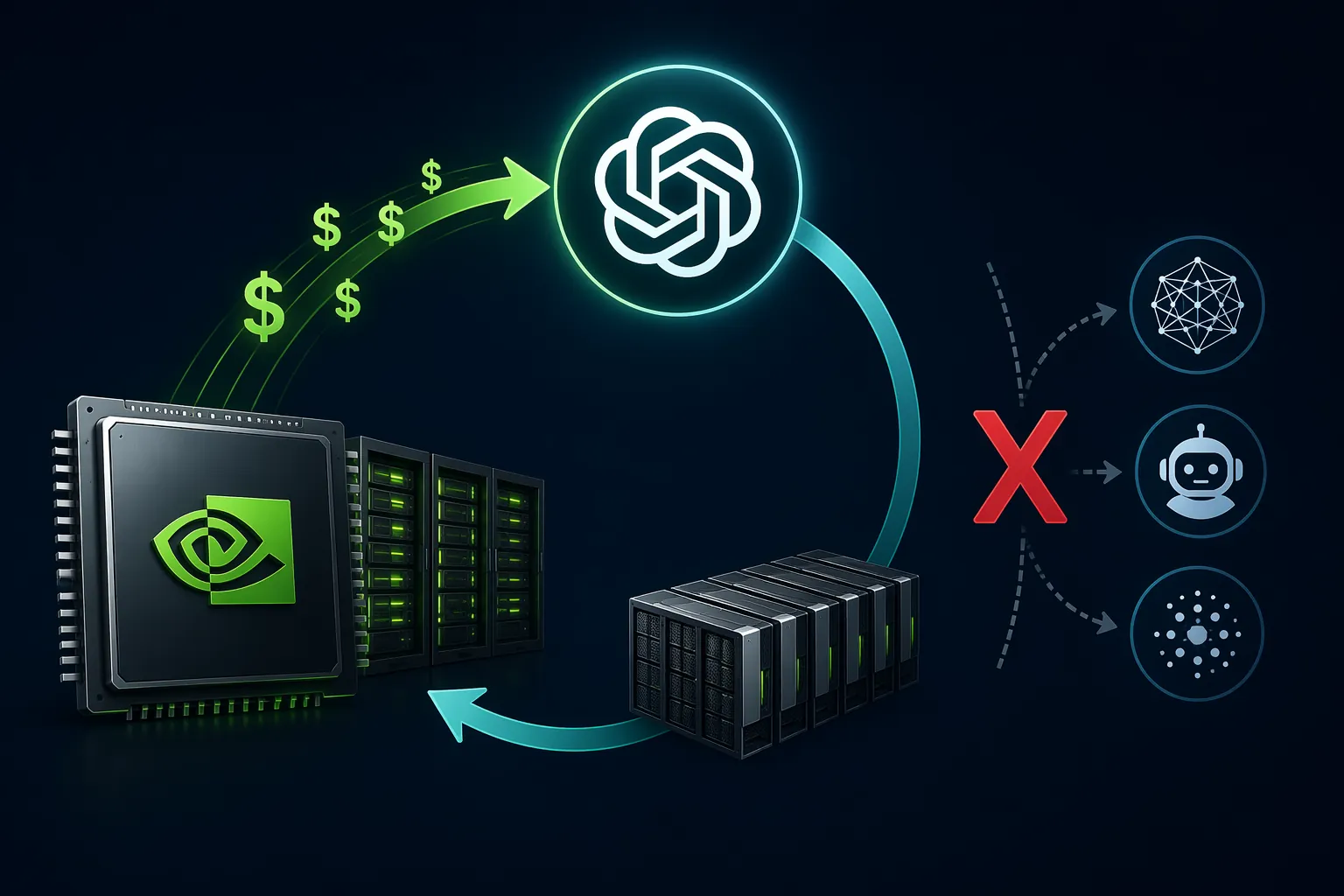
Quinn Emanuel compared the emerging AI data center financing pattern to dot-com-era vendor financing at Nortel and Lucent, which later generated SEC enforcement actions and bankruptcy litigation.[6] That comparison does not prove antitrust liability here. It does, however, identify why courts and plaintiffs may look skeptically at arrangements where a supplier’s investment helps fund the customer’s purchases from that same supplier.
The disclosure record already reflects uncertainty. NVIDIA’s Q3 FY2026 Form 10-Q stated, “There is no assurance that we will enter into definitive agreements with respect to the OpenAI opportunity.”[7] That sentence is primarily a securities-law disclosure, not an antitrust concession. Still, it is relevant to risk assessment because it confirms that the public announcement had not ripened into final contracts at the time of the filing.
The broader litigation climate is also becoming less forgiving. Quinn Emanuel identified two securities class actions in the AI-infrastructure space: Ohio Carpenters’ Pension Plan v. Oracle Corp., filed as a bondholder lawsuit on January 14, 2026, and Masaitis v. CoreWeave, filed as a shareholder lawsuit on January 12, 2026.[6] Those cases are not antitrust cases against NVIDIA or OpenAI. They show that plaintiffs are already testing AI-infrastructure financing, customer concentration, and disclosure theories in court.
Where Section 2 and Section 7 would diverge
Sherman Act Section 2 would be the more natural home for a foreclosure theory. The claim would focus on monopoly power or attempted monopolization in data center GPUs, followed by exclusionary conduct through preferential supply, exclusive dealing, or demand-locking arrangements. The question would be whether the challenged conduct helped maintain power in the GPU market or unlawfully extended it into adjacent AI infrastructure markets.
Clayton Act Section 7 would enter differently. Because the announced investment involved non-voting shares, and because no definitive agreement has been signed, the Section 7 analysis would depend heavily on the final form of the transaction.[1][2] If the investment, governance rights, commercial commitments, and exclusivity provisions together give NVIDIA influence over OpenAI’s compute procurement or materially lessen competition in a relevant market, Section 7 becomes more plausible. If the final documents are limited, non-exclusive, and operationally separable, that theory becomes harder.
Private plaintiffs would face their own hurdles. Rival AI developers or cloud customers would need to show antitrust injury: higher prices, delayed access, impaired model development, lost customers, or other competitive harm tied to the challenged arrangement. Complaints built only on market concentration and public deal announcements may not travel far. Complaints supported by allocation records, procurement denials, customer losses, or financing documents would be more serious.
What would lower the risk
The risk is not fixed. It can diminish materially before signing. The most obvious way is for the deal to collapse. The next is for the parties to remove exclusive-supplier language and replace it with non-exclusive purchasing rights, ordinary volume commitments, or capacity reservations that do not impair rival access to comparable GPUs.
Other changes would matter as well: documented firewalls between investment decisions and chip allocation; clear evidence that rivals retain commercially viable access to equivalent supply; shorter duration commitments; transparent pricing; and contractual language preserving OpenAI’s ability to buy from other suppliers. None of those features would immunize the transaction. They would, however, make the foreclosure story less direct.
Counsel should pay particular attention to any public or contractual description of “exclusive.” In a press release, the word can blur preferred supply, sole supply, priority allocation, and technical standardization. In litigation, those distinctions matter. A preferred supplier may compete for orders; a sole supplier may block alternatives; a priority supplier may create practical foreclosure even without a formal prohibition on buying elsewhere.
The practical watch points through the rest of 2026
- Definitive agreements: whether the LOI becomes binding, and whether exclusivity survives.
- Allocation evidence: whether OpenAI receives priority access to scarce GPUs while rivals face longer delays or worse commercial terms.
- Financing linkage: whether NVIDIA capital is contractually or practically tied to NVIDIA GPU purchases.
- Agency posture: whether DOJ or FTC issue civil investigative demands, public statements, workshops, or merger-review inquiries focused on AI inputs.
- Private plaintiff activity: whether rival developers, cloud customers, shareholders, or bondholders translate infrastructure concerns into pleadings.
The most credible conclusion is restrained but serious. If NVIDIA and OpenAI sign a definitive agreement preserving NVIDIA’s exclusive GPU-supplier role for the 10 GW buildout, the arrangement becomes a significant antitrust watch item under Sherman Act Section 2 and potentially Clayton Act Section 7. If the deal remains stalled, collapses, or is restructured into a genuinely non-exclusive procurement relationship, the foreclosure concern falls sharply.
References
- Nvidia to invest up to $100 billion in OpenAI, linking two artificial intelligence titans, Reuters, Sept. 22, 2025
- Nvidia, OpenAI stalled on their mega deal. AI giants need each other, CNBC, Feb. 3, 2026
- Nvidia's $100 billion OpenAI play raises big antitrust issues, Reuters, Sept. 23, 2025
- Data Centers and AI: Antitrust Compliance in a World of New Energy Regulations, Steptoe & Johnson
- Nvidia's $100B Investment in OpenAI Raises Antitrust Eyebrows, MoginLaw LLP
- Client Alert: Emerging Litigation Risks in Financing AI Data Centers Boom, Quinn Emanuel, March 2026
- Nvidia says 'no assurance' of deal with OpenAI after $100 billion pact, CNBC, Nov. 19, 2025
Operationalizing workflow
No workflow has been explicitly linked to this obligation yet. See Workflows generally.
Illustrative cases
No illustrative case is currently tracked for this obligation. See Risk Digest for documented incidents generally.
← Back to RegulationReport a correction or tip
Spotted an outdated figure, a misstated fact, or a ruling this regulation entry should reflect? Public comments are disabled for this content given the professional cost of a misreported case outcome, penalty amount, or rule text — use the structured correction channel instead.
Report a correction or tip for this record →