
Does Your NYC Property Qualify for the Pied-à-Terre Tax Exemption?
- Authority
- New York City Department of Finance
- Rule type
- regulation
- Jurisdiction scope
- US state
- Effective date
- Jul 14, 2026
- Source text
- Read primary rule text ↗
Verify DOF Phase 1 market value; if above threshold, prove primary residence as of January 5, 2026 for covered owner, family, or lessee using tax return or two-of-three documents.
Start with the January 5, 2026 facts, not with how the property is used now. For the NYC pied-à-terre tax eligibility rules, the useful question is not whether an apartment feels like a home, sits vacant too often, or has a market price that sounds high at a dinner table. The question is narrower: did the property cross the Department of Finance value threshold, and if so, did a covered person have a valid primary-residence claim on the taxable status date?
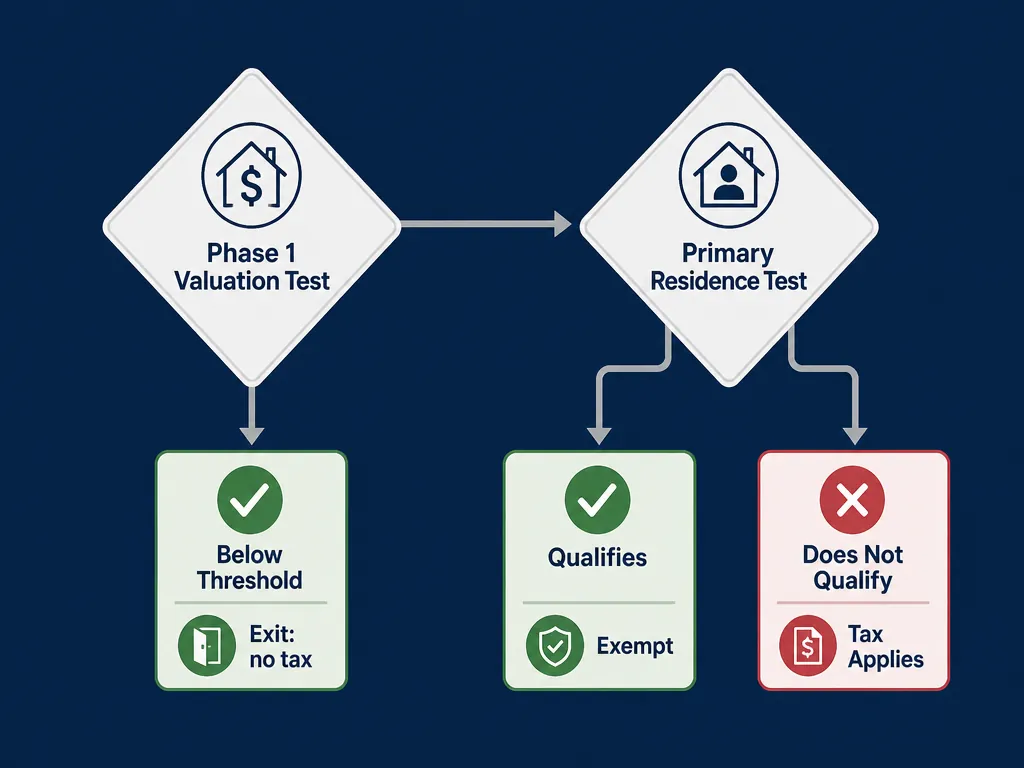
Run the analysis in that order. A property below the threshold exits before anyone argues about residence. A property above the threshold still may avoid the surcharge, but only if the right person, in the right ownership posture, can prove primary residence as of January 5.
| Question | What must be true | Why it matters |
|---|---|---|
| 1. Is the property in the surcharge universe? | Class 1 homes must meet the $5 million threshold; condos and co-ops must meet the $1 million DOF Phase 1 market-value threshold. | For condos and co-ops, the operative number is not ordinary resale value. |
| 2. If in scope, who can claim primary residence? | A covered owner, certain immediate family members, or a qualifying arm's-length lessee must have used the property as a primary residence on January 5, 2026. | Intent to move in later, renovation plans, or general NYC presence do not cure a failed taxable-status-date claim. |
| 3. Can the claim be documented? | The owner must be ready to use the income-tax-return route or the two-of-three document route, with added proof for spouses or certain tenants where relevant. | The August 30 notice deadline is an administrative deadline, not a suggestion. |
The First Gate Is DOF Value, Not Sale Price
For Class 1 homes, the threshold is $5 million. For condos and co-ops, the more common trap is the $1 million threshold, because the relevant measure is DOF Phase 1 market value, not the owner’s estimate of what the unit would sell for and not a broker’s comparable-sales deck. Rosenberg & Estis and Sullivan & Cromwell both flag the Phase 1 valuation mechanics as central to determining whether a property is even in scope.[1][2]
That distinction can cut in both directions. A condo described in ordinary conversation as a multi-million-dollar apartment may fall below the surcharge threshold if its DOF Phase 1 value is below $1 million. Another owner may be surprised in the opposite direction because the DOF figure, not a recent offer or the owner’s own valuation instinct, controls the initial gate.
The phrase “market value” is especially easy to misuse here. In the condo and co-op context, Phase 1 value is a DOF value used at the threshold stage. It is not necessarily the same thing as the apartment’s expected transaction price, and it is not the later Phase 2 measure that may be used after administrative remedies are exhausted. The Phase 1 versus Phase 2 distinction is why a casual statement that “the apartment is worth $5 million” does not answer the tax question.[1][2]
Co-ops deserve extra care because the precise method for computing imputed cooperative values is still an area where operational details may matter. The safer administrative move is to verify the property’s DOF value directly against the applicable assessment materials rather than assume that share allocation, purchase price, or building reputation supplies the answer.
If the Property Crosses the Threshold, January 5 Controls Residence
Once the property is above the applicable threshold, the analysis shifts from property value to residence status. The primary-residence exemption depends on the property being the primary residence, as of January 5, 2026, of a covered owner, an eligible immediate family member, or a qualifying arm’s-length lessee. The Final Rules were published on July 14, 2026 and took effect immediately under the NYC Charter’s substantial-need exception, according to law-firm summaries of the rulemaking.[1]
The most important negative rule is blunt: contemplated use does not count. If the apartment was under renovation on January 5 and the owner planned to move in after completion, that plan does not create a primary-residence exemption. DOF Final Rules §62-08 is described in the available analyses as rejecting a renovation or intended future occupancy theory.[1][2]
That is where many expensive mistakes begin. Owners often preserve proof of intent: contractor emails, temporary leases elsewhere, designer schedules, school planning, or correspondence showing a planned move. Those documents may explain why the property was not being used as a primary residence. They do not, under the cited rules and analyses, replace primary-residence status on the taxable status date.
The same discipline applies to later life changes. A marriage, a relocation, a child’s move into the apartment, or a tenant’s later occupancy may matter for a later year if the rules continue to apply in the same form. They do not rewrite January 5, 2026.
Covered Owners Are a Legal Category, Not a Vibe
For an individual owner, the residence question is usually the most direct: was the property that person’s primary residence on January 5, and can the person prove it? The harder cases begin when the owner is a trust, partnership, corporation, LLC, or layered entity structure.
Trusts
For trusts, the key concept is the sole present beneficiary. Analyses by Day Pitney, Holland & Knight, and Steptoe describe the rules as looking to an individual who is the sole present beneficiary, with multiple individuals able to qualify collectively as sole beneficiaries, while future or contingent interests are disregarded.[3][4][5]
That rule is narrower than many families expect. A remainder beneficiary does not become the covered person merely because the family treats the apartment as eventually belonging to that person. Immediate family members of a beneficiary also do not independently qualify through the trust-beneficiary rule on the materials summarized by those firms.[3][4][5]
Entities
For entities, the look-through rule is tied to majority interest. The relevant summaries describe majority interest as more than 50% of voting power or stock value for corporations, or more than 50% of capital or profits for partnerships and similar entities.[3][4][5]
Direct aggregation is not the same thing as tracing through every tier of a structure. The available summaries warn that aggregation is permitted only for direct co-owners in the same entity, and that tiered structures, such as an LLC that owns another LLC, cannot be used to establish covered-owner status in the same way.[3][4][5]
That is not a small drafting point. An owner who controls the economics of a property through a stack may still lack the covered-owner path needed for the primary-residence exemption if the qualifying majority interest is not held in the required direct manner.
Immediate Family and Lessees
The exemption is not limited to the owner personally occupying the unit. The cited sources identify eligible immediate family members and qualifying arm’s-length lessees as possible residence paths. The practical point is to identify which path is being claimed before assembling proof; a spouse’s proof problem is not the same as a month-to-month tenant’s proof problem.
The Statutory-Resident Trap
New York tax residency concepts do not line up neatly with the pied-à-terre exemption. Day Pitney and Holland & Knight both flag the problem for owners domiciled outside New York City who spend 183 or more days in the city: they may be treated as statutory residents for income-tax purposes, but that does not automatically make the NYC property their primary residence for this surcharge.[3][4]
The reason is definitional. If the owner’s domicile remains outside the city, the owner may have enough New York City presence to create income-tax exposure while still failing the primary-residence exemption because the city property is not the owner’s primary residence. Kaufman Rossin also describes this as a potential double-hit scenario for affected owners.[6]
This is counterintuitive only if “I am in New York all the time” is treated as the same statement as “this New York property is my primary residence.” For this exemption, those statements need separate proof.
Proof Comes After Eligibility, But It Cannot Wait
Morgan Lewis gives the clearest practical breakdown of documentation. One route is the most recently filed state or federal income tax return, including a truthful amended return, showing the NYC address as the primary residence. The other route is two of three documents: driver’s license, voter identification, or other proof acceptable to DOF.[7]
The income-tax-return route is clean when it is true and already consistent with the residence claim. It is dangerous when treated as a paperwork shortcut. A return should not be amended to create a tax position the facts will not support.
The two-of-three route is more document-intensive and less forgiving of stale records. A driver’s license address that changed after January 5 may not answer the taxable-status-date question. Voter registration that does not match the claimed residence creates the kind of inconsistency that usually costs more time than owners expect.
- For an individual owner, match the claimed primary residence to the January 5 facts before choosing the tax-return or document route.
- For a spouse-based claim, be prepared to add the marriage certificate where the documentation path requires it.
- For a qualifying tenant, confirm the lease posture and gather the tenant affidavit materials described for month-to-month situations.
- For a trust or entity, prove the covered-owner path first; residence documents do not fix a failed look-through analysis.
The August 30 notice deadline matters because the exemption claim is not just a conclusion. It is a package of status, ownership, and proof that must be assembled in time for DOF administration.
Side Gates: Excluded Properties and Rate Verification
Some properties may be outside the surcharge for reasons separate from the primary-residence exemption. Dechert identifies exclusions including certain unsold sponsor units tied to the original offering-plan filer, with successor sponsors excluded under the Final Rules, and properties lacking a required certificate of occupancy.[8]
Those exclusions should be checked early, but they should not be allowed to blur the main sequence. If an exclusion applies, the property may exit through that side gate. If not, the owner is back to threshold value, covered-owner status, primary residence, and proof.
Rate schedules also deserve primary-source verification before anyone models liability. Morgan Lewis reports a different rate schedule, reported as 0.4% to 4.0% across more granular brackets, while Day Pitney, Sullivan & Cromwell, Steptoe, Dechert, and Rosenberg & Estis are described as corroborating a 4% to 6.5% three-bracket schedule.[1][2][3][5][7][8]
The eligibility answer does not require choosing between those reported schedules. The rate-table conflict is a verification note: confirm the operative schedule against N.Y. Tax Law §§ 1350–1356 and current DOF materials before relying on any liability calculation.
Privacy Concerns Do Not Change the Tax Test
The pied-à-terre tax has an obvious privacy dimension, especially for owners whose property records, entity structures, or residence claims may draw attention. That issue is real, but it is separate from whether the property qualifies for the exemption. Lex Machina Review’s prior Risk Digest article on legal consequences of doxing wealthy property owners is the better place to treat that as a disclosure and safety problem rather than an eligibility rule.
What to Do Before August 30
The administrative sequence is short, and it should stay short. Verify the DOF Phase 1 value first. If the property is below the applicable threshold, the residence file may never matter for this surcharge. If the property is above the threshold, identify the covered-owner path: individual, trust beneficiary, majority-interest entity holder, immediate family member, or qualifying lessee.
Then gather the proof that matches that path. Use the income-tax-return route only when it accurately reflects the facts. Otherwise, work through the two-of-three document route and any spouse or tenant materials that apply. Treat renovations, intended move-ins, and later occupancy as irrelevant to the January 5, 2026 primary-residence test.
References
- NYC Finalizes Pied-à-Terre Tax Rules: Property Owners Should Check the July 25 Assessment Roll Addendum, Rosenberg & Estis
- New NYC Non-Primary Residence Tax, Sullivan & Cromwell, July 2026
- New York Enacts New Pied-a-Terre Tax on Certain High-Value New York City Residences, Day Pitney
- New York State Enacts Pied-a-Terre Tax, Holland & Knight, June 2026
- New York City’s New Pied-à-Terre Tax Effective July 1, 2026, Steptoe
- Pied-à-Terre Tax, Kaufman Rossin
- NYC Property Owners Should Prepare for Pied-à-Terre Tax Exemptions, Appeals, and Legal Challenges, Morgan Lewis, July 2026
- New York City Imposes Pied-à-Terre Tax: A Surcharge on High-Valued Residential Properties, Dechert, June 2026
Operationalizing workflow
No workflow has been explicitly linked to this obligation yet. See Workflows generally.
Illustrative cases
No illustrative case is currently tracked for this obligation. See Risk Digest for documented incidents generally.
← Back to RegulationReport a correction or tip
Spotted an outdated figure, a misstated fact, or a ruling this regulation entry should reflect? Public comments are disabled for this content given the professional cost of a misreported case outcome, penalty amount, or rule text — use the structured correction channel instead.
Report a correction or tip for this record →