
How Oklo's 2022 Denial Reshaped Nuclear Reactor Licensing
- Authority
- U.S. Nuclear Regulatory Commission
- Rule type
- regulation
- Jurisdiction scope
- US federal
- Effective date
- Jan 6, 2022
- Source text
- Read primary rule text ↗
Applicants must provide complete safety analysis and classification to support combined license review under Part 52.
The Denial That Did Not Close the Door
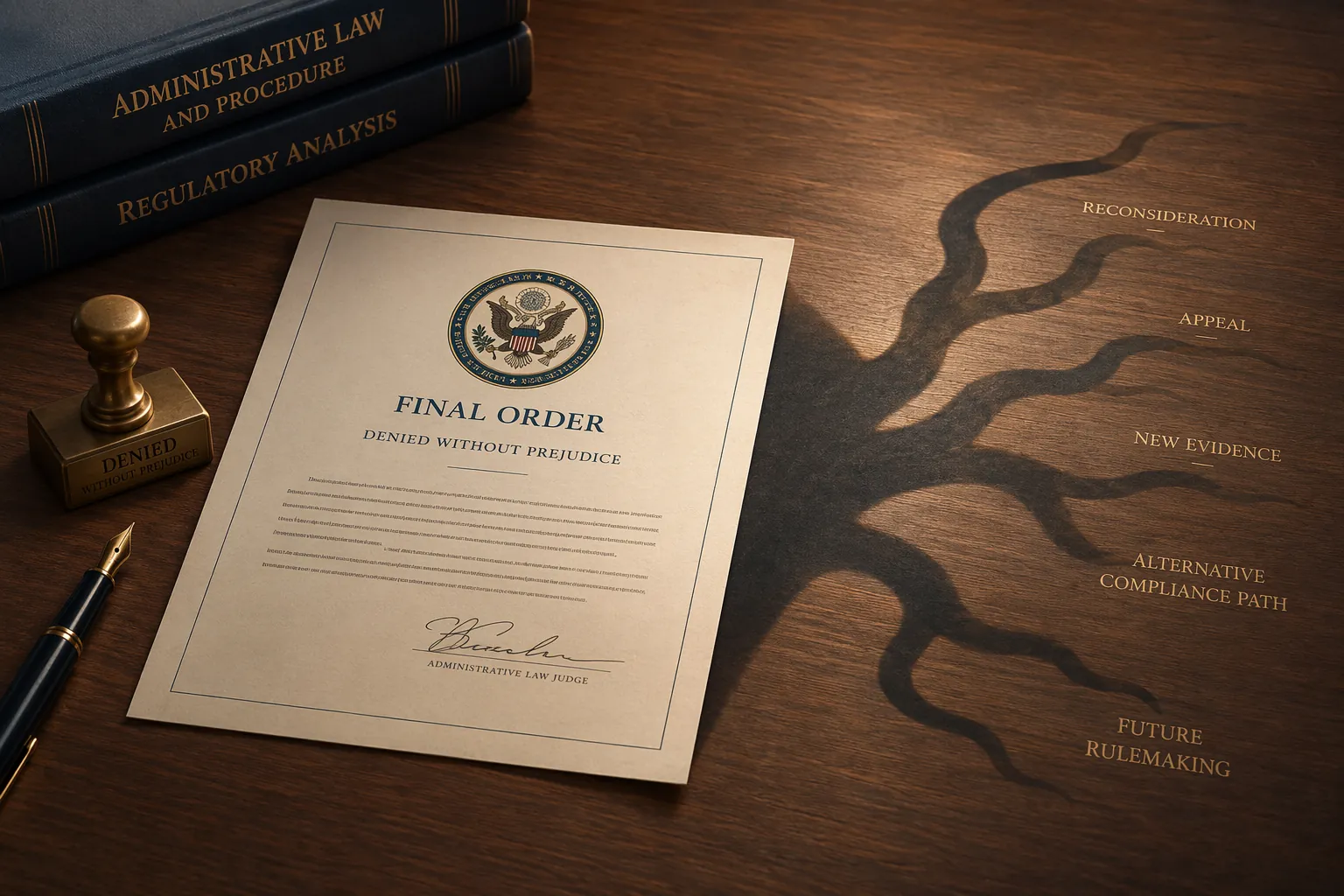
The Oklo nuclear reactor regulatory approval process became legally interesting on January 6, 2022, for a reason that is easy to flatten and important not to. The Nuclear Regulatory Commission denied Oklo Power’s combined license application for its Aurora reactor “without prejudice” after a 22-month review, citing “significant information gaps” in areas including accident analysis and the safety classification of structures, systems, and components.[1]
That was not the same thing as a finding that the reactor was unsafe. It was a finding that the record before the agency was not adequate for the agency to keep moving the application through the combined license process. In administrative terms, the difference matters. A denial with prejudice can function like a closed gate. A denial without prejudice leaves the applicant free to come back with a better-supported record.
For lawyers, that procedural posture is the hinge. The NRC did not bless the design, and it did not permanently reject it. It refused to proceed on the application as submitted. The practical consequence was still severe: Oklo’s first-of-a-kind licensing effort stopped. But the legal consequence was narrower than much of the public shorthand suggested. The application failed at the level of record development.
Oklo’s chief executive later described the denial as “surprising” and said it catalyzed “a new wave of support, momentum, and introspection.”[2] That reaction is useful evidence of industry perception, but it should not replace the agency record. The NRC’s stated basis was not a concealed merits ruling dressed in procedural language. It was a documented refusal to continue reviewing a submission the staff considered materially incomplete.
Why Part 52 Became Part of the Story
The uncomfortable question after the denial was not whether every advanced reactor applicant deserves a faster path. It was whether the existing path was asking the wrong kind of application to perform the wrong kind of evidentiary ritual.
Part 52 was not written around Oklo’s business model or design posture. It came from a licensing environment built for a different generation of nuclear projects, especially large light-water reactors, and it reflected the administrative assumptions of that era.[6] That does not make Part 52 an obvious villain. Licensing frameworks are supposed to be conservative, structured, and demanding when the regulated activity carries high consequence. The harder point is that a demanding framework can still be mismatched to the evidence a new technology can reasonably provide at a particular stage.
Oklo’s failed application exposed that tension in a concrete way. The company tried to move through a combined license pathway with a nontraditional reactor project, while the NRC looked for safety analysis and classification materials it considered essential to its review.[1] The result was not a philosophical disagreement about innovation. It was a procedural impasse: the applicant had not supplied what the agency said it needed, and the framework did not readily absorb the applicant’s different development posture.
There is also a source-note caveat that should keep the engineering discussion modest. Aurora’s power rating has been reported inconsistently across materials, with early references to 1.5 MWe and later NRC-related filings referring to up to 75 MWe. That inconsistency matters for anyone reconstructing the technical record, but it is not the central legal point here. The central point is that the agency’s denial turned on missing information in the application record, not on a final adjudication of the design’s safety.
What Oklo Did After the Procedural Failure
A denial without prejudice tests whether an applicant treats the decision as a terminus or an instruction. Oklo did not simply publish objections and leave the field. In September 2022, it relaunched its licensing work through a Licensing Project Plan that restarted engagement with the NRC after the failed combined license application.[3]
That move matters because it preserves the distinction between grievance and adaptation. Oklo had reason to object to a process it regarded as ill-fitted to its technology, and industry observers had reason to see the denial as evidence that advanced reactor licensing needed reform. But the company’s later conduct was more legally significant than its frustration. It re-entered the administrative process under revised expectations, with a clearer need to build the record in pieces before asking the agency for a licensing decision.
The lesson is not that an incomplete application was somehow vindicated by later events. It remained incomplete for the purpose for which it was submitted. The lesson is that the incomplete application became evidence in a broader institutional argument: perhaps the existing system was not giving advanced reactor applicants a usable way to mature safety information, test agency expectations, and proceed toward authorization without forcing too much into a single licensing package too early.
The Reform Chain Was Broader Than One Company
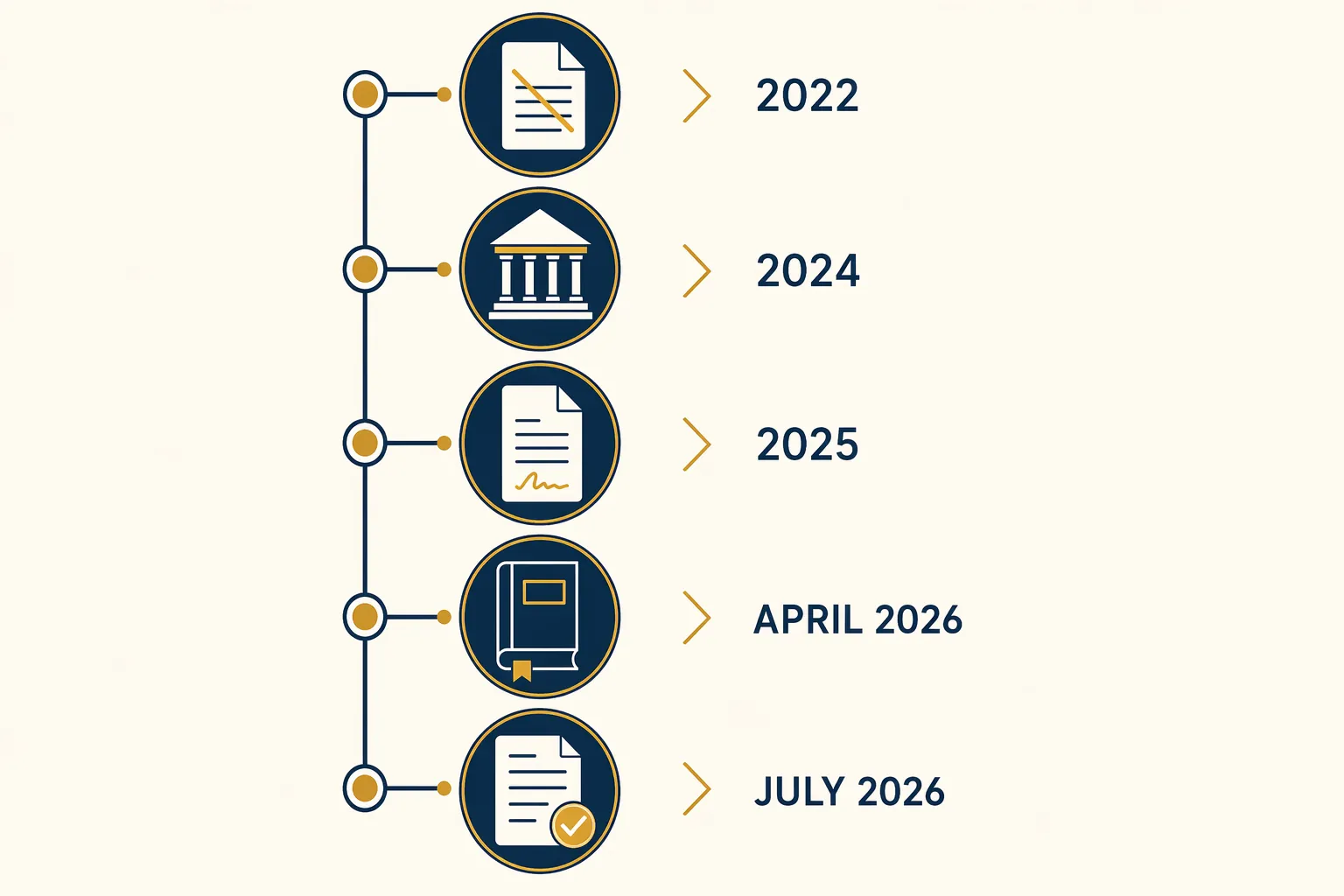
Calling the Oklo denial a watershed is defensible only if the claim stays disciplined. It did not single-handedly produce Congress’s later legislation, the White House’s later executive order, or the NRC’s later rulemaking. Regulatory reform rarely has a single author. What the denial did was supply a vivid administrative example of mismatch: a novel reactor applicant, a legacy licensing pathway, a long review, and a decision that stopped the application without foreclosing a return.
| Milestone | Procedural significance |
|---|---|
| January 2022 NRC denial without prejudice | Stopped Oklo’s combined license application while preserving the ability to resubmit. |
| September 2022 licensing relaunch | Shifted Oklo back into structured engagement with the NRC after the failed application. |
| July 2024 ADVANCE Act | Reduced hourly fees for advanced reactor applicants and reflected congressional pressure to modernize licensing. |
| May 2025 Executive Order 14301 | Created a DOE Reactor Pilot Program with an aggressive criticality deadline. |
| April 2026 Part 53 final rule | Established a new reactor licensing framework, the first since the Part 52 era. |
| July 2026 modernization proposal | Showed additional reform still in live rulemaking rather than final implementation. |
The ADVANCE Act, signed in July 2024, changed the economics of advanced reactor applications by reducing NRC hourly fees for advanced reactor applicants by 55%, from $323 per hour to $146 per hour.[4] Fee reform is not the same thing as substantive approval, and it does not cure a deficient safety record. But for applicants whose licensing work depends on repeated technical engagement with agency staff, cost is a procedural condition. Lowering that cost changes how often and how early applicants may be able to test their submissions against agency expectations.
Executive Order 14301, issued in May 2025, pushed from a different direction. It created the DOE Reactor Pilot Program and set a July 4, 2026 criticality deadline for participating projects.[5] That deadline structure was not merely symbolic. It created a competing federal pathway alongside the NRC-centered licensing process, putting pressure on agencies and companies to demonstrate whether advanced reactor authorization could move through staged review without abandoning safety evaluation.
Then came Part 53. The NRC’s final rule, effective in April 2026, created the first new reactor licensing framework since 1989.[6] Its importance is not that it retroactively proves Oklo was right in 2022. A later framework does not transform an incomplete earlier application into a complete one. Its importance is institutional: the agency now had a newer vehicle for advanced reactor licensing, one that responded to the same category of mismatch the Oklo denial had made difficult to ignore.
The Dual-Track Strategy in 2026
By 2026, Oklo’s posture was no longer just a resubmission story. It was pursuing progress through both NRC-facing work and DOE-adjacent authorization. That dual-track strategy is the practical consequence of a regulatory environment in transition: one pathway remains the traditional nuclear regulator’s domain, while another pilot pathway tests whether federal authorization can be staged differently for selected projects.
On the NRC side, Oklo announced in May 2026 that the agency had accepted its principal design criteria topical report for review in 15 days, compared with a typical acceptance timeline of 30 to 60 days.[7] Acceptance for review is not approval of the reactor. It means the agency agreed to begin reviewing that topical report. Still, for a company whose first licensing effort ended because the record was not adequate to continue, faster acceptance of a targeted technical submission is a concrete process change.
On the DOE-adjacent side, Oklo announced in June 2026 that it had received approval of its Preliminary Documented Safety Analysis, described as step 3 of 4 under the Reactor Pilot Program.[8] Again, the legal meaning is narrower than the headline might suggest. PDSA approval is not commercial operation, and it is not the same as an NRC operating license. It does show that Oklo was able to move through a staged safety-document process under the pilot program in a way that its original combined license application did not.
The limiting fact is equally important. As of late July 2026, Oklo had not announced criticality under the Reactor Pilot Program. Aalo Atomics and Antares had achieved the July 4 deadline, while Oklo had not announced the same milestone. That asymmetry should not be overread, but it prevents a premature victory lap. Procedural reform has created new routes and intermediate approvals. It has not yet demonstrated, in Oklo’s case, an operating reactor.
Modernization Is Still a Live Record
The reform sequence did not end with Part 53. In July 2026, the NRC issued a proposed modernization rule, published in the Federal Register on July 16, with a 45-day comment period ending August 31, 2026. Reporting on the proposal described estimated savings of $1.86 billion.[9]
That proposal belongs in the story because it shows the licensing system still moving. It also requires careful tense. A proposed rule with an open comment period is not an accomplished reform. The estimate is an estimate, the proposal may change, and the final administrative record will matter. For anyone trained to read agency action, this is not fine print. It is the difference between policy direction and binding law.
The same caution applies to broader claims about what Oklo’s denial caused. The denial helped organize a narrative and supplied a documented example reformers could point to. It did not, by itself, enact fee reductions, create a pilot program, or write Part 53. The legally sound claim is narrower and stronger: the denial exposed a procedural inadequacy at a moment when Congress, the executive branch, the NRC, and advanced reactor companies were already contesting how new nuclear projects should be reviewed.
What the Oklo Record Now Stands For
Oklo’s January 2022 denial is best understood as a procedural watershed, not as a safety verdict and not as a simple morality play about regulators and innovators. The NRC identified major information gaps after a long review and denied the application without prejudice.[1] That preserved the possibility of resubmission, but it also made public a deeper problem: the existing licensing path could stop a novel reactor application without offering a clearly workable route for staged maturation of the record.
The reforms that followed changed the environment around that problem. The ADVANCE Act lowered advanced reactor applicant fees.[4] Executive Order 14301 created a pilot pathway with a deadline structure.[5] Part 53 supplied a new licensing framework.[6] Oklo’s 2026 topical report acceptance and PDSA approval showed the company using the changed environment rather than merely protesting the old one.[7][8]
The unresolved part is the part that matters most in administrative law: implementation. A new framework must still be applied in actual records. A pilot approval must still lead to the remaining required milestones. A proposed modernization rule must survive notice and comment before anyone can treat it as settled law. As of Q3 2026, Oklo’s denial has reshaped nuclear reactor licensing by exposing a procedural mismatch and helping organize the response to it. Whether that reshaping produces durable approvals, safe operations, and repeatable licensing practice remains an open question.
References
- NRC denies Oklo combined licence application, World Nuclear News, January 2022
- Nuclear startup Oklo’s reactor application rejected by NRC, Canary Media, January 2022
- Oklo Relaunches Licensing Project Plan, POWER Magazine, September 2022
- The ADVANCE Act Will Help Build New Nuclear, Third Way, November 2024
- Executive Order 14301, The White House, May 2025
- NRC Issues Final Part 53 Rule for Advanced Reactors, Orrick, April 2026
- Oklo Announces NRC Acceptance of Principal Design Criteria Topical Report, Oklo, May 2026
- Oklo Receives PDSA Approval Under Reactor Pilot Program, ANS Newswire, June 2026
- NRC proposes modernization rule for advanced reactors, ANS Newswire, July 2026
Operationalizing workflow
No workflow has been explicitly linked to this obligation yet. See Workflows generally.
Illustrative cases
No illustrative case is currently tracked for this obligation. See Risk Digest for documented incidents generally.
← Back to RegulationReport a correction or tip
Spotted an outdated figure, a misstated fact, or a ruling this regulation entry should reflect? Public comments are disabled for this content given the professional cost of a misreported case outcome, penalty amount, or rule text — use the structured correction channel instead.
Report a correction or tip for this record →