
Why Older Borrowers Don't Access Available Student Loan Debt Relief
- Authority
- U.S. Department of Education
- Rule type
- regulation
- Jurisdiction scope
- US federal
- Source text
- Read primary rule text ↗
Last verified July 25, 2026. This Regulation & Ethics analysis is not legal advice; it traces the legal options and administrative failure points that determine whether older adults with defaulted federal student loans actually reach relief that could stop Social Security offset.
The contradiction is not hard to state. A large share of older borrowers facing Social Security offset appear to sit inside existing relief categories, yet the system rarely moves them there. The Consumer Financial Protection Bureau reported that 452,000 borrowers ages 62 and older had defaulted student loans and likely received Social Security benefits, while nearly 90,000 borrowers ages 81 and older still held federal student loan debt, with an average balance of $29,000.[1] Those numbers matter less as a demographic surprise than as an obligations problem: the federal collection system can identify the debt and intercept a benefit, but often does not route the same person toward the exemption or discharge that could make collection unlawful, inappropriate, or at least reviewable.
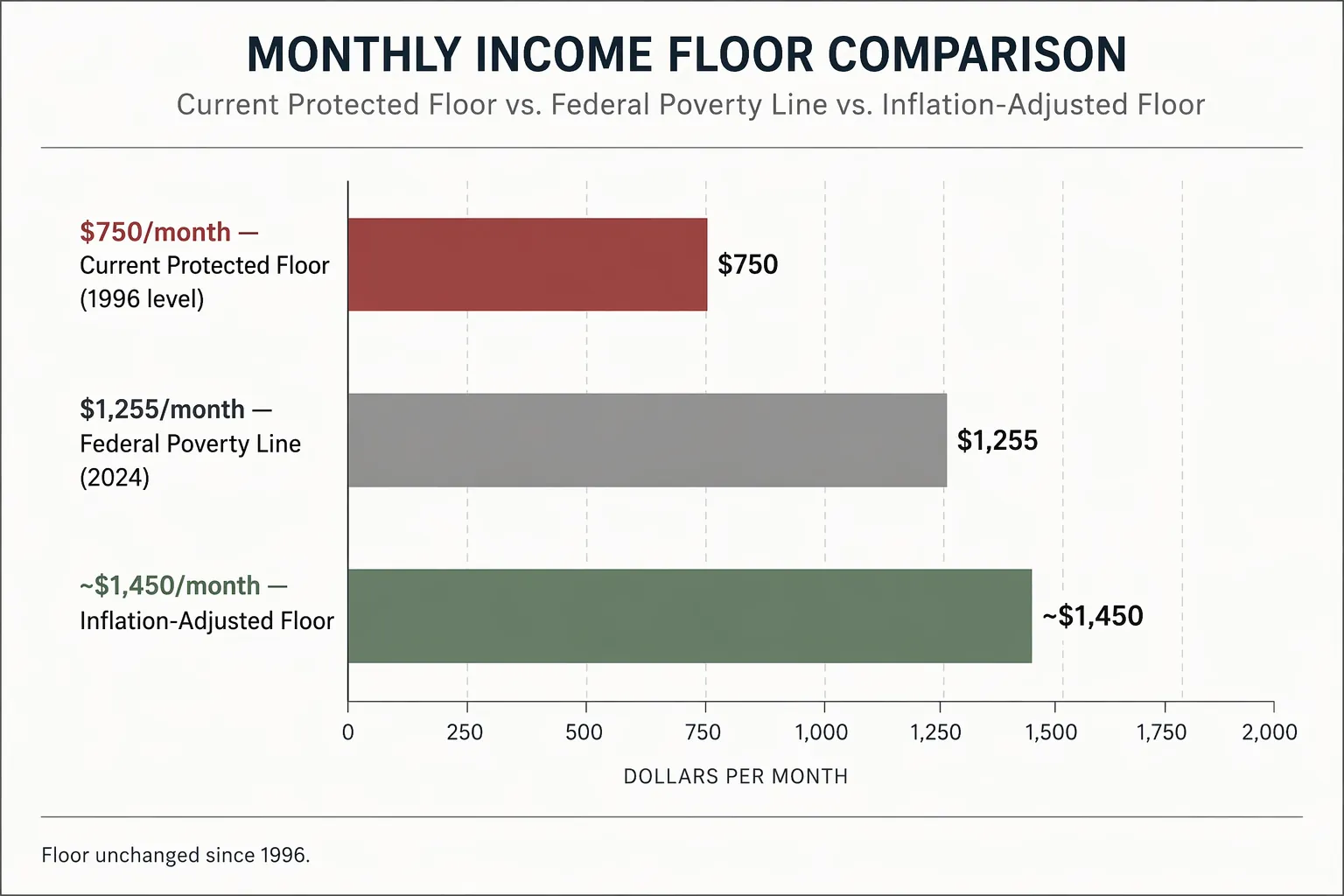
The most telling design choice is the one that looks least dramatic on paper. Social Security offset rules protect $750 per month from seizure, a floor that has not been adjusted since 1996. In 2024, the individual federal poverty threshold was $1,255 per month, and the CFPB calculated that a CPI-adjusted floor would be approximately $1,450 per month.[1] The Government Accountability Office had already identified the same problem years earlier and recommended congressional action to adjust the protected amount.[2] A protection that remains fixed while subsistence costs move is not neutral administration. It is a rule that quietly transfers inflation risk to the beneficiary.
The floor protects a number, not subsistence
Social Security offset is not supposed to be limitless. Federal law and implementing procedures preserve a monthly amount before the government collects on defaulted federal student loans. But the $750 protected amount performs a very different function in 2026 than it did when set in 1996. It now marks the point below which the Treasury may not offset; it does not mark an income level at which an older borrower can plausibly meet rent, food, utilities, medical costs, and transportation.
That distinction is where many descriptions of student loan debt relief for older adults become too generous. A borrower may be told that a protected amount exists. That is formally true. But if the floor is $400 below the 2024 poverty threshold and roughly $700 below what it would be after inflation adjustment, the notice has described a legal limit on collection, not a meaningful hardship screen.[1][2]
The hardship exemption is the companion mechanism that should matter here. The GAO found that older borrowers could request a reduction or suspension of offset based on financial hardship, and that the Department of Education’s offset notices and website did not specifically mention the financial hardship exemption option at the time of GAO’s review.[2] That omission is not a small readability issue. It is the difference between a beneficiary recognizing a legally relevant category and assuming that offset is automatic because the government has already decided.
The measured result is what one would expect from a protection that depends on unprompted recognition. The CFPB, relying on Survey of Household Economics and Decisionmaking data and GAO findings, reported that 82% of Social Security beneficiaries with defaulted student loans appeared eligible for a financial hardship exemption, yet fewer than 10% applied.[1][2] The gap should not be casually described as borrower inaction. A right that must be invoked through an obscure channel, after a notice that does not name it, is not being declined in any ordinary sense.
Eligibility disappears when the notice does not name the remedy
Offset administration depends on a sequence of small acts: the borrower receives a notice, identifies that the notice concerns federal student loan collection, understands that Social Security benefits may be reduced, recognizes a hardship or disability category, obtains the relevant form or review channel, submits documentation, and waits for the agency or contractor to process the request. None of those acts is exotic for a trained advocate. For an 80-year-old beneficiary living on a fixed income, the sequence is the barrier.
That is why the absence of the hardship exemption from notices carries more regulatory weight than it might appear to carry in a consumer-facing guide. The question is not whether a sophisticated reader could eventually discover the exemption somewhere else. The question is whether the government’s own collection communication gives the affected person the legally necessary cue at the moment the benefit is threatened. GAO’s finding that ED materials did not specifically mention the exemption is therefore central to the obligations analysis.[2]
The National Consumer Law Center’s borrower-assistance materials describe Social Security and other federal benefit seizure as a collection consequence of defaulted student loans, with hardship review available in that collection context.[3] For counsel, the practical map is familiar: default status creates exposure; offset notice starts the contest period; hardship documentation may reduce or stop the offset. The failure point is not the absence of any legal option. It is that the option is buried downstream from a notice architecture that does not reliably surface it.
| Protection or relief route | What it can do | Where the access failure appears |
|---|---|---|
| Protected offset floor | Prevents offset below $750 per month | Amount has not changed since 1996 and sits below poverty-level subsistence |
| Financial hardship exemption | Can reduce or suspend Social Security offset | Most apparently eligible beneficiaries do not apply, and ED notices reviewed by GAO did not specifically name the exemption |
| Total and Permanent Disability discharge | Can discharge qualifying federal student loan debt | Automatic matching excludes some retirement-age disabled borrowers because disability status is not tracked after full retirement age |
| Loan rehabilitation | Can remove a default after successful qualifying payments | Success rates are especially low among borrowers aged 75 and older |
Data matching solves one access problem and creates another
Automatic Total and Permanent Disability discharge shows why the issue cannot be reduced to borrower education. Data matching can convert a paper entitlement into actual relief without asking a disabled borrower to know the right vocabulary. But the same mechanism can exclude the people whose records no longer carry the necessary signal.
The CFPB reported that 22% of older beneficiaries receiving retirement benefits also reported a disability, but that borrowers past full retirement age are excluded from automatic TPD discharge matching because the Social Security Administration does not track disability status for people already past full retirement age.[1] That is a narrow finding, and it should stay narrow. It does not prove that every disabled retirement-age borrower qualifies for TPD discharge. It does show that a data pathway designed to identify disability-based relief loses visibility exactly when disability and advanced age overlap.
The ethical problem is not merely that the borrower must file another form. It is that the government already relies on linked administrative systems to collect, offset, and report default, while the relief pathway remains dependent on a data element that disappears at retirement age. When collection is automated and discharge is not, formal eligibility understates the burden placed on the beneficiary.
Rehabilitation is available, but older defaulted borrowers rarely complete it
Loan rehabilitation is another legal route that can matter in default, but the age gradient is severe. The CFPB’s analysis of Department of Education administrative data found that only 5% of borrowers aged 75 and older successfully rehabilitated, compared with 11% of borrowers ages 50 to 59.[1] The difference should be read carefully. It does not isolate a single cause, and it does not prove that rehabilitation is impossible for older borrowers. It does suggest that a process built around repeated payment performance, paperwork, and communication with servicers or collectors is poorly matched to the oldest defaulted population.
For legal aid and pro bono counsel, this is where the file often stops looking like a repayment question and starts looking like an administrative-capacity question. The relevant facts are not only income and balance. They include who opened the notice, whether the borrower understood that Social Security was at risk, whether a representative payee or family member is involved, whether disability documentation exists, whether the borrower can complete online forms, and whether prior collection communications used language that would have alerted a reasonable beneficiary to hardship review.
The scale is no longer an edge case
Older-borrower offset can still be misread as a marginal problem because the individual files are scattered: a Parent PLUS loan here, an unfinished degree there, accrued interest after years of deferment or default somewhere else. The administrative data point in the other direction. The CFPB’s January 2025 spotlight identified 452,000 borrowers ages 62 and older with defaulted loans who likely receive Social Security benefits.[1] The same report cited nearly 90,000 borrowers ages 81 and older with federal student loan debt.[1]
The oldest borrowers are not the largest segment of the student loan portfolio, but they are the segment for whom offset can collide most directly with subsistence income. A younger borrower in default may face wage garnishment, tax refund seizure, damaged credit, and collection costs. An older beneficiary may face those consequences too, but Social Security offset has a particular severity because the intercepted payment may be the income source around which all other household decisions have already been rationed.
Broader distress in the student loan system increases the pressure. Protect Borrowers reported 3.62 million new delinquencies in the fourth quarter of 2025.[4] That figure is not specific to older borrowers, and it should not be used as if it were. Its relevance is institutional capacity: as more borrowers fall behind, relief systems that already require precise notice, timely forms, and individualized review become easier to miss and harder to administer well.
The 2026 repayment transition adds pressure, not clarity
The repayment-plan landscape in 2026 does not cure the older-borrower offset problem. It adds another layer of transition for borrowers already vulnerable to default. The National Consumer Law Center explained that the One Big Beautiful Bill Act preserves Income-Based Repayment for legacy borrowers but eliminates ICR, PAYE, and SAVE by 2028; it also described the new Repayment Assistance Plan as requiring minimum $10 monthly payments even for the lowest-income borrowers.[5] NPR reported that, after the SAVE plan was vacated by a federal court in March 2026, borrowers on SAVE would begin being transitioned starting July 1, 2026.[6]
Those changes matter here only to the extent they affect exposure to default and collection. A $10 minimum payment may sound modest in the abstract. For a borrower whose income consists largely of Social Security and whose budget is already below a poverty-level benchmark, the question is not whether the amount is symbolically low. The question is whether nonpayment after transition can eventually put the borrower back into default, collection, and offset.
As of this verification date, the January 2026 pause on collections of defaulted loans should be treated as a temporary condition, not a legal resolution of the offset problem.[4] A pause may stop or delay immediate collection activity while it lasts. It does not adjust the $750 floor, rewrite hardship notices, restore disability data visibility after full retirement age, or ensure that eligible borrowers are affirmatively routed into discharge or exemption review.
Where the regulatory duty fails
The older-borrower relief gap is easiest to see by separating the legal entitlement from the activation mechanism. Congress and agencies have created several ways to limit or end collection in appropriate cases: a protected amount for Social Security benefits, hardship review, disability discharge, and default rehabilitation. The evidence does not show that every older borrower qualifies for every form of relief. It shows that the system’s activation points are badly aligned with the population most at risk.
- The protected floor is traceable but obsolete: $750 remains the operative monthly shield even though it has not been adjusted since 1996 and sits below the 2024 poverty threshold.[1][2]
- The hardship exemption exists but is under-triggered: 82% of affected beneficiaries appeared eligible, while fewer than 10% applied.[1][2]
- The notice pathway is defective at the point of consequence: GAO found that ED’s reviewed notices and website did not specifically mention the hardship exemption.[2]
- The disability pathway depends on data the system stops tracking for retirement-age beneficiaries: 22% of older retirement beneficiaries reported a disability, yet automatic TPD matching excludes those past full retirement age because SSA no longer tracks disability status for that group.[1]
- The rehabilitation pathway is formally available but weakly used by the oldest borrowers: 5% of borrowers aged 75 and older successfully rehabilitated, compared with 11% of borrowers ages 50 to 59.[1]
Those are not five versions of the same complaint. They are five different administrative failures: an unindexed dollar threshold, an unnamed exemption, an application-dependent remedy, a missing data match, and a process completion gap. Together they explain why the phrase "available relief" can be accurate in a statute book and misleading in a benefit-offset file.
For advocates reviewing these matters, the useful question is not simply whether an older borrower has legal options for student loan debt relief. The useful question is which official communication, data pathway, or review procedure should have brought the option into view before Social Security income was threatened. If the answer is that the borrower had to know the right term, find the right form, and prove hardship after receiving a notice that did not name hardship review, the failure sits in system design rather than personal choice.
Temporary collection pauses can reduce immediate harm, but they leave the legal exposure intact. When default collection resumes or policy changes, Social Security benefits remain vulnerable under a floor that has lost its subsistence meaning. Eligible borrowers remain invisible unless notices name the remedy, protected amounts reflect present conditions, and administrative data routes disability and hardship information toward relief instead of waiting for the oldest borrowers to discover it alone.
References
- Issue Spotlight: Social Security Offsets and Defaulted Student Loans, Consumer Financial Protection Bureau, Jan. 2025.
- Social Security Offsets — Improvements to Program Design Could Better Assist Older Student Loan Borrowers, Government Accountability Office, Dec. 2016.
- Social Security and Other Government Benefits Seizure, National Consumer Law Center / Student Loan Borrower Assistance.
- Default Crisis Fact Sheet Jan 2026, Protect Borrowers, Jan. 2026.
- Big Bill Means Big Changes for Student Loan Borrowers: What You Need to Know, National Consumer Law Center, Jul. 2025.
- Student loan options change July 1, NPR, Jun. 2026.
Operationalizing workflow
No workflow has been explicitly linked to this obligation yet. See Workflows generally.
Illustrative cases
No illustrative case is currently tracked for this obligation. See Risk Digest for documented incidents generally.
← Back to RegulationReport a correction or tip
Spotted an outdated figure, a misstated fact, or a ruling this regulation entry should reflect? Public comments are disabled for this content given the professional cost of a misreported case outcome, penalty amount, or rule text — use the structured correction channel instead.
Report a correction or tip for this record →