
Why Federal Clearance Isn't Enough for the Paramount-Warner Bros Merger
- Authority
- California Attorney General (on behalf of 12-state coalition)
- Rule type
- statute
- Jurisdiction scope
- US state
- Source text
- Read primary rule text ↗
State attorneys general may independently challenge mergers under Clayton Act §16 after federal clearance.
Last updated July 31, 2026, 00:00 UTC. This Paramount-Warner Bros. merger antitrust analysis addresses live litigation and public-source materials available as of that time. It is not legal advice, and it does not assume that the states, Paramount, Warner Bros. Discovery, the DOJ, or any other regulator will ultimately prevail.
The practical question is no longer whether the Department of Justice reviewed the Paramount-Warner Bros. Discovery merger. It did. The Antitrust Division closed an eight-month investigation after reviewing more than 2 million documents from more than 80 custodians and concluded that the transaction was likely to increase competition across subscription video-on-demand, linear television, and theatrical markets.[1] The harder question for boards, lenders, integration teams, and deal counsel is what that federal closure actually buys when state attorneys general file for injunctive relief days later.
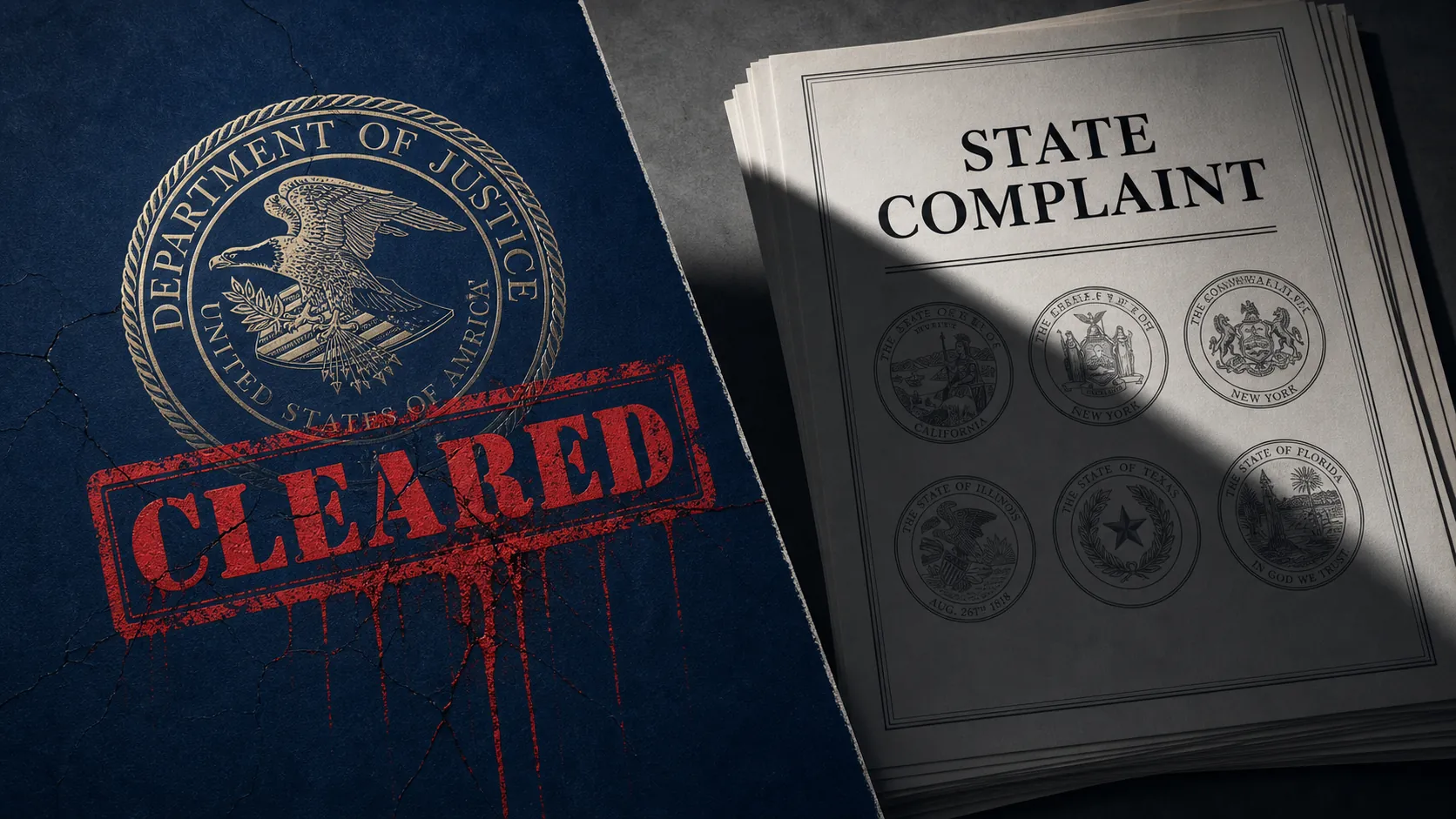
The answer, at least at the risk-allocation level, is narrow but important: federal clearance reduces one enforcement risk. It does not create a safe harbor against state injunctive action.
Clearance Did Not End the Transaction Risk
The sequence is what matters. The DOJ closed its investigation. On July 13, a coalition of 12 states led by California Attorney General Rob Bonta filed suit challenging the $111 billion Paramount-Warner Bros. Discovery merger. On July 20, Judge Rita F. Lin Martinez-Olguín issued a two-week temporary restraining order. Paramount then agreed to pause the merger pending trial, while the parties disputed whether trial should occur in fall 2026 or in 2027.[2][3]
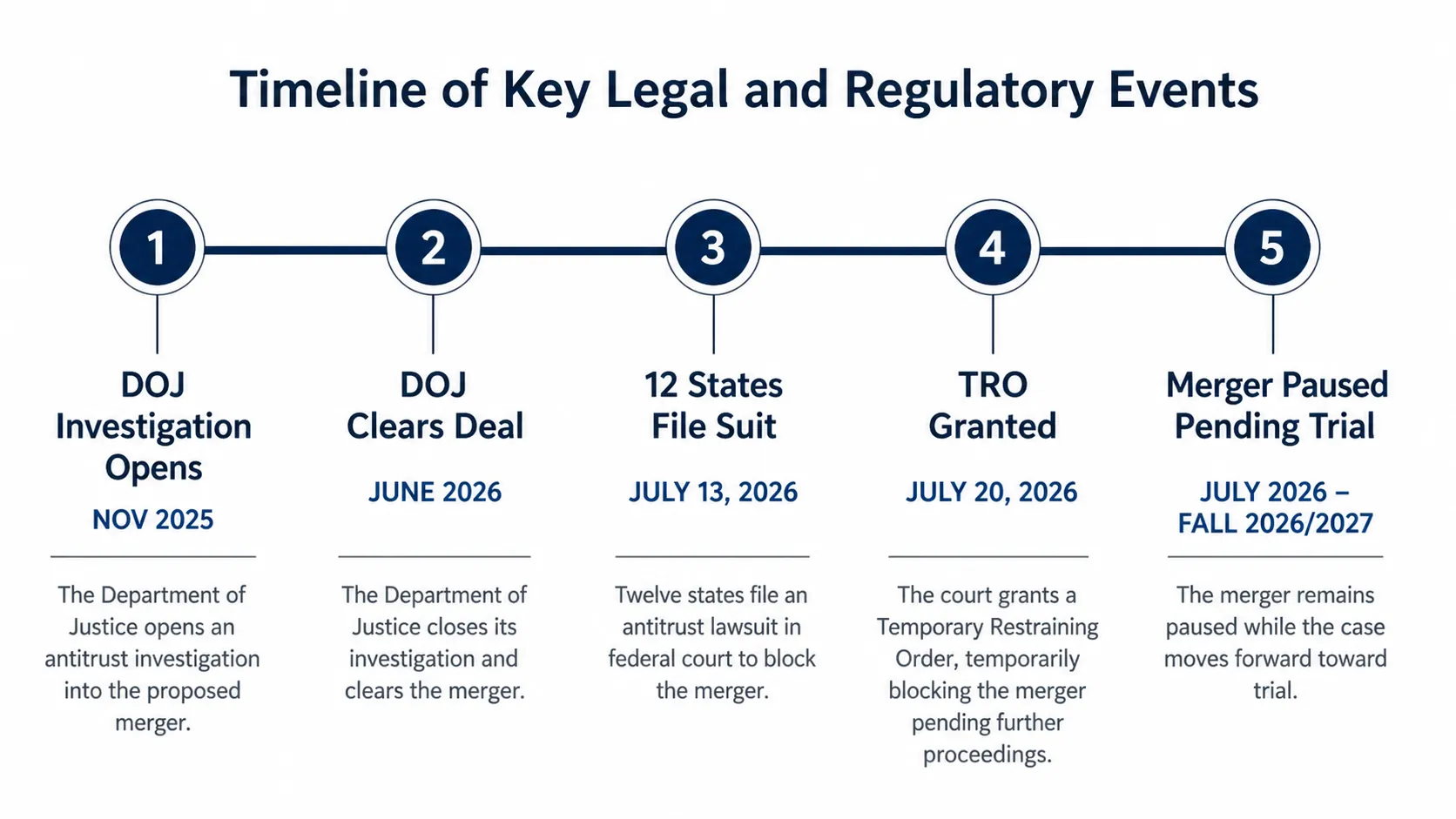
That is not a completed enforcement story. It is a timing problem converted into litigation leverage. A transaction can be federally cleared and still face a court-ordered pause, a negotiated standstill, an unresolved trial schedule, and the financing, covenant, employee-retention, and integration uncertainty that follows.
For deal planners, the most consequential word in that sequence is not “blocked.” The transaction has not been finally blocked on the present public record. The more precise word is “disrupted.” The states obtained enough interim leverage to stop closing from proceeding on the original path. That is the legal risk a federal clearance memo has to confront.
Why State Attorneys General Can Sue After DOJ Non-Action
The states’ position rests on independent authority to seek injunctive relief under Clayton Act § 16. The point is not that state attorneys general sit as appellate reviewers of DOJ clearance decisions. They do not. The point is that federal non-action does not extinguish their own capacity to ask a federal court to stop conduct they allege threatens antitrust injury.
California v. ARC America Corp. supplies the core federalism premise: state antitrust enforcement and remedies are not displaced merely because federal antitrust authorities make a different enforcement choice. The Harvard Law School analysis of the Paramount-WBD suit frames the case within that tradition and the related doctrine giving states “special solicitude” when they assert quasi-sovereign interests on behalf of their residents.[2]
That matters because clearance language is often operationalized too aggressively inside deal processes. A DOJ closing statement may be treated as a green light for communications, staffing, financing, customer messaging, and integration sequencing. The Paramount-WBD suit is a reminder that the green light is agency-specific. It does not bind a state plaintiff, and it does not bind the court asked to evaluate a temporary restraining order or preliminary injunction.
The legal burden remains the states’ burden. They still must show why equitable relief is warranted. But the existence of a closed DOJ investigation is evidence the merging parties will use; it is not jurisdictional immunity.
The Market Fight Is Not One Hollywood-Monopoly Claim
The state complaint’s most forceful theory is not simply that “Hollywood” is becoming concentrated. Its sharper claim concerns theatrical distribution, especially blockbuster film distribution. The states argue that the combined Paramount-WBD entity would hold more than 30% of that market and that four firms would control 93%.[2]
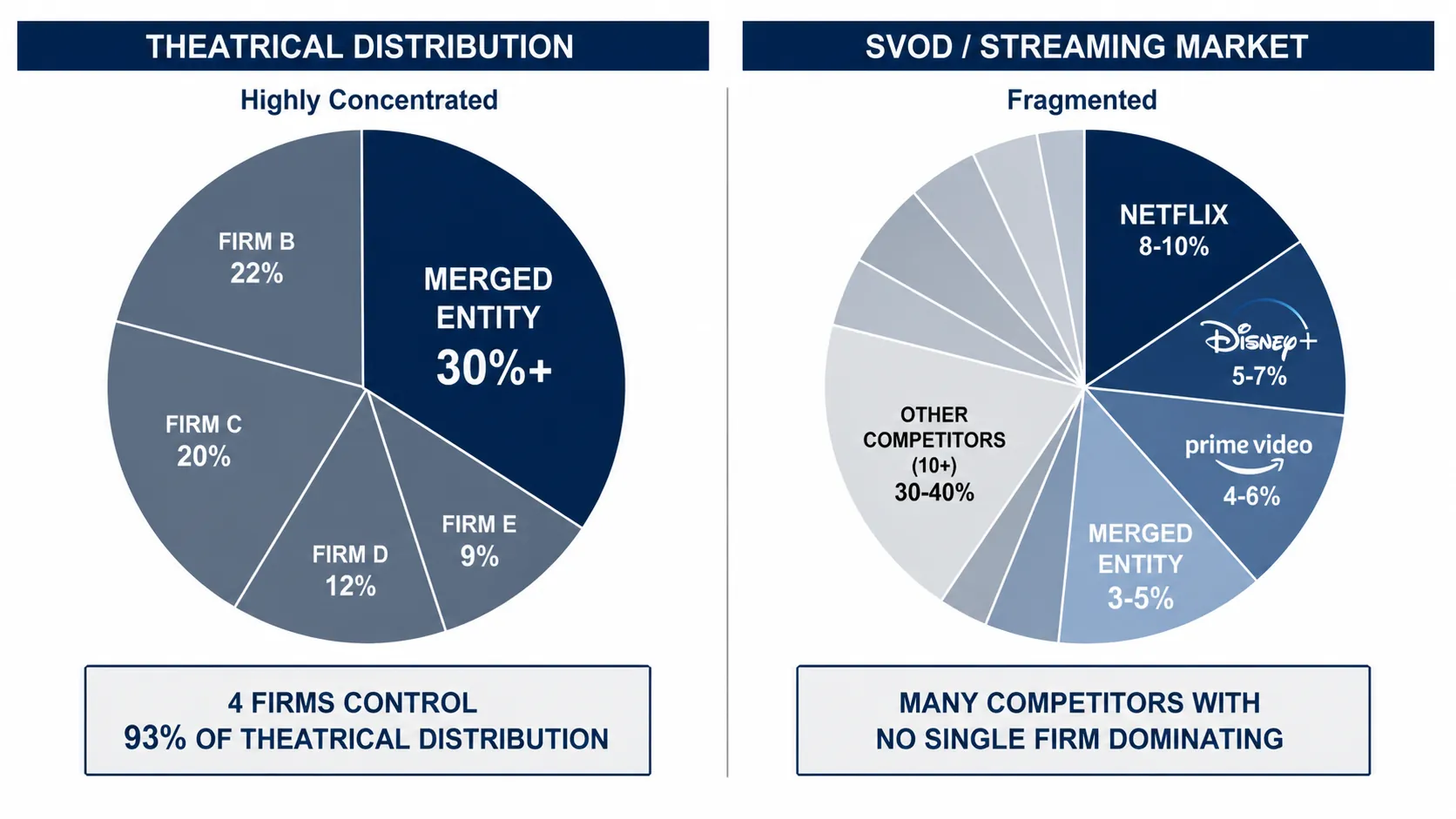
That theory has to be kept separate from the DOJ’s broader conclusion. The DOJ did not say that every entertainment submarket is unconcentrated. It said that, after its investigation, the merger was likely to increase competition across SVOD, linear TV, and theatrical markets.[1] A clearance statement at that level of aggregation does not answer every narrower market-definition dispute the states may press in court.
Paramount’s response attacks the state case at exactly that point. It called the lawsuit “one of the weakest merger challenges in modern antitrust history” and argued that the complaint ignores low barriers to entry and expansion capacity by firms including Universal, Disney, Amazon MGM, Sony, Lionsgate, A24, and NEON.[3] That is not a public-relations answer alone. It is a market-definition and competitive-effects answer: if rivals can expand output, finance major releases, acquire scripts, book screens, and discipline pricing or terms, then the states’ concentration theory becomes harder to translate into likely harm.
The concentration metrics are also easy to misuse. One source describes the states’ complaint as calculating a post-merger film-distribution Herfindahl-Hirschman Index of about 2,123, with a delta of 252.[4] Another analysis, focused on SVOD rather than theatrical distribution, found an HHI delta below 100.[5] Those figures are not competing measurements of the same market. They are measurements of different asserted markets. Treating them as interchangeable would make the antitrust analysis look more definitive than the underlying materials allow.
| Issue | State AG theory | Paramount / DOJ response posture | Risk significance |
|---|---|---|---|
| Relevant market | Blockbuster theatrical film distribution is the pressure point. | DOJ evaluated broader SVOD, linear TV, and theatrical markets; Paramount disputes narrow framing. | The court’s market-definition work may determine whether concentration numbers matter. |
| Concentration | Merged firm would exceed 30%; four firms would control 93%. | Paramount points to rival capacity and entry or expansion by multiple studios and distributors. | High shares create injunction leverage only if the market boundary is accepted. |
| HHI evidence | Film-distribution HHI estimated around 2,123 with delta 252. | SVOD-focused analysis finds a delta below 100 in a different market. | Cross-market HHI comparisons are not evidence unless the market is the same. |
| Federal clearance | Does not bar independent state injunctive claims. | DOJ closure supports the merging parties’ merits narrative. | Clearance is persuasive material, not a dispositive shield. |
The point is not that the states’ theatrical theory is necessarily correct. It is that it is legally cognizable enough to create procedural risk if a court is willing to entertain the narrower market and preserve the status quo while the merits are tested.
What the DOJ Statement Does and Does Not Prove
The DOJ statement is important evidence for Paramount. An eight-month investigation, more than 2 million documents, and more than 80 custodians are not trivial facts.[1] A court considering emergency relief may care that the federal antitrust agency had extensive access to documents and still declined to sue.
But the statement is not a merits judgment by a court. It does not produce claim preclusion. It does not make state plaintiffs strangers to the Clayton Act. It does not prevent a judge from asking whether a narrower alleged market, different evidentiary presentation, or different sovereign interest justifies interim relief.
This is the institutional mismatch that deal documents often compress. A federal agency’s decision not to bring a case is a meaningful risk reducer. A state coalition’s decision to bring a case is a separate litigation event. The Paramount-WBD posture shows both can be true at the same time.
Recent Precedents Make the Risk Concrete
The Paramount-WBD lawsuit is not the first reminder that state antitrust litigation can matter after federal review. The International Center for Law & Economics points to the Kroger-Albertsons state victory in 2024 and a Live Nation state win after a federal settlement as recent examples showing that state attorneys general can obtain meaningful results even where federal enforcement has taken a different path.[6]
Those matters should not be overread as predictions. Grocery markets, ticketing, and film distribution involve different facts, customer groups, remedies, and political economies. Their value here is more limited and more useful: they show that state challenges after federal clearance are not academic hypotheticals. They have to be modeled in transaction timing.
The European Commission’s parallel treatment of the deal adds a different kind of comparison. The Commission approved the transaction on July 22, 2026, conditioned on Paramount exiting the UIP joint venture with Universal within 13 months.[7] That remedy does not answer the U.S. state-law question. It does show that different competition authorities can look at the same transaction and reach different clearance outcomes, impose different conditions, or focus on different market mechanisms.
Internal Deal Politics Are Secondary, But Not Irrelevant
There is also an internal-industry layer. Variety reported that some Warner Bros. executives hoped the state lawsuit would derail the deal.[8] That does not change the Clayton Act analysis. It does, however, illustrate why litigation risk does not operate only outside the merging parties.
A merger pause can alter bargaining leverage among executives, shareholders, lenders, employees, and counterparties. A lawsuit that begins as external enforcement can become part of the internal timing environment: who waits, who leaves, who resists integration, who renegotiates, and who benefits from delay. Counsel do not need to treat that as proof of antitrust harm to recognize it as transaction risk.
What Deal Planners Should Take From the Paramount-WBD Posture
The lesson is not to discount DOJ clearance. It remains a major event in any U.S. merger process. The lesson is to draft, finance, and sequence the deal as if clearance from one enforcer may not end enforcement exposure.
- Closing conditions should account for state injunctive actions, not just federal waiting-period expiration or DOJ/FTC non-action.
- Outside-date and termination provisions should model a TRO, preliminary-injunction schedule, and trial-date dispute.
- Integration planning should preserve a pause mode for employee communications, customer commitments, data sharing, and executive appointments.
- Board materials should separate federal clearance probability from state litigation probability, rather than blending both into a single antitrust-risk rating.
- Market-concentration analysis should stay disciplined by market: theatrical distribution evidence should not be casually merged with SVOD evidence.
For counsel advising around the Paramount-WBD transaction specifically, the live question is not whether the DOJ’s work disappears. It plainly does not. The live question is whether the states can sustain a narrower market theory long enough, and with enough equitable force, to keep the transaction from closing on the parties’ preferred timetable.
That is a materially different question from whether the merger is good entertainment policy, whether streaming competition is healthy, or whether studio consolidation is culturally desirable. The litigation-risk question is more procedural and more immediate: can state attorneys general frame a concentrated market, move quickly for interim relief, and force timing concessions after federal clearance? The Paramount-WBD record shows that they can at least get that far.
References
- Statement from the Department of Justice Antitrust Division Closing Its Investigation of the Merger of Paramount, Department of Justice
- Will 12 States Block the $111B Paramount-Warner Bros. Merger?, Harvard Law School Today
- Paramount Slams States’ Lawsuit Over Warner Bros. Merger, Variety
- Incipient Monopolization in Digital Streaming: Judicial Oversight of Contemporary Entertainment Consolidation, Columbia Undergraduate Law Review
- Netflix Appears to Face Greater Antitrust Barriers to Acquiring Warner Bros. Discovery Than Paramount, ProMarket
- Paramount’s Mission: Impossible Antitrust Case, International Center for Law & Economics
- European Commission Approves Paramount-Warner Bros., Variety
- Paramount-Warner Bros. Execs Hope Merger Antitrust Lawsuit Will Derail Deal, Variety
Operationalizing workflow
No workflow has been explicitly linked to this obligation yet. See Workflows generally.
Illustrative cases
No illustrative case is currently tracked for this obligation. See Risk Digest for documented incidents generally.
← Back to RegulationReport a correction or tip
Spotted an outdated figure, a misstated fact, or a ruling this regulation entry should reflect? Public comments are disabled for this content given the professional cost of a misreported case outcome, penalty amount, or rule text — use the structured correction channel instead.
Report a correction or tip for this record →