
Tracking Pentagon AI data center energy regulation through the NDAA
- Authority
- U.S. Congress
- Rule type
- statute
- Jurisdiction scope
- US federal
- Source text
- Read primary rule text ↗
Bans adversary-manufactured components in Pentagon data centers; requires DOD to brief Congress on community impacts before construction.
As of July 2026, there is no settled federal regime for Pentagon AI data center energy-consumption regulation. There is a House-passed FY2027 NDAA with one narrow security rule, a rejected House amendment that could still reappear in conference, a bipartisan appropriations rider on community-impact briefings, and several adjacent grid and ratepayer bills that may never become NDAA text but can still change project economics. The practical question is not whether Congress is “regulating data centers.” It is which vehicle survives reconciliation, who must do something, and when that obligation can stop, delay, disclose, redesign, or reprice a project.
| Vehicle | Provision | Current posture | Covered obligation | Affected actor | Likely timing | Confidence level |
|---|---|---|---|---|---|---|
| FY2027 NDAA — House version | Rep. Cory Mills adversary-component ban | Included in the House-passed NDAA in July 2026 [1] | Would bar certain adversary-manufactured components in covered Pentagon data center projects; exact compliance mechanics depend on final text | DOD, military departments, project developers, suppliers, procurement counsel | Could become binding if retained in House-Senate conference and enacted | High confidence that it is in the House bill; lower confidence on final enactment |
| FY2027 NDAA — House amendment not adopted | Rep. John Garamendi energy and water impact-assessment language | Excluded from the House-passed NDAA [1] | Would have required broader assessment of energy and water impacts tied to military data center plans | DOD, installation commands, developers seeking land-use or project approvals | Not binding unless revived in conference or attached elsewhere | High confidence on House exclusion; speculative as a final obligation |
| Defense appropriations | Rep. Ken Calvert community-impact briefing rider | Advanced with bipartisan support as an appropriations provision [1] | Would require DOD to brief Congress on community impacts before data center construction | DOD, congressional affairs staff, installation officials, project sponsors waiting on construction sequencing | Appropriations cycle; could affect construction starts before or alongside NDAA implementation | Meaningful near-term watch item; final scope depends on appropriations text |
| Ratepayer Protection Act, HR 9340 | Limits or targets data center energy cost passthrough to residential customers | Standalone bill identified in 2026 policy tracking [3] | Would address whether data center-related electricity costs can be shifted to residential ratepayers | Utilities, state regulators, large-load customers, data center operators, possibly federal project sponsors indirectly | Separate from NDAA unless incorporated or mirrored elsewhere | Adjacent risk; not an NDAA obligation on current materials |
| GRID Act — Hawley/Blumenthal | Large data center interconnection upgrade cost responsibility | Introduced or tracked in February 2026 policy reporting [3] | Would require large data centers to pay for grid interconnection upgrades | Data center developers, utilities, transmission providers, regulators, project finance teams | Standalone bill timeline; committee status not independently verified here through primary congressional sources | Substantive risk to economics; procedural confidence is limited |
| Rep. Rashida Tlaib standalone bill | Standalone data center oversight or impact legislation | Identified as a separate legislative vehicle in the Q3 2026 tracking set | Potential obligations would depend on bill text and any later incorporation into appropriations or authorization | Data center operators, affected communities, federal agencies if federal projects are covered | Separate legislative path; could influence negotiations even if not enacted alone | Watch-list item; no narrower binding obligation can be stated from the available materials |
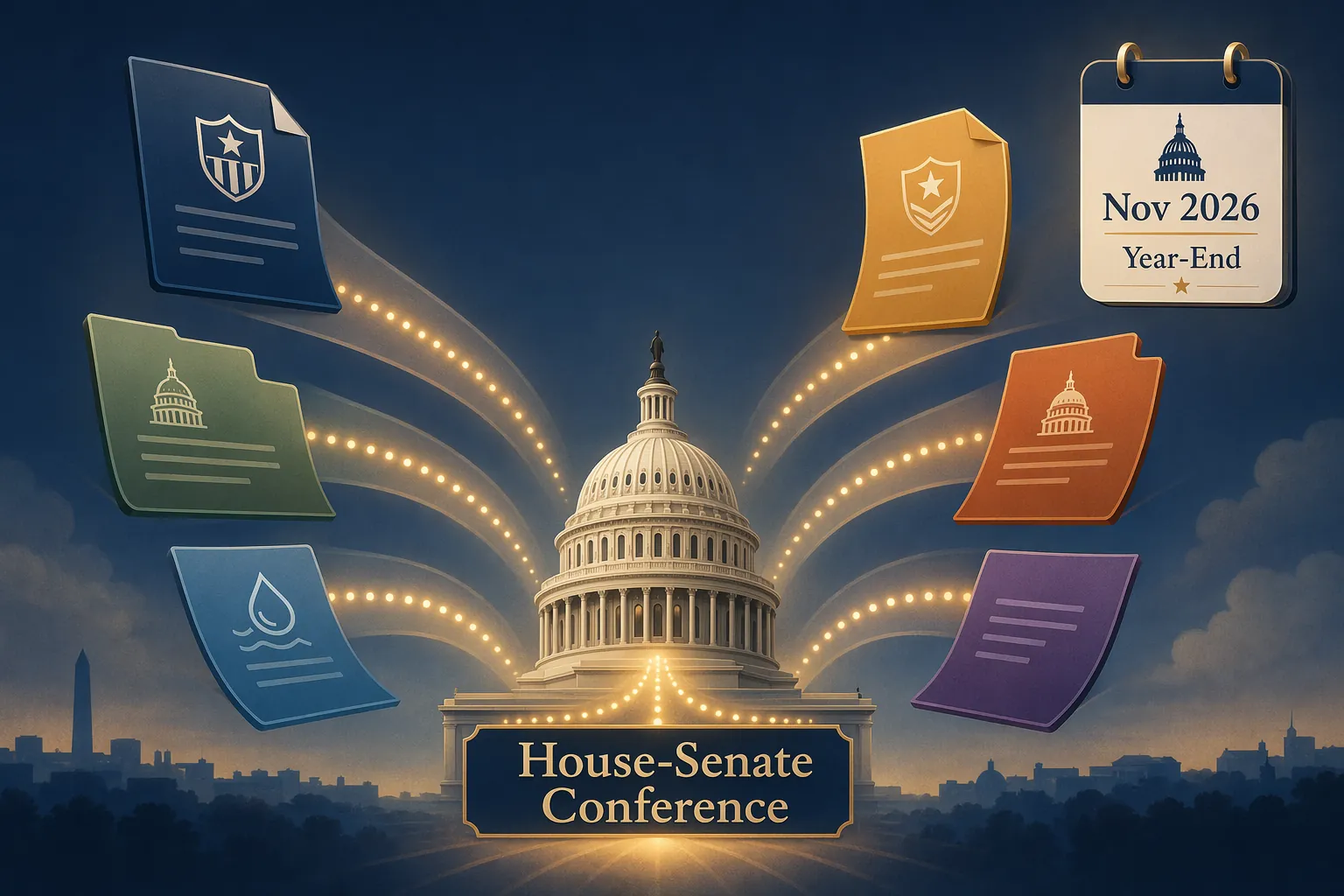
Why the NDAA answer is still not the regulatory answer
The House-passed NDAA is the right place to start, but it is the wrong place to stop. The House version passed in July 2026 with Mills’ adversary-component provision included and Garamendi’s broader energy and water impact-assessment language left out [1]. That is a real status point, not a final compliance regime.
The Senate version differs, and the House and Senate versions must be reconciled after the November 2026 elections, leaving a months-long window in which the decisive language can be retained, dropped, narrowed, expanded, or moved into a different legislative vehicle [1]. For counsel briefing a project team, that means the House bill can support a risk memo. It cannot support a definitive implementation calendar.
Appropriations add a second track. Calvert’s rider is not the same instrument as the NDAA component ban, but it may be more operationally visible to a project manager because it attaches to construction timing: DOD would have to brief Congress on community impacts before construction [1]. A provision that forces a briefing before work begins can matter even when it does not prescribe a technical energy standard.
That procedural mismatch is the center of the current file. The House NDAA points toward supply-chain security. The rejected Garamendi amendment points toward energy and water review. The Calvert rider points toward pre-construction disclosure. The ratepayer and interconnection bills point toward who pays for grid consequences. Treating those as one congressional “crackdown” makes the compliance problem look simpler than it is.
The obligations sort better by compliance function than by sponsor
Project teams do not implement amendments by sponsor name. They implement them through checklists, representations, board papers, utility filings, environmental records, construction gates, and congressional-notification packages. On the current record, five compliance functions deserve separate tracking.
Construction and community notice
Calvert’s rider is the clearest example of an obligation that could bite without becoming an energy-efficiency standard. If enacted in its reported form, DOD would have to brief Congress on community impacts before data center construction [1]. The likely pressure point is sequencing: who prepares the briefing, what counts as “community impacts,” whether a conditional land-use deal can proceed while the briefing is pending, and whether construction packages must wait for congressional receipt.
This kind of requirement can be underestimated because it sounds procedural. In a facilities project, procedure is not decoration. A required pre-construction briefing can affect financing assumptions, contractor mobilization, public-affairs strategy, and the installation commander’s willingness to let a project move from paper to dirt.
Energy and water assessment
Garamendi’s energy and water impact-assessment language did not make it into the House-passed NDAA [1]. That fact should be stated plainly because it is the difference between a current House position and a possible conference revival. On the available materials, there is no House-passed broad energy and water assessment mandate for Pentagon AI data centers.
The language still matters as a negotiating marker. If revived, it would move energy source, water demand, and local infrastructure effects from policy objections into formal review subjects. That would change who has to produce data and when: installation officials, utility partners, private developers, and DOD reviewers would need a record that can survive congressional scrutiny, not just a project narrative.
Component sourcing and security
Mills’ amendment is narrower than a resource-consumption rule, but it is currently the strongest House NDAA hook because it survived into the House-passed bill [1]. Its target is adversary-manufactured components, not kilowatt-hours or gallons. That puts the first-order burden on procurement representations, supplier tracing, contract warranties, replacement rights, and due diligence over equipment already specified for a project.
Army officials have warned that the amendment could create an “unworkable standard” and drive “over $1.3 billion in private capital” away from Army land [2]. That warning should not be accepted or dismissed as a press quote. It should be tested against the final definition of covered components, the scope of prohibited manufacturing ties, any waiver authority, and whether the rule reaches already-negotiated conditional agreements.
Ratepayer cost protection
HR 9340, the Ratepayer Protection Act, sits outside the NDAA track on the current materials. Its relevance is economic rather than installation-specific: it targets data center energy cost passthrough to residential customers [3]. If that concept advances, utilities and large-load customers may face a sharper fight over whether infrastructure costs created by data center load can be socialized through ordinary residential rates.
For a Pentagon-linked project, that issue may arrive indirectly through the utility rather than through DOD. A project can clear a land-use gate and still become harder to finance if the local cost-allocation environment changes. The NDAA does not need to carry a ratepayer provision for ratepayer politics to affect a military-installation data center.
Grid interconnection cost allocation
The Hawley/Blumenthal GRID Act is the adjacent bill to watch for interconnection economics. The reported proposal would require large data centers to pay for grid interconnection upgrades [3]. That is not a construction briefing and not a DOD procurement rule; it is a cost-allocation rule that could affect whether a project’s power plan is financeable on the original assumptions.
The procedural footing is weaker here than for the House NDAA provisions. The committee status was not independently verified through primary congressional sources for this tracker, and partially paywalled reporting about related FERC activity is not enough to state a separate binding obligation. The safe treatment is to track the GRID Act as a serious adjacent risk, not as a rule already imposed on Pentagon projects.
Fort Bliss shows where the hooks would attach
Fort Bliss is the useful test case because it is concrete enough to expose the compliance seams. Reporting on the project describes a 3 GW Carlyle Group data center plan targeting late 2027 initial operating capability; Army officials said combined-cycle natural gas was the “most likely” power source, and the cited reporting stated that no formal NEPA document had been released [4]. Those are not minor details for a regulatory tracker. They identify the documents and decisions that pending legislation would try to force into the open.
Start with Calvert’s rider. A project of that scale would raise obvious community-impact questions before construction: power generation, water use, local infrastructure, public services, air emissions, and construction disruption. The rider, if enacted as reported, would not necessarily dictate the answer to those questions. It would require DOD to brief Congress before construction, which can create a gate even without a substantive prohibition [1].
Now apply the rejected Garamendi concept. If energy and water assessment language returns in conference, a Fort Bliss-type project would be the kind of project likely to face a more formal resource-impact record. The point is not to assume the revived text will pass. The point is that counsel cannot tell a developer to ignore water and energy documentation merely because the House left that language out in July.
Mills’ component ban would hit a different file drawer. The power source and water profile would not answer whether server, cooling, electrical, or control-system components fall within a prohibited supply chain. For procurement staff, the relevant work would be supplier certifications, country-of-manufacture tracing, contract remedies, and substitution cost. For Army officials trying to keep private capital on federal land, the risk is that a security rule written too broadly can disturb already fragile project economics.
The grid and ratepayer bills would sit outside the installation gate but still press on the same project model. A 3 GW load is not just a tenant improvement. If federal or state policymakers restrict residential passthroughs or require large data centers to fund interconnection upgrades, the project sponsor may need to absorb costs that were previously expected to be spread across the system. That is a financing consequence, not a talking point.
What is actually imminent
The near-term watch should be ranked by procedural posture, not by the volume of political attention. On that basis, the House NDAA component ban and the Calvert appropriations rider are the highest-salience items. One is in the House-passed NDAA; the other has advanced with bipartisan support on the appropriations track [1]. Both can create concrete work for legal and compliance teams before any broad energy-consumption regime exists.
- For the Mills provision, prepare a supply-chain issue list: covered equipment categories, adversary-manufactured component definitions, supplier certification language, audit rights, cure periods, waiver possibilities, and effect on existing conditional agreements.
- For the Calvert rider, prepare a construction-gate issue list: who drafts the community-impact briefing, whether the briefing must precede any site work or only major construction, what impacts must be addressed, and how congressional delivery is documented.
- For Garamendi-style assessment language, keep an evidence file ready rather than treating the issue as dead: power source, water demand, utility coordination, alternatives considered, installation impacts, and any existing environmental-review record.
- For HR 9340 and the GRID Act, assign ownership to the energy-regulatory and project-finance side of the team, not only to federal procurement counsel.
The broader project pipeline is not hypothetical. At least five military installations have been offered for AI data center development, and two Army conditional agreements have been signed [2]. That is enough activity to make pre-enactment tracking worthwhile, but not enough to justify treating every pending bill as if it already binds DOD.
The conference window is the compliance window
The decision point is the post-election NDAA conference and the year-end appropriations process. Until the House and Senate reconcile their NDAA versions after the November 2026 elections, the final authorization text remains unsettled [1]. That is the period in which a rejected assessment requirement can reappear, a component ban can be narrowed through definitions or waiver language, and an appropriations rider can become the more immediate construction constraint.
A disciplined tracker should therefore separate four questions that often get collapsed.
- Is the provision in a House-passed or Senate-passed vehicle, or only introduced as a standalone bill?
- Does it impose a binding obligation, require a briefing or assessment, or merely shift economic exposure?
- Who must act first: DOD, an installation, a private developer, a utility, a supplier, or a regulator?
- Does the trigger occur before construction, before procurement, before interconnection, or only after rates or costs are allocated?
The answer may be different for each vehicle. The NDAA component ban points to procurement diligence. The appropriations rider points to congressional briefing logistics. The energy and water assessment language, if revived, points to project documentation. HR 9340 and the GRID Act point to utility cost allocation. Rep. Tlaib’s standalone bill remains a watch item unless its operative language advances or is folded into another vehicle.
Until conference concludes, counsel should treat the House NDAA component ban and the Calvert briefing rider as the highest-salience pending obligations, keep the broader energy and water assessment concept on watch despite its House exclusion, and track the standalone grid and ratepayer bills as adjacent risks that could alter project economics even if they never become NDAA text.
References
- The Pentagon wants to build data centers. Congress would like a word, Politico, July 25, 2026
- Congress ramps up scrutiny of Pentagon AI data center plans, Federal News Network, July 2026
- Federal and State Policymakers Target AI Data Centers as Electricity Costs and Grid Reliability Concerns Mount, Troutman Pepper Locke, 2026
- Fort Bliss data center water electricity use Army Carlyle Group Meta Project Jupiter, El Paso Matters, April 30, 2026
Operationalizing workflow
No workflow has been explicitly linked to this obligation yet. See Workflows generally.
Illustrative cases
No illustrative case is currently tracked for this obligation. See Risk Digest for documented incidents generally.
← Back to RegulationReport a correction or tip
Spotted an outdated figure, a misstated fact, or a ruling this regulation entry should reflect? Public comments are disabled for this content given the professional cost of a misreported case outcome, penalty amount, or rule text — use the structured correction channel instead.
Report a correction or tip for this record →