
Permanent Daylight Saving Time Would Push Winter Sunrises Past 9 AM
- Authority
- U.S. Congress
- Rule type
- statute
- Jurisdiction scope
- US federal
- Source text
- Read primary rule text ↗
Scope: regulation-ethics data brief. This article is a planning reference, not legal advice. Status is current as of July 28, 2026: H.R. 139 has passed the House by a 308–117 vote, but the Senate timeline remains unknown, so every sunrise projection below is contingent on enactment rather than a change already in force. [1]
The impact of permanent daylight saving time on winter sunrises is easiest to see before getting into legislative procedure: during the darkest winter weeks, the clock would move sunrise one hour later than it is under standard time. The table uses published sunrise reporting and local projections from AccuWeather, The Atlanta Journal-Constitution, NorthJersey.com, and WLWT; the entries should be read as approximate January 15-area planning figures, not site-specific astronomical calculations. [2][3][4][5]
| City / metro reference | Approx. sunrise on or around Jan. 15 under permanent DST | Source basis | Operational planning note |
|---|---|---|---|
| Miami | 8:09 a.m. | AccuWeather projection [2] | Early school arrivals, airport staffing, port and service-sector shifts would still begin in darkness for many workers. |
| Boston | 8:10 a.m. | AccuWeather projection [2] | Courthouse, transit, hospital, and school-start routines would occur before sunrise during the darkest winter period. |
| Kansas City | 8:35 a.m. | AccuWeather projection [2] | Morning commute and student-transport windows would remain dark well past ordinary office-arrival times. |
| Billings | 8:51 a.m. | AccuWeather projection [2] | A near-9 a.m. sunrise shifts winter darkness into bus routes, road maintenance, and shift-change periods. |
| Atlanta | 8:43 a.m. | AJC local projection, consistent with the one-hour DST shift [3] | The relevant issue for districts and employers is not the label on the clock, but the dark conditions during arrival. |
| Cincinnati | Around 9:00 a.m. | WLWT Ohio-specific projection [5] | A 9 a.m.-area sunrise is the kind of fact that should appear in a transportation, premises, or school-safety advisory. |
| Los Angeles | Around 7:58 a.m. | AccuWeather projection [2] | The time is earlier than in northern and western cities, but still later than many school and work start times. |
The calculation is simple but legally important. Permanent DST would keep the summer clock in place through winter, so a sunrise that occurs at 8:00 a.m. under standard time would appear at 9:00 a.m. on the civil clock. Local reporting does not eliminate the need for a site-specific check before advising a school district, transit agency, warehouse operator, or courthouse administrator, but it supplies a defensible baseline for identifying where winter-morning darkness would fall into ordinary arrival windows.
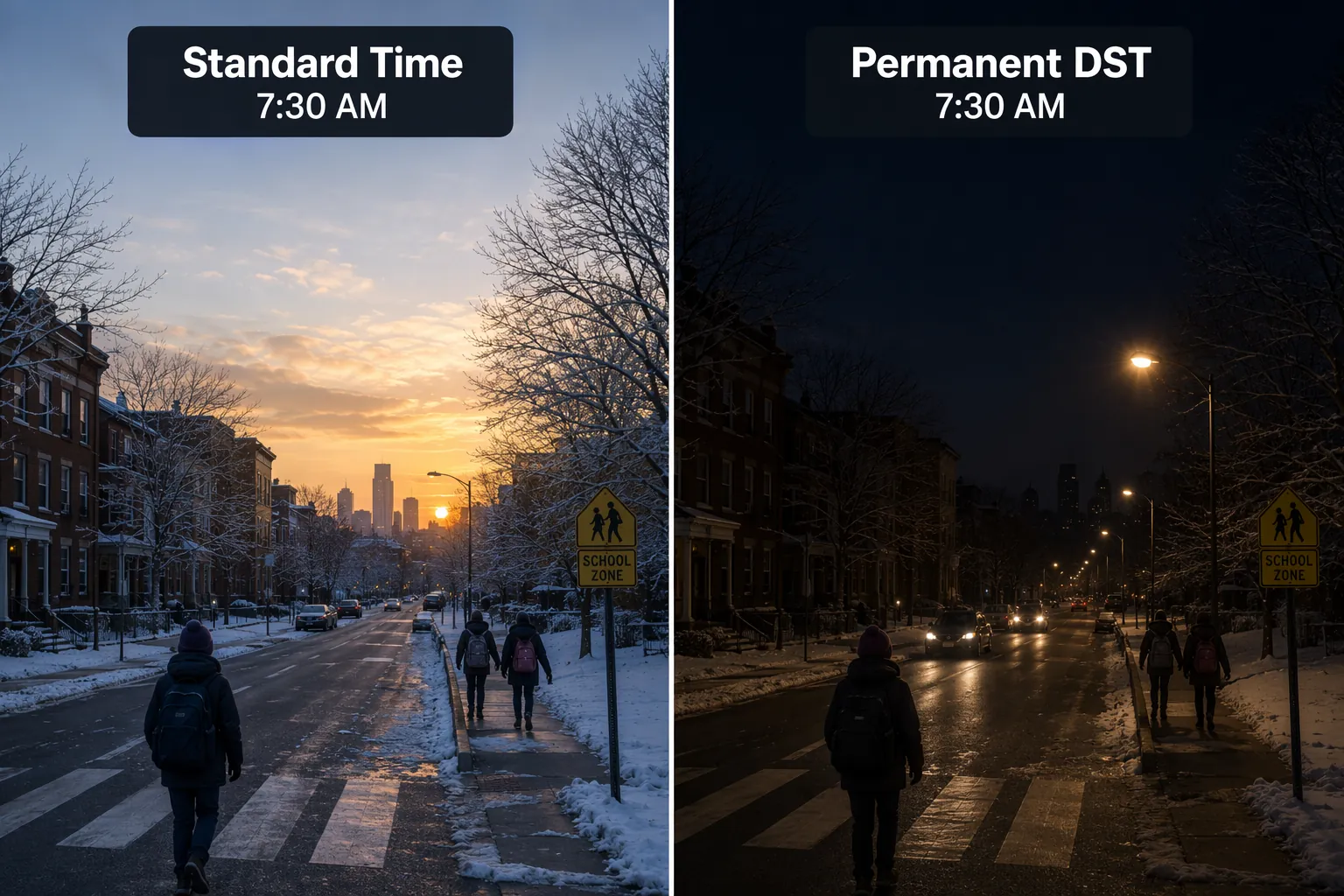
For counsel, the useful question is not whether later evening daylight is popular. It is who cannot move their start time when the statute moves the clock. A student assigned to a fixed bus pickup, a clerk opening a courthouse, a hospital employee reporting before 7 a.m., and a parent driving to a child-care drop-off do not experience the change as an abstract hour. They experience it as darkness placed into a scheduled duty.
Why the sunrise table belongs in risk planning
A later sunrise is not, by itself, proof of negligence in any later accident. It is, however, the sort of condition that can become foreseeable once a district, employer, carrier, or public agency has been warned that its ordinary winter schedule now operates in darkness. That matters for bus-stop placement, lighting audits, pedestrian-routing decisions, start-time negotiations, and written explanations of why an existing schedule was kept or changed.
The most direct safety benchmark in the available record is Gentry et al.’s 2022 Time & Society finding: locations with sunrises at least 30 minutes later had a 21.8% higher motor-vehicle crash fatality rate. That is a population-level association useful for risk screening, not a formula for proving causation in a particular collision. [6]
The city table shows why that benchmark cannot be left in the literature review. Cincinnati around 9:00 a.m. and Billings at 8:51 a.m. are not marginal inconveniences for organizations that put buses, delivery vans, patrol vehicles, court staff, and hourly workers on the road before ordinary business hours. A client advisory does not need to predict a crash; it needs to identify which scheduled movements would newly occur before sunrise and who is responsible for deciding whether the schedule, route, lighting, supervision, or warning system changes.
Health evidence helps frame the risk, but it has limits
The strongest health-evidence anchor is the 2025 Stanford Medicine report on a PNAS modeling study. The model estimated that permanent standard time would reduce obesity by 2.6 million cases and stroke by 300,000 cases, with permanent daylight saving time achieving about two-thirds of that estimated effect. The same source matters for its caveat: the model assumes consistent 10 p.m. to 7 a.m. sleep schedules, so real-world adaptation could produce different population outcomes. [7]
That distinction should stay intact in legal writing. The study is not a clinical guarantee that one clock rule will produce a fixed number of avoided diagnoses. It is evidence that clock policy interacts with light exposure, sleep timing, and health at population scale. For an employer, insurer, school board, or transportation client, that is enough to justify treating the sunrise shift as a planning variable rather than a public-relations footnote.
The burden also does not fall evenly. Krishnan and Johnson’s 2023 Journal of Clinical Sleep Medicine study identifies teenagers, young adults, and lower-income households with early school or work start times as groups that bear disproportionate sleep-loss effects when morning light is delayed. [8]
Those findings fit the practical record. Teenagers often have fixed school start times. Lower-income early-shift workers may have less ability to refuse a start time, work remotely, drive later, or buy substitute child care. Young adults in service, logistics, health-care support, and transportation roles may be reporting to work while office employees are still able to treat the darker morning as a commute preference. A client’s legal exposure will depend on jurisdiction and facts, but the scheduling asymmetry is not hard to identify.
The 1974 episode is a caution, not a one-to-one forecast
Permanent daylight saving time has a prior U.S. test case. In the current debate, Sen. Tom Cotton has cited a February 1974 Time magazine report stating that eight children were killed in pre-dawn Florida traffic accidents during the first two months of the 1974 experiment. The original Time article was not independently retrieved for this article, so the figure should be attributed as Cotton’s floor statement citing Time, with secondary verification rather than treated as a newly authenticated primary-source count. [1][9]
That caveat does not make the episode useless. It makes it usable in the right way. The 1974 account is a vivid warning about children moving through traffic before sunrise, not proof that the same number or pattern would recur in 2026. Rep. Frank Pallone’s counterargument belongs in the same paragraph of any serious advisory: commuting patterns have changed, and far fewer children walk to school today. [1]
The practical question for school districts is therefore narrower and more concrete: which children would still be waiting, walking, biking, or transferring before sunrise under the new clock? That is where the 9 a.m.-area Cincinnati projection and the 8:43 a.m. Atlanta projection become more useful than a national argument about whether the 1970s are comparable.
For a deeper school-specific liability discussion, see How the Sunshine Protection Act Could Expose Schools to Liability.
The law has not changed yet
The House vote does not settle the operating rule. As of July 28, 2026, H.R. 139’s Senate path is uncertain, and the competing Sunshine for Our Kids Act, introduced July 9, 2026, creates a parallel track that could alter the baseline assumption. [1]
State opt-out and federal-authority questions are also active variables, not afterthoughts. The Sunshine Protection Act legislative history includes state-level complications around time-zone authority and daylight-saving observance, and those issues can affect how national clock policy turns into local compliance work. [10] For the constitutional and federalism angle, see Is Permanent Daylight Saving Time Constitutional?.
That uncertainty should be preserved in client communications. The right wording is not that a 9 a.m. sunrise is now certain in Cincinnati; it is that, if permanent DST is enacted and applies locally, published projections place the darkest-winter sunrise around that time. The same conditional framing should be used for staffing models, school transportation memos, court-opening plans, and employee-safety notices.
For broader legislative tracking, see Why permanent daylight saving time legislation keeps failing in Congress.
How to use the projections in an advisory
A legal or risk advisory should start with the city-specific sunrise baseline, then map the client’s fixed obligations against it. The exercise is mechanical enough to do before a statute takes effect and narrow enough to avoid policy advocacy.
- Identify fixed start points: first bell, first bus pickup, courthouse opening, dock shift, patrol change, security post, clinic intake, or required employee arrival.
- Compare those times with the local winter sunrise projection, using the city table only as a baseline and checking the precise address or service area before final advice.
- Separate safety measures by actor: school district, employer, landlord, carrier, public agency, contractor, or parent-facing program.
- Document uncertainty: Senate enactment, local applicability, actual commuting behavior, weather, lighting, supervision, and the limits of modeling studies.
- Avoid converting population-level studies into case-specific causation claims unless the facts and expert record support that step.
Permanent DST would not merely rename the clock. In identifiable cities, it would move winter-morning darkness into school, commute, court, and shift-change hours. The sunrise table is the planning baseline; the crash, sleep, and health studies provide the risk context; and any advisory should keep the remaining uncertainty visible rather than turning projections into promises.
References
- House passage and permanent daylight saving time legislative report, Reuters, July 14, 2026.
- Permanent daylight saving time sunrise projections, AccuWeather, July 2026.
- Atlanta permanent daylight saving time sunrise projection and local impact analysis, The Atlanta Journal-Constitution, July 23, 2026.
- New Jersey sunrise data under permanent daylight saving time, NorthJersey.com, July 15, 2026.
- Ohio permanent daylight saving time sunrise projection, WLWT, 2026.
- Time & Society study on later sunrises and motor-vehicle crash fatality rates, Time & Society, 2022.
- Permanent standard time would be better than permanent daylight saving time for health, study finds, Stanford Medicine, September 2025.
- Journal of Clinical Sleep Medicine study on disproportionate sleep-loss effects under later sunrises, Journal of Clinical Sleep Medicine, 2023.
- Fact-check on 1974 permanent daylight saving time claims, FactCheck.org, June 2026.
- Sunshine Protection Act, Wikipedia.
Operationalizing workflow
No workflow has been explicitly linked to this obligation yet. See Workflows generally.
Illustrative cases
No illustrative case is currently tracked for this obligation. See Risk Digest for documented incidents generally.
← Back to RegulationReport a correction or tip
Spotted an outdated figure, a misstated fact, or a ruling this regulation entry should reflect? Public comments are disabled for this content given the professional cost of a misreported case outcome, penalty amount, or rule text — use the structured correction channel instead.
Report a correction or tip for this record →