
Is Your NYC Property Subject to the 2025 Pied-à-Terre Tax?
- Authority
- New York City Department of Finance
- Rule type
- regulation
- Jurisdiction scope
- US state
- Effective date
- Jul 1, 2026
- Source text
- Read primary rule text ↗
Owners of high-value residential properties must file exemption application by August 21 (houses/condos) or August 24 (co-ops) 2026, providing proof of primary residence, immediate family occupancy, or arm's-length lease.
For anyone searching the NYC pied-à-terre tax eligibility rules for 2025, the first correction is practical: the operative compliance problem is now in 2026. The tax became effective July 1, 2026; the Department of Finance was expected to publish an assessment-roll addendum on July 25; exemption applications are due August 21 for houses and condos and August 24 for co-ops; DOF must send initial notices by August 30; and owners generally have a 30-day appeal window after receiving a notice.[1][2]
That sequence matters more than the label attached to the tax year. A property owner who waits to sort out whether a Manhattan apartment is “really” a non-primary residence can lose the most important part of the file: proof that fits the exemption category DOF recognizes before the August deadline closes.

The Threshold Screen Comes First
The surcharge is not imposed on every second home, every investment apartment, or every owner with an out-of-city mailing address. Phase 1 applies to high-value residential property that meets the statutory threshold and does not qualify for an exemption. For fiscal years 2027 and 2028, the commonly cited Phase 1 rate range in the practical compliance materials is 4.0% to 6.5%, depending on property class and value band.[1][3][4]
| Property type | Phase 1 threshold | Value measure | First question |
|---|---|---|---|
| Class 1 one-, two-, and three-family homes | $5 million or more | DOF market value | Does the DOF market value meet or exceed the Class 1 threshold? |
| Class 2 condos and co-ops | $1 million or more | DOF assessed value | Does the assessed value meet or exceed the Class 2 threshold? |
The Class 1/Class 2 distinction is not a drafting nicety. A $5 million market-value screen for a townhouse is not the same test as a $1 million assessed-value screen for a co-op or condominium. Articles that refer only to “high-value homes” leave out the question that determines whether the property even enters the surcharge analysis.
Once the threshold is met, the owner’s task is not to argue that the property feels unlike a pied-à-terre. The task is to fit the property into a recognized exemption and preserve that claim in the form and timing DOF requires.
The Three Exemption Routes That Usually Matter
The core exemption pathways are narrower than many owners expect, but they are real. The final-rule materials and law-firm analyses identify three recurring routes: qualifying primary-residence use, qualifying immediate-family occupancy, and an arm’s-length lease for at least one year.[2][3][4]
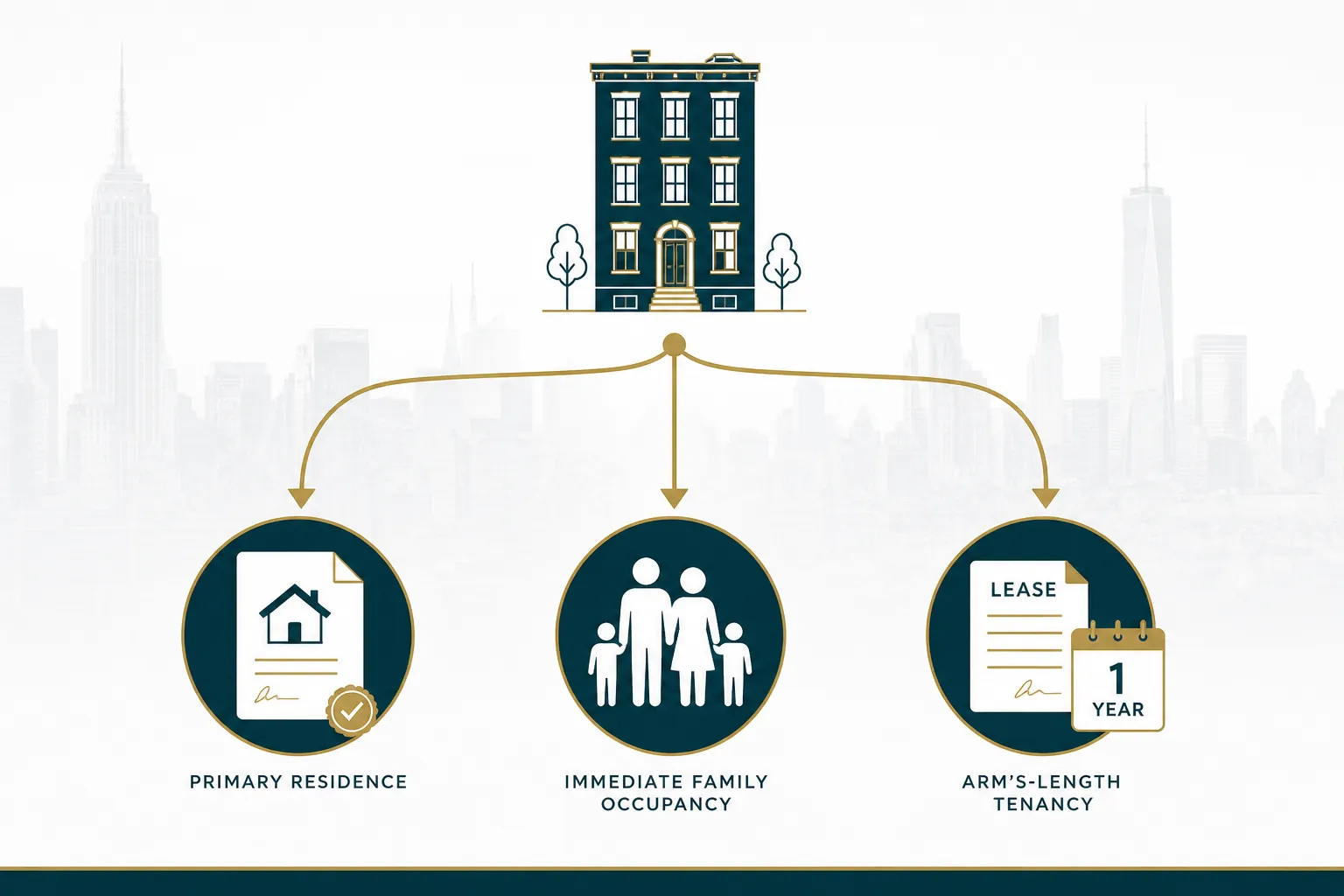
| Route | Basic claim | Main proof problem |
|---|---|---|
| Primary residence | The property is used as the primary residence by a covered owner or qualifying person. | The file must show actual qualifying occupancy as of the taxable status date and under the majority-of-days standard. |
| Immediate family occupancy | A spouse, child, sibling, parent, grandparent, or grandchild uses the property as a qualifying primary residence. | The file must prove both the family relationship and the resident’s primary-residence facts. |
| Arm’s-length tenancy | The property is leased to a tenant under an arm’s-length lease of at least one year. | The lease must be real, sufficiently long, and independent enough to withstand review. |
The immediate-family route is often the difference between a taxable apartment and a defensible exemption file. A parent’s name on a deed, a child’s actual occupancy, and a family explanation may feel obvious within the household. DOF will still need documents that establish the relationship and the resident’s use of the property as a primary residence.
The tenancy route has its own discipline. A short-term arrangement, informal family understanding, or revocable occupancy arrangement is not the same as an arm’s-length lease of at least one year. If the exemption depends on tenancy, the lease file should be treated as tax evidence, not just a real estate document.
Primary Residence Proof Is a File, Not a Label
The January 5 taxable status date anchors the factual inquiry. The practical question is whether the qualifying person occupied the property as a primary residence under the applicable majority-of-days standard, not whether the owner intended to live there someday or used it often enough to feel connected to it.[3][5]
DOF’s evidence structure is especially important because it gives owners a path, but not unlimited discretion. Sullivan & Cromwell describes a two-route system: a New York State income tax return listing the property as the permanent address, or a combination of driver’s license, voter registration, and additional proof.[3]
| Evidence route | What it generally requires | What counsel should check |
|---|---|---|
| Tax-return route | A New York State income tax return listing the property as the permanent address. | Whether the return position is consistent with the owner’s broader residency posture. |
| License/voter route | Driver’s license and voter registration tied to the property, plus additional supporting proof. | Whether the documents align with utility, insurance, financial, family, and occupancy records. |
| Family-occupancy route | Proof of immediate-family relationship and the family member’s primary-residence use. | Whether the resident, not merely the owner, satisfies the occupancy and document trail. |
| Lease route | An arm’s-length lease for at least one year. | Whether the tenant, term, rent, and possession facts support an independent tenancy. |
A clean exemption file usually starts with the boring documents: tax return address, driver’s license, voter registration, lease term, family occupancy facts, utility and insurance records, and any ownership chart needed to show who counts as a covered owner. Those documents are not interchangeable. A driver’s license may support residence, but it does not prove an arm’s-length lease. A lease may support tenancy, but it does not solve an owner’s separate residency inconsistency.
The harder files are the ones where the facts sound sympathetic but do not yet map to an exemption: an apartment held empty during renovations, a property reserved for post-retirement use, a unit used intermittently by several family members, or a trust-owned co-op where no one has drawn a simple beneficiary chart. Those files need sorting before a notice arrives, because the August window is not built for reconstructing years of household practice.
Trusts, Entities, Co-ops, and Unsold Units
Ownership form can change the exemption analysis. Rosenberg & Estis’ final-rule discussion is useful here because it separates rules that sound similar in conversation but function differently in a filing. For trusts, multiple individuals may collectively be the sole beneficiaries, and contingent or future interests may be disregarded for this purpose.[2]
For entity-owned property, direct members or partners may aggregate interests to show a greater-than-50% majority interest, but multi-tier structures are excluded from that look-through treatment.[2] That is a material limitation for family offices and investment structures that hold New York residential property through stacked LLCs or partnership chains.
| Ownership structure | Rule or issue | Risk if ignored |
|---|---|---|
| Trust | Multiple individuals may collectively qualify as sole beneficiaries; contingent and future interests may be disregarded. | A trustee may overstate or understate exemption eligibility without a beneficiary analysis. |
| Direct entity ownership | Direct members or partners may aggregate more than 50% majority interests. | A filing may fail if the ownership chart stops at the entity name. |
| Multi-tier entity structure | Multi-tier look-through treatment is excluded. | A family or investment structure may not qualify even if ultimate owners are identifiable. |
| Co-op | Boards face statutory collection mechanics and possible conflicts with existing corporate and proprietary-lease structures. | Collection obligations may arise before governing documents are fully aligned. |
| Unsold units | Final-rule analysis identifies an exclusion for unsold units. | Sponsors and boards need to separate excluded units from taxable or exemption-claim units. |
Co-ops deserve their own caution. Holland & Knight flags the statutory collection mandate and possible conflicts involving Business Corporation Law §501 and federal tax rules if proprietary leases are not amended.[1] That does not mean every co-op dispute is ripe on the same facts. It does mean boards should not assume the surcharge is solely an owner-level problem once billing and collection mechanics reach the building.
What to Do When a DOF Notice Arrives
A notice recipient should first confirm that the property is in the taxable class and value band, then decide whether the response is an exemption filing, a valuation challenge, or both. Katten’s notice-response guidance emphasizes fast triage: identify the property class, verify the assessment basis, gather exemption evidence, and preserve appeal rights within the available window.[6]
- Confirm the property classification: Class 1 house or Class 2 condo/co-op.
- Confirm the applicable value measure: market value for Class 1, assessed value for Class 2.
- Match the facts to one exemption route: primary residence, immediate family occupancy, or arm’s-length lease.
- Collect documents that fit that route rather than documents that merely tell a favorable story.
- Calendar the August 21 or August 24 exemption deadline and the 30-day appeal period after notice.
- Check for audit exposure before submitting any statement that could later be characterized as negligent or bad-faith.
The audit and enforcement provisions make the filing more than a one-season administrative task. DOF has six-year audit authority, and negligent or bad-faith misrepresentations can carry a 50% penalty, with lien and foreclosure mechanisms available for unpaid amounts.[3][4] A rushed exemption claim may solve the August problem and create a worse record for the next six years.
Where the File Can Still Burn You
Statutory residency exposure
The most uncomfortable exemption file is the one that asks New York City to accept primary-residence facts while another part of the owner’s tax life depends on a different residency posture. Kaufman Rossin illustrates the point with a Greenwich-domiciled partner whose facts could produce a $183,750 pied-à-terre tax exposure, while also raising the separate concern that claiming New York City primary-residence treatment may disturb statutory residency analysis.[7]
That concern should be framed carefully. The current materials support a potential exposure warning, not a settled rule that every pied-à-terre exemption claim creates city-residency liability. Hodgson Russ and Holland & Knight similarly flag the issue as a factual and legal risk area.[1][5] The practical response is to have state and local tax counsel review the exemption position before the filing is made, especially where domicile, day count, and permanent-place-of-abode issues are already sensitive.
Renovation and contemplated use
Renovating a property for future occupancy is not the same as occupying it as a qualifying primary residence. The available guidance identifies “contemplated use” as a trap: an owner may have a credible plan, substantial construction records, and a sincere explanation, while still lacking actual qualifying occupancy for the relevant period.
That distinction is harsh but administrable. Tax files work better with dates, addresses, leases, and actual occupants than with intent. If renovations interrupted occupancy, the exemption file should confront that fact directly rather than bury it under invoices and architectural plans.
Valuation and Phase 2 uncertainty
Phase 1 is the immediate filing problem. Phase 2 valuation remains less settled in the available materials, and Hodgson Russ notes uncertainty around future valuation methodology.[5] That uncertainty is not a reason to miss a current exemption deadline. It is a reason to preserve rights now and avoid relying on later guidance to repair a missed 2026 filing.
Appeals and legal challenges
Morgan Lewis is most useful on process and challenge posture: owners should prepare for exemption filings, appeals, and potential legal challenges rather than treating the DOF notice as a final bill.[8] The appeal window is short, and it should be handled as a preservation exercise even where broader constitutional or statutory arguments may later be developed.
For rate calculations, use the 4.0% to 6.5% Phase 1 range reflected in the main compliance materials, not conflicting lower-rate summaries. A spreadsheet built on the wrong rate range is not a harmless placeholder when it drives settlement posture, board communications, or client reserves.
A Brief Context Note
The tax also sits inside a political and revenue debate. CNBC covered the May 2026 passage and the surrounding political context.[9] The New York City Comptroller previously estimated potential pied-à-terre tax revenue at $340 million to $380 million, compared with a $500 million estimate associated with the Governor’s proposal.[10]
Those numbers may explain why the tax exists. They do not answer whether a particular apartment, townhouse, trust-owned unit, or co-op share must pay it in August 2026. That answer still turns on class, value measure, taxable status date, actual occupancy, ownership attribution, lease terms, and the documents submitted on time.
The Conservative Compliance Position
Many high-value NYC properties will have a defensible exemption. A primary residence, a qualifying immediate-family occupant, or an arm’s-length tenant with a lease of at least one year can take the property out of the surcharge if the facts and proof line up. The risk is assuming that the conclusion is obvious before the file is built.
For Q3 2026, the safer posture is narrow and procedural: use the 4.0% to 6.5% Phase 1 rates; verify every exemption against the final DOF rules; treat statutory residency and renovation-intent arguments as material open issues; and do not wait for later guidance on co-op mechanics, LLC attribution, or Phase 2 valuation before preserving current rights.
References
- New York State Enacts Pied-à-Terre Tax, Holland & Knight
- NYC Finalizes Pied-à-Terre Tax Rules: Property Owners Should Check the July 25 Assessment Roll Addendum, Rosenberg & Estis
- New NYC Non-Primary Residence Tax, Sullivan & Cromwell
- New York City’s New Pied-à-Terre Tax Effective July 1, 2026, Steptoe
- The Pied-a-Terre Tax Has Landed, Hodgson Russ
- Received a NYC Pied-à-Terre Tax Notice? What Homeowners Must Do Now to Avoid the Surcharge, Katten
- Pied-à-Terre Tax, Kaufman Rossin
- NYC Property Owners Should Prepare for Pied-à-Terre Tax Exemptions, Appeals, and Legal Challenges, Morgan Lewis
- New York Mamdani Pied-a-Terre Tax Passes, CNBC, May 28, 2026
- The Pied-à-Terre Tax and Its Potential Revenues, New York City Comptroller
Operationalizing workflow
No workflow has been explicitly linked to this obligation yet. See Workflows generally.
Illustrative cases
No illustrative case is currently tracked for this obligation. See Risk Digest for documented incidents generally.
← Back to RegulationReport a correction or tip
Spotted an outdated figure, a misstated fact, or a ruling this regulation entry should reflect? Public comments are disabled for this content given the professional cost of a misreported case outcome, penalty amount, or rule text — use the structured correction channel instead.
Report a correction or tip for this record →