
The Legal Framework for Data Center Backup Generation in PJM
- Authority
- U.S. Department of Energy
- Rule type
- standing order
- Jurisdiction scope
- US federal
- Source text
- Read primary rule text ↗
Comply with PJM Backup Generator Action instructions within 15 minutes; maintain environmental compliance records and notify state DEQ if required under applicable law.
When a PJM backup-generation instruction reaches a data center control room, the legal question is no longer limited to whether the generator can start. For large data centers in PJM, emergency backup power now sits inside a layered compliance chain: DOE emergency authority under Federal Power Act Section 202(c), PJM’s emergency procedure as revised in Manual 13, and the facility’s federal and state air obligations. DOE’s published 2026 order list shows at least six PJM backup-generation curtailment orders or amendments — Order Nos. 202-26-06, 202-26-06A, 202-26-23, 202-26-33, 202-26-33A, and 202-26-35 — and PJM’s June 24, 2026 Manual 13 Revision 98 is reported to have created an escalation sequence of Capacity Advisory, Backup Generator Warning, and Backup Generator Action, with a 15-minute response point at the Action stage.[1][2][3]
For a covered operator, the instruction is not merely an operations request. It can activate a federal emergency order, a PJM procedural obligation, and an environmental compliance problem at the same time. Reporting on the DOE orders describes PJM as authorized to direct data centers with at least 50 MW of peak load to move onto backup generation as a last resort before Energy Emergency Alert Level 3, although the 50 MW threshold remains tied to DOE order language rather than a fully embedded PJM governing-document standard as of the latest reporting.[3][4]
| Article posture | Scope used here |
|---|---|
| Current as of | Q3 2026, using 2026 DOE Section 202(c) order materials and cited 2026 PJM/trade reporting. |
| Category | Regulation and ethics; not legal advice. |
| Primary source footing | DOE 2026 Section 202(c) order list for order existence and sequencing. |
| PJM procedure footing | Manual 13 Revision 98 mechanics are described from PJM Inside Lines and Data Center Knowledge reporting; the Manual 13 PDF was not independently reviewed for this article. |
| State-law coverage | Concrete examples are limited mainly to Virginia and Illinois because those materials are the most developed in the available record. |
The risk is not hypothetical, and it is not confined to a late-summer peak narrative. The May 18, 2026 order was triggered when PJM had less than 5,800 MW of reserves while more than 40 GW of generation was offline for planned maintenance, a spring-maintenance condition that mattered precisely because the system was short before the classic heat-wave framing took over.[1][5] During the July 2026 heat wave, PJM reportedly used the Backup Generator Warning process operationally for the first time; demand response reduced 6,113 MW on July 2, though PJM did not escalate to a full Backup Generator Action order.[3][4]

The federal order is the first document in the stack
The first question for counsel is not whether the generator is called “backup” in the facility documents. The first question is whether a DOE Section 202(c) order is in effect, whether PJM’s instruction falls within that order, and whether the facility is within the covered class of large loads. Once that answer is yes, the generator’s historical role as idle emergency equipment becomes less important than the legal character of the present instruction.
Section 202(c) orders are emergency instruments. They do not turn every data center generator into a market resource in the ordinary sense, and they do not by themselves settle compensation, tariff status, or emissions accounting. But repeated orders change the compliance posture. A one-off emergency may be handled as an exception file. At least six orders and amendments in the same year require a standing playbook, identified decision-makers, and a defensible record of what the operator did when PJM moved from warning to action.[1]
The hierarchy matters. Federal emergency authority supplies the legal basis. PJM’s manuals and notices supply the operational mechanism. Environmental statutes, federal engine rules, and state permits remain relevant because the DOE order language does not neatly rewrite them in advance. Treating those layers as interchangeable is how a 15-minute dispatch issue becomes a months-long enforcement file.
How PJM turns emergency authority into an instruction
The federal/PJM handoff is the most important operational development in 2026. DOE’s orders provide the emergency authority; PJM’s revised emergency procedures provide the sequence by which large-load curtailment and backup generation can become actionable inside the control room. Reported Manual 13 Revision 98 mechanics use a staged sequence rather than a single surprise command: Capacity Advisory, Backup Generator Warning, and then Backup Generator Action.[2][3]
| Stage | Legal and operational consequence |
|---|---|
| Capacity Advisory | Reportedly can provide up to five days of advance notice that PJM sees a capacity concern. This is the point to assemble the legal, facilities, environmental, and communications file before any generator run. |
| Backup Generator Warning | Signals that PJM may need covered large-load facilities to prepare backup generation. The warning matters even if no run occurs, because it tests whether the operator can identify covered assets, exemptions, permit limits, and contacts quickly. |
| Backup Generator Action | Reported as the point at which PJM can require response within 15 minutes. This is where the order ceases to be planning material and becomes a contemporaneous compliance event. |
A lawyer reviewing the Action stage should resist the temptation to flatten the instruction into either “must run” or “cannot run.” The better record asks a narrower set of questions: What DOE order is PJM invoking? Which facility and meters are covered? Is the load at or above the applicable threshold? Are any exempt functions involved? Which generators are physically available? Which permits, federal engine classifications, run-hour logs, and reporting duties attach? Who has authority to approve a run if environmental limits may be approached?
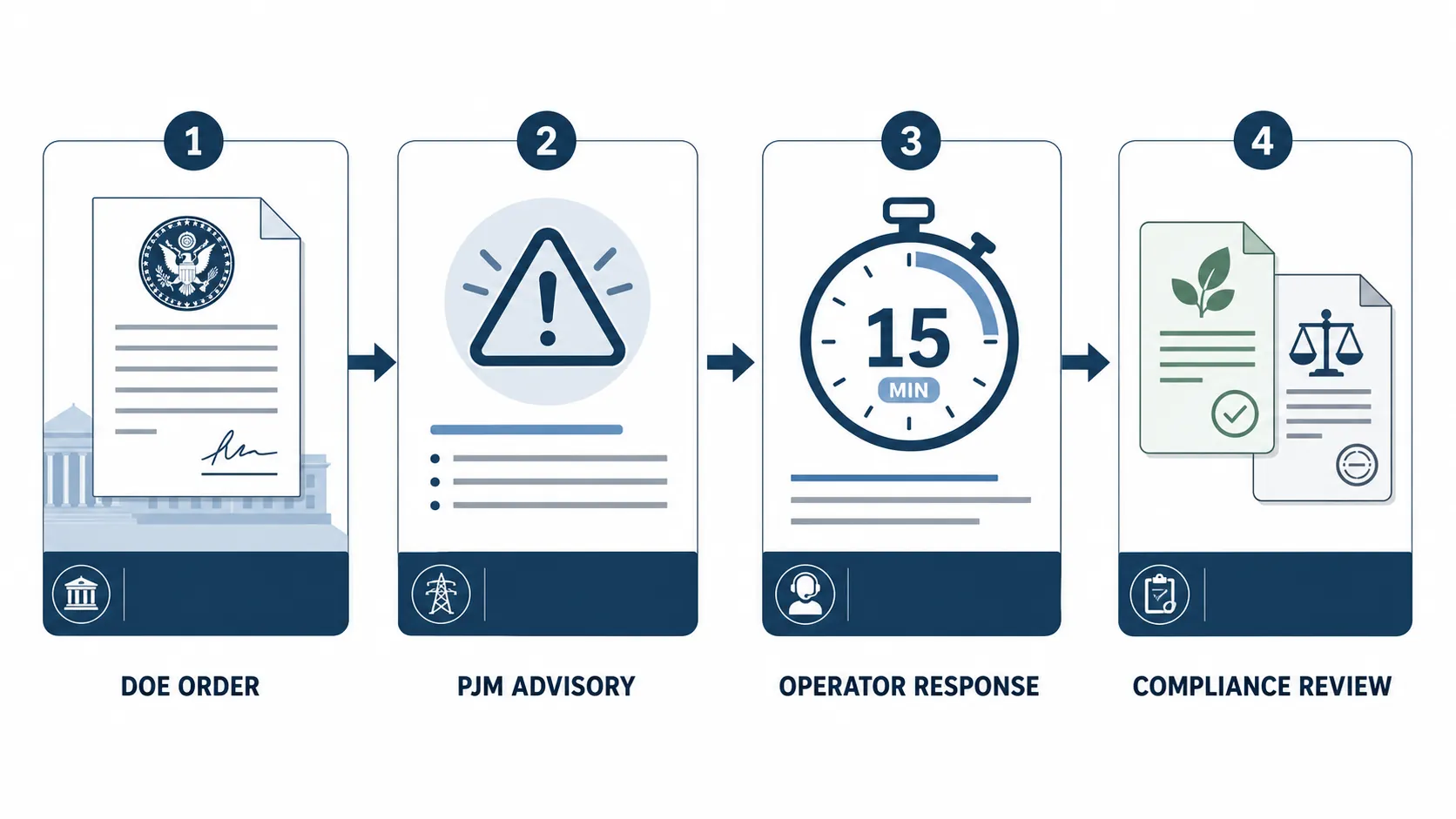
The hard part is timing. A Capacity Advisory may give days. A Warning may give hours or less. A Backup Generator Action, as reported, puts the operator at a 15-minute response point.[2][3] That response window is too short for first-time legal analysis of air permits, RICE rule status, state notification duties, or customer-service consequences. Those decisions need to be reduced to a pre-cleared matrix before the warning, not invented during the action.
Coverage, thresholds, and exemptions
The 50 MW figure should be used carefully. It appears in the June 30, 2026 order framework and is being followed by PJM as the DOE order’s definition, but reporting states that the threshold has not yet been formally adopted into PJM’s governing documents.[3] That distinction is not academic. A threshold embedded in a tariff, operating agreement, or manual has a different administrative posture from a threshold incorporated through an emergency order. Covered operators still need to respond to a valid order, but counsel should preserve the source of the obligation in the record.
The same is true of exemptions. Hospitals, 911 services, water treatment plants, air traffic control, and defense installations are reported as categorically exempt from curtailment orders.[6] For mixed-use campuses, that does not end the analysis. A data center supporting an exempt function, adjacent to an exempt function, or sharing electrical infrastructure with an exempt function should not assume that the entire load is exempt. The file should identify the exempt load, the legal basis for the exemption, and the operational method for avoiding an instruction that would impair it.
Nor is the available megawatt quantity a settled public fact. The current materials do not pin down how many megawatts of data-center backup generation PJM can actually dispatch in practice. The legally useful point is narrower: PJM now has an emergency process that can reach covered large-load backup generation, while the exact dispatchable inventory remains uncertain.
The environmental order language does not erase the air permit
The environmental collision is where the “backup” label becomes most misleading. A generator permitted, modeled, and logged as emergency or limited-use equipment may be asked to operate because PJM needs grid support. The DOE order may require action under federal emergency authority, but the generator’s Clean Air Act framework may still classify hours, emissions, maintenance testing, demand response, and reporting in categories that were not drafted around RTO-directed dispatch.
The phrase that usually appears in this discussion is that environmental compliance must be maintained “to the maximum extent practicable.” That language matters, but it should not be read as a blanket permit amendment. It does not automatically convert non-emergency hours into emergency hours. It does not necessarily suspend state permit conditions. It does not answer whether a RICE NESHAP or NSPS hour category has been exceeded. It is better understood as a duty to comply where practicable, minimize noncompliance where compliance is not practicable under the emergency order, and create a contemporaneous record explaining the choices made.[1]
That record should be specific enough to survive later review. A useful file identifies the PJM notice stage, the DOE order number, the start and stop time, the units operated, the load transferred, the emissions controls used or unavailable, the permit conditions reviewed, the personnel approving the run, and any notice made to a state agency. A conclusory note saying “PJM ordered us to run” may be true and still be insufficient.
The 50-hour demand-response rule stops short of PJM-directed dispatch
The unresolved gap is the federal engine-rule treatment of non-emergency demand-response operation. Current legal analysis of EPA’s 50-hour allowance describes it as permitting emergency generators to operate up to 50 hours per year for certain non-emergency demand-response purposes, but not when the dispatch comes from an RTO or ISO such as PJM. The allowance is described as limited to local balancing authorities, not wholesale-market RTO/ISO dispatch.[7][8]
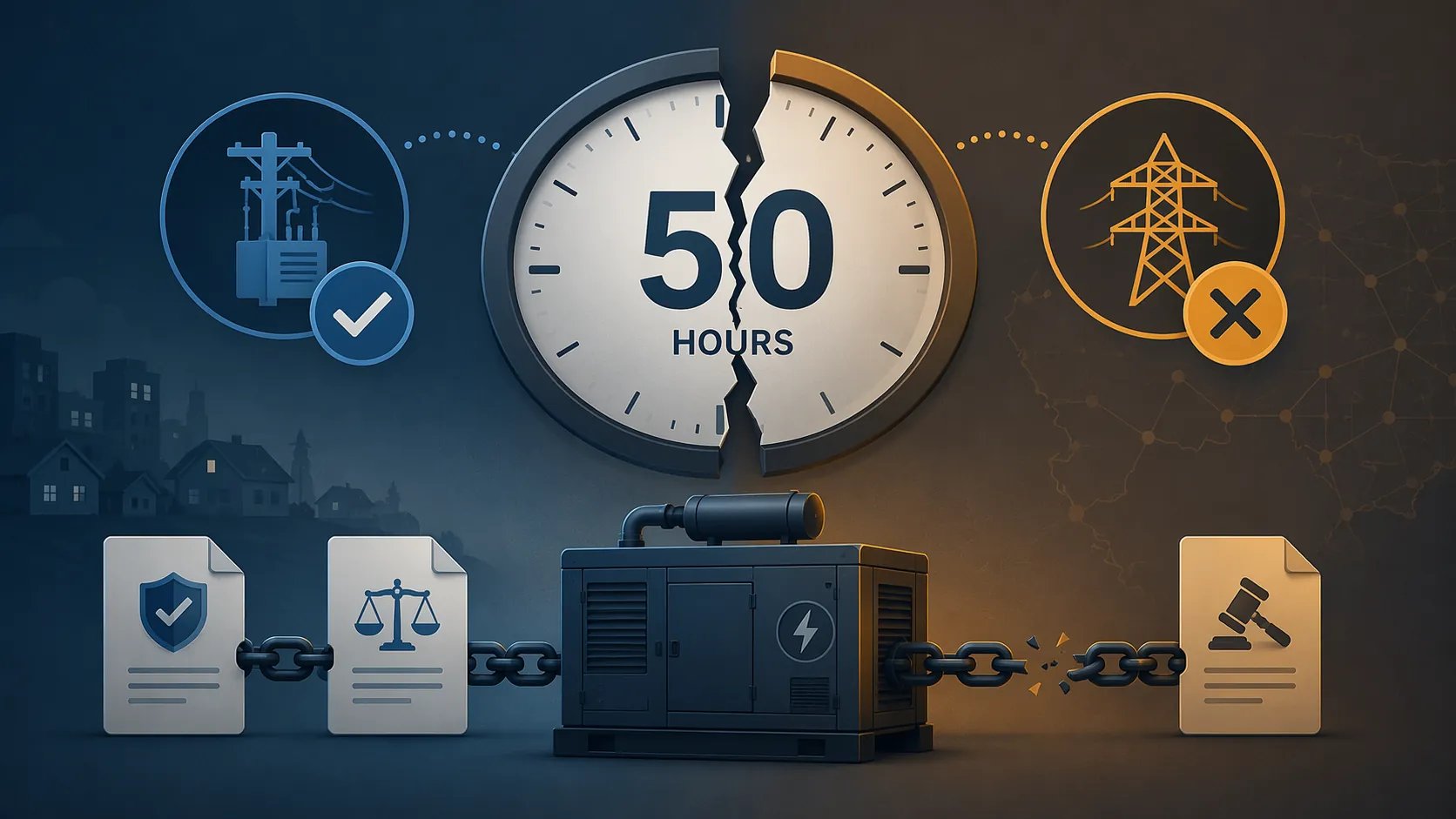
That is the Catch-22 for extended operation. PJM may be acting under DOE emergency authority and may direct a covered data center to move load onto onsite generation. Yet the EPA 50-hour non-emergency demand-response pathway, as currently described, does not appear to fit RTO-directed dispatch. The May 2025 Duke Energy interpretation clarified when some operators may use emergency backup generators, but available analysis does not treat it as having solved the wholesale-market PJM problem.[7][8]
For counsel, the consequence is not that every PJM-directed run is unlawful. The consequence is that the run cannot be cleared by pointing to the 50-hour rule unless the facts actually fit that rule. If the dispatch is RTO-directed, the operator needs a separate legal theory tied to the DOE order, the facility’s permit, the applicable federal engine standards, and any state-agency guidance or reporting requirement. If EPA later changes the rule, that may alter future analysis; it does not fill the gap for a present dispatch record.
State examples show why the permit file cannot be generic
Virginia is the obvious stress test because its data center generator fleet is large and heavily scrutinized. Available air-permitting commentary describes roughly 9,000 permitted generators at Virginia data centers, with about 8,000 characterized as Tier II units without advanced NOx controls.[9][10] Virginia’s revised DEQ guidance, effective July 1, 2026, establishes Tier 4 BACT at 0.60 g/hp-hr and is tied to HB 507’s new statutory framework.[9][3][6]
HB 507 also matters operationally because reporting describes it as requiring data centers to notify DEQ when generators operate and to conduct air monitoring.[6][9] A PJM Action notice therefore may require more than a generator start and a PJM response. In Virginia, the operator may need a state-notification workflow that can run on the same compressed timeline, or at least a documented basis for any notice made after the run begins.
Illinois shows the same problem through a different rule set. The Clean and Reliable Grid Affordability Act is described as requiring Tier 4-equivalent standards for diesel backup gensets and Tier 2 standards for natural-gas backup gensets.[10] That does not answer PJM dispatch treatment by itself, but it confirms that a data center’s backup-generation obligation cannot be reviewed only at the PJM footprint level. The state permit and state generator standard may decide which unit can run, how long it can run, and what must be reported afterward.
Tariff treatment and revenue mechanisms remain unsettled
The emergency-order framework should not be confused with a mature participation model. CIFP developments, behind-the-meter generation questions, and co-location proceedings show that PJM and FERC are still working through how large loads, onsite generation, and grid services should be classified and compensated.[11][12] Those proceedings may eventually produce clearer pathways for resources that can reduce load or support the grid. They do not currently supply a complete answer to the emergency backup-generator problem.
That matters because legal compulsion and revenue eligibility are separate questions. A DOE-backed PJM instruction may require action even if the operator has not enrolled the generator as an ordinary market resource or secured a clean revenue stream. Conversely, a future tariff product would not automatically cure air-permit hour limits. The compliance file should keep those questions separate: authority to instruct, duty to respond, eligibility for payment, environmental permission, and reporting.
What should be decided before the next warning
A covered data center should be able to answer the following before PJM issues the next Backup Generator Warning: which facilities meet or may meet the 50 MW threshold; which loads are exempt or tied to exempt services; which generators are legally and physically available; which units have Tier 4, Tier II, or other relevant classifications; which permits constrain hours, emissions, fuel, testing, or dispatch; whether the EPA 50-hour pathway is unavailable because the dispatch is PJM-directed; and who can approve operation when environmental compliance is uncertain.
The final point is simple enough to put in the runbook: a PJM backup-generation instruction is not only an operations event. For covered data centers, it can activate a federal compliance duty, a PJM procedural duty, and a still-imperfect environmental compliance analysis. The review belongs before the warning, not after the generator has already run.
References
- 2026 DOE 202(c) Orders, U.S. Department of Energy.
- PJM Inside Lines, PJM.
- Data Center Knowledge July 20, 2026 reporting, Data Center Knowledge, July 20, 2026.
- Utility Dive reporting on PJM backup generation orders, Utility Dive.
- DOE's Emergency Order Signals New Role for Data Centers' Backup Power, Gibson Dunn.
- Inside Climate News reporting on data center generator exemptions and Virginia HB 507, Inside Climate News.
- New EPA Guidance Clarifies When Data Centers and Other Operators May Utilize Emergency Backup Generators, Kirkland & Ellis.
- CPower Energy analysis of EPA emergency backup generator guidance, CPower Energy.
- Frequently Asked Air Questions: Understanding Data Center Emergency Generators and Their Air Permits, Williams Mullen.
- Encino Environmental analysis of data center generator standards, Encino Environmental.
- PJM proposes to carve out new services for co-located data centers, White & Case.
- FERC's PJM Co-Location Order: A Turning Point for AI Data Center Power Strategy, Steptoe & Johnson.
Operationalizing workflow
No workflow has been explicitly linked to this obligation yet. See Workflows generally.
Illustrative cases
No illustrative case is currently tracked for this obligation. See Risk Digest for documented incidents generally.
← Back to RegulationReport a correction or tip
Spotted an outdated figure, a misstated fact, or a ruling this regulation entry should reflect? Public comments are disabled for this content given the professional cost of a misreported case outcome, penalty amount, or rule text — use the structured correction channel instead.
Report a correction or tip for this record →