
Does the PROMISE Act Cut Social Security Benefits?
- Authority
- U.S. Senate
- Rule type
- statute
- Jurisdiction scope
- US federal
- Source text
- Read primary rule text ↗
Forces expedited congressional consideration of a Social Security solvency plan; does not change benefits or taxes.
No. The PROMISE Act does not cut Social Security benefits, change eligibility, raise payroll taxes, alter COLAs, impose means-testing, or rewrite the benefit formula. As introduced, S. 4979 is a procedural bill: it tries to force a Social Security solvency proposal through a defined congressional process, rather than making any beneficiary’s check smaller by itself.[1][2]
The number alarming people — a 22% benefit reduction — comes from a different legal mechanism. That is the projected current-law automatic reduction if the Old-Age and Survivors Insurance trust fund is depleted in Q4 2032 and Congress has not enacted a fix. The 2026 Trustees Report was released before the PROMISE Act was introduced, and the projected cut is part of the current-law baseline, not a new cut created by this bill.[3]
As of July 28, 2026, the bill remains in committee and could be amended. That caveat is not decorative. A later version of any Social Security bill can matter very much. But the question most readers are asking is narrower: whether the PROMISE Act now pending would reduce next month’s benefit, or any benefit under the existing formula. On the text and descriptions now available, it would not.
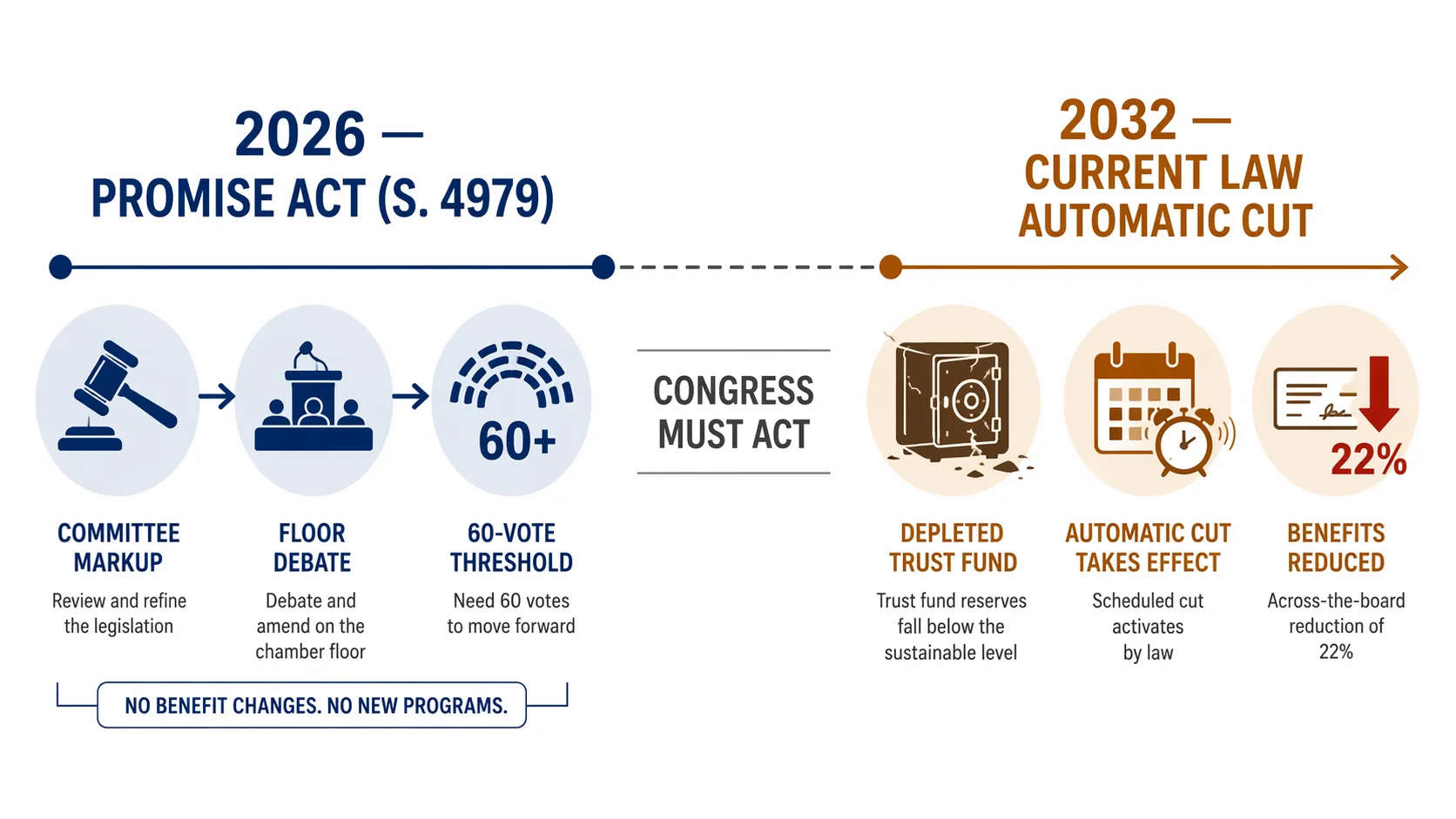
Two separate events are being blended together
The PROMISE Act was introduced in July 2026 as a mechanism to make Congress consider Social Security solvency legislation. The 22% reduction is the benefit cut projected under current law if the OASI trust fund runs out of reserves in 2032. Those two facts can appear in the same news story because the bill is aimed at the same problem that produces the projected cut. They are not the same legal act.
That distinction is not a technicality. A bill that changes the benefit formula, raises the retirement age, changes the COLA formula, or adds means-testing would operate directly inside Social Security’s benefit rules. The PROMISE Act, by contrast, creates a sequence for producing and voting on a solvency plan. The danger it is responding to is real; the attribution of the cut to this bill is the part that needs correction.
What the PROMISE Act would actually do
The bill’s operative idea is a forced process. It would direct the Social Security Advisory Board to produce a plan intended to restore long-term solvency, then require congressional committees and the Senate to handle that plan under an expedited structure. BPC Action describes the pathway as a Social Security Advisory Board plan, committee consideration, extended floor debate, and a Senate vote threshold; CRFB likewise describes the bill as a way to jumpstart action rather than as a benefits rewrite.[1][4]
| Procedural step | What it does | What it does not do |
|---|---|---|
| SSAB solvency plan | Requires the Social Security Advisory Board to produce a plan aimed at solvency.[1] | Does not itself amend the benefit formula or change anyone’s current check. |
| Committee consideration | Moves the plan into congressional committee action under a defined timetable.[1] | Does not make the committee’s eventual policy choices automatic. |
| Floor debate | Allows extended floor debate, reported as 100 hours under the proposed process.[1] | Does not enact benefit cuts merely because debate occurs. |
| Senate vote threshold | Uses a 60-vote Senate threshold in the described process.[1][4] | Does not bypass the need for Congress to pass legislation. |
Some reported timelines put the SSAB plan at roughly 60 days after enactment, with committee action and a lame-duck floor vote later in 2026 if the bill were enacted on that schedule.[5][6] The important phrase is “after enactment.” A bill being introduced does not start reducing benefits; a procedural timetable, even an aggressive one, is not the same thing as a change in benefit law.
This is also where sponsor-friendly shorthand can become unhelpful. Calling the PROMISE Act a bill to “save Social Security” skips the hard part. It does not decide which taxes, benefits, eligibility rules, or transfers would be used to close the gap. It tries to force Congress to confront those choices in a structured way.
What the bill does not touch
As introduced, the PROMISE Act does not raise the payroll tax rate. It does not raise the retirement age. It does not change the COLA formula. It does not add means-testing. It does not repeal or alter WEP/GPO rules. It does not recalculate benefits for current retirees or near-retirees. Those are the kinds of provisions one would look for in a bill that directly changes Social Security benefits; they are not the operative provisions of this procedural proposal.[2]
That does not mean a future solvency package produced through this process would be harmless, generous, austere, or politically acceptable. It means the PROMISE Act itself is not that package. The legal lever missing from S. 4979 is the lever that would actually change benefit calculations.
Where the 22% figure comes from
The 22% figure comes from the 2026 Social Security Trustees Report’s projection for the OASI trust fund. The report projects that the OASI trust fund will be depleted in Q4 2032; if that happens and Congress has not acted, incoming payroll tax revenue would be insufficient to pay scheduled benefits in full, producing an automatic across-the-board reduction under current law.[3]
Some coverage uses “roughly 20%” instead of 22%. That is not necessarily a contradiction; it is a rounded description of the same basic trust-fund shortfall problem. But when a reader is trying to understand what is legally projected, the cleaner number to use for the OASI current-law automatic reduction is 22%, because that is the figure tied to the 2026 Trustees Report discussion.[3][5][6]
The dollar examples explain why the headline spread so quickly. One report translated the automatic cut into roughly $450 a month for an average monthly benefit of $2,071, and about $10,560 a year for a couple with roughly $3,600 in combined monthly benefits.[7] Those examples describe the current-law shortfall scenario. They are not estimates of a PROMISE Act benefit cut.
There is one additional accounting nuance. Discussions sometimes combine the OASI trust fund with the Disability Insurance trust fund. Under a combined OASI/DI framing, depletion is discussed around 2034 with a smaller projected reduction of about 17%, but that combination itself would require legislation and is not the same as the OASI-only trigger described above.[8] For a beneficiary trying to identify the source of the 22% warning, the OASI current-law projection is the relevant point.
The SSAB role is a real complication, not a hidden benefit cut
The Social Security Advisory Board piece deserves attention because the bill gives the board the first drafting assignment. The SSAB describes itself as an independent, bipartisan board that advises the President, Congress, and the Commissioner of Social Security on Social Security and Supplemental Security Income policy.[9] Its ordinary role is advisory, not legislative command.
There is also a practical capacity issue: reporting on opposition to the expedited process noted that only 4 of the board’s 7 seats were filled.[10] That does not turn the PROMISE Act into a benefits cut. It does, however, raise a fair question about how realistic and representative a forced SSAB-led plan could be, especially on a short timetable.
That is the right criticism to keep separate from the wrong one. A process can be rushed, politically loaded, or poorly designed without itself reducing checks. If Congress later used the process to pass a solvency bill that changed benefits, taxes, or eligibility, that later bill would need to be read on its own terms.
Why the bill is controversial even though it does not cut benefits
The controversy is about process and power. Supporters present the PROMISE Act as a way to force Congress to stop waiting for the trust fund deadline.[4] Critics object to an expedited process for a program that affects retirees, disabled workers, survivors, and families across the country.[10] Both positions can exist without changing the basic answer to the benefits question.
For lawyers, firm managers, and anyone fielding calls from older clients or family members, the useful clarification is narrow: this is a statutory-process issue. It is not an AI-risk story and it should not be dressed up as one. It belongs in a regulation-and-ethics conversation because precise legal characterization matters when public benefits are involved.
What can be responsibly concluded now
A benefits recipient does not need to treat the PROMISE Act, as introduced, as notice that a Social Security check is about to be reduced. The bill does not change the payment formula, eligibility rules, payroll tax rate, COLA calculation, or retirement age.
The real risk is the already projected current-law reduction in 2032 if the OASI trust fund is depleted and Congress does nothing. The PROMISE Act is one proposed procedural response to that risk. It is not the cut.
References
- Fact Sheet: The PROMISE Act, BPC Action.
- Social Security reform, CNBC, July 14, 2026.
- Social Security Trustees Report: 22% Benefit Cut Looms In 2032, Forbes, June 10, 2026.
- PROMISE Act Jumpstarts Path Toward Saving Social Security, Committee for a Responsible Federal Budget.
- Social Security Update: Congress Forced to Make Major Changes Under Proposal, Newsweek.
- Bipartisan group of senators introducing legislation to avert looming Social Security benefit cuts, ABC News.
- New bipartisan plan seeks to prevent Social Security benefit cuts from trust fund depletion, Fox Business.
- 2026 Social Security Trustees Report Explained, Bipartisan Policy Center.
- About, Social Security Advisory Board.
- AARP opposes expedited Social Security process proposed in PROMISE Act, HousingWire.
Operationalizing workflow
No workflow has been explicitly linked to this obligation yet. See Workflows generally.
Illustrative cases
No illustrative case is currently tracked for this obligation. See Risk Digest for documented incidents generally.
← Back to RegulationReport a correction or tip
Spotted an outdated figure, a misstated fact, or a ruling this regulation entry should reflect? Public comments are disabled for this content given the professional cost of a misreported case outcome, penalty amount, or rule text — use the structured correction channel instead.
Report a correction or tip for this record →