
Why the Protect College Sports Act May Raise Lawsuit Risk
- Authority
- U.S. Congress
- Rule type
- statute
- Jurisdiction scope
- US federal
- Source text
- Read primary rule text ↗
Creates private right of action for athletes and bars pre-dispute arbitration agreements
The Senate has not yet voted on the Protect College Sports Act of 2026. As of July 30, the bill remains pending, with no floor vote before the August 7 recess and with the Big Ten and SEC having missed the July 29 deadline that was supposed to help settle conference concerns. For institutional counsel, that timing matters less as a political calendar item than as a budgeting problem: if the bill passes in its current form, the legal department will not be asking only what lawsuits disappear. It will be asking which new complaints arrive first.
The Protect College Sports Act promises federal order through limited antitrust protection and preemption. Its enforcement provisions point in the other direction. Section 119 creates a private right of action for athletes alleging violations involving NIL, scholarships, medical coverage, and health-and-safety protections. The bill also bars enforcement of pre-dispute arbitration agreements. And it deliberately does not decide whether college athletes are employees.
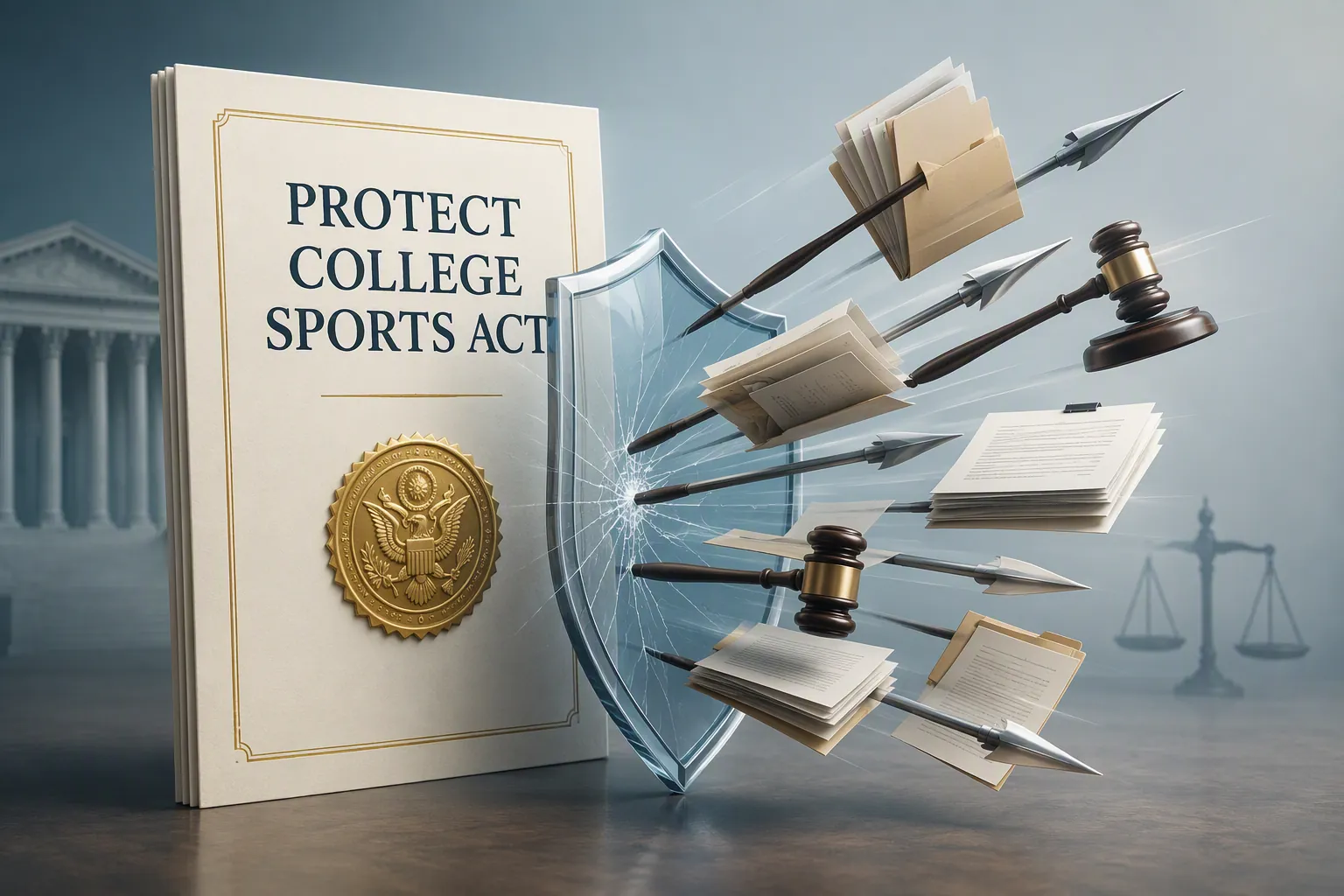
The sharpest warning comes from inside the reform coalition. CBS Sports reported on an SEC memo dated June 8, 2026, warning university presidents that the bill’s Section 119 private right of action could “effectively waive sovereign immunity” for public universities and that voiding pre-dispute arbitration agreements “is likely to increase litigation rather than reduce it.” The SEC has not publicly released the full memo, so the document should be treated as reported material rather than a public primary text. Even with that caveat, the memo is hard to dismiss: it is not athlete-side opposition rhetoric. It is a conference telling its own presidents that a bill designed to stabilize college sports could expand litigation exposure. [1]
The Bill Solves One Set of Problems by Opening Another
Limited antitrust exemption and federal preemption can reduce uncertainty only if the remaining enforcement path is narrow, predictable, and procedurally contained. The PCSA does not take that route. It gives athletes a federal cause of action, preserves whistleblower protections, removes pre-dispute arbitration as a gatekeeping device, and leaves employment status outside the settlement.
| PCSA Feature | Intended Stabilizing Effect | Litigation Exposure It Leaves or Creates |
|---|---|---|
| Limited antitrust protection | Reduces attacks on covered NCAA and conference rules | Invites disputes over what conduct is actually covered |
| Section 121 preemption | Centralizes federal authority over conflicting state rules | Creates threshold litigation over whether state law both conflicts with and prevents compliance |
| Section 119 private right of action | Creates direct enforcement for athlete protections | Gives athletes a new pleading vehicle against institutions, conferences, or governing bodies |
| Bar on pre-dispute arbitration agreements | Keeps statutory claims in public adjudicative forums | Increases class leverage, motion practice, and public litigation volume |
| Employment-status neutrality | Avoids resolving the athlete-employee fight in this bill | Leaves NLRB, circuit-court, and state worker-protection disputes alive |
That is the litigation paradox. The bill may close some antitrust theories while handing plaintiffs a cleaner statutory claim. It may displace some state-law conflicts while giving courts a new preemption test to interpret. It may quiet one category of uncertainty while preserving the employment classification fight that has driven some of the most consequential athlete-rights litigation.
Section 119 Is Not a Minor Enforcement Detail
A private right of action changes the role of the statute. Without it, federal standards often depend on agency enforcement, conference compliance systems, or defensive use in litigation. With it, the statute becomes a plaintiff’s pleading template.
Section 119 matters because it appears to cover areas that already generate conflict: NIL restrictions, scholarship treatment, medical coverage, and health-and-safety obligations. Those are not abstract compliance categories. They are the places where athletes can allege direct economic injury, retaliation, denial of promised benefits, or exposure to unsafe conditions. A complaint need not begin as a challenge to the whole college-sports system. It can begin with a roster decision, a collective rule, a medical-coverage dispute, or an NIL limitation that an athlete says violated a federal right.
For private universities, that means more federal statutory claims to price into litigation reserves. For public universities, the SEC memo’s sovereign-immunity concern is more sensitive. If the private right of action is construed to subject state institutions to suits they otherwise could resist on immunity grounds, the bill would not merely regulate conduct. It would alter a core defense posture for public defendants. CBS Sports’ account of the SEC memo says the conference warned that Section 119 could “effectively waive sovereign immunity,” a phrase that should get more attention than the familiar promise of national uniformity. [1]
There is a difference between saying athletes should have enforceable rights and saying institutions should expect fewer lawsuits. Section 119 may be defensible as athlete protection. It is not, on the present record, easy to describe as litigation reduction.
The Arbitration Bar Moves Claims Into More Expensive Forums
The bill’s prohibition on pre-dispute arbitration agreements does not create liability by itself. It changes where and how liability is fought. That distinction is not academic for athletic departments, conferences, or insurers.
If pre-dispute arbitration clauses cannot be enforced, defendants lose a procedural tool that can reduce public filings, narrow class mechanisms, and move disputes into a forum designed for individualized claims. Plaintiffs gain the ability to file in court, test class theories, seek public rulings, coordinate copycat actions, and use discovery pressure in ways that arbitration usually limits. That is why the SEC memo’s reported language is unusually direct: voiding pre-dispute arbitration agreements “is likely to increase litigation rather than reduce it.” [1]
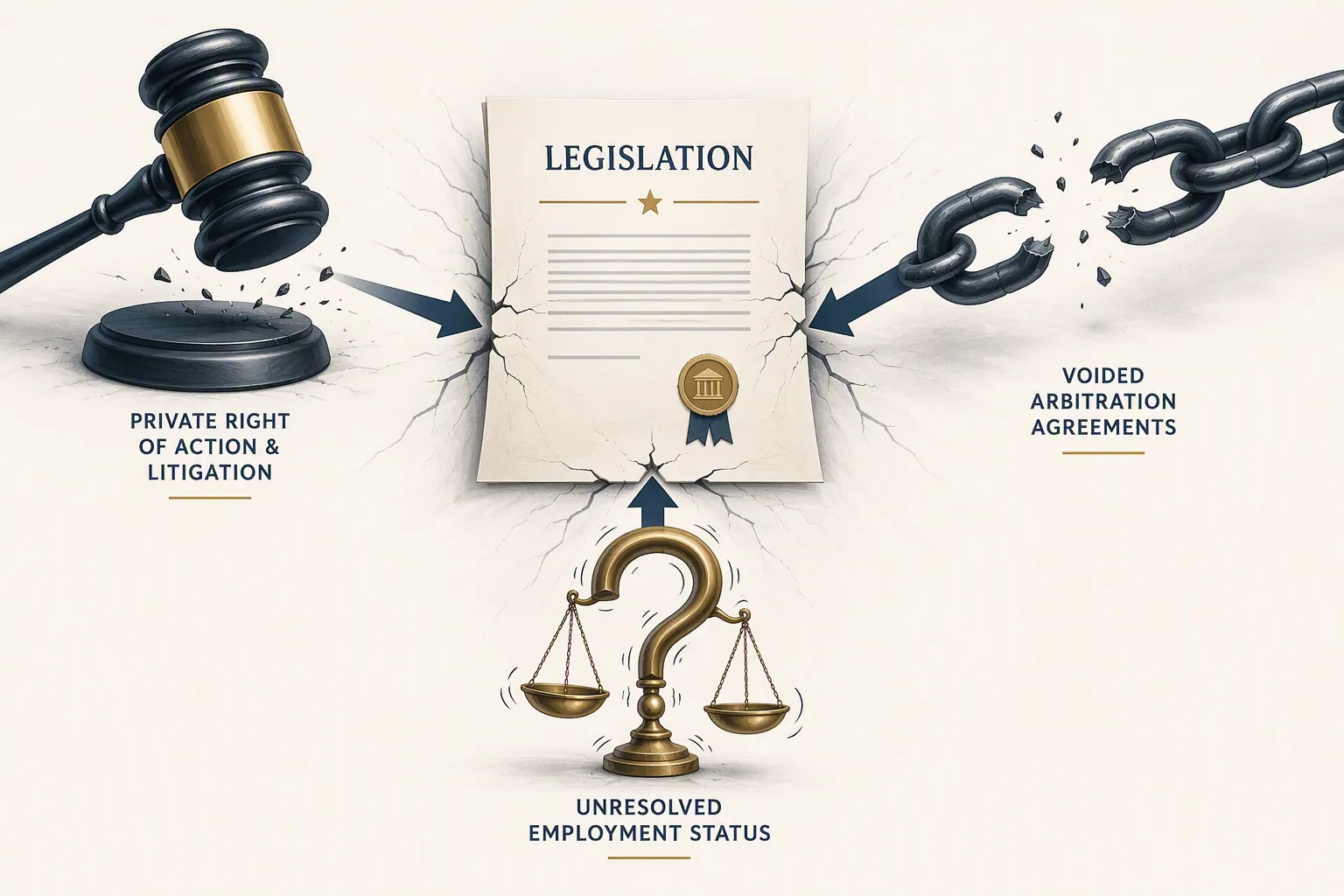
The practical effect is visible before any court interprets the statute. Counsel would need to assume more filed complaints, more public dockets, more motions to dismiss testing statutory boundaries, more certification fights, and more settlement pressure when claims can be aggregated. Even successful defenses become more expensive when they must be won in court rather than routed through a contractually selected forum.
Ili v. NCAA Is the Preemption Test File
The pending class action Ili v. NCAA shows why the preemption question cannot be handled with a sentence about federal supremacy. Filed in June 2026 in the Northern District of California, the case alleges that the NCAA and Power Four conferences exceeded the authority of the House settlement by imposing NIL restrictions that conflict with California law and the laws of 16 other states. The complaint also pleads Sherman Act theories, including price-fixing and group boycott allegations. [2]
That mix of claims is exactly what Section 121 would have to confront. If the PCSA becomes law, defendants would likely argue that state-law NIL protections must yield where they conflict with the federal scheme. Plaintiffs would likely answer that not every state protection prevents compliance with federal law, and that preemption should be read only as far as Congress clearly provided.
The SEC reportedly identified that problem as well. Its memo argued that the bill’s “conflict plus prevent compliance” language sets a higher bar than ordinary conflict preemption, meaning some state-law claims may survive rather than disappear. [1] If that reading is right, Section 121 does not end cases like Ili at the courthouse door. It supplies a new first fight: whether the challenged state rule actually makes compliance with the federal act impossible or merely imposes additional obligations.
That threshold fight will matter even when defendants ultimately prevail. A preemption defense usually needs briefing, factual framing, and often appellate development. In a national college-sports system with different state NIL statutes and different institutional defendants, one early ruling will not necessarily settle the field.
What Ili Suggests About Plaintiff Strategy
Ili also shows how plaintiffs may plead around reform. They do not have to rely on a single legal theory. They can frame a restriction as a violation of state NIL protections, a Sherman Act restraint, an overreach beyond a settlement framework, and, if the PCSA is enacted, potentially a violation of federal athlete protections. The bill’s antitrust exemption may block some of that architecture, but it will not prevent plaintiffs from testing the edges of the exemption and arguing that challenged conduct falls outside the protected zone.
For defendants, the relevant question is not whether preemption exists in the abstract. It is whether preemption is strong enough, clear enough, and broad enough to dispose of the claim before discovery, class certification pressure, or parallel state-law litigation changes the economics of the case.
Employment Status Remains a Separate Litigation Stream
The PCSA’s silence on athlete employment classification is not accidental. The bill is expressly neutral on whether college athletes are employees, unlike the SCORE Act approach that would have categorically prohibited employee classification. Senator Cantwell has said the question “remains open for discussion,” while House leaders have criticized the omission as a serious defect. [3]
Neutrality may be politically necessary. It is not legal closure. If athletes are not classified by the statute one way or the other, employment-status disputes continue before the NLRB, in federal appellate litigation, and under state worker-protection regimes. The PCSA can centralize parts of NIL and institutional governance while leaving open whether athletes can invoke labor-law rights, wage-and-hour protections, workers’ compensation theories, or related statutory claims.
That matters because employment status is not merely a label. It can change bargaining obligations, compensation exposure, retaliation theories, workplace-safety duties, and the availability of collective action. A university may obtain some protection from antitrust challenges to covered athletic rules and still face a separate proceeding arguing that its athletes are workers under another legal regime.
Political Instability Is Litigation Positioning
The public political fight around the bill should not be ignored, but it should be read for what it tells counsel about future pleadings. Athletes.org and the National College Players Association have attacked the proposal as codifying NCAA-supported restrictions and stripping athletes of leverage. The Congressional Black Caucus has urged the Senate to suspend consideration of the bill. Title III, the Ignite HBCUs Sports and Media Act section, remained blank in the July 28 revision and was still under negotiation. [3]
Those objections do not prove that a future claim will succeed. They do identify the vocabulary likely to appear in complaints, amicus briefs, opposition to motions to dismiss, and legislative-history arguments: coerced restrictions, unequal bargaining power, race and resource disparities, improper insulation of NCAA rules, and inadequate athlete remedies.
The missed Big Ten and SEC deadline adds another practical concern. A bill presented as a stabilizing compromise is moving while key institutional actors are still identifying unresolved risks. That does not make enactment impossible. It does mean counsel should be wary of treating passage as the end of the matter.
The Counsel-Facing Risk Judgment as of July 30
If enacted in its current form, the PCSA may reduce some uncertainty around antitrust exposure and state-law fragmentation. It may give conferences and institutions stronger arguments against certain challenges to covered rules. That is not the same as reducing lawsuit risk across the board.
The bill’s enforcement architecture points toward immediate litigation over at least four issues: the scope of Section 119 claims, the effect of the arbitration bar, whether public universities retain sovereign-immunity defenses, and how far Section 121 preemption reaches when state NIL laws do not squarely prevent compliance with federal law. At the same time, the bill’s employment-status neutrality leaves a separate and already active line of labor and worker-protection disputes unresolved.
The safer institutional assumption is therefore not that the Protect College Sports Act eliminates the litigation era in college athletics. It likely changes the pleadings, the forums, and the first motions. For universities, conferences, and the NCAA, that is a different risk profile, not a clean release.
References
- SEC warns Protect College Sports Act will trigger more lawsuits, not fewer, CBS Sports, cbssports.com/college-football/news/sec-protect-college-sports-lawsuits/
- College Sports’ Search for Order Continues, Labor & Employment Law Counsel, July 2026, laborandemploymentlawcounsel.com/2026/07/college-sports-search-for-order-continues/
- Protect College Sports Act analysis, Morgan Lewis, June 2026, morganlewis.com/pubs/2026/06/...
Operationalizing workflow
No workflow has been explicitly linked to this obligation yet. See Workflows generally.
Illustrative cases
No illustrative case is currently tracked for this obligation. See Risk Digest for documented incidents generally.
← Back to RegulationReport a correction or tip
Spotted an outdated figure, a misstated fact, or a ruling this regulation entry should reflect? Public comments are disabled for this content given the professional cost of a misreported case outcome, penalty amount, or rule text — use the structured correction channel instead.
Report a correction or tip for this record →