
New Jersey Noncitizen Registration Case Ends DOJ's Title III Theory
- Authority
- U.S. District Court for the District of New Jersey
- Rule type
- standing order
- Jurisdiction scope
- US federal
- Effective date
- Jul 29, 2026
- Source text
- Read primary rule text ↗
Statewide voter registration databases are not subject to compulsory access under Title III.
New Jersey gave the Justice Department the fact pattern it wanted and still won the legal question it needed. On July 29, 2026, U.S. District Judge Zahid N. Quraishi dismissed DOJ v. Caldwell with prejudice, holding that Title III of the Civil Rights Act of 1960 did not entitle the federal government to New Jersey’s statewide voter registration database. The state’s disclosure that a Motor Vehicle Commission software error had improperly routed roughly 6,600 noncitizen applicants into voter registration had, in the court’s words, “no bearing” on whether Title III covered the database itself.[1]
That is the legal significance of the New Jersey noncitizen voter registration software error: the administrative failure mattered, but it did not change the statute. DOJ did not lose because the MVC problem was trivial. It lost because Title III, as Quraishi read it, reaches records that come into election officials’ possession, not a modern database the state creates, modifies, audits, and keeps current under separate federal election statutes.[1]

The Software Error Was Serious, But It Was Not the Statutory Key
The underlying New Jersey error is not a footnote. According to the reported timeline, the MVC software problem operated from June 2023 through June 2024 and improperly sent about 6,600 noncitizen applicants into the voter registration process. About 400 of those registrants cast ballots, and roughly 2,000 may have later naturalized.[2]
Those numbers explain why DOJ tried to recast the case after the disclosure. A database demand that might otherwise sound abstract suddenly sat next to a concrete system failure: a state intake pathway misclassified people, names entered the rolls, and some ballots were cast. For any election office, that is not “noise.” It is a failure of routing, validation, remediation, and public confidence.
But it still did not answer the access question. The state had not turned over identifying data to DOJ, and the specific circumstances of the roughly 400 ballot-casting registrants remained unverified by federal investigators in the available reporting. More importantly for the lawsuit, the existence of an error did not supply a missing statutory hook. Title III either authorized compulsory access to the statewide database or it did not. Quraishi held that it did not.[1]
Title III Covers Received Records, Not a Live Statewide System
The hinge of the opinion is a dry verb phrase: records that “come into” an election official’s possession. That phrasing fits paper registration forms, affidavits, correspondence, and other discrete materials that arrive from outside the office and are then retained. It fits a file cabinet better than it fits a statewide computerized voter registration system.
Quraishi drew that line directly. Title III, he held, applies to static records that passively enter official possession; it does not extend to computerized databases that a state builds and continuously maintains. The database is not merely a received object. It is an administrative product: updated when voters register, move, die, change names, lose eligibility, regain eligibility, or require correction under state and federal list-maintenance rules.[1]
That distinction can look technical until a subpoena or civil demand lands on a state election office. If Title III treats a live database as a covered record, then ordinary maintenance becomes legally suspicious. If it does not, DOJ must find some other source of authority. The New Jersey ruling is important because it does not treat database architecture as a cosmetic update to paper-era records law. It treats the system’s continuing mutability as legally relevant.
| Material | How Quraishi Treated It |
|---|---|
| Paper registration forms and voter affidavits | Discrete records that may fit Title III’s received-records language |
| Statewide voter registration database | A state-created, continuously updated system outside Title III’s reach |
| MVC noncitizen-registration disclosure | Factually important, but not a new Title III entitlement |
The Justice Department’s theory needed the database to be treated as a record in the old sense: something already sitting there, capable of being inspected without changing its legal character. Statewide voter databases do not behave that way. They are instruments of present administration, not archival snapshots. Their value depends on correction.
NVRA and HAVA Make the Freeze Theory Hard to Administer
The most damaging problem for DOJ was not just vocabulary. It was collision. Quraishi noted that if Title III covered the statewide database, Title III’s anti-alteration rule would run into the National Voter Registration Act and the Help America Vote Act, which require states to keep registration lists current. Bloomberg Law reported the court’s conclusion that DOJ’s reading would create an “untenable” result because a database covered by Title III could not be altered even while NVRA and HAVA required continuous updates.[3]
That is not a clever litigation inconvenience. It is the kind of statutory conflict that tells a court the proposed reading has probably gone wrong. A state cannot responsibly administer an election list by pretending that its central database is a sealed exhibit. Voters move. Duplicate records are resolved. Death records arrive. Clerical mistakes are corrected. Eligibility determinations change. A system that cannot be altered is not a voter registration system; it is a preservation copy.
DOJ’s theory did not solve that operational problem. It tried to use Title III’s retention-and-inspection framework to reach a database whose legal function is active maintenance. The MVC error made the maintenance stakes more visible, not less. The fix for a bad intake pathway is not to freeze the state’s core registration infrastructure under a statute written for a different kind of record.
The Elections Clause Reinforces the Boundary
Quraishi also placed the statutory reading against the constitutional allocation of election authority. The Elections Clause assigns power over the times, places, and manner of congressional elections to state legislatures, subject to alteration by Congress. In the court’s formulation, the Executive Branch does “not feature at all” in that assignment.[1]
That does not mean federal election oversight is illegitimate. Congress can legislate, and federal agencies can enforce statutes Congress actually enacted. But when DOJ asks a court to infer a sweeping inspection power over state voter databases from Title III, the constitutional background matters. The Executive Branch is not given a free-standing supervisory role over state registration systems merely because it identifies a real administrative failure.
The same federalism pressure appears in other election disputes, including challenges involving executive action and congressional proof-of-citizenship proposals. For related constitutional context, see the Elections Clause analysis of the mail-in voting executive order and the discussion of SAVE Act constitutional attack vectors. The recurring question is not whether election administration can be regulated federally. It is which federal actor has been given which power, and by what text.
The Losing Record Now Matters in Risk Terms
New Jersey is one district-court ruling, not a Supreme Court judgment. It does not automatically bind every state that received a DOJ demand, and DOJ had not announced an appeal as of the day after the decision. But the litigation pattern is now difficult to price as ordinary uncertainty.
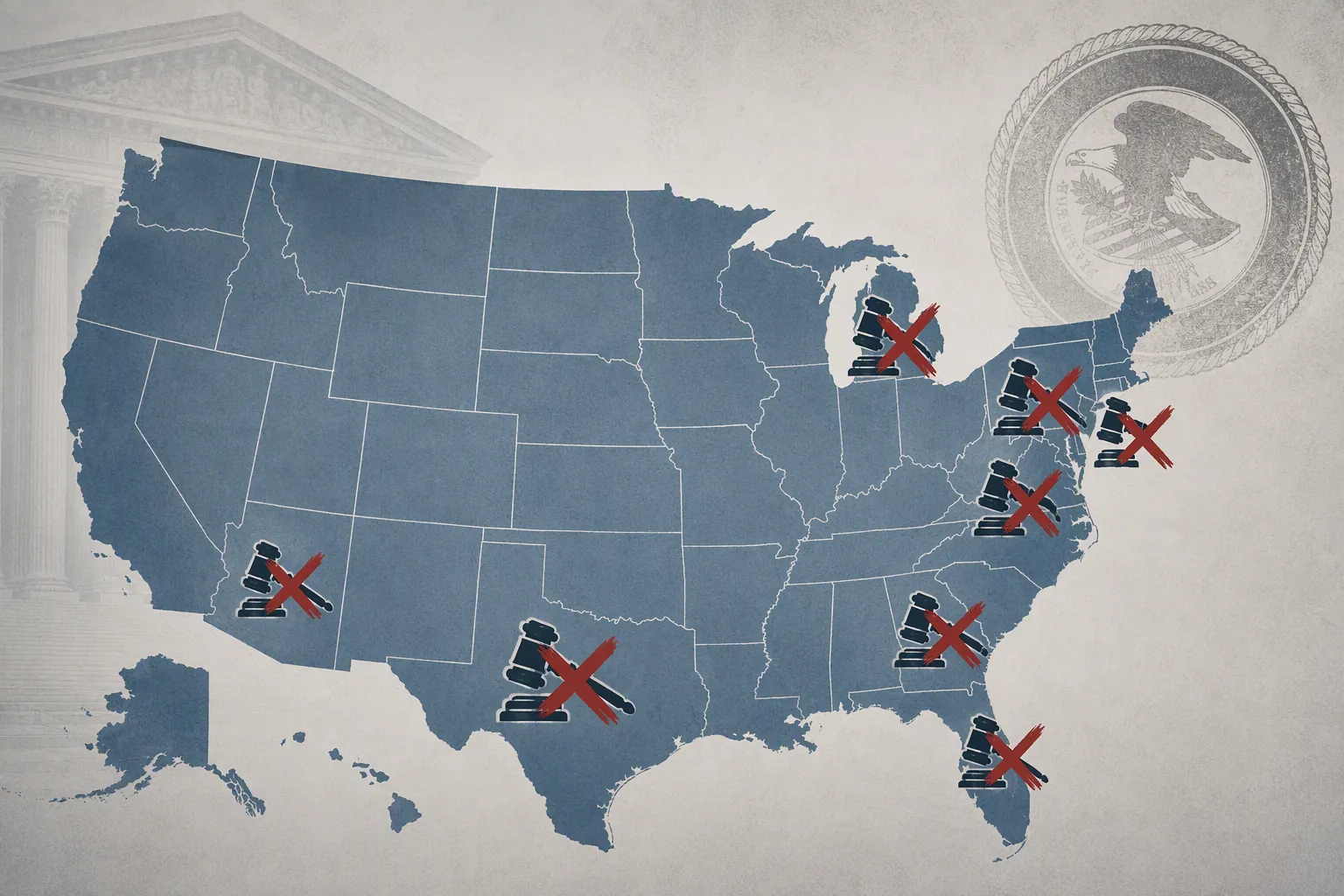
Democracy Docket reports that DOJ is now 0 for 18 in courts that have considered broad-access claims under Title III, across 31 filed actions; Bloomberg Law’s coverage corroborates the broader point that the New Jersey ruling rebuffed DOJ’s effort to scrutinize the state’s voter rolls.[4][3] The Democracy Docket count should be read with source awareness because the site is produced by Elias Law Group, which represents defendant-intervenors in this area. Still, the reported alignment across district courts and one federal court of appeals is not a marginal signal.
For state counsel, the practical lesson is narrower than “ignore DOJ” and stronger than “wait and see.” The New Jersey opinion supplies a clean statutory answer to one particular theory: Title III does not convert a continuously updated statewide voter registration database into an inspectable federal record. If a demand rests on that theory, the state has more than a policy objection. It has a growing line of adverse rulings to cite.
That matters for the 29-plus other states that received demands because compliance decisions are rarely made in the abstract. Election officials and lawyers must decide whether to negotiate, refuse, preserve, produce partial records, seek declaratory relief, or await suit. Quraishi’s ruling gives them language for the core distinction: documents that come into possession are not the same thing as the state’s live registration system.
What the Ruling Does Not Decide
The decision does not verify the individual circumstances of every improperly registered person in New Jersey. It does not determine whether any particular ballot was unlawful. It does not resolve whether DOJ may obtain narrower categories of documents through other statutes, ordinary litigation discovery, or a properly supported investigation. It also does not prevent Congress from changing the governing law.
It does, however, make continued reliance on the same broad Title III database theory legally fragile. The government can appeal, and the Supreme Court could eventually take a different view. Until that happens, the district-court map is not merely unfavorable to DOJ; it is uniform against the theory as reported. A vivid software failure did not supply the missing textual bridge in New Jersey, and that is the problem the remaining demands still have to cross.
References
- Federal judge dismisses DOJ lawsuit seeking New Jersey voter registration database, Jersey Vindicator, July 29, 2026
- The Vindicator explains: How 6,600 noncitizens were registered to vote in New Jersey, Jersey Vindicator, July 26, 2026
- DOJ's Efforts to Scrutinize NJ Voter Rolls Rebuffed by Court, Bloomberg Law
- Trump DOJ loses bid for New Jersey voter rolls, now 0 for 18, Democracy Docket
Operationalizing workflow
No workflow has been explicitly linked to this obligation yet. See Workflows generally.
Illustrative cases
No illustrative case is currently tracked for this obligation. See Risk Digest for documented incidents generally.
← Back to RegulationReport a correction or tip
Spotted an outdated figure, a misstated fact, or a ruling this regulation entry should reflect? Public comments are disabled for this content given the professional cost of a misreported case outcome, penalty amount, or rule text — use the structured correction channel instead.
Report a correction or tip for this record →