
What Legal Force Does Trump's Ratepayer Protection Pledge Have?
- Effective date
- Mar 9, 2026
The first legal question about the Trump ratepayer protection pledge for AI data centers is not whether it sounds protective. It does. The question is where the obligation is filed. As released by the White House in March 2026 and published in the Federal Register at 91 FR 11439, the Ratepayer Protection Pledge is an official federal statement asking participating companies to follow five commitments tied to new AI data center load: build, bring, or buy enough power for their facilities; pay for needed delivery upgrades; pay for power whether or not they use it; invest in local communities; and contribute to grid resilience.[1][2]
That publication matters politically. It does not, by itself, turn the pledge into a contract, a regulation, a statute, a utility tariff, a commission order, or a private cause of action. A company can sign a pledge and still have its enforceable duties determined somewhere else: in an interconnection agreement, a special contract, a state-approved large-load tariff, a certificate proceeding, a rate case, or a statute that tells a public utility commission how to allocate costs.
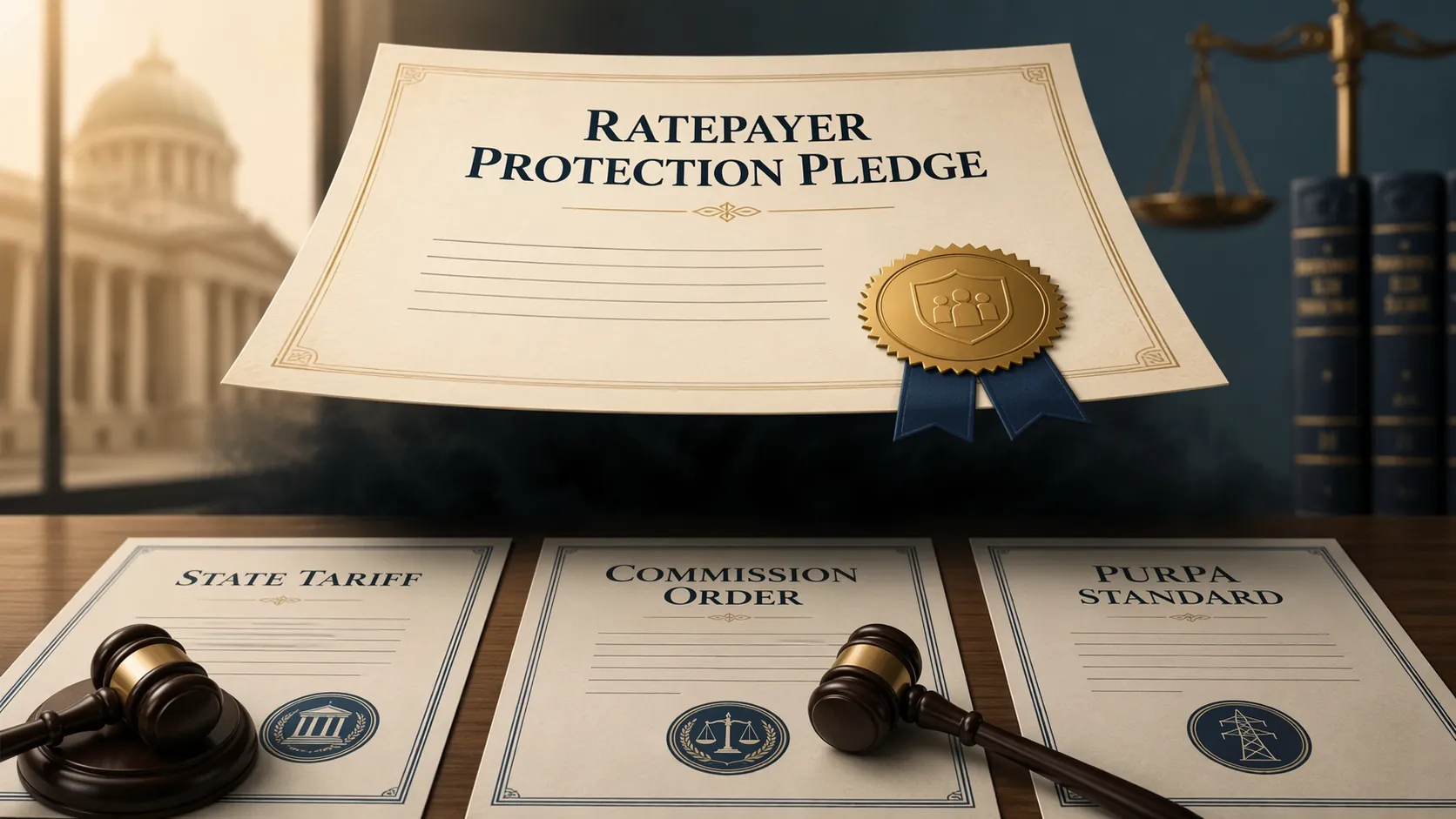
The White House fact sheet gives the pledge the language of national energy affordability and AI infrastructure policy.[3] Later efforts to broaden the pledge’s circle of participants may expand its political reach, but not its legal status. That framing may affect negotiations, public expectations, and commission politics. It may also make a signatory uncomfortable walking back a promise in a contested proceeding. But discomfort is not enforcement. If a data center load causes a utility to build transmission, distribution, generation, or capacity resources, the ratepayer-protection question is still whether the relevant legal instrument keeps those costs off ordinary customers’ bills.
What the pledge asks, and what would make it enforceable
The pledge’s five principles are useful as a checklist, but only if they are translated into utility-law machinery. The difference is not semantic. A civic commitment says a large load should pay its way. A filed tariff says who pays, when, under what formula, for how long, and what happens if the customer delays, downsizes, or leaves.
| Pledge principle | What it means in policy language | What would usually make it enforceable |
|---|---|---|
| Build, bring, or buy power | The data center should not rely on uncompensated system supply created for other customers. | A special contract, resource procurement condition, capacity charge, or tariff requirement tying service to identified supply obligations. |
| Pay for delivery upgrades | The data center should bear transmission or distribution costs needed to serve its load. | Commission-approved line-extension rules, contribution-in-aid-of-construction requirements, facilities agreements, or large-load tariff provisions. |
| Pay whether power is used or not | The customer should not reserve system capacity and later shift stranded costs to other ratepayers. | Take-or-pay clauses, minimum demand charges, minimum contract terms, exit fees, collateral, or termination-payment provisions. |
| Invest locally | The host community should receive some local economic or infrastructure benefit. | Development agreements, tax arrangements, community-benefit commitments, siting conditions, or state/local permitting requirements. |
| Contribute to grid resilience | The project should strengthen, not merely consume, grid capability. | Tariffed resilience charges, interconnection conditions, demand-response obligations, backup-generation operating limits, or commission-approved cost assignments. |
The third principle is the one lawyers should read twice. “Pay whether used” is the difference between a press-ready assurance and a stranded-cost protection. AI data center projects can move faster than regulated utility infrastructure. If a utility builds or contracts for resources in expectation of a large load, and that load arrives late, scales down, or never materializes, the unpaid balance has to land somewhere. A take-or-pay obligation, minimum bill, or termination payment answers that question before the ribbon-cutting. A pledge does not.
The same is true of delivery upgrades. “Pay for delivery” can mean many things unless a commission has approved the method. Does the customer pay only directly assigned interconnection facilities, or also upstream network upgrades? Are costs estimated in advance and trued up later? Are reinforcements socialized because they become part of the integrated grid? Can a utility recover unreimbursed balances in base rates? Those are not pledge questions. They are tariff and rate-case questions.
Federal publication is not federal enforcement
Brookings framed the unresolved problem directly in July 2026: a pledge to protect ratepayers from AI data center costs needs enforcement.[4] That is the right pressure point. The federal government can convene, endorse, publish, and praise. It can influence agencies within federal jurisdiction. It can also propose legislation. But retail electric rates, utility cost allocation, large-load tariffs, and most distribution-system obligations remain primarily state commission work.
Nothing in the materials supporting the pledge creates a private right of action for a residential customer, small business, ratepayer advocate, or competing customer class to sue a signatory for breach of the pledge. Nor does the Federal Register notice appear to create an agency enforcement process, penalties, complaint procedures, refund authority, or mandatory reporting regime.[2] That is the practical legal answer counsel need before moving to the harder policy questions.
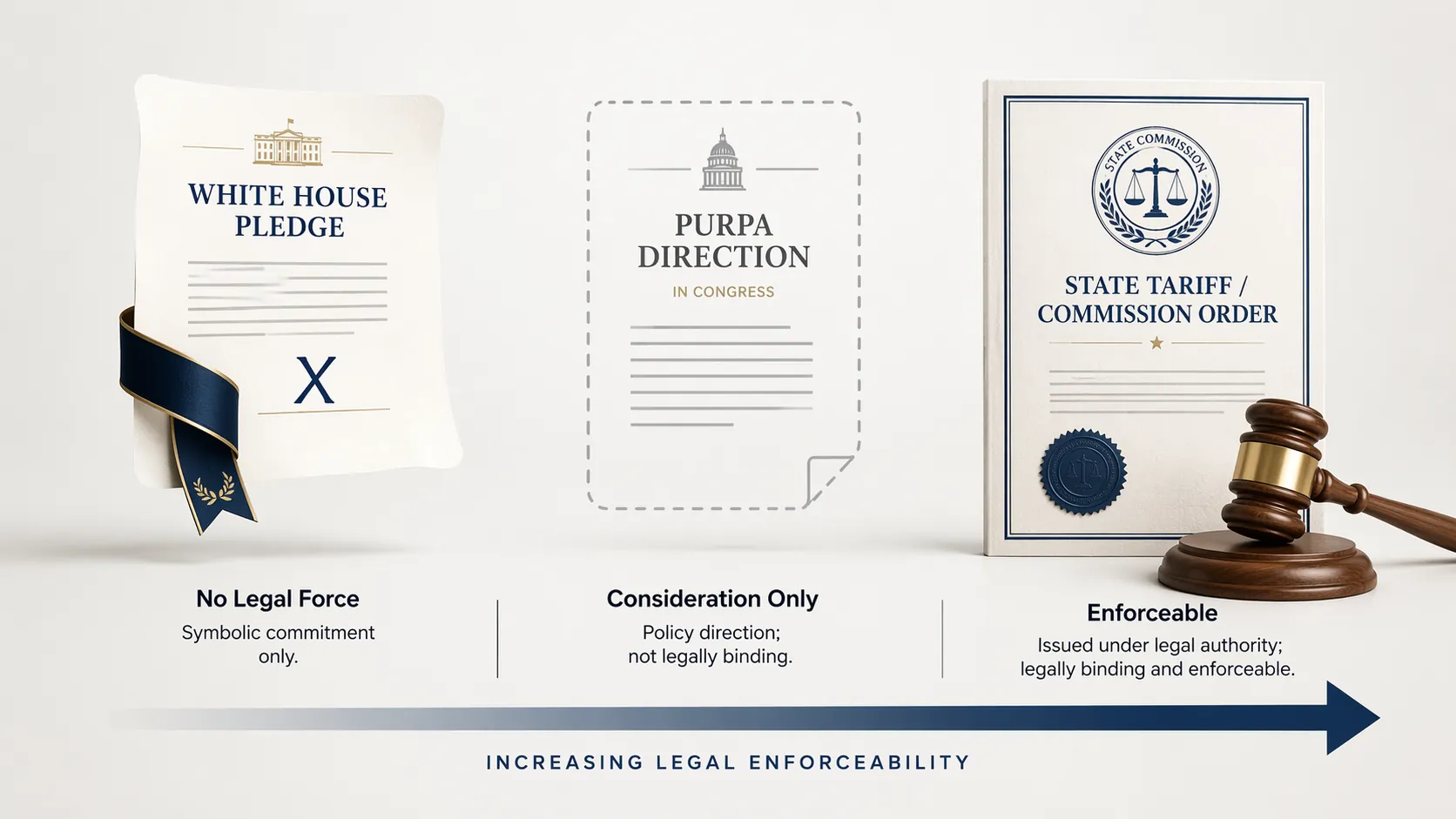
A signatory may still face consequences for inconsistency. A commission may ask about the pledge in testimony. A ratepayer advocate may attach it to discovery. A governor may cite it when pressing for a settlement. A utility may invoke it when negotiating a special contract. Those are real advocacy uses. They are not the same as an enforceable federal duty.
H.R. 9340 narrows the gap, but only to consideration
The Ratepayer Protection Act, H.R. 9340, is the federal proposal most likely to be mistaken for a cure. As described in the available reporting, it would amend PURPA Section 111(d) to direct state regulators to consider a large-load cost-allocation standard for facilities at or above 100 MW.[5] Quartz reported that the bill cleared the House Energy subcommittee on June 24, 2026.[6] Those are meaningful procedural facts, but they do not make the standard self-executing.
Heatmap’s account captures the central limitation. Harvard’s Ari Peskoe described the bill as “largely symbolic” and said it has “no enforcement mechanism.”[5] That is not a casual objection. PURPA’s familiar structure can require state commissions and nonregulated utilities to consider certain standards, and to make a determination after the required process. It does not simply federalize the state commission’s final answer.
The distinction between “consider” and “adopt” is where a great deal of federal energy legislation becomes less dramatic than its title. If Congress directs a state commission to consider a large-load standard, the commission may open a docket, receive evidence, hear from utilities and customer classes, and then reject, modify, or adopt the standard depending on state law and the record. That process can be valuable. It can force visibility. It can produce findings that make later cost-shifting harder to defend. But unless Congress has supplied a valid enforcement hook and the statute compels the substantive result, consideration is not protection.
There is also a source limitation worth keeping in view. Because the Congress.gov listing for H.R. 9340 was not available for direct review, the bill description here rests on Heatmap, Quartz, and the committee-related reporting they describe rather than direct statutory text from Congress.gov.[5][6] For live legal advice, that means checking the current bill text, amendments, committee reports, and any state implementation dockets before treating the proposal as fixed.
Why the real action moves to state commissions
R Street’s analysis puts the institutional problem plainly: state utility laws are the primary barrier to making the pledge enforceable.[7] That is not a defect in wording that can be cured by another federal paragraph praising affordability. It is the basic architecture of retail utility regulation. State commissions approve tariffs, allocate costs among customer classes, decide whether utility spending is prudent, and determine whether a large load receives ordinary service, special-contract service, or service under a dedicated large-load schedule.
Once the issue is in a state docket, the pledge’s principles can become concrete. A commission can require a data center class to pay a higher minimum monthly charge. It can approve a tariff that imposes a minimum contract term. It can require upfront payment for certain delivery upgrades. It can assign costs to the cost causer rather than spreading them across residential and small commercial customers. It can require collateral or termination payments if the project does not take service as forecast.
That is also where disputes become more honest. The question is not whether AI infrastructure is good or bad. The question is whether a utility’s ordinary customers should insure a very large customer’s forecast, timing, credit risk, and load-shape risk. If the answer is no, the tariff has to say so in terms a billing system, a rate case, and a reviewing court can recognize.
The state examples are mechanisms, not decoration
MultiState’s June 2026 comparison identified ratepayer-protection bills across five states and compared thresholds, mechanisms, and cost definitions.[8] The useful lesson is not that every state has found the same answer. They have not. The useful lesson is that enforceability begins when a state defines the covered load, identifies the costs to be assigned, and gives a commission or utility a rule to administer.
Virginia and Ohio matter in this discussion because they illustrate the kinds of state-level tools that move beyond pledge language: separate tariffs for large customers, minimum contract terms, and take-or-pay-style obligations.[8] Those tools do not merely ask a data center operator to behave responsibly. They change the economic consequences of requesting service. A customer that wants capacity reserved for it must commit to paying for that reservation on terms approved under state law.
Thresholds are doing real work in these bills. A 100 MW facility is not regulated as a large load because the number sounds impressive; it is regulated because a load at that scale can drive planning, procurement, and delivery-system decisions that affect other customers. But threshold design is also a source of avoidance and dispute. A rule may need to address phased projects, affiliated sites, colocated campuses, expansions, and requests split across nominally separate accounts. If the statute or tariff does not define aggregation, a sophisticated customer will read that silence before anyone else does.
Cost definitions matter just as much. “Grid expansion” can cover direct interconnection facilities, distribution upgrades, transmission upgrades, generation procurement, capacity obligations, ancillary services, administrative costs, or some subset of those categories. A narrow definition may leave ordinary customers exposed to upstream costs. An overbroad definition may deter projects or invite claims that the state is discriminating against a particular customer class. The commission record has to carry that line-drawing.
Stronger state rules are not frictionless
It is tempting to treat state large-load tariffs as the clean answer: if the pledge lacks teeth, file a tariff with teeth. That is directionally right, but incomplete. WilmerHale’s February 2026 client alert describes emerging state regulation of data centers and flags constitutional and statutory challenge theories that may be raised against stronger state rules.[9] The point is not that every challenge will succeed. The point is that moving from voluntary pledge to enforceable obligation also moves the fight into administrative record-building, statutory authority, discrimination claims, dormant Commerce Clause arguments, federal preemption questions, and review under state administrative law.
A well-designed tariff therefore has to do more than express frustration with Big Tech load growth. It needs a defensible customer classification, a cost-causation record, a reasonable relationship between charges and risks, and a procedure for updating estimates as projects change. If a utility asks for a 10-year minimum term, it should be able to explain what costs or commitments persist for that period. If a state requires a customer to pay for network upgrades, it should be able to say which upgrades are attributable to that customer and which remain system benefits.
The better state proceedings will not pretend that all risk can be assigned perfectly. Load forecasts fail. Resource costs move. Transmission planning is regional. A facility may create both local burdens and system benefits. But a contested, evidence-based allocation is still more legally meaningful than a federal pledge that never enters the tariff book.
What counsel can and cannot rely on in Q3 2026
For a data center operator, the pledge is not a safe-harbor document. Signing it does not answer whether the host utility can demand a minimum term, a facilities payment, collateral, a special rate schedule, or a take-or-pay commitment. Those obligations will come from the utility’s tariff, the state commission’s orders, the customer’s service agreement, and any applicable state statute.
For a utility, the pledge is not cost-recovery authority. If the utility wants to protect nonparticipating customers from stranded costs, it still needs commission approval for the relevant tariff, contract, accounting treatment, or rate-case recovery. A press release cannot substitute for prudence review. Nor can it guarantee that the commission will let the utility recover costs if the utility failed to secure adequate commitments from the large-load customer.
For ratepayer advocates, the pledge is useful but limited evidence. It can show that the signatory publicly accepted the principle that AI data center load should not shift costs to ordinary customers. It can support discovery questions and settlement pressure. It cannot, standing alone, compel refunds, impose penalties, or rewrite an approved tariff.
For state commissions, the pledge may help frame the public interest, but the order still has to rest on state statutory authority, record evidence, and ordinary principles of reasoned decision-making. The commission’s enforceable work is the unglamorous part: class definitions, billing determinants, contract duration, upgrade-cost assignment, exit obligations, and review procedures.
That leaves the pledge in a narrower but still real category. It is a political and signaling instrument. It may accelerate state action, shape negotiations, and make cost-shifting harder to defend in public. But as of Q3 2026, it creates no private right of action and no direct federal enforcement mechanism. Ratepayer protection exists only where state regulators or legislatures have converted pledge-like principles into filed, reviewable obligations. Anyone relying on the current landscape should check effective dates, source text, and current commission proceedings before treating those obligations as settled.
References
- Ratepayer Protection Pledge, The White House, March 2026.
- Ratepayer Protection Pledge, Federal Register, March 9, 2026.
- Fact Sheet: President Donald J. Trump Advances Energy Affordability with the Ratepayer Protection Pledge, The White House, March 2026.
- The pledge to protect ratepayers from AI data center costs needs enforcement, Brookings, July 9, 2026.
- The Mystery of the Ratepayer Protection Act, Heatmap News.
- Congress is moving to make Big Tech pay for what AI data centers are doing to the grid, Quartz.
- State utility laws are the primary barrier to Trump's AI ratepayer protection pledge, R Street Institute.
- How States Are Requiring Data Centers to Pay for Grid Expansion, MultiState, June 4, 2026.
- State Regulation of Data Centers: Emerging Trends and Potential Legal Complexities, WilmerHale, February 23, 2026.
Operationalizing workflow
No workflow has been explicitly linked to this obligation yet. See Workflows generally.
Illustrative cases
No illustrative case is currently tracked for this obligation. See Risk Digest for documented incidents generally.
← Back to RegulationReport a correction or tip
Spotted an outdated figure, a misstated fact, or a ruling this regulation entry should reflect? Public comments are disabled for this content given the professional cost of a misreported case outcome, penalty amount, or rule text — use the structured correction channel instead.
Report a correction or tip for this record →